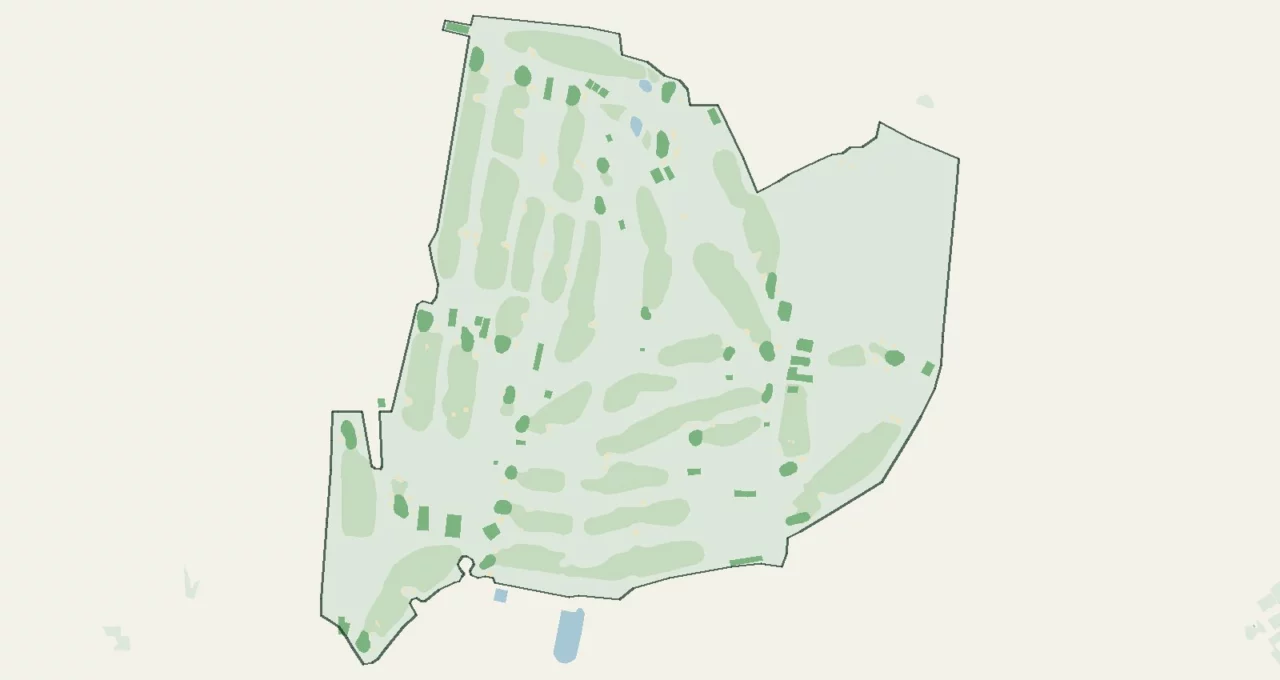
Layout of Southampton City Golf Course from OpenStreetMap survey data (ODbL licence).
Southampton City Golf Course
Holes
27: an 18-hole course and a separate nine-hole course (council, Wikipedia, Daily Echo)
By
18-hole course: 70 from the white and yellow tees, 72 from the red (Golfify and 18Birdies scorecard; 70 also given by the council and Wikipedia); nine-hole course: 33 (Hole19, Golfshake)
Length
18-hole course: 6,213 yards white, 6,103 yellow, 5,618 red (Golfify and 18Birdies scorecard); Wikipedia and the council give 6,174 yards; nine-hole course: 1,997 yards yellow (Hole19), 2,273 (Golfshake)
Green fee
—
Best season
Open all year; opening hours vary with the season and are published by the council
Southampton City Golf Course is a public, council-run golf facility of 27 holes at Bassett, on the northern side of Southampton in Hampshire. It consists of an 18-hole course, which Southampton City Council presents as its championship course, and a separate nine-hole course. Five times Open champion J H Taylor designed it, and it was completed in 1935 as part of a municipal sports scheme championed by Sir Sidney Kimber, a former mayor of the city. The facility has had several managers over the years; since 1 April 2021 Southampton City Council has run it directly. No membership is needed: visitors register with the council and then book a tee time. On the scorecard reproduced by Golfify and 18Birdies, the 18-hole course measures 6,213 yards from the white tees and 6,103 from the yellows, for a par of 70.
The course is still very much in use. The council publishes a season ticket scheme running from June 2026 to May 2027, and golfers were still posting reviews of rounds played there in the autumn of 2026. This page sets out what the public record says about the course, how it came about, what the card asks of a golfer, and what players who have been there report.
Which course is this?
OpenStreetMap maps the ground as Southampton City Golf Course, with Southampton Municipal Golf Course recorded as its former name, and links it to the Wikidata item Q17018779 and to the English Wikipedia article titled Southampton Municipal Golf Course. Both names are in current use. The council’s own pages still say Southampton Municipal Golf Course, the Southern Daily Echo uses either, and golf directories and apps mostly list it as Southampton City Golf Course; the Echo also calls it the Muni.
A third name causes the most confusion. Southampton Golf Club is the members’ club whose home is the municipal course: it runs competitions and sections for its members but does not own or manage the land. Golfshake lists the whole facility under the club’s name, and Hampshire Golf, the county union, lists the club at the same address. The club has nothing to do with Southampton Golf Club in the state of New York, a private course with which it shares a name and many search results, nor with the Victorian club known as The Cowherds, which Golf’s Missing Links documents between 1875 and 1922.
The address is Golf Course Road, Bassett, Southampton, SO16 7LE, according to Golfshake, Hole19, Hampshire Golf and other directories. Reverse geocoding of the OpenStreetMap outline gives Ardnave Crescent, Bassett, with the postcode SO16 7FJ. The map at the foot of this page uses the OpenStreetMap position.
History: golf for the whole city
The course belongs to a period when Southampton set out to give its residents leisure facilities that had previously been the preserve of private clubs. According to Wikipedia, which draws on the members’ club’s own history, Sir Sidney Kimber envisaged after the First World War that the council should provide leisure for the people of Southampton, at a time when most private golf clubs were fairly exclusive and the working man was not welcome. Kimber, a councillor from 1910 and mayor from 1918 to 1920, pioneered both the Civic Centre and the Southampton Sports Centre, which included the municipal golf course, according to his own Wikipedia entry; he was knighted in 1935, the year the course was completed. The Southern Daily Echo, in a 2004 profile, called the course his brainchild and part of a futuristic sports complex that made the city a municipal trend-setter before the war.
The design is credited to J H Taylor, who won the Open five times between 1894 and 1913 and later designed courses across Britain. Wikipedia and the Daily Echo name Taylor alone; Golfshake credits J H Taylor and F W Hawtree. The Echo describes a clever design of three loops with three different starting points, forgiving enough not to frighten beginners but long enough for experienced players. It also reports that the course was hailed as the best municipal golf course in England when it opened shortly before the Second World War. Wikipedia adds that it only became playable all year round after the war.
Demand has risen and fallen with the game. The Echo reported close to 200,000 rounds a year in the boom of the 1980s and 1990s, a fall to as few as 70,000 as more pay and play courses opened in south Hampshire, and a recovery to close to 100,000 by 2004, after a major investment by the council in an overhaul of the course.
The management has changed hands several times since. In 2010 the council approved a 12-year contract for the management and operation of the course with a preferred partner; the Daily Echo reported at the time that the deal was lined up for Mytime Active, a charitable leisure trust. The arrangement ended early. In February 2021 the council announced that the effects of the pandemic had led Mytime Active to stop operating the course, and that the council would run it from 1 April 2021, by mutual agreement, with the staff who worked mainly at the course transferring to council employment. Wikipedia, citing the council, says the greens were then hollow cored and treated with a feed, seed and sand mix, irrigation work was carried out, and further work on greens, drainage and paths followed in late 2021.
The course is in an open setting near woodland, and that has had a cost. In August 2023 riders on bikes and quad bikes damaged part of the 4th green, according to the Daily Echo. The members’ club said it was not the first incident that year, which the council disputed; the council arranged an alternative green while the damaged area was repaired.
What it asks of the golfer
The council describes the 18-hole course as set in mature parkland within a conservation area. The text that the course supplies to Golfshake goes further: a fully mature woodland course that requires distance and accuracy from the tee, good iron play and accomplished putting, with an abundance of natural hazards, unseen greens and water features. The Echo’s 2004 profile quoted the club secretary of the day saying that birdies are hard to come by because many greens are elevated and the holes cannot be seen from the fairway.
The most detailed card we found is the one published by Golfify, whose white and yellow yardages match the yellow card on 18Birdies hole for hole. It gives three sets of tees for the 18-hole course:
- White tees: 6,213 yards, par 70 (35 out, 35 home).
- Yellow tees: 6,103 yards, par 70.
- Red tees: 5,618 yards, par 72 (35 out, 37 home).
Other sources give different figures. Wikipedia and the council give 6,174 yards and par 70; Golfshake gives 6,213 yards and par 69 in its summary, but par 70 in its own table; the Echo’s 2004 profile gave 6,203 yards and par 69. The par of 69 appears to belong to an earlier card. Course and slope ratings are no more consistent: the USGA’s rating database, quoted by Wikipedia, gives 68.9 and a slope of 118 for 6,174 yards; 18Birdies gives 67.9 and 115 for men from the whites; Golfify gives 71.4 and 128; and Golfshake lists several white and yellow ratings side by side. We have not found a current card from the council itself, and we give no single rating as authoritative.
The 18-hole course, hole by hole
Read with the white tee yardages, the card describes a course that starts gently, then saves its longest par 4s for the middle of the round:
- There are four par 3s: the 1st (158 yards), the 5th (191), the 10th (176) and the 17th (165, stroke index 18). Opening a round with a par 3 is unusual, and the Echo noted it in 2004.
- There are only two par 5s: the 2nd (469 yards), which is stroke index 1, and the 16th (476 yards).
- The weight of the course is in its par 4s. The 7th (454 yards, index 3), the 14th (448, index 6), the 15th (461, index 2) and the 12th (431, index 4) are all long two-shotters, and from the red tees the 7th, 14th and 15th are played as par 5s.
- Against them sit a handful of shorter par 4s, such as the 3rd (302 yards), the 9th (326) and the 13th (327), where position counts for more than length.
The Echo’s 2004 profile picked out the same 158-yard opener and 469-yard 2nd, which suggests the start of the round has not changed in twenty years. It singled out the 8th, a par 4 of 401 yards on today’s card, for its raised green with a pond below that demands good iron play; the 12th, a teasing dogleg; and the 17th, a par 3 played across a valley. A recent reviewer adds that several holes play uphill to the green, that there are many blind tee shots, and that the slopes around the 9th and the 17th are steep enough to tire some players. Several fairways run side by side, so a wayward tee shot can end up on the neighbouring hole.
The 2nd, stroke index 1
The hardest hole on the card comes straight after the opening par 3: a par 5 of 469 yards from the whites and 464 from the yellows, played as a par 5 of 422 yards from the reds. It is short for a par 5 by modern standards, but it is ranked the hardest hole on the course, ahead of the long par 4s that follow.
The nine-hole course
Alongside the main course sits a nine-hole layout which the council describes as including par 3, par 4 and par 5 holes, easy to fit into a busy day and suitable for every level, from complete beginners to experienced players. The Echo called it ideal for beginners in 2004. Hole19 gives a par of 33 and 1,997 yards from the yellow tees, with a single par 5, the 9th; Golfshake gives par 33 and 2,273 yards from the yellows; the Echo gave 2,389 yards in 2004. One reviewer on Hole19 noted that the nine-hole course is played off mats rather than proper tee boxes.
Practice
18Birdies lists a putting green, a chipping green, a practice bunker and a grass practice area among the facilities. The Echo described in 2004 two putting greens, an 18-acre practice area, practice nets and a chipping green. We did not find a current description of the practice ground from the council, and reviewers’ opinions of it are lukewarm.
What golfers say
We read the reviews published on Golfshake, 18Birdies and Hole19, and search summaries of the reviews on GolfPass, which refused our direct requests. The points below summarise what recurs. They are other people’s opinions, not ours; nobody from Panxis has played the course, and we name and quote no one.
What comes up in its favour
- Value for money is the most consistent theme: reviewers repeatedly describe it as one of the cheapest full 18-hole rounds in the area, and value is the best-rated category on 18Birdies.
- The setting and the layout: reviewers praise a great location in mature woodland and some very good holes, and several feel that the course could be outstanding with more investment.
- A welcoming, unpretentious atmosphere, open to beginners and to golfers who would not join a private club; hospitality scores well on Golfshake.
- Some reviewers say the course has improved since the council took it back in 2021, and the nine-hole course is recommended as a good introduction to the full course.
What comes up against
- Course condition is the main complaint, especially in 2025 reviews: uneven or bare tees, patchy and lumpy fairways, divots, and bunkers short of sand.
- The greens divide opinion. Some reviewers found them slow, dry or bumpy after hollow coring, and a few reported temporary tees and greens and standing water; others describe them as in good order.
- Deep rough, in which balls are easily lost, and fairways and greens sometimes left too long.
- Drainage: parts of both courses are reported as boggy or waterlogged after rain.
- The terrain itself: hills, blind shots and parallel fairways make the course more tiring and less predictable than its yardage suggests.
The picture is of a well-designed municipal course in a fine setting, good value and accessible, whose condition depends on the season and on the money available for its upkeep.
Playing as a visitor
Both courses are open to the public without membership. To book, golfers must either hold a season ticket or register as a visitor on the council’s book a tee page, which also handles season ticket renewals and group bookings. Tee times can also be booked by telephone through the pro shop on 023 8076 0546, up to 14 days ahead according to Golfshake. The council’s golf course pages carry the current opening hours, which vary with the season, and the contact details for groups and societies.
Season tickets are sold for the 18-hole and for the nine-hole course, including seven-day tickets. Golfers who want to play competitions and hold a handicap can join Southampton Golf Club, the members’ club based at the course, which Hampshire Golf lists among the county’s clubs. 18Birdies lists buggies, pull trolleys and club hire among the services, along with a pro shop, lessons and a restaurant; we have not been able to confirm buggy hire on the council’s own pages, so check with the pro shop before relying on one.
Getting there and when to go
The course lies at Bassett, on the northern edge of the city, about three miles from the city centre and close to the M27 and M3 motorway links, according to the Daily Echo. The Echo’s directions bring golfers along Bassett Avenue to Golf Course Road; the postcode for the entrance is SO16 7LE. We did not verify current parking arrangements or public transport routes, and we leave them out.
The course is open all year, a point Wikipedia notes was only achieved after the Second World War. Reviews mention boggy patches after rain and, at times, temporary tees and greens, while summer reviews mention dry, slow greens. Opening hours change with the season and are published by the council.
Green fees
The council publishes separate rates for the 18-hole and nine-hole courses, for weekdays and weekends, and for the spring and summer and the autumn and winter seasons, along with concessions: see the council’s fees page for current prices.
How this page was made
The factual frame comes from public sources: OpenStreetMap and reverse geocoding for the location, the current and former names; Wikidata for the linked item; Wikipedia for the operator, the year of completion, the designer, the course rating quoted from the USGA database, Sir Sidney Kimber’s role, year-round play after the war and the work done in 2021; Wikipedia’s article on Sidney Kimber for his career; the Southern Daily Echo for the 2004 profile (design in three loops, rounds played, holes described, practice facilities, location and directions), the 2010 contract, the council’s takeover in 2021 and the vandalism of 2023; The Golf Business for the 2021 handover; the council’s decision records for the 12-year contract approved in 2010; search summaries of the council’s golf pages for the nine-hole course, booking rules and season tickets, since the council’s site refused our direct requests; Golfify and 18Birdies for the hole-by-hole scorecard; Golfshake for the club’s description of the course, the address and the designers; Hole19 for the nine-hole card; Hampshire Golf for the members’ club; and Golf’s Missing Links for the older club called The Cowherds. The opinions summarised above come from Golfshake, 18Birdies, Hole19 and search summaries of GolfPass.
Where sources disagree, we say so. The 18-hole course is given as 6,213 yards (Golfify, 18Birdies, Golfshake summary), 6,174 yards (Wikipedia, the council as quoted by Wikipedia, the USGA database) and 6,203 yards (Daily Echo, 2004), and its par as 70 (scorecard, council, Wikipedia) or 69 (Golfshake summary, Daily Echo 2004). The white tee rating is 68.9 with a slope of 118 (USGA via Wikipedia), 67.9 and 115 (18Birdies) or 71.4 and 128 (Golfify). The nine-hole course is given as 1,997 yards (Hole19), 2,273 yards (Golfshake) and 2,389 yards (Daily Echo, 2004). The designer is J H Taylor for Wikipedia and the Echo, J H Taylor with F W Hawtree for Golfshake. Golfify describes the course as a links, which it is not. The members’ club and the council disagreed in 2023 about how many acts of vandalism the course had suffered that year. The address is Golf Course Road, SO16 7LE, for the directories and Ardnave Crescent, SO16 7FJ, by reverse geocoding.
The council’s website, the members’ club’s website, GolfPass and Today’s Golfer refused our requests or sat behind a paywall; we have used only what search summaries reported of the council’s pages and nothing from the others for any figure. Golfshake still points visitors to the booking system of the former operator, which no longer runs the course; we have left it out. We found no current scorecard published by the council, no reliable list of opening hours, no confirmed account of parking and public transport, and no detailed description of Taylor’s original layout, and we have not invented them. Green fee amounts are deliberately left out.
The opinion section summarises reviews read in November 2026. We report recurring themes rather than individual voices, and we reproduce no quotations from reviewers. Nobody from Panxis has played or visited this course, and this page is no substitute for a round.
Neither the council nor the members’ club has paid for this page, seen it before publication or had any say over its content. This page contains no commercial link and earns us no commission. If you know the course and something here is wrong or out of date, write to us and we will correct it.
Other courses nearby
Closest to this one in our British directory:
- Meon Valley Golf Club — 9 mi
- Gosport & Stokes Bay Golf Club — 17 mi
- Sandford Springs Golf Club — 27 mi
- Newbury & Crookham Golf Club — 31 mi
The hole to know
The 2nd, stroke index 1: a par 5 of 469 yards from the white tees and 464 from the yellows, straight after a 158-yard par 3 opener (Golfify and 18Birdies scorecard, Daily Echo).