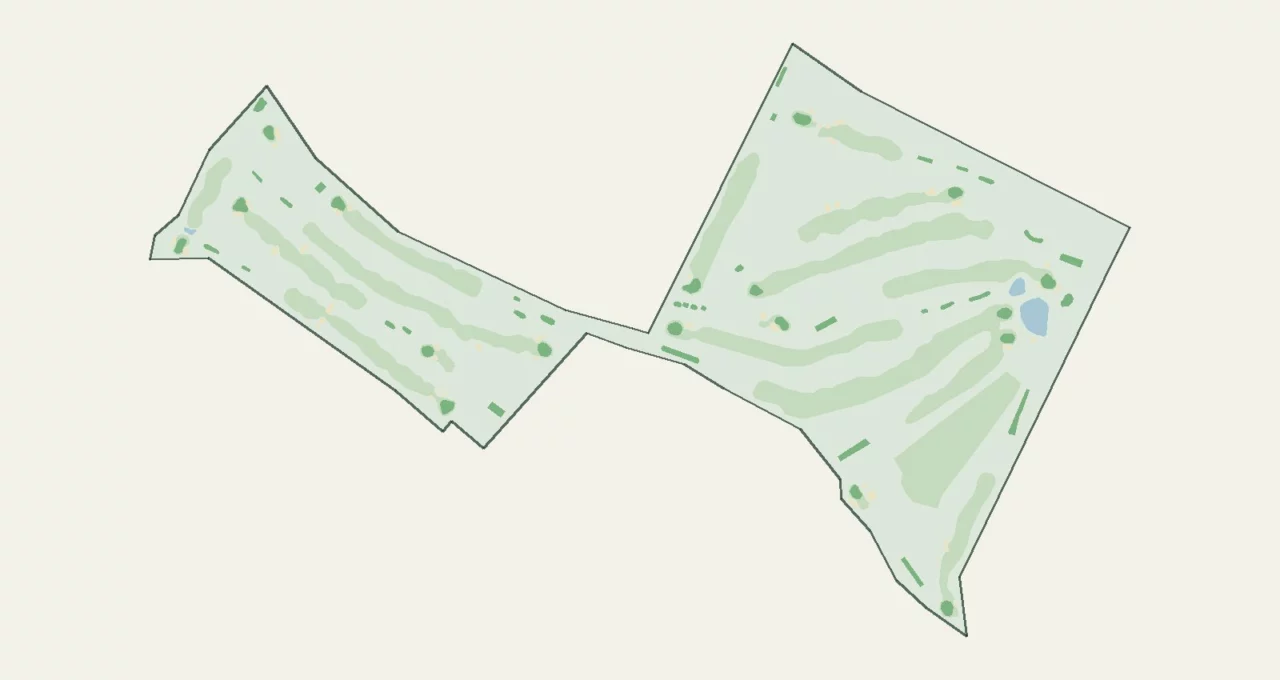
Layout of The West Berkshire Golf Club from OpenStreetMap survey data (ODbL licence).
The West Berkshire Golf Club
Holes
18
By
73 from every tee (club scorecard, 2026)
Length
7,008 yards from the blue tees, 6,738 white, 6,275 yellow, 5,994 green, 5,645 red (club scorecard, 2026)
Green fee
—
Best season
Open all year; the club says its natural geology and modern irrigation keep the course playable in every season
The West Berkshire Golf Club lies high on the Berkshire Downs, just outside the village of Chaddleworth and between Newbury, Lambourn and Wantage, inside the North Wessex Downs Area of Outstanding Natural Beauty. The club gives its postal address as Chaddleworth, Newbury, Berkshire, RG20 7DU, but warns visitors not to use the postcode to find the course: the entrance is on Hangmanstone Lane. It is a single eighteen-hole course, opened in 1975, and it is long. The club’s 2026 scorecard gives par 73 from every tee and 7,008 yards from the blue tees, with four shorter sets down to 5,645 yards from the reds.
The course is usually credited to Robin Stagg, a designer Top 100 Golf Courses calls relatively unknown. The club itself describes it as a mature downland layout on a gently rolling plateau, with views over the downs and four tee positions that let golfers of very different standards play the same holes. Top 100 Golf Courses ranks it nineteenth in Berkshire, a county crowded with famous heathland clubs, and describes it as a parkland-cum-downland course. Its claim to attention outside the county is simple: few courses in the south of England ask a golfer to walk this far, and its 5th is one of the longest par 5s in the region.
Fifty years on the downs, and a change of hands
The written record of the club’s history is thin. The club dates itself to 1975, a date repeated by Wikipedia, Top 100 Golf Courses, Where2Golf and the property agents who marketed it in 2025. The club’s own website has no history page and does not name an architect. Top 100 Golf Courses and Where2Golf name Robin Stagg; the English Wikipedia article, a short stub whose only reference is the club’s website, credits Robin Stagg together with Paul Simpson, who is the club’s head professional; the 2025 sale particulars name a Robert Stagg. We have found nothing that settles the question, and we have not found a history of how the farmland became a golf course.
What is documented is the course’s slow growth into its landscape. Top 100 Golf Courses and Where2Golf both note that trees planted around twenty years before their descriptions were written have begun to give the holes definition and character, and the club now speaks of tree-lined fairways. Top 100 Golf Courses calls it one of the best up-and-coming new courses in England, while Where2Golf, more cautiously, judges it a good test worth a visit rather than a recognised hidden gem. Top 100 Golf Courses also says the course was built with USGA-style greens and tees, so that it plays all year round.
The most important recent event concerns ownership. On 9 July 2025 Golf Business News reported that the club, a freehold proprietary club, had been put on the market by the specialist agents HMH because its owners wished to retire. The particulars describe 117 acres, the course of 7,008 yards and par 73, practice facilities, a clubhouse of about 4,400 square feet with a west-facing terrace, a greenkeeping complex and a three-bedroom bungalow, and say it was the first time the club had been offered for sale. The listing on Golf Courses 4 Sale, added the same day, now shows the club as sold, without a buyer’s name or a completion date. A golfer review published on 18Birdies in 2026 refers to new ownership. We have not been able to confirm who the new owners are or when the sale completed, and the club’s website does not mention it. If you are planning a visit, it is worth checking the club’s current arrangements directly.
What the course asks of you
The figures below come from the 2026 scorecard published on the club’s website. From the blue tees the course measures 7,008 yards, par 73, with an outward nine of 3,888 yards and par 38 and an inward nine of 3,120 yards and par 35. The white tees measure 6,738 yards, the yellows 6,275, the greens 5,994 and the reds 5,645, all at par 73. The club’s course rating certificate, issued on 26 April 2024 under the World Handicap System, gives a course rating of 74.7 and a slope of 130 from the blues, 73.1 and 128 from the whites, 70.5 and 129 from the yellows, and 67.3 and 119 for men and 72.7 and 131 for women from the reds. The green tees do not appear on that certificate.
The certificate says something the scorecard only hints at: the two nines are very different. From the blue tees, the front nine carries a slope of 138 and the back nine 121; from the yellows, 135 against 122. The front nine holds three of the five par 5s and nearly eight hundred yards more than the back nine from the back tees. On paper, at least, the back nine is where a card can be repaired.
Length, and the par 5s
Length is the defining fact of the course. There are five par 5s, at the 1st, 5th, 9th, 13th and 16th, and only four par 3s, at the 7th, 11th, 14th and 17th. Top 100 Golf Courses points out that every par 5 is a genuine three-shotter, averaging 568 yards from the back tees and about 513 from the yellows, figures that match the current card. The round starts stiffly, with a par 5 of 579 yards from the blues (506 from the yellows), followed by the 2nd, a par 4 of 438 yards that is stroke index 5.
The 5th is the hole everyone talks about: 626 yards from the blue tees on the current card (Top 100 Golf Courses and Where2Golf give 627), 613 from the whites, 580 from the yellows and 479 from the reds, and stroke index 1. Where2Golf calls it one of the longest par 5s in England. One reviewer on Top 100 Golf Courses describes a tight tee shot with water on the left, then a long run downhill towards the green. The 9th, 556 yards from the blues, is stroke index 3, and closes an outward nine that can feel very long for a mid-handicapper.
On the back nine the 13th is the shortest par 5, 492 yards from the blues and stroke index 14, and the obvious birdie chance among the long holes. The 16th, 589 yards from the blues and stroke index 4, is a dogleg that one reviewer singles out for its scenic green, and another lists among the best holes on the course.
The shorter holes
Length is not the whole story. Several par 4s are short: the 3rd, 337 yards from the blues and stroke index 17, and the 12th, 293 yards and stroke index 8, the shortest par 4 on the course. One reviewer on Top 100 Golf Courses mentions drivable par 4s as part of the variety. The par 3s are fairly even in length, from 159 yards at the 11th (stroke index 18) to 197 yards at the 7th from the blues, and reviewers rate them highly, with bunkers and the natural contours around the greens doing the defending. The 17th, 183 yards from the blues, is the one picked out most often.
The finish is strong. The 18th is a par 4 of 447 yards from the blues, 394 from the yellows and stroke index 6. According to one reviewer it runs downhill to a large green with a pond on the right, set in front of the clubhouse, whose patio, the club says, overlooks the 18th green. The 10th, 425 yards from the blues, is stroke index 2, so the back nine is shorter but not soft.
The ground and the trees
Where2Golf describes the fairways as generous and fairly flat, and the course as easy to walk; Top 100 Golf Courses also calls it an easy, pleasant walk. One reviewer on Top 100 Golf Courses sees the mature trees as the course’s main line of defence, together with its length. The club says its greens and tees are irrigated. Buggies must stay in the rough or on paths and enter the fairways at right angles, and buggies and trolleys must never pass between greenside bunkers and greens; the club may restrict buggies in bad weather.
What golfers say
The points below summarise the golfer reviews published on Top 100 Golf Courses (ten reviews dated from 2004 to 2024, with an overall score of three out of five), the three reviews on The Social Golfer (2008 and 2009), the visible reviews on 18Birdies (2026) and Hole19 (2025 and 2026, very few with text), together with the editorial assessment on Where2Golf. Older reviews may not reflect the course today. These are other people’s opinions, not ours. Nobody from Panxis has played the course, and we name no reviewer.
What comes up in its favour
- Condition. Reviews across many years describe a course in good or excellent shape, firm and fast running in summer, and one reviewer was struck by how well it played after weeks of heavy rain.
- Greens. Fast, true greens are the most consistent compliment, from 2008 to 2026, although one recent reviewer found them on the slower side.
- Variety and challenge. Reviewers enjoy the mix of very long par 5s, short par 4s and good par 3s, and find it a test for players of different abilities; the 5th, 15th, 16th, 17th and 18th are the holes most often praised.
- Views. The back nine, with its outlook over the surrounding countryside, comes up in recent reviews.
- Welcome and value. Many reviewers mention friendly staff, a relaxed clubhouse and good value for the round.
- Generous fairways. Wide fairways with little punishing rough make it forgiving off the tee for its length.
What comes up against
- Too ordinary for a ranking. Several reviewers on Top 100 Golf Courses, mostly before 2015, feel the course is pleasant but plain and does not stand comparison with the best courses in the area.
- Design details. Some bunkers and mounds strike reviewers as oddly placed or artificial, and one suggested a different order of holes to balance the round.
- The par 5s. Where2Golf notes that some have been described as lacklustre and overly long.
- Tees. Uneven or worn teeing areas come up in reviews from 2008 to 2026, most recently after a long, hot, dry summer, along with aprons in need of attention.
- Wet weather. A clay base may make the course wet in winter or after heavy rain, according to some reviewers, and an older review describes a wet course in November.
- Slow play on busy days and, in older reviews, signage that made the way round hard to follow.
Getting there and when to go
The course is reached from Hangmanstone Lane, and the club asks visitors not to rely on the postcode for directions. The club says it is about eight minutes north of junction 14 of the M4. Where2Golf describes the route: from junction 14 follow the A338 towards Wantage through Great Shefford, then turn right towards RAF Welford and Chaddleworth; the club is on the right. By our measurement on the map, the course lies a little over a mile from the centre of Chaddleworth, about five miles from Lambourn and about seven from Wantage, in a straight line. The nearest railway stations we found are Hungerford, about six miles away, and Newbury, about seven, both in a straight line and further by road; a car is effectively essential.
The club says visitors are welcome on weekdays and at weekends by arrangement. Its green fee table, read in October 2026, lists visitor rates on weekdays from 11am and at weekends from 1pm, with weekend visitor times bookable up to five days ahead, and a twilight rate from 4pm. Tee times can be booked through the club’s visitor online booking page or by phoning the pro shop. Societies are taken by arrangement with the office, with tee times from 11am at the earliest and catering arranged before and after golf.
The green fee table also lists buggy hire for visitors, pull trolley hire and a driving range. The club describes two large practice areas, a putting green and a chipping area with a practice bunker, and the 2025 sale particulars add covered and open practice tees and two practice nets. The clubhouse has a lounge with a bar, a separate dining room and a large patio overlooking the 18th green, with catering from 8am to 4pm. The pro shop is run by Paul Simpson, a PGA professional who, according to the club, has played on the European Tour, represented Great Britain and Ireland in the PGA Cup and won a PGA national title; he gives lessons and runs a custom-fitting service.
The course is open all year: the club says its natural geology and modern irrigation keep it playable in every season, and Top 100 Golf Courses credits its USGA-style greens and tees. Reviewers who played in summer describe firm, fast-running fairways, which help on a course of this length; some reviewers warn that the course can be wet in winter and after heavy rain.
How this page was made
The factual frame comes from public sources: OpenStreetMap for the location and our distance measurements; the club’s website, read in October 2026, for the address and access, the course description, the 2026 scorecard, the World Handicap System course rating certificate of April 2024, the visitor, society and green fee pages (without the prices), the buggy policy, the facilities and the pro shop; Top 100 Golf Courses for its course description, county ranking and golfer reviews; Where2Golf for its course description, directions and editorial opinion; Golf Business News (9 July 2025) and Golf Courses 4 Sale for the sale of the club; the English Wikipedia article on the club. Wikidata identifies the club as Q7984468.
Where sources disagree, we say so. The architect is given as Robin Stagg by Top 100 Golf Courses and Where2Golf, as Robin Stagg and Paul Simpson by Wikipedia, and as Robert Stagg by the sale listing; the club names nobody. The blue tees measure 7,008 yards on the 2026 scorecard, the rating certificate and the sale particulars, but 7,022 on the club’s course page and on Where2Golf and GolfNow. The club’s home page and Wikipedia give the shortest tee as 5,450 yards, against 5,645 on the current card; Where2Golf and GolfNow give 5,777 yards and par 74 from the red tees, while the 2026 card shows par 73 from every tee, and The Social Golfer lists par 72. The 5th measures 626 yards from the blues on the card and 627 in Top 100 Golf Courses and Where2Golf. The club speaks of four tee positions, while its card shows five sets of tees. The club describes the course as set on a chalk plateau, while Top 100 Golf Courses and one of its reviewers say it was built on clay. One reviewer dates the construction to 1974; every other source gives 1975. Where2Golf describes visitor access at weekends after midday and asks for a handicap, details that do not appear on the club’s own pages today.
We could not open the GolfPass pages on the club (access refused, error 403) or the Today’s Golfer page (behind a paywall), and the Cademy review page returned an error, so none of them has been used. Hole19 shows a high average score from several dozen ratings, but almost none of the reviews we could see contained text. The club’s website has no history page and describes no recent changes to the course; we have not found the name of the new owners.
The opinion section summarises golfer reviews on Top 100 Golf Courses, The Social Golfer, 18Birdies and Hole19, read in October 2026. We report recurring themes rather than individual voices, and we reproduce no quotations from reviewers. Nobody from Panxis has played or visited this course, and this page is no substitute for a round.
The club has not paid for this page, has not seen it before publication and has no say over its content. This page contains no commercial link and earns us no commission. If you know the club and something here is wrong or out of date, write to us and we will correct it.
Other courses nearby
Closest to this one in our British directory:
- Newbury & Crookham Golf Club — 9 mi
- Goring and Streatley Golf Club — 11 mi
- Sandford Springs Golf Club — 14 mi
- Calcot Park Golf Club — 17 mi
The hole to know
A par 5 of 626 yards from the blue tees (580 from the yellows) and stroke index 1, one of the longest par 5s in the region according to Top 100 Golf Courses and Where2Golf, with a tight tee shot and a long run downhill towards the green.