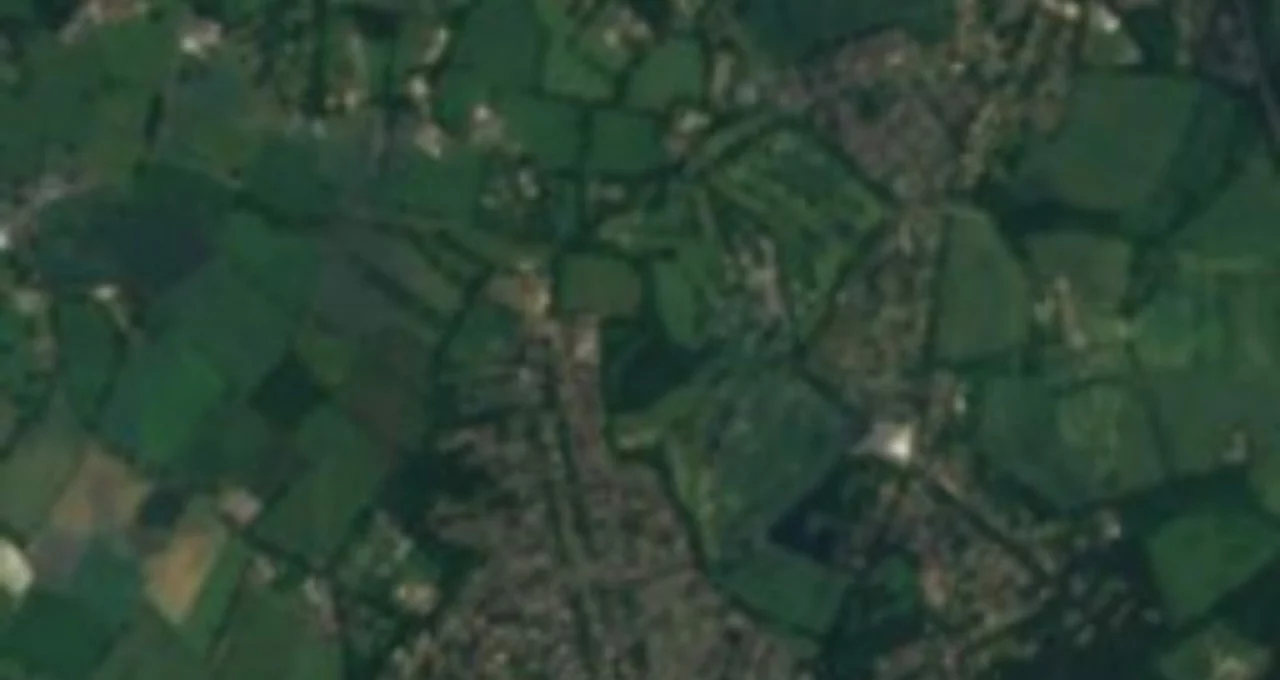
Sand Martins Golf Club from space. Sentinel-2 cloudless 2016 by EOX IT Services GmbH (contains modified Copernicus Sentinel data), CC BY 4.0.
Sand Martins Golf Club
Holes
18
By
70 (GolfNow and Golfify scorecards, Top 100 Golf Courses, OpenStreetMap)
Length
6,232 yards from the white tees, about 5,980 yellow, about 5,420 red (GolfNow and Golfify scorecards); 5,763 metres from the back tees according to Top 100 Golf Courses
Green fee
—
Best season
Year-round (GolfNow); the club distinguishes November to March from April to October for visitors and says the course is in good condition all year
Sand Martins Golf Club lies on Finchampstead Road on the southern side of Wokingham, the Berkshire market town between Reading and Bracknell. The club gives its address as Finchampstead Road, Wokingham, Berkshire, RG40 3RQ, and describes itself as being just off junction 10 of the M4 and junction 3 of the M3. It is an eighteen-hole course of par 70, measuring 6,232 yards from the white tees on the scorecards published by GolfNow, Golfify and Today’s Golfer. The club dates its opening to 1993, and it built the course as two loops of nine holes that could hardly be more different: a parkland front nine with lakes and dog-legs to the north of the clubhouse, and a back nine to the south that the club and most guides describe as links in style, with sand banks, broom and deep revetted bunkers.
It is a proprietary club rather than a famous one. Top 100 Golf Courses places it 18th in its ranking of Berkshire courses, a county crowded with heathland names, and Today’s Golfer gives it 3.5 out of 5 in a review last updated in 2016, calling the quality and condition of the course exemplary and the layout interesting for golfers of all levels. What every source agrees on is the contrast between the two halves. The club quotes a PGA professional from Royal Cinque Ports who found the back nine closer in feel to St Andrews than to the Berkshire commuter belt; several of the golfers whose reviews we read were less convinced. Both views are set out below.
From Fox Golf to a members’ rescue
The club’s own pages say little about its history, so the outline here is pieced together from public records and guides. According to Top 100 Golf Courses, Edward T. Fox bought the 120-acre property in 1991 and designed the course that is played today. Companies House supports the date and the name: the company that now trades as Sand Martins Golf Club Ltd, company number 02631592, was incorporated on 23 July 1991 under the name Fox Golf Limited, and kept that name until 9 June 2005. The club, Today’s Golfer and GolfNow all give 1993 as the year the course opened.
The change of name in 2005 matches the most dramatic episode in the club’s story. Top 100 Golf Courses records that the golf facility was almost sold to developers that year, and that members and management won with a rival bid to take control of the business and keep it running as a golf venue. We found no further detail on the bid or on who owns the club today; the club refers to its owners without naming them.
The course has kept changing since. In a news item dated 29 December 2022, the club explains that a five-year course vision was first drawn up in 2012 with a team of golf course specialists including the architect Alan Leather, and that many items from that plan have been completed, among them covered bays on the driving range and a performance and club fitting studio. The updated vision, developed with the golf course architect David Jones, lists back-to-back sprinklers around the greens, overseeding of the roughs and mounding on the back nine with rye and fescue grasses, new planting, new tee furniture and sleeper entrances to the tees, refurbishment of bunkers and paths, a new covered driving range building with a teaching and fitting studio, and a rebuilt pitching green with proper drainage. The stated aims are to improve the course’s appearance, playability, interest, drainage and safety. The club does not give dates for each item, and we have not been able to establish which of them are finished in October 2026.
The design credit is not settled. Top 100 Golf Courses names Edward T. Fox, which fits the company’s original name, while the course listings of GolfN and GolfPass credit Jonathan Gaunt with the 1993 design. Alan Leather’s role, on the club’s account, was the course plan of 2012 rather than the original layout. We set out the disagreement rather than choose between the sources.
What the course asks of you
The lengths on the published scorecards are 6,232 yards from the white tees, about 5,980 yards from the yellow tees (5,978 on the Golfify card, 5,982 on GolfNow) and about 5,420 yards from the red (5,421 and 5,425). The par is 70, split 35 and 35. Top 100 Golf Courses gives a slightly longer course, 5,763 metres from the back tees, or roughly 6,300 yards, and one recent reviewer there also speaks of just under 6,300 yards. The club itself publishes no scorecard on its website that we could find, and course ratings and slopes do not appear on its pages. The figures we did find come from secondary listings: GolfPass gives a rating of 69.8 and a slope of 125 for the men’s white tees, 68.8 and 120 for the yellow, 66.2 and 112 for men from the red tees, and 70.8 and 122 for women from the red. The Social Golfer’s scorecard agrees on the yellow tees at 68.8 and 120. We could not check any of these against England Golf, so treat them as indicative.
For individual holes we rely on the Golfify scorecard, whose totals match the GolfNow listing. It has five par 3s, at the 4th, 8th, 12th, 14th and 17th, and three par 5s, at the 3rd, 16th and 18th. That shape matches Top 100 Golf Courses, which describes the 3rd as the only par 5 on the front nine and picks out the trio of short holes on the back nine, and a recent reviewer who counts three par 5s, eleven par 4s and five par 3s.
The parkland nine
The outward nine, according to the club, is set in parkland with lakes, water hazards and dog-leg holes, and is a good example of risk and reward golf. It opens with a par 4 of 418 yards from the whites that one reviewer describes as a sharp dog-leg to the left, demanding a brave tee shot before anyone has had a chance to warm up; another, writing in 2015, noticed that the first two holes play to greens set at right angles to the fairways, so that distance control matters more than power. The 2nd is a short par 4 of 325 yards on the card. The 3rd, a par 5 of 514 yards, doglegs to the right according to Top 100 Golf Courses. The 5th, a par 4 of 409 yards, is stroke index 1 on the card. The 8th, at 197 yards, is the longest of the short holes, and the 9th, a par 4 of 371 yards, finishes in front of the clubhouse with an approach that one reviewer describes as played over a pond framed by weeping willows.
Water is the main theme of this half. A reviewer who played in 2026 counted ponds in play on six holes of the front nine and three more on the back, and earlier visitors recommended a course guide for the parkland holes precisely because it is easy to find water from the tee. This is not a course where every tee shot calls for a driver: several reviewers mention course management and keeping the ball in play ahead of length.
The links-style nine
After the halfway house the character changes. The club calls the back nine unusual for an inland course, with deep revetted bunkers and hazards on every hole. Today’s Golfer speaks of sand banks, high revetted bunkers and banks of broom, and Top 100 Golf Courses of an inland links with a number of revetted bunkers. The ground has more movement than the front nine, with mounds between the holes, and in summer, according to one reviewer, fescue rough waits for anything off line. The club’s latest course plan proposes overseeding the roughs and mounds on this nine with rye and fescue grasses.
The club singles out two holes here. The 13th, a par 4 of 422 yards from the whites and stroke index 2 on the card, is in the club’s words a hole where a par feels like a birdie. The 15th, named Deception, is a par 4 of 377 yards with a ravine across the fairway. The three short holes, the 12th at 156 yards, the 14th at 145 and the 17th at 165, are described by Top 100 Golf Courses as wonderful little holes that examine short iron play. Of these the 17th is the one golfers talk about: reviewers describe it as a downhill par 3 over a pond and among the prettiest holes on the course. The round ends with two par 5s in the last three holes, the 16th at 517 yards and the 18th at 512, the latter finishing in front of the clubhouse terrace.
Greens and set-up
The greens were built to USGA specifications, according to Today’s Golfer and Top 100 Golf Courses, and they are the feature reviewers praise most consistently. The club says a fully automated watering system keeps fairways, tees and greens in condition throughout the year, and its course plan adds sprinklers around the greens for complete coverage. Because each nine finishes in front of the clubhouse, the club notes that a shorter round of nine holes is possible, and its visitor booking page offers tee times from both the 1st and the 10th, for nine or eighteen holes.
What golfers say
The points below summarise the public reviews we were able to read: those published on Top 100 Golf Courses between 2011 and 2026, the player reviews on Today’s Golfer between 2009 and 2015, and the reviews on The Social Golfer between 2009 and 2018. They are other people’s opinions, not ours. Nobody from Panxis has played the course, and we name no reviewer.
What comes up in its favour
- The greens. Almost every review mentions them, as fast, true and consistent, and some visitors found them very quick indeed.
- Condition. Reviewers describe a well-kept course, including in autumn and winter, and several note that it drained well after rain.
- The contrast between the two nines, which many find memorable and which makes for a varied round where course management counts for more than length.
- The 17th, the par 3 over water, mentioned more often than any other hole, followed by the 9th, the 3rd and the closing par 5.
- Practice facilities: covered range bays, grass tees in good weather, a short game area and two putting greens.
- A friendly welcome in the shop and clubhouse, the terrace above the 18th green and, in older reviews, the halfway house between the 9th and 10th.
What comes up against
- The links label. Some reviewers think it oversells the back nine, which they see as open holes among mounds rather than true links golf.
- The front nine. A minority found it repetitive and hard to remember compared with the back nine.
- Bunkers. Several recent reviews describe the sand as inconsistent in quality or quantity.
- Water from the tee. Visitors who did not know the course found the ponds of the front nine costly, and recommend a course guide.
- Waterlogged early holes after very heavy rain, according to one review from 2015, and slow play on a busy day with societies on the course, according to one from 2009.
- Value. Opinions differ: older reviewers found the round good value with a voucher, while one in 2023 thought the visitor rate high for what the course offered.
Getting there and when to go
The course lies about a mile and a half south-west of Wokingham town centre by our measurement on the map, on the road towards Finchampstead. The club places it just off junction 10 of the M4 and junction 3 of the M3, and gives the distance as 29 miles from Heathrow and 39 miles from central London. Wokingham railway station is roughly a mile and a half to the north in a straight line, and Reading about seven miles to the north-west. Some listings, including GolfNow, file the club under Reading and Today’s Golfer under Finchampstead, but the postal address is Wokingham.
Visitors and members’ guests are welcome seven days a week, according to the club’s visitors page, and county card holders may play from Monday to Friday, except on bank holidays. Visitor tee times can be booked through the club’s visitor booking page, which in October 2026 offered tee times from the 1st and the 10th, for nine or eighteen holes; for anything else, the club asks visitors to telephone or use its contact page. The club also runs golf days for societies and companies, open competitions, and lessons with its team of PGA professionals. Twilight tee times start at different hours through the year, from midday in winter to mid-afternoon in summer.
The club’s practice facilities include a covered driving range, which it describes as a members’ range, with a swing and fitting studio, a short game area with a contoured green, a practice pot bunker and a 40-yard approach area, and two putting greens, all a short walk from the 1st tee. The clubhouse has a bar and a restaurant with a seasonal menu and a sun terrace overlooking the practice putting green and the 9th and 18th greens. The club does not mention buggies on its website; Today’s Golfer and GolfNow both list buggy hire, as well as trolley and club hire, so it is worth asking when booking.
The dress code is relaxed by club standards and the club says so itself: it considers behaviour more important than dress. On the course, any recognised golfing apparel is accepted, shorts must be tailored, and golf shoes must be worn; jeans, cargo shorts, tracksuits, football or rugby shirts, trainers and sandals are not allowed. Mobile phone calls are not permitted on the course or the driving range. In the clubhouse, smart casual clothing including denim is acceptable.
The club publishes no closed season. It distinguishes November to March from April to October in its visitor rates, and says the course is in good condition all year round, which some winter and autumn reviews confirm. Spring and summer bring the fescue and broom of the back nine into their own; in very wet weather, it may be worth calling before setting out.
How this page was made
The factual frame comes from public sources: OpenStreetMap for the location, the par recorded for the course and our distance measurements; the club’s website, read in October 2026, for the address, the opening year, the description of the two nines and of the 13th and 15th holes, the five-year course vision, the visitor policy, the practice facilities, the clubhouse and the dress code; the club’s visitor booking page for the starting tees and the nine and eighteen hole options; Companies House for the company’s incorporation in 1991 and its former name; Top 100 Golf Courses for the history, the acreage, the designer, the length in metres, the county ranking and its reviews; Today’s Golfer for its verdict, its course details and its player reviews; GolfNow and Golfify for the scorecard; GolfPass and The Social Golfer for course ratings and slopes; GolfN for the alternative design credit. Wikidata identifies the club as Q7415832; it has no Wikipedia article that we could find. We could not open the GolfPass and 1Golf pages directly and relied on what search results showed of them.
Where sources disagree, we say so. The design is credited to Edward T. Fox by Top 100 Golf Courses and to Jonathan Gaunt by GolfN and GolfPass; the club names neither, and mentions the architect Alan Leather only for its course plan of 2012. The length from the back tees is 6,232 yards on GolfNow, Golfify and Today’s Golfer, but 5,763 metres, roughly 6,300 yards, on Top 100 Golf Courses. The yellow tees are 5,978 yards on Golfify and 5,982 on GolfNow, the red 5,421 and 5,425. Golfify’s rating table gives par 69 for the yellow tees and par 71 for the red, although its own scorecard adds up to 70 for every tee. The Social Golfer’s course description gives par 72 and 6,708 yards, which no other source supports and which we have not used. Top 100 Golf Courses lists the 2nd among its highlight holes as a short hole with water protecting the green, while the scorecards show a par 4 of 325 yards. One reviewer says the back nine was built on an old quarry; we found nothing to confirm it. Course ratings and slopes come only from secondary listings and could not be checked against England Golf. Top 100 Golf Courses lists a different telephone number from the one the club publishes. Our account of the halfway house dates from older sources, and the club’s visitor booking page carried a broken link in October 2026, so we give the working address of the same page.
The opinion section summarises the reviews published on Top 100 Golf Courses, Today’s Golfer and The Social Golfer, read in October 2026. We report recurring themes rather than individual voices, and we reproduce no quotations from reviewers. Nobody from Panxis has played or visited this course, and this page is no substitute for a round.
The club has not paid for this page, has not seen it before publication and has no say over its content. This page contains no commercial link and earns us no commission. If you know the club and something here is wrong or out of date, write to us and we will correct it.
Other courses nearby
Closest to this one in our British directory:
- Bearwood Lakes Golf Club — 2 mi
- Royal Ascot Golf Club — 8 mi
- Calcot Park Golf Club — 9 mi
- Lambourne Golf Club — 14 mi
The hole to know
Par 3 of 165 yards from the white tees on the Golfify card, played over a pond and described by reviewers as downhill; the hole golfers mention most often.