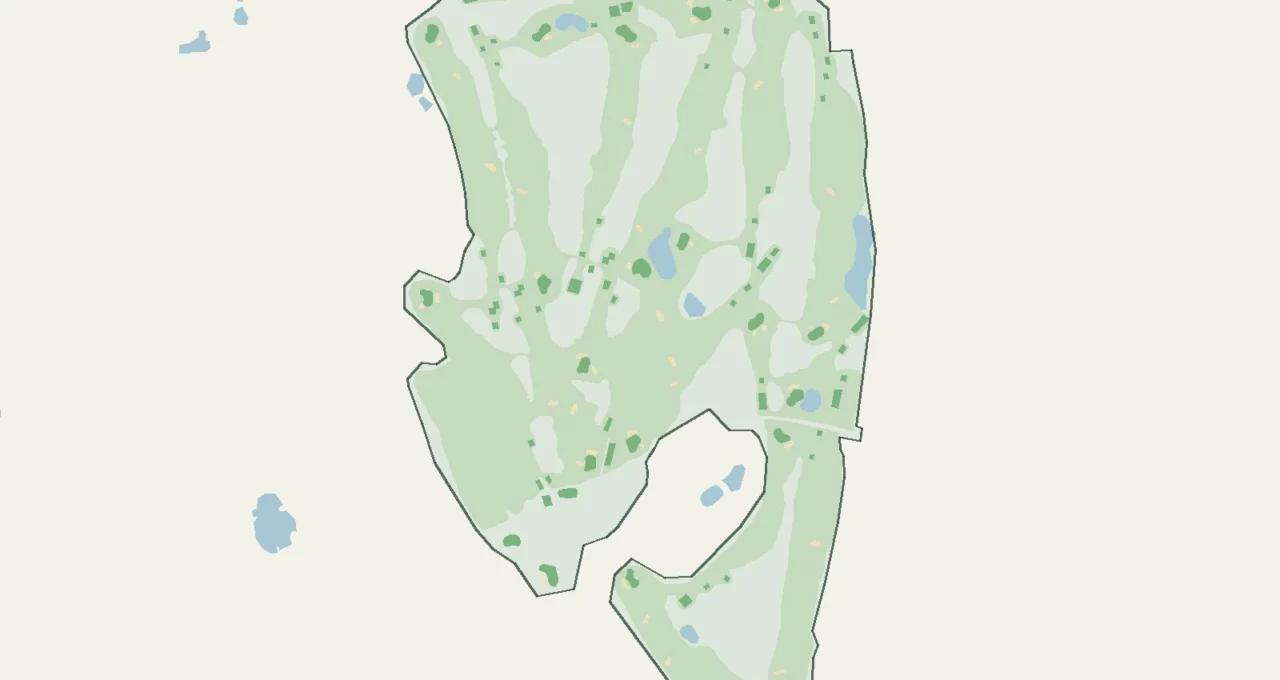
Layout of Lambourne Golf Club from OpenStreetMap survey data (ODbL licence).
Lambourne Golf Club
Holes
18
By
72 (men); 73 (women)
Length
6,834 yards from the black tees, 6,575 orange, 6,060 royal blue; women 6,060 royal blue, 5,537 sage green, 5,079 purple (club scorecard); club pages give 6,798 from the back tees
Green fee
—
Best season
Year-round; free-draining chalk and gravel, no temporary tees or greens and trolleys never banned (club); winter rules in season
Lambourne Golf Club, which also trades as The Lambourne Club, is a private members’ club on Dropmore Road, Burnham, Buckinghamshire, postcode SL1 8NF. Wikipedia places it about a mile north of Burnham village and three miles north-west of Slough, and the club places itself close to the M4, the M40 and the M25 and some 25 miles from central London. The course is an eighteen-hole parkland layout by Donald Steel, whose other work the club lists as including Killarney, Formby, Skibo Castle and the Bracken course at Woodhall Spa. It is a par 72 for men and a par 73 for women. On the club’s current scorecard it measures 6,834 yards from the black tees, with a course rating of 73.7 and a slope of 134; the club’s own pages give 6,798 yards from the back tees, a difference we come back to below.
The setting is the selling point. The club describes 180 acres of mature parkland with old oaks and beeches and six lakes, and says the property is unspoilt by houses and roads, with deer running freely across it. It also likens the place in spring, when the rhododendrons and azaleas bloom, to Augusta. On the day we checked in October 2026, the club’s course status read open, with buggies, trolleys and quads allowed, the driving range and short game areas open and winter rules in force.
A Steel design of the early 1990s
The club gives 1991 as the year the course opened, and Top 100 Golf Courses dates Steel’s design to the same year. Other sources do not agree. Wikipedia says the club was established in 1992, and a Golf Business News report from January 2000 says it opened in 1993. The county’s Bucks in 100 Objects project mentions a member who joined in 1991, which supports the club’s date. We give 1991 as the club does and flag the others.
The same Golf Business News report is the clearest public record of the club’s early ownership. In January 2000, it said, the club near Burnham was sold by Golf Club Holdings PLC, a company listed on AIM, to Lowe Destination Europe, part of the Los Angeles group Lowe Enterprises. The club then had 675 members. We found no reliable public account of who owns the club today, and we make no claim about it.
The club describes its clubhouse as colonial in style, with a bar, a restaurant, a function room and a sun terrace; Golf Business News gave it three storeys and 15,000 square feet in 2000, and Today’s Golfer mentions a steam room and a sauna in the first-floor changing rooms. The Bucks in 100 Objects entry, which was nominated by a long-standing member, mentions an investment of £1.5 million in additional tees, bunkering and water features under the architect David Jones. The page carries no date, and the club’s own site does not describe the work, so we cannot say when it was done or whether it is finished.
Lambourne is not a famous name outside the county. Top 100 Golf Courses added it to its Buckinghamshire ranking when the county lists were last revised in late 2023, according to one of its reviewers, and its page shows the course at number 12 in the county.
What the course asks of you
The routing is two returning nines. On the club’s card, the black tees give 3,446 yards out and 3,388 back; the orange tees 6,575 yards, with a rating of 72.5 and a slope of 129; and the royal blue tees 6,060 yards, rated 70.2 with a slope of 124. For women, the card gives 6,060 yards from the royal blue tees (rating 76.1, slope 138), 5,537 from the sage green (73.2, 128) and 5,079 from the purple (70.5, 124), all at par 73, because the 8th becomes a par 5. There are four par 3s and four par 5s, and the club points out six par 4s of more than 400 yards from the back.
The club’s case for the course in winter is its soil. It says Lambourne sits on a mix of chalk and gravel that drains freely, so that it never has to ban trolleys or use temporary tees or greens, and that a full irrigation system keeps fairways and approaches green in summer. The hole-by-hole notes below come from the club’s own course guide unless we say otherwise; yardages are from the black tees on the current card.
The 1st, a par 4 of 413 yards, is played from an elevated tee with a large oak standing in the fairway. The club’s advice is to drive to the right, short of the bunker, or, for the long hitter, to go over the tree. The green has two bunkers and slopes from back to front, so going long is the wrong miss. The 2nd, 514 yards, is the shortest par 5 and, says the club, a definite birdie chance for the better player: a drive that starts right and draws back, away from a fairway bunker on the right and out of bounds on the left, then an approach to a green above you that plays longer than its yardage.
The 3rd, 417 yards, doglegs gently from left to right through an avenue of trees. The approach goes down to a large green that slopes from front to back and from left to right. The 4th, a par 5 of 519 yards, can be reached in two by long hitters; for everyone else the plan is a mid or long iron short of the water, then a pitch to a large green. The 5th is the longest of the short holes, 194 yards on the card, played into the prevailing wind to a green that runs away from front to back with bunkers on both sides.
The 6th, 451 yards, is stroke index 1 on the card and the hole the club says will make you very happy if you par it. The drive must find the fairway; the approach is to a wide green on a rise, and anything short rolls back down the slope. The 7th, 157 yards, is played across water to a long, narrow green that slopes from right to left towards its bunker. The 8th, 457 yards, offers what the club calls the most inviting tee shot on the course, from an elevated tee towards a bunker on the left, followed by a long approach to a green guarded on the right and sloping from right to left and from back to front. The 9th, at 324 yards, is the shortest par 4: the drive goes between two fairway bunkers and short of a ha-ha that crosses the fairway at around 250 yards, and the second must carry two more bunkers.
The back nine opens with two longer par 4s. The 10th, 401 yards, has a fairway sloping left to right towards a bunker; from the left half the approach is played over a lake that runs to within 30 yards of the green, and the club suggests laying up short of the water after a poor drive. A bunker runs the full length of the green on the right. The 11th, 438 yards, has what the club calls the most testing tee shot on the course, with trees placed on both sides, and a long approach to a narrow, two-tier green some 40 yards deep with bunkers either side.
The 12th, a par 5 of 543 yards, asks for a drive kept left and a well-placed second to a green sloping right to left. The 13th, 181 yards, is the short hole the club rates most highly: played down to a green with two deep bunkers on the right and water on the left, sloping severely from back to front to a plateau at the back. A three, says the club, is always a good score. The 14th is the longest hole, 542 yards, with a tee shot across the club’s driveway, two fairway bunkers on the left for the longer hitter and a wide, shallow green that rewards distance control.
The 15th and 16th are short, doglegging par 4s of 373 and 348 yards. On the 15th the drive must split water on the right and a bunker on the left, and dead ground in front of the green makes the approach play longer than it looks. The 16th bends left and needs an accurate tee shot to the corner, then a carry over dead ground short of the green. The 17th, 150 yards, is the shortest hole, played over a deep bunker that spans the green, with a pot bunker at the back left and wind that tends to swirl around the tee. The 18th, 412 yards, is a demanding finish: the fairway slopes back towards the tee and moves right to left between trees, and the green is raised, guarded by deep bunkers on both sides and split by a spine running from back to front. The club’s own advice, if the match is still alive, is that playing for a five is no disgrace.
What golfers say
Public reviews of Lambourne are few, so the themes below come from a small pool: the user reviews on Top 100 Golf Courses, published between 2024 and 2026, and the short course verdict on Today’s Golfer. They are other people’s opinions, not ours. Nobody from Panxis has played the course, and we name no reviewer.
What comes up in its favour
- Condition. Every review we read praises the presentation of greens, fairways and bunkers, and two note that the course stood up well after very wet spells in autumn.
- The setting. Reviewers describe wide fairways framed by big oaks and beeches, autumn colour and a calm, almost private feel, with an American country club atmosphere that the club’s own talk of Augusta encourages.
- Certain stretches. The 2nd to the 4th and the 12th to the 14th are singled out as enjoyable runs, and the 6th, 13th and 18th are named among the best holes.
- Playability. Reviewers say the challenges are laid out in front of you, that the course suits players of very different handicaps, and that a first visit leaves people wanting a second.
- The clubhouse and its facilities, described as large and comfortable.
What comes up against
- Sameness. One reviewer finds a degree of repetition among the longer holes, and Today’s Golfer, while calling it a quality course that is well maintained, found many of the holes relatively ordinary.
- Strategy and variety. The detailed scores published by reviewers rate variety lower than condition or facilities, and one suggests the course is worth playing when invited rather than worth a trip on its own.
- The 16th, seen by one reviewer as out of character with the rest of the course.
- Pace of play. One reviewer’s only complaint was a slow round, and the club’s own scorecard carries a plea to avoid slow play.
Getting there and when to go
The club publishes directions on its contact page: from junction 7 of the M4 up through Burnham village towards High Wycombe, with brown tourist signs along the way, or from junction 2 of the M40 by the A355 and then three miles towards Burnham. The nearest railway stations are Burnham and Taplow, each about two and a half miles away in a straight line by our measurement on the map, and further by road. Cliveden is close by: Golf Business News put it two miles from the club in 2000, while the Bucks in 100 Objects page says less than a mile.
Visitors are welcome, and the club’s fee table is written for visitors with a handicap certificate. Tee times are booked by telephone through the professional’s shop, up to seven days in advance; the club does not offer an online visitor booking page that we could find. The fee table shows weekday play, twilight rates after 4 pm, and weekend and bank holiday play from 1 pm, so weekend mornings appear to be reserved for members. Societies and corporate days are taken only on Tuesday afternoons and on Thursdays, all year, with packages of 18, 27 and 36 holes. The club asks visitors to read its dress code before arriving.
GPS buggies, GPS electric trolleys, pull trolleys and hire clubs are available. The practice ground has a 300-yard range with three covered bays, a short game area with two greens and bunkers, and a large putting green.
The course is played all year, and the club’s claims for its free-draining chalk and gravel make it a reasonable winter option for the area. For colour, the club’s own suggestion is spring, when the rhododendrons and azaleas bloom; one reviewer’s account of a sunny afternoon among the autumn oaks and beeches argues for October as well.
Green fees
Visitor rates vary by day and time and are published by the club on its green fees page. Tee times are booked through the professional’s shop by telephone.
How this page was made
The factual frame comes from public sources: OpenStreetMap for the location, the address and the station positions; the club’s website, read in October 2026, for the opening date, the architect, the acreage, the lakes, the soil and irrigation, the course status, the hole-by-hole guide, the scorecard with its ratings and slopes, the handicap tables dated May 2024, the visitor and society arrangements, the hire equipment, the practice facilities, the clubhouse and its hours, and the directions; Top 100 Golf Courses for the county ranking, its course description and its user reviews; Today’s Golfer for its course verdict and the changing rooms; Golf Business News for the sale of the club in 2000; the Bucks in 100 Objects entry on the Buckinghamshire Culture site for the 1991 member and the course investment; Wikipedia for the location relative to Burnham and Slough and the 1992 date; Wikidata for the identifiers. The distances from the stations are our own measurement.
Where sources disagree, we say so. The club’s pages give 6,798 yards from the back tees, and so does Today’s Golfer, while the club’s current scorecard gives 6,834 from the black tees; Top 100 Golf Courses says almost 6,800. The club’s visitor page calls the back tees blue, while on the card the royal blue tees are the shortest men’s set. The club speaks of four sets of tees; the card shows five colours. The opening year is 1991 for the club and Top 100 Golf Courses, 1992 for Wikipedia and 1993 for Golf Business News, which also spells the name Lamborne in its report. The club gives 180 acres, Top 100 Golf Courses about 165. The club counts six lakes; Top 100 Golf Courses mentions a couple of ponds, one reviewer four. In the club’s course guide, the note on the 5th gives it as 196 yards against 194 on the card, the 2nd is 486 yards from the orange tees against 489 on the card, and the text on the 11th calls it stroke index 1, while the card and the guide’s own figures make the 6th stroke index 1 and the 11th stroke index 2; Top 100 Golf Courses follows the text. Cliveden is two miles from the club for Golf Business News and less than a mile for the Bucks in 100 Objects page. We could not read the Leading Courses page and use nothing from it.
The opinion section summarises reviews on Top 100 Golf Courses and the verdict of Today’s Golfer, read in October 2026. We report recurring themes rather than individual voices, and we reproduce no quotations from reviewers. Nobody from Panxis has played or visited this course, and this page is no substitute for a round.
The club has not paid for this page, has not seen it before publication and has no say over its content. This page contains no commercial link and earns us no commission. If you know the club and something here is wrong or out of date, write to us and we will correct it.
Other courses nearby
Closest to this one in our British directory:
- Stoke Park — 3 mi
- Beaconsfield Golf Club — 4 mi
- Denham Golf Club — 6 mi
- Royal Ascot Golf Club — 10 mi
The hole to know
Par 3 of 181 yards from the black tees, played down to a green with two deep bunkers on the right and water on the left, sloping severely from back to front to a plateau at the back.