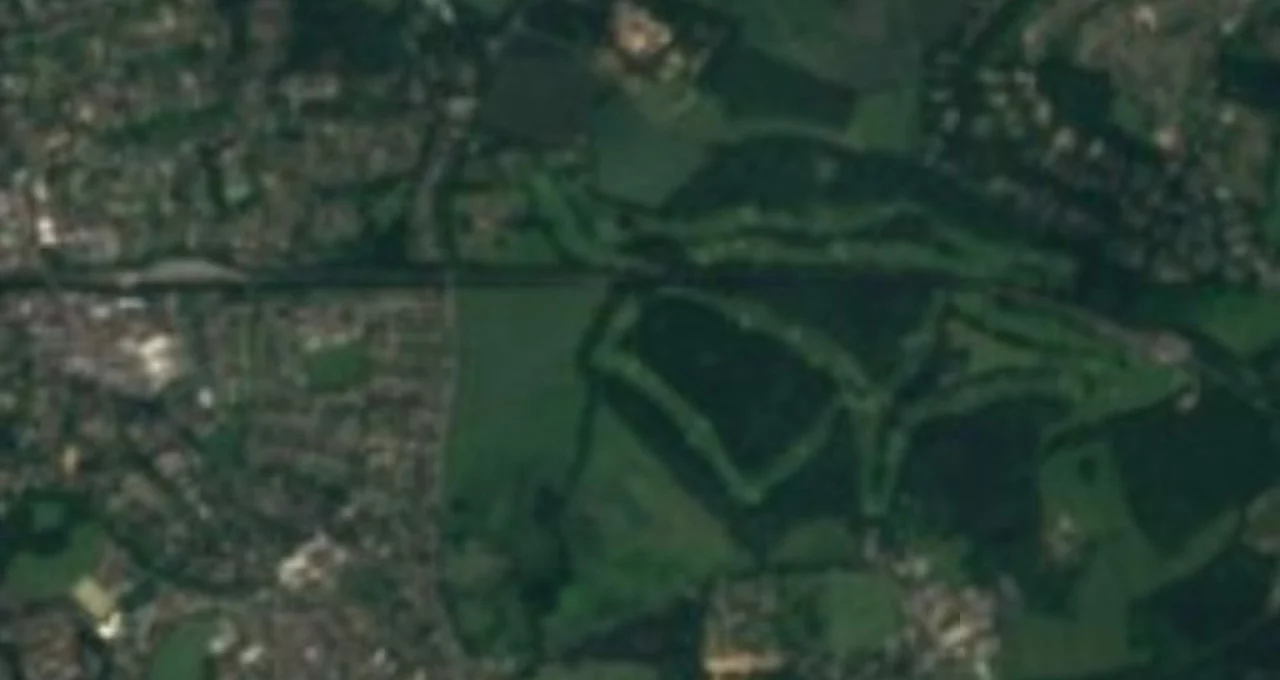
Beaconsfield Golf Club and its surroundings from space. Sentinel-2 cloudless 2016 satellite image by EOX IT Services GmbH (contains modified Copernicus Sentinel data), CC BY 4.0.
Beaconsfield Golf Club
Holes
18
By
72
Length
6,584 yards from the Black tees (club scorecard); Blue 6,171, Gold 5,794, Green 5,200. Golfshake lists 6,575 yards from the Black tees
Green fee
—
Best season
—
Beaconsfield Golf Club is an 18-hole members’ club on Farm Lane in Seer Green, a village just east of Beaconsfield in south Buckinghamshire, on the edge of the Chiltern Hills. The postcode is HP9 2UR. The course was laid out by Harry Colt in 1913 and opened in July 1914, and the club says its layout remains much the same today as it was then. On the club’s scorecard it is a par 72 of 6,584 yards from the Black tees, with three further sets of tees going down to 5,200 yards. It is a parkland course in the classic sense: holes separated from one another by mature mixed woodland, a great deal of bunkering, and greens that the club describes as unusually large.
The club is also one of the few in England with a railway station built for it. The Chiltern Main Line between London Marylebone and Birmingham runs through the property, and the halt beside the course, now Seer Green and Jordans, began life as a private platform for golfers. That line is part of the club’s history and, as the reviews summarised further down show, part of the experience of playing there today.
From Wilton Park to a Colt course
The club’s heritage page traces its origins to Colonel William Du Pre, who inherited the Wilton Park estate at Beaconsfield in 1896. He came from a family of French Huguenot descent and sat as Member of Parliament for High Wycombe from 1914 to 1923. His first sporting passion was croquet, at which the club says he won the world championship on numerous occasions, but around the turn of the century he took to golf. In 1902 he founded the Wilton Park Golf Club, with a nine-hole course in the grounds of his estate.
That date is the source of a small inconsistency in how the club is described. Wikipedia gives 1902 as the year the club was established and 1914 as the year it moved to its new course, and the club celebrated its centenary in 2002, which counts from the Wilton Park nine. Elsewhere on its own website, however, the club gives 1914 as its founding date, which is the opening of the present course. Both are defensible; they simply measure from different starting points.
The railway is the other strand of the story. When the line from London to Birmingham was being built across his estate, the Colonel negotiated a covenant obliging the railway companies to build a station near a golf house he was planning. According to Wikipedia, the station opened on 23 December 1914 as Beaconsfield Golf Links Halt, at first as a private platform for the golf club, and opened to the public on 1 January 1915. The club’s heritage page puts the opening in 1915, a year after the course, which matches the public opening. The halt has since changed name several times; it is now Seer Green and Jordans, served by Chiltern Railways.
In 1913 the Colonel engaged Harry Colt to design a new 18-hole course to replace the nine. By then, the club notes, Colt had already designed some twenty courses, among them St George’s Hill in Surrey, and he was involved in the early design of Pine Valley in New Jersey. The clubhouse was the work of Stanley Hamp, a London architect. The club opened on Saturday 18 July 1914 with an exhibition match featuring Harry Vardon, Ted Ray and James Jones, a little over two weeks before Britain entered the First World War. A second exhibition followed in 1920, with James Braid, George Duncan, Abe Mitchell and Vardon again.
For its first decades the club leased the course and clubhouse from the estate. Colonel Du Pre died in 1946, and in 1951 the club bought the clubhouse and course outright, becoming, in the words of its heritage page, a true members’ club.
Members and championships
The club’s list of past members includes two prime ministers, David Lloyd George and Stanley Baldwin, along with the golf writer Bernard Darwin, the amateur champions Roger Wethered and Cyril Tolley, and Cecil Leitch, one of the leading women golfers of the years around the First World War. Luke Donald learned the game at Beaconsfield and was club champion as a junior; he turned professional in 2001 and reached the top of the world rankings in May 2011. The club runs a junior competition in his name, the Luke Donald Salver, a 36-hole medal for players under 18 that in 2026 was an order of merit event for Berkshire, Buckinghamshire and Oxfordshire and a qualifier for the Telegraph Junior Championship. The heritage page also records that Christine Watson won the ladies’ club championship twenty years in a row, from 1987 to 2006.
Top 100 Golf Courses, the ranking website, notes that Beaconsfield hosted the Girls Amateur Championship three times between 1949 and 1961. We did not find the individual years confirmed elsewhere.
Who designed it, and when
All the sources agree that this is a Harry Colt course. They do not all agree on the date. The club, Golfshake and the club’s own course page give 1913 for the design and 1914 for the opening, and the club’s account of the opening match makes 1914 hard to dispute. Top 100 Golf Courses, however, dates Colt’s design to 1924, and quotes the broadcaster Peter Alliss describing it as a 1924 Colt course. We have found no evidence of a 1924 redesign; the date may refer to later work by Colt, or it may simply be an error. We give 1913 and 1914, the dates the club itself uses, and flag the other.
The design features most often attributed to Colt here are the diagonal cross bunkers, which the club singles out, the large greens, and the use of natural hollows, which the club’s hole notes call craters and older writing calls a ravine. Top 100 Golf Courses mentions the ravine across the 6th fairway, where the player must choose between laying up and going for the carry, and a ravine on the dogleg 10th.
What it asks of you
The figures first. The club’s scorecard gives four sets of tees: Black at 6,584 yards, Blue at 6,171, Gold at 5,794 and Green at 5,200. Par is 72 for men, made up of 35 on the front nine and 37 on the back. The club’s hole notes describe the 1st and 6th as par 5s for women, and the card gives women a par of 74 from the Gold tees. The club’s website does not publish course ratings or slope. Golfshake, the golf review platform, lists a rating of 72 and a slope of 136 from the Black tees, 70 and 132 from the Blue, and 74 and 142 from the Gold for women, and gives the Black yardage as 6,575 rather than 6,584, which suggests its card predates a small change. A slope in the mid 130s marks a course that is noticeably harder than average for a higher-handicap player, and a few reviews on that platform suggest the figure flatters the difficulty.
The card itself has an unusual shape. The par 3s are not short: from the Black tees they measure 159, 190, 176 and 202 yards. Four par 5s, at the 4th, 10th, 14th and 17th, run from 504 to 562 yards, and three of them sit on the back nine, which is longer than the front by about 150 yards. The par 4s, by contrast, are mostly of moderate length, between 356 and 393 yards, with two long ones on the front nine, the 1st at 453 and the 6th at 425, and one drivable risk-and-reward hole, the 15th at 279.
The ground is rolling rather than hilly. The club says the course is easily walkable except for the 6th and 8th, where the land rises and falls more sharply. Bunkering is the defining hazard: the course notes describe fairway bunkers in the driving zone on most holes and two or three around nearly every green. Top 100 Golf Courses counts 75 bunkers on the course. The natural craters come into play on several holes, short of the green on the 11th, in the lay-up zone on the 17th, left of the 5th green, and across the fairway at about 280 yards on the 10th.
The greens are where most of the scoring is decided. The club’s own notes describe the 7th green as very undulating and advise playing to the middle rather than to the flag, the 9th green as very quick, and the 15th as two-tiered. A good number of the greens slope from back to front, which rewards keeping the ball below the hole, but the 8th, 9th and 18th run away from front to back, so an approach that pitches on the front edge can finish at the back. Reviews return to the same point: the greens are large and subtle, and three-putts are common for those who do not read them carefully.
Hole by hole, from the club’s notes
Yardages are from the Black, Blue and Gold tees, as printed on the club’s scorecard, with the stroke index for men. The descriptions summarise the professional’s notes on each hole page of the club’s website.
- 1st, par 4, 453, 436 and 414 yards, stroke index 3. A long opener; a drive that avoids the fairway bunker on the left sets up a chance to reach the green. Played as a par 5 by women.
- 2nd, par 4, 361, 348 and 333 yards, stroke index 13. A drive over the fairway bunkers leaves a mid or short iron to a long, narrow green with bunkers on both sides.
- 3rd, par 4, 376, 366 and 352 yards, stroke index 7. A slight dogleg right that plays uphill to a green sloping from back to front; the drive should go down the left, clear of the bunker.
- 4th, par 5, 517, 484 and 452 yards, stroke index 9. A dogleg left that straightens towards the green. The ideal drive moves from right to left past the fairway bunkers at around 200 yards; bunkers short of the green guard the entrance for those going for it in two.
- 5th, par 3, 159, 149 and 134 yards, stroke index 17. A mid-iron to a green ringed by three bunkers, with a crater waiting on the left.
- 6th, par 4, 425, 403 and 395 yards, stroke index 1. The hardest hole on the card. The club advises a drive of no more than about 250 yards to stay short of the drop-off, then a long iron to a green guarded by bunkers and sloping from back to front. Played as a par 5 by women.
- 7th, par 3, 190, 157 and 133 yards, stroke index 11. A mid to long iron to a very undulating green; the club’s advice is to ignore the flag and aim for the middle.
- 8th, par 4, 376, 340 and 326 yards, stroke index 5. A dogleg left where the drive needs to carry about 200 yards to clear the brow of a hill, leaving a mid or short iron to a green that runs away from front to back, with a bunker on either side.
- 9th, par 4, 358, 343 and 328 yards, stroke index 15. The fairway tilts from right to left and punishes a wayward drive; the green is very quick and slopes away from the player.
- 10th, par 5, 504, 464 and 440 yards, stroke index 14. A dogleg left; the drive should favour the right side of a fairway that cambers to the left, avoiding a crater at about 280 yards and a fairway bunker on the left.
- 11th, par 3, 176, 164 and 144 yards, stroke index 12. Uphill, with a crater short and a bunker left, and a false front that makes it play longer than its yardage.
- 12th, par 4, 356, 346 and 332 yards, stroke index 4. The fairway slopes from left to right; a tee shot up the left gives the best look at a slightly blind green, with bunkers in front for anything short.
- 13th, par 4, 361, 341 and 312 yards, stroke index 8. Bunkers scattered around the hole; a drive left of centre leaves an uphill approach to a narrow green.
- 14th, par 5, 562, 525 and 500 yards, stroke index 2. The longest hole. Even a drive over the first fairway bunkers leaves around 250 yards, so most players will lay up short of the bunkers before a wedge to a green tilting from right to left.
- 15th, par 4, 279, 264 and 255 yards, stroke index 18. A risk-and-reward hole: the green is within reach for long hitters, but a wayward drive is punished. The safer line is down the right, leaving a wedge to a two-tiered green.
- 16th, par 3, 202, 185 and 155 yards, stroke index 16. The longest of the short holes, with a large collection area short of the green and bunkers left and right. The club’s own verdict is that par is a good score.
- 17th, par 5, 536, 503 and 450 yards, stroke index 6. Two fairway bunkers to negotiate from the tee, then a choice between laying up short of the crater and going for the green. Top 100 Golf Courses describes it as a dogleg with a large, heavily bunkered pit.
- 18th, par 4, 393, 353 and 339 yards, stroke index 10. A blind tee shot, with the fairway bunkers as the aiming line; the left side of the fairway is preferred, and the green runs away from front to back.
Taken together, the notes describe a course that asks for position more than length. On the 6th the club actively advises against hitting driver too far, the 15th tempts but punishes, and on several of the par 5s the sensible play is a lay-up short of a crater or a cluster of bunkers. Longer hitters have chances on the 4th and 10th, but the stroke index puts the 6th, 14th, 1st and 12th among the hardest holes, and three of those four are holes where accuracy from the tee matters more than distance.
What golfers say
Beaconsfield has been reviewed on golf course ranking websites, review platforms and in golf guides. The points below summarise what recurs in that material. They are other people’s opinions, not ours; nobody from Panxis has played the course, and we name no reviewer.
What comes up in its favour
- The condition of the course is the most frequent compliment: reviewers describe fairways and greens in excellent order, with a ground staff visibly at work.
- Drainage is repeatedly praised. Several reviewers say the course stays playable after heavy rain and through the winter, which is not something every Chilterns parkland can claim.
- The Colt architecture draws admiration, particularly the bunkering, the open, spacious parkland feel and holes that are separated from one another by trees. The 6th, 7th, 8th, 10th, 11th and 15th are the holes most often singled out.
- The clubhouse and the atmosphere are a recurring theme: reviewers describe a traditional, well-run club with understated character, a welcoming staff and good catering.
- The practice facilities are described as extensive and among the best of any club in the area.
What comes up against
- The railway is the most common complaint. The main line crosses the course, and several reviewers find the noise of passing trains and the way the line divides the layout into separate sections intrusive.
- Some reviewers find the routing disjointed, partly because of the railway and partly because the practice ground sits within the course.
- The greens, praised for their condition, are also the most criticised element of the design on one ranking site, where some players find them hard to read and less interesting than the rest of the course.
- Value for money divides opinion. Some reviewers consider the visitor fees high for what they found, and others see the restricted access, with weekend and county card play limited, as making the club feel exclusive.
- Smaller points come up occasionally: a car park layout some find confusing, a slope rating some consider generous relative to the actual difficulty, and slow play from groups ahead on busy days.
Getting there and when to go
The club is at Farm Lane, Seer Green, Beaconsfield HP9 2UR. Golf Today places it two miles east of Beaconsfield and gives junction 2 of the M40 as the nearest motorway exit; Wikipedia says about a mile east of the town. The difference probably depends on whether one measures from the old town or the newer part around the station. Either way, from the M40 the course is a short drive through the lanes north-east of Beaconsfield.
By train, Seer Green and Jordans station on the Chiltern Main Line sits beside the course. Chiltern Railways runs, in normal off-peak hours, one train an hour in each direction between London Marylebone and High Wycombe, with some peak services running further. It is one of the rare English clubs that a visitor from central London can reach comfortably by rail with a set of clubs.
The club does not publish a season. The course is played through the year, with winter rules in force in the colder months: trolleys, single-seat buggies and buggies must then be kept off tees, collars and approaches. Reviewers’ comments on drainage suggest it holds up well in wet weather, but as on any parkland course, the late spring to early autumn months will see it at its firmest and fastest. Single-seat buggies can be hired, the club says, and the club does not hire out sets of clubs to visitors.
Access is the main practical constraint. Visitors are welcome from Monday to Friday by prior arrangement and must hold a current handicap certificate. At weekends and on public holidays, the course is open only to members and their guests. Tee times are booked through the professional’s shop by phone or email, using the details on the club’s visitors page; we found no online booking system. Societies of twelve or more are taken on Tuesdays and Wednesdays, with day packages that include catering. The club also has a dress code, published on its website, which is worth reading before arrival.
Green fees
Visitor, junior, county card and members’ guest rates are set by the club and published on its green fees page.
How this page was made
The factual frame comes from public sources: OpenStreetMap for the location of the course; the club’s website for the address, the history of Colonel Du Pre and the Wilton Park nine, the railway covenant, the 1914 opening and exhibition matches, the 1951 purchase, the list of past members, the scorecard, the hole-by-hole notes, the visitor, society and buggy arrangements and the Luke Donald Salver; Wikipedia for the 1902 and 1914 dates and the history and names of Seer Green and Jordans station; Wikidata for the identifiers and coordinates; Top 100 Golf Courses for its county ranking, the bunker count, the Girls Amateur Championships, the 1924 attribution and the ravines on the 6th and 10th; Golfshake for the course ratings and slope figures; Golf Today for the distance from Beaconsfield and the motorway junction.
Where sources disagree, we say so. The club gives 1914 as its founding date on one page and counts its centenary from 1902 on another, the date Wikipedia also uses. The club, Golfshake and others date Colt’s design to 1913; Top 100 Golf Courses dates it to 1924. The club’s scorecard gives 6,584 yards from the Black tees, Golfshake 6,575. Wikipedia and the club date the station’s opening a few days apart, the first to the private halt in December 1914 and the second to the public opening in 1915. The club describes itself as ranked in the top four in Buckinghamshire and among the top 100 parkland courses in the United Kingdom; Top 100 Golf Courses ranks it sixth in the county. Course ratings and slope come only from Golfshake and are not published by the club.
The opinion section summarises reviews on Top 100 Golf Courses, Golfshake and other golf review platforms and guides, read in October 2026. We report recurring themes rather than individual voices, and we reproduce no quotations from reviewers. Nobody from Panxis has played or visited this course, and this page is no substitute for a round.
The club has not paid for this page, has not seen it before publication and has no say over its content. This page contains no commercial link and earns us no commission. If you know the club and something here is wrong or out of date, write to us and we will correct it.
Other courses nearby
Closest to this one in our British directory:
- Stoke Park — 5 mi
- Moor Park Golf Club — 7 mi
- Royal Ascot Golf Club — 13 mi
- Fulwell Golf Club — 16 mi