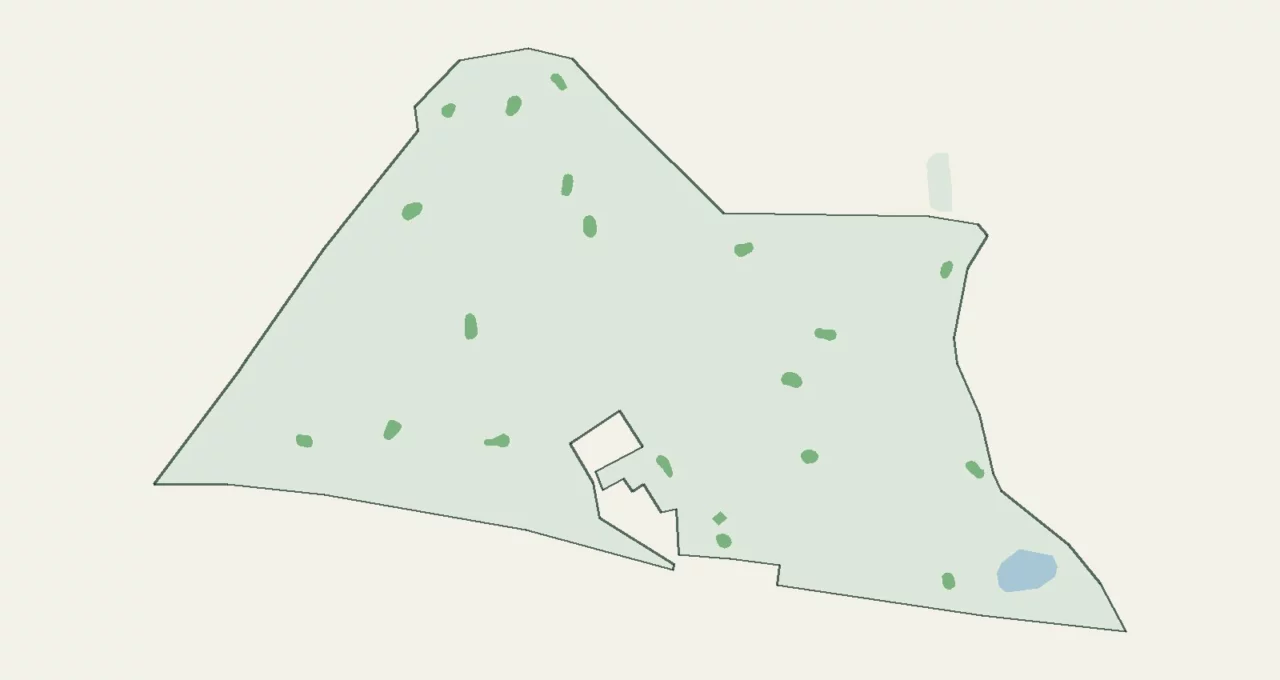
Layout of Denham Golf Club from OpenStreetMap survey data (ODbL licence).
Denham Golf Club
Holes
18
By
70
Length
6,493 yards from the white tees, 6,243 yellow, 6,029 blue, 5,595 red (WHS card via Stymie)
Green fee
—
Best season
Year-round; on gravel, the club says it hardly ever closes and has no temporary greens
Denham Golf Club is a private members’ club on Tilehouse Lane at Denham, Buckinghamshire, just north of the village of Higher Denham, postcode UB9 5DE, a few minutes from the junction of the M40 and the M25 and about twenty miles by road from central London. Its course was laid out by Harry Colt and opened in May 1911, on the free-draining gravel of the old Hill Barn Farm in the Colne Valley. It plays to 6,493 yards and par 70 from the white tees, with a course rating of 72.0 and a slope of 129. The clubhouse was made from a sixteenth-century tithe barn and farmhouse at the heart of the property, and the club has something almost no other in England can claim: a railway station of its own, Denham Golf Club, on the Chiltern line from London Marylebone, from which members and visitors walk across the 11th fairway to the clubhouse.
Denham has never been a famous name in the way that Sunningdale or Swinley Forest are, and it is not trying to be. It is a traditional club whose visitors come on set days, whose dining room and lunch are as much talked about as its greens, and whose course has been quietly restored over the past few years. In the 2026 edition of the England ranking by Top 100 Golf Courses it entered the list for the first time, at number 98, and National Club Golfer places it ninth among the courses of London.
Colt, a farm and a station
The club was conceived at a meeting of seven local men in August 1910, and shares were issued in December of that year, according to the account prepared for its centenary from the club archive. The course opened for play in May 1911; the club’s own website gives the date as 29 May. The archive records Colt’s fee as paid in September 1911, while he was still serving as the first secretary of Sunningdale. A contemporary press note quoted by the architecture site Evalu18 explains that the plan was to build few bunkers at first and add them where experience showed they were needed, and that twenty-seven holes were once planned, of which only eighteen were ever built.
The railway followed. National Club Golfer dates the station to 1912 and says it was built at the club’s request; Evalu18 adds that the platforms had to be lengthened to cope with London businessmen travelling out to play, and that by the autumn of 1912 the club was advertising for caddies for the weekends. The station is still open. The farm buildings had by then become the clubhouse, and its dining room, with exposed beams, brick walls and the former landowner’s hunting trophies on display, is the room reviewers mention most often.
The course is not entirely Colt’s. Evalu18, which has studied a 1921 Colt plan held by the club, says that James Braid later added the present 15th green and 16th tees, replacing Colt’s original short 16th, and that the firm of Hawtree and J.H. Taylor advertised in the late 1920s that it had designed and built the 15th green. The bunkering has changed several times since. In recent years the club carried out a master plan drawn up in 2021 by the architect Clyde Johnson, which, according to one reviewer and the club, remodelled the bunkers and restored the strategic width of Colt’s playing corridors. Donald Steel, the golf course architect, has been a member for more than sixty years and is a past captain.
What the course asks of you
The clubhouse sits in the middle of the course, and both nines start from it: the front nine mostly to the north and the back nine to the south. The ground is undulating rather than hilly, with old gravel workings and natural hollows on several holes, and the course has developed a parkland character over heathland soil, with pockets of gorse and fescue that recall what it once was. Out of bounds runs close on the early holes. Because the subsoil is gravel, the club says it hardly ever closes and never has temporary greens in play.
The card is built on par 4s. There are twelve of them, four par 3s and only two par 5s, which come back to back at the 13th and 14th. From the white tees the front nine measures 375, 381, 413, 426, 201, 383, 455, 185 and 450 yards for 3,269 yards and par 34; the back nine 390, 366, 131, 533, 497, 416, 135, 349 and 407 yards for 3,224 yards and par 36. The yellow tees play 6,243 yards, the blue 6,029 and the red 5,595, all to par 70 for men; women’s ratings on the same tees run from 73.0 to 78.0.
National Club Golfer’s hole guide gives a fair idea of the shape of the round. The 1st is a gentle opening par 4 with a downhill second. The 2nd is a sharp dogleg right with out of bounds down the right, and the 3rd, over 400 yards, has out of bounds on both sides. The 5th, the first of the short holes, is more than 200 yards and slightly uphill to a green guarded by three bunkers, and National Club Golfer considers it arguably the hardest of the par 3s. The 7th, 455 yards, is stroke index 1; the 9th, 450 yards, finishes the outward half on a two-tiered green.
The 11th is the hole walkers from the station already know. At 366 yards from the white tees it looks harmless, but the fairway is short and narrow, the ground drops from the fairway to the green, and four large bunkers defend the putting surface. The 12th, about 130 yards, is set into a slope across a small ravine, with bunkers on the left and a hard recovery from below the green on the right; an old review in the local press called it one of the most picturesque short holes anywhere, in bluebell season. The 15th, 416 yards, is the hardest hole on the back nine and has the bold, two-tiered, false-fronted green that Evalu18 attributes to Braid or to Hawtree and Taylor, in contrast to the more delicate Colt green at the short 16th. The 18th, 407 yards, finishes in front of the clubhouse between trees and four bunkers.
What golfers say
Denham is reviewed in depth on Top 100 Golf Courses, where twelve reviews average 4.0 out of five, and more briefly on golf apps, where it is rated 4.7 on Hole19. The points below summarise what recurs. They are other people’s opinions, not ours. Nobody from Panxis has played the course, and we name no reviewer.
What comes up in its favour
- The clubhouse and the lunch, described again and again as half of the reason to go, and the atmosphere of a traditional members’ club that is friendly to its guests.
- The condition. Several reviewers describe immaculate fairways and fast, testing greens, and one recalled not a single poor lie in a whole August round.
- The Colt green complexes, rated the course’s strongest feature by those who score it in detail, and the recent bunker work, which reviewers credit with adding strategy.
- The par 4s, especially the 7th and the 15th, and the short 12th; the 11th, 8th and 16th are also among the holes named as best.
- The station. Reaching a classic course by train from Marylebone and walking across a fairway to the first tee is, for many visitors, part of the charm.
What comes up against
- Some find the course solid rather than spectacular: an honest parkland round, in the words of more than one reviewer, more charming than thrilling.
- The variety is rated lower than the greens, and some reviewers find the two par 5s ordinary; the 13th in particular is criticised for having lost the dramatic tee shot over a gravel pit that it once had.
- Trees planted over the decades have pushed the course from heathland towards parkland, and some feel this has narrowed holes such as the 2nd.
- Visitors who came during the renovation found the course under heavy remedial work and wished they had been told; the work has since been completed.
- Access is limited. This is a members’ club first, with visitors on certain weekdays only.
Getting there and when to go
By road, Denham is just inside the M25, close to the M40, with Heathrow less than ten miles to the south, according to National Club Golfer. By rail, Denham Golf Club station is on the southern boundary of the course, on the Chiltern Main Line between Denham and Gerrards Cross. The club says trains from Marylebone take just over twenty minutes and that the clubhouse is a five-minute walk from the platform across the 11th hole. Mind the players on the fairway.
Visitors play as individuals on a green fee or as societies. The club’s pages give Tuesdays and Thursdays as the main visitor days; the visitors page itself says Monday to Thursday, with some times on Friday and Sunday afternoons. The club has chosen not to run a tee-time sheet for its members, and its pages disagree on whether visitors should book a time through the professional’s shop or simply telephone to check availability: call before you travel. There is a large practice ground with open and covered bays, two chipping greens with a practice bunker and a big putting green beside the clubhouse. The course plays all year.
Nearby courses in this directory include Stoke Park, another Colt design a few miles to the south-west.
Green fees
Visitor rates vary by season and day and are published by the club on its visitors and green fees page.
How this page was made
The factual frame comes from public sources: OpenStreetMap for the location and the address; the club’s website, as indexed in October 2026, for the opening date, the gravel subsoil, the visitor days, the booking arrangements and the train times; the World Handicap System card published by Stymie for the yardages, pars, ratings and slopes; National Club Golfer for the hole-by-hole guide, the station date, the London ranking, the practice facilities and the distances; Top 100 Golf Courses for the 2026 England ranking, the clubhouse and Donald Steel’s long membership; Evalu18 for the 1921 Colt plan, the changes by Braid and by Hawtree and Taylor, the original plan for twenty-seven holes and the 1939 press review; the centenary account designed for the club for the 1910 meeting and the payment to Colt; the English Wikipedia article on the station; Wikidata for the identifiers.
Where sources disagree, we say so. Lengths from the back tees range from 6,486 yards (Today’s Golfer) and 6,488 (GolfPass) to 6,493 (Stymie) and 6,527 on an older card published by Golfify, which also gives par 71; we use the current rated card. Hole19’s card, at 5,491 yards and par 71, does not match any other source. The founding year is 1910 for National Club Golfer and Top 100 Golf Courses and 1911 for Golfify and the course opening. The club’s pages give two different telephone numbers for the professional’s shop, and Top 100 Golf Courses a third general number. Train frequencies differ: National Club Golfer says every other hour on weekdays, Evalu18 hourly; check the timetable. Evalu18 attributes the review of 1939 to Bernard Darwin in its heading and to Harry Rountree in its text.
The opinion section summarises reviews on Top 100 Golf Courses and Hole19, read in October 2026. We report recurring themes rather than individual voices, and we reproduce no quotations from reviewers. Nobody from Panxis has played or visited this course, and this page is no substitute for a round.
The club has not paid for this page, has not seen it before publication and has no say over its content. This page contains no commercial link and earns us no commission. If you know the club and something here is wrong or out of date, write to us and we will correct it.
Other courses nearby
Closest to this one in our British directory:
- Moor Park Golf Club — 4 mi
- Beaconsfield Golf Club — 5 mi
- Stoke Park — 5 mi
- Lambourne Golf Club — 6 mi
The hole to know
Par 4 of 366 yards beside the station: a short, narrow fairway, a drop to the green and four large bunkers around it; walkers from the train cross it to reach the clubhouse.