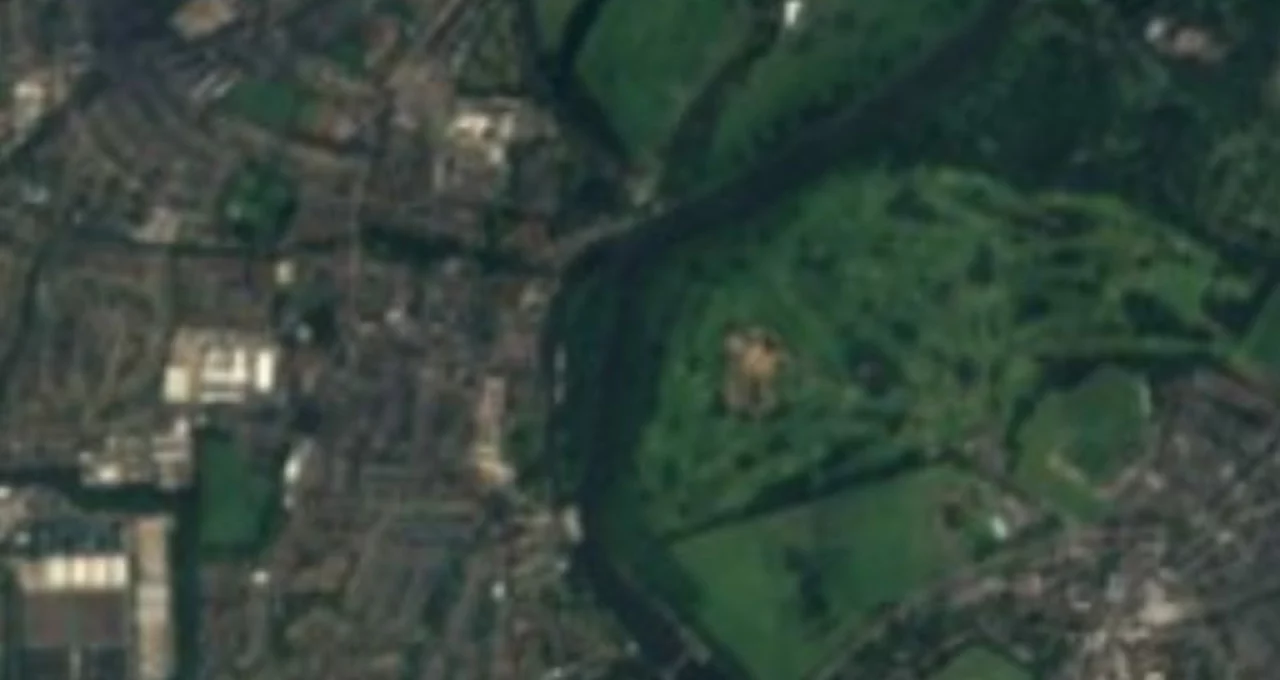
Royal Mid-Surrey Golf Club from space. Sentinel-2 cloudless 2016 by EOX IT Services GmbH (contains modified Copernicus Sentinel data), CC BY 4.0.
Royal Mid-Surrey Golf Club
Holes
36 (two 18-hole courses): the J H Taylor, formerly the Outer, and the Pam Barton, formerly the Inner (club website, Wikipedia)
By
J H Taylor (main course): 69 for men from the black and burgundy tees, 73 for women; Pam Barton: 68 for men, 71 for women (club scorecards and rating tables)
Length
J H Taylor (main course): 6,360 yards black, 6,082 burgundy, 5,723 green, 4,498 navy blue; Pam Barton: 5,521 burgundy, 5,379 green, 4,120 navy blue (club scorecards, 2022); other sources give 6,402 or 6,318 and 5,544 or 5,634
Green fee
—
Best season
—
Royal Mid-Surrey Golf Club is a private members’ club with two 18-hole parkland courses in the Old Deer Park at Richmond, on the east bank of the Thames in south-west London, with the Royal Botanic Gardens at Kew immediately to the north. It was founded in 1892, received its royal title from George V in 1926, and for 47 years had J. H. Taylor, five times Open champion, as its professional. The two courses were long known as the Outer and the Inner. Today they carry the names of two of the club’s most famous golfers: the J H Taylor Course, the longer one, which runs round the edge of the property, and the Pam Barton Course, which sits inside it. On the club’s current scorecard the J H Taylor measures 6,360 yards from the black tees for a par of 69, and the Pam Barton 5,521 yards from the burgundy tees for a par of 68. This page treats the J H Taylor as the main course, because it is the longer, the one the club rebuilt between 2009 and 2014, and the one rated from the back tees, and it describes the Pam Barton alongside it.
The land belongs to the Crown Estate, from which the club bought an extended lease in 2015, according to its own heritage page. The setting is unusual even by the standards of London golf: the Grade I listed King’s Observatory, built for George III, stands within the boundaries of the courses, and Wikipedia says the foundations of Sheen Priory, the Carthusian house founded by Henry V in 1414, lie under the fairway of the 14th. What follows sets out what the public record says about the club, what the two cards ask of a golfer, what published reviews report, and how a visitor can, or currently cannot, get a game.
Which club is this?
OpenStreetMap maps the ground as Royal Mid-Surrey Golf Club and links it to the Wikidata item Q7374478 and the English Wikipedia article of the same name. Wikidata gives 1892 as the year of foundation and rmsgc.co.uk as the official website, which is the site we used throughout. The club’s own address is Old Deer Park, Twickenham Road, Richmond, Surrey, TW9 2SB; one directory, Top 100 Golf Courses, gives the postcode TW9 1PQ instead. Despite the county in its name and its postal address, Richmond has been part of Greater London since 1965, and the club lies in the London Borough of Richmond upon Thames.
The name should not be confused with Royal Wimbledon, Richmond Golf Club at Sudbrook Park, or the public Richmond Park Golf Course a few miles to the south-east, which are separate clubs on separate ground. Nor is Royal Mid-Surrey anywhere near the middle of present-day Surrey: the name dates from a time when Richmond lay in that county.
History: Taylor, a royal charter and a fire
The club’s timeline dates its opening to 24 October 1892, on land rented from a farmer, and its heritage page says it was founded in a pub in Richmond with both men and women among its members, which the club calls progressive for the time. Its first president was Prince George, Duke of Cambridge, according to Wikipedia and the club. A clubhouse followed in 1894.
In 1899 J. H. Taylor left Royal Wimbledon to become the professional at Mid-Surrey. He stayed until 1946. The club credits him with the humps and hollows that give the courses their character, and its timeline says he oversaw the completion of the Inner course, now the Pam Barton. Wikipedia goes further and says Taylor laid out the 36 holes on the northern part of the Old Deer Park, working with the greenkeeper Peter Lees to give some relief to otherwise flat ground. We found no account of who laid out the first holes in 1892, seven years before Taylor arrived, and we do not guess. The club’s timeline adds that Taylor founded the first Professional Golfers’ Association in September 1901. A later trade report, on Pitchcare, describes him as the original designer of both courses.
In 1926 George V granted the club its royal title, and the Prince of Wales, the future Edward VIII, was club captain; the club’s timeline puts both in that year. The heritage page records a new colonial-style clubhouse in 1937, the first to bring men and women golfers under one roof, and the formation in 1947 of an Artisan Section, whose members built their own clubhouse during a severe freeze; the club says it still stands.
Taylor’s successors as professional were notable in their own right. The club’s timeline names Henry Cotton, three times Open champion, as professional from 1946 to 1952; Wikipedia says Cotton was followed by his assistant Max Faulkner, the 1951 Open champion, until 1953, then by Jimmy Adams until 1969, by David Talbot from 1969 and by his son Philip Talbot from 1999.
Pam Barton, after whom the inner course is named, was a member from 1929 according to the club. Born in Barnes in 1917, she won both the British Ladies Amateur and the US Women’s Amateur in 1936, at the age of 19, according to Wikipedia; the club’s timeline also credits her with a second British title in 1939. She played in the Curtis Cup in 1934 and 1936. She was killed on 13 November 1943, aged 26, when the aircraft in which she was a passenger crashed on take-off at RAF Detling in Kent, and was buried with military honours.
On 30 March 2001 a fire destroyed the clubhouse, and with it most of the club’s records and memorabilia, portraits and trophies. The club says the cause was never identified. Members used a marquee for over two years until the present, larger clubhouse was opened on 21 November 2003 by the Duke of York, according to the timeline. In 2004 the club voted for full equality between men and women members. Since 2022 it has held GEO certification for sustainable golf.
The rebuilding of the J H Taylor
The most significant change to the courses in recent decades was the reconstruction of the J H Taylor under the guidance of the architect Martin Ebert, of the firm Mackenzie and Ebert. According to Pitchcare’s report of January 2014, the contractor MJ Abbott rebuilt the back nine in 2009, and the front nine in a second phase of 16 weeks between early June and late September 2013. The agronomist Charles Henderson acted as consultant. The work included nine new greens in the second phase, a chipping green, new tees, bunkers, wetlands, a new irrigation system and around 15,000 square metres of fescue turf. The club’s timeline dates the reopening of the course to 29 June 2014, after seven years of work, with 18 greens built to USGA specification, and says the redesign kept Taylor’s humps and hollows.
The constraints were unusual. The site is a Grade I registered landscape, and Pitchcare says sight lines from the King’s Observatory had to be protected in negotiation with English Heritage and the Crown Estate. The ground lies in the flood plain of the Thames: the 8th and 9th greens were built higher to sit above flood water, and because they could not be raised enough to be safe from every flood, their greenside bunkers were replaced by grass hollows and mounds that the project called Taylor mounds, after the original designer. New wetlands and lowered areas compensated for the raised greens. Badger setts near four of the new greens delayed the work until August 2013, and a gas main runs beneath the course.
We found no source describing a similar rebuild of the Pam Barton. The club says only that it has changed over the years to keep pace with improvements in clubs and balls.
What it asks of the golfer
The club publishes both scorecards, dated March 2022, and rating tables updated in 2024, on its course pages. We read the printed cards and the rating images directly. Both courses are flat in the main, laid out on parkland by the river, with mature trees, and both rely for their defence on Taylor’s mounds and hollows, bunkering and small or raised greens rather than on length.
The J H Taylor Course (formerly the Outer)
- Black tees: 6,360 yards, men’s par 69 (34 out, 35 home), course rating 71.1, slope 128.
- Burgundy tees: 6,082 yards, men’s par 69, rating 69.3, slope 125; women’s par 73, rating 75.4, slope 133.
- Green tees: 5,723 yards, men’s rating 68.1, slope 119; women’s par 73, rating 73.8, slope 128.
- Navy blue tees: 4,498 yards, men’s par 65, rating 62.7, slope 100; women’s par 68, rating 65.9, slope 113.
The Pam Barton Course (formerly the Inner)
- Burgundy tees: 5,521 yards, men’s par 68 (34 out, 34 home), rating 66.7, slope 118; women’s par 71, rating 72.2, slope 132.
- Green tees: 5,379 yards, men’s par 68, rating 66.1, slope 117; women’s par 71, rating 71.6, slope 130.
- Navy blue tees: 4,120 yards, men’s par 65, rating 61.1, slope 105; women’s par 65, rating 63.7, slope 107.
Other sources give older or different figures. Golfshake, Top 100 Golf Courses and GolfMagic give the J H Taylor (or Outer) as 6,402 yards from the white tees, Top 100 with a standard scratch score of 71; Wikipedia gives 6,318 yards. For the Pam Barton, Wikipedia gives 5,634 yards and Golfshake 5,544 from the whites. These are probably earlier measurements from before the rebuild and the change to coloured tees, but none of the sources dates them. We use the club’s current card.
The J H Taylor, hole by hole
From the black tees the card describes a par 69 built on long par 4s and strong short holes:
- It opens with a par 3 of 219 yards, unusual anywhere and the longest of the five short holes. GolfMagic and National Club Golfer both describe it as a demanding start to a small, bunkered green.
- The 2nd is the longest hole on the property, a par 5 of 531 yards, stroke index 6. GolfMagic says it is lined by mature oaks and narrows the further you hit it.
- The other par 5 is the 14th, at 522 yards; there are only two on the course.
- The par 3s are the 1st (219 yards), 5th (145), 8th (185), 11th (150) and 16th (207). The 5th has a raised green with two large bunkers in front, according to GolfMagic.
- Seven par 4s measure over 400 yards: the 6th (404), 9th (427), 10th (438), 12th (455), 15th (456), 17th (421) and 18th (402). The hardest holes by men’s stroke index are the 12th (index 1), the 6th (index 2) and the 15th (index 3).
- The home nine, at 3,368 yards for a par of 35, is almost 400 yards longer than the outward half, 2,992 yards for a par of 34.
Reviewers describe the front nine as tighter, along the boundary with Kew, and the back nine as more open. The local rules on the card show where the hazards of the site come into play: out of bounds beyond the fence and white posts around the Observatory enclosure at the 12th, 13th and 14th, and around the spinney at the 10th and 12th; a no play zone to the left of the 12th and 18th fairways, where the driving range lies, and to the right of the 13th and 14th, where the short game area lies; and a metalled road crossing the course at the 12th and 18th. GolfMagic says the 18th plays towards the Pagoda in Kew Gardens behind the green, needs a straight drive, and has one of the largest greens on the course.
The 12th on the J H Taylor
The card rates the 12th as the hardest hole on the course for men, stroke index 1. It is a par 4 of 455 yards from the black tees and 448 from the burgundy, where the women play it as a par 5. Three of the local rules apply to it: the spinney with its line of white posts, the fence around the Observatory enclosure, both out of bounds, and the no play zone along the left of the fairway beside the driving range, from which the card requires a drop under penalty in a marked zone. A road also crosses the hole, and the card extends the road to two club-lengths either side. On a course that rarely asks for length, this is the hole where a golfer needs both distance and a straight line, with the Observatory, the oldest structure on the property, as the backdrop.
The Pam Barton, hole by hole
The Pam Barton is around 840 yards shorter than the J H Taylor from their longest tees and has no par 5 for men, though the women play the 7th, 16th and 18th as par 5s. Its card shows:
- Four par 3s for men: the 3rd (153 yards), 6th (122, the shortest hole on either course), 10th (164) and 15th (147). The other fourteen holes are par 4s, several of them short: the 11th (265 yards), 13th (270) and 17th (287) are all within reach of long hitters. From the navy blue tees the 2nd, 11th and 13th become par 3s, giving a par of 65.
- The hardest hole is the 7th, a par 4 of 456 yards, stroke index 1, which Wikipedia names as the longest hole on the course at 459 yards; the 14th (404 yards, index 2) and 4th (397 yards, index 3) follow.
- The finish is strong: the 16th (408 yards, index 4) and the 18th (442 yards, index 6) are both long par 4s.
- Out of bounds around the Observatory enclosure comes into play at the 15th and 16th, and a road crosses the 16th.
The men’s slope of 118 from the burgundy tees, against 128 for the J H Taylor from the blacks, confirms the Pam Barton as the more forgiving of the two. Reviewers on Golfshake call it short, though one found its back nine harder than the front.
Practice
The club lists a driving range about two minutes’ walk from the clubhouse, with tokens from the pro shop; putting and chipping greens near the first tees of both courses; two outdoor nets; a short game and bunker area; and an indoor performance studio with swing analysis and club fitting. Top 100 Golf Courses describes the range as about 180 yards long. The club does not give the number of bays.
What golfers say
We read the Golfshake summary and ratings, the Top 100 Golf Courses page and one of its full reviews, and the published reviews of the J H Taylor by GolfMagic (2017) and National Club Golfer (2017, updated 2023). GolfPass refused our requests. On Golfshake the club scores 4.2 out of 5 from 49 reviews, though its own listing gives 29, with 96 per cent of reviewers saying they would play again; facilities and service score best and value for money and practice facilities lowest. Top 100 Golf Courses shows an average of 3.5 out of 5. The points below summarise what recurs. They are other people’s opinions, not ours; nobody from Panxis has played the courses, and we name and quote no one.
What comes up in its favour
- The setting: a quiet stretch of parkland next to Kew Gardens, with the Observatory and the Pagoda in view, which reviewers say makes it easy to forget the city.
- Presentation and condition, including after heavy rain; the rebuilt greens of the J H Taylor are often described as smooth and true.
- Taylor’s mounds and hollows, and the bunkering around the short holes and the closing stretch, which give character to flat ground.
- The strength of the par 3s and of the long par 4s, which make the J H Taylor play harder than its yardage.
- The clubhouse and the welcome given to societies and guests.
What comes up against
- The ground is flat, and some critics find it lacks standout holes; Top 100 Golf Courses reports and answers that criticism.
- Aircraft on the Heathrow flight path pass overhead, a point raised in almost every review, though most reviewers say it does not spoil the golf.
- Value for money and the practice facilities are the lowest-rated categories on Golfshake.
- Some reviewers found the greens less immaculate than expected, and the Pam Barton is seen as short by some.
- The J H Taylor is short by modern standards for a par of 69, which some read as a weakness and others as a warning not to underestimate it.
Playing as a visitor
Royal Mid-Surrey is a private members’ club, and the position on visitors is unclear at the time of writing. The club’s visitors page says that it will not be accepting visitors for the foreseeable future and asks for enquiries to the office. Its tee time page, by contrast, says visitors are welcome at selected times and should telephone to enquire on 020 8940 1894 or write to reception@rmsgc.co.uk. Online booking is for members only.
When visitors are accepted, the club’s stated conditions are as follows. Guests introduced by a member are welcome; visitors without an introduction may play from Monday to Thursday after 10am. Handicap certificates are preferred and golf competency is required: men should be able to play to a handicap of 24 and women to 34. Golf societies need at least eight players, and company golf days are possible except at weekends. The club’s events office handles societies.
Buggies may be hired from the pro shop, weather permitting, as may clubs and trolleys. The dress code, last updated in July 2023, asks for golf clothing of the kind sold in professional shops, allows tailored shorts, and excludes T-shirts, sports shirts, fitness wear, cargo trousers, denim on the courses, reversed caps and sandals for men; the first floor of the clubhouse is smart casual. The club runs open competitions, including the Mothers and Daughters Open, which began in 1932 and which Pam Barton won with her mother in 1935.
Getting there and when to go
The club is at Old Deer Park, Twickenham Road, Richmond, TW9 2SB, and says it is a few minutes’ walk from Richmond station. Wikipedia places it on the east bank of the Thames, with Kew Gardens to the north and the Old Deer Park sports ground, home of London Welsh rugby club among others, to the east. We did not verify parking arrangements and leave them out.
The club does not publish a season or opening hours on the pages we read. Because the ground lies in the Thames flood plain, as the 2013 works make clear, conditions after prolonged wet weather are worth checking with the club before travelling.
Green fees
Visitor arrangements and rates are set by the club and depend on whether visitors are being accepted at all: see the club’s visitors page.
How this page was made
The factual frame comes from public sources: OpenStreetMap for the location and name; Wikidata for the year of foundation and the official website; the club’s website for the address, history, timeline, course pages, the March 2022 scorecards and their local rules, the 2024 rating tables, the practice facilities, the dress code and the visitor policy; Wikipedia for the location, the Observatory and Sheen Priory, the professionals, the 2001 fire and the course figures it gives; Wikipedia’s article on Pam Barton for her career and death; Pitchcare and the contractor MJ Abbott for the reconstruction of the J H Taylor; and Top 100 Golf Courses, GolfMagic and National Club Golfer for descriptions of the holes. The opinions summarised above come from Golfshake, Top 100 Golf Courses, GolfMagic and National Club Golfer.
Where sources disagree, we say so. The J H Taylor is given as 6,360 yards (club card, black tees), 6,402 yards (Golfshake, Top 100, GolfMagic) and 6,318 yards (Wikipedia); the Pam Barton as 5,521 yards (club card), 5,544 yards (Golfshake) and 5,634 yards (Wikipedia), whose figure of 459 yards for the 7th also differs from the card’s 456. Top 100’s closing stretch of 458, 209, 423 and 405 yards and its 225-yard 1st do not match today’s card. The postcode is TW9 2SB for the club and TW9 1PQ for Top 100. The club’s visitors page says no visitors are being accepted, while its tee time page says visitors are welcome at selected times. Golfshake gives both 49 and 29 reviews. The club’s heritage page dates Pam Barton’s British title to 1936 and its timeline adds 1939. The club gives 1768 to 1769 for the Observatory, Wikipedia 1769. Who laid out the first holes in 1892, before Taylor arrived, is not stated by any source we read.
GolfPass refused our requests, and Today’s Golfer’s page was behind a paywall; neither has been used. The printed scorecards give par in a compressed row with two figures for some holes, and we have reconciled it with the club’s course pages. The season and opening hours are not published in the sources we read. Green fee amounts are deliberately left out.
The opinion section summarises reviews read in November 2026. We report recurring themes rather than individual voices, and we reproduce no quotations from reviewers. Nobody from Panxis has played or visited this course, and this page is no substitute for a round.
The club has not paid for this page, seen it before publication or had any say over its content. This page contains no commercial link and earns us no commission. If you know the club and something here is wrong or out of date, write to us and we will correct it.
Other courses nearby
Closest to this one in our British directory:
- The Richmond Golf Club — 2 mi
- Richmond Park Golf Course — 3 mi
- Fulwell Golf Club — 3 mi
- The Buckinghamshire Golf Club — 11 mi
The hole to know
The 12th on the J H Taylor, stroke index 1: a par 4 of 455 yards from the black tees, with out of bounds at the spinney and the King's Observatory enclosure and a no play zone along the left (club scorecard and local rules).