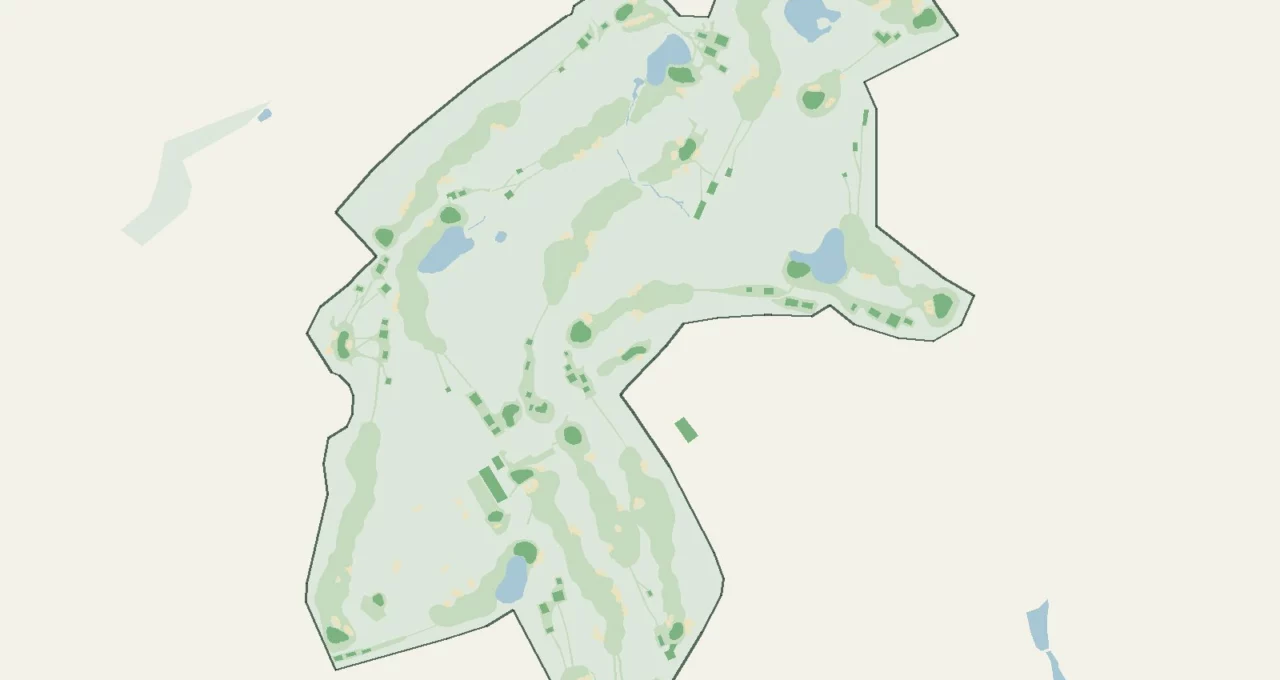
Layout of Queenwood Golf Club from OpenStreetMap survey data (ODbL licence).
Queenwood Golf Club
Holes
18 (Wikipedia, Where2Golf, Golfshake)
By
72 (Where2Golf, Golfshake and a 2024 review on Top 100 Golf Courses; the club publishes no scorecard)
Length
6,878 yards from the back tees and 6,494 from the next tees (2024 review, Top 100 Golf Courses); directories give 6,831 or 6,851 and 6,430
Green fee
—
Best season
—
Queenwood Golf Club is a private 18-hole golf club on Stonehill Road in Ottershaw, Surrey, in the borough of Runnymede. Its course was designed by the Scottish architect David McLay Kidd, best known for the first course at Bandon Dunes in Oregon, and opened in 2001 for the American developer Fred Green. The figures published by reviewers and directories give a par of 72 and a length of between 6,830 and 6,880 yards from the back tees. The club takes no visitors: only members and the guests they invite can play, and its website, queenwood.co.uk, consists of nothing more than two login buttons, one for members and one for guests.
That discretion shapes this page. The club publishes no scorecard, no history, no description of its course and no contact details beyond what appears in company records and golf directories. Everything below comes from third parties: OpenStreetMap, Wikidata and Wikipedia, the register of companies, a trade report from the time of the opening, golf directories and rankings, and accounts written by golfers who have played the course as guests. Where those sources disagree, and on a club this quiet they often do, we say so.
Name and location
The company behind the club is registered as Queenwood Golf Club Limited, and Wikipedia and Wikidata use the same name. The club’s own website calls itself simply Queenwood. OpenStreetMap maps the ground as Queenwood Golf Course and links it to the Wikidata item Q60770122, which places it in Surrey and in the Runnymede and Weybridge parliamentary constituency. OpenStreetMap’s address lookup on the course’s coordinates returns Ottershaw, in Runnymede, and the map at the foot of this page uses the OpenStreetMap position.
The postal address given by Companies House, Where2Golf and Golfshake is Stonehill Road, Ottershaw, Surrey, KT16 0AQ. Where2Golf puts the club about 25 miles south-west of central London. Stonehill Road is also the address of Foxhills Club & Resort, and a guest reviewer on Top 100 Golf Courses, writing in 2019, describes Queenwood as lying opposite Foxhills. The area is part of the belt of sandy heathland west and south-west of London that holds some of England’s best-known inland courses, and the trade press at the time of the opening named Sunningdale, Worplesdon, Swinley Forest and West Hill among the neighbours that inspired the design.
A farm, a developer and a young architect
The company records give the earliest dates. The company that now runs the club was incorporated on 21 April 1999 under the name Cloudgrange Limited, renamed Queenwood Farm Golf Club Limited on 28 June 1999 and Queenwood Golf Club Limited on 1 September 1999. Its registered office is the club’s address on Stonehill Road. The intermediate name suggests the course was built on land known as Queenwood Farm, but we found no source that describes the site before the golf course, and we have not tried to reconstruct it.
The fullest contemporary account is a report published by Golf Business News on 4 February 2002, under the headline Queenwood Golf Club opening announced. It says that little had been known about the club beyond rumour, and that it was expected to become one of the most exclusive in Europe. It names the developer as Fred Green, an American known for high-end clubs such as Nantucket and Eagle Springs in Colorado, and the architect as David Kidd. According to the same report, a firm called Barrelfield Golf found the site, negotiated its purchase on Green’s behalf, obtained planning permission, helped assemble the development team and built the course itself, its first construction job after years as a project manager. The report announces that the club would open fully in May 2002.
Wikipedia, citing a 2017 book on the business of golf, credits Green with developing the club and says that another American businessman, Walter Forbes, was also involved. Some copies of the Wikipedia article in circulation online give Forbes alone as the developer; the current version names both, with Green first, and the 2002 trade report names only Green.
Top 100 Golf Courses describes Kidd as the son of Jimmy Kidd, a former greenkeeper, and a blog review published in 2011 calls Queenwood his first course in the United Kingdom. DMK Golf Design, his practice, lists Queenwood in its company profile alongside Bandon Dunes, Nanea and Gamble Sands.
The design idea
The design intent is better documented than anything else about the club. Wikipedia, drawing on DMK Golf Design’s own page about the course, says Kidd used heather both for its strategic and its aesthetic value, most notably on the faces of the bunkers, and that he set out to revive the understated heathland tradition of nearby Sunningdale, Walton Heath, Woking and Swinley Forest. Where2Golf reports Kidd describing the site as tranquil parkland and calling the putting surfaces among the toughest and fastest he has built. A directory description that appears in search results describes a tumbling parkland layout with fescue-lipped bunkers and a great deal of heather, deliberately made to look like a traditional heathland course. The 2002 trade report, for its part, speaks of a tribute to Harry Colt and Herbert Fowler, two of the architects who shaped the Surrey and Berkshire heathland courses in the early twentieth century.
So the course is a modern construction on ground that sources variously call parkland and heathland, made to look and play like the old heathland courses around it. One guest reviewer who wrote at length in 2024 argues that the course is less artificial than its critics suggest, because the rolling land and most of the trees and shrubs were already there. A 2011 blog review lists gorse among the plantings, alongside heather and tall pines.
What it asks of you
The club does not publish a scorecard, so there is no official figure for anything on this page. The most detailed set of numbers we found is in a review published on Top 100 Golf Courses in August 2024, whose author lists the par and two yardages for every hole and gives the course rating and slope for two sets of tees:
- Back tees: 6,878 yards, par 72, course rating 73.9, slope 148.
- Next tees forward: 6,494 yards, rating 72.0, slope 140.
The same reviewer mentions shorter and combination tees without giving their figures. Other sources are close but not identical. Where2Golf lists 6,831 yards from the back tees and 6,430 from the club tees, both par 72, with standard scratch scores of 73 and 71. Golfshake gives 6,851 yards in its summary but lists 6,430 yards from the blue tees (standard scratch 71) and 6,206 from a blue and white combination (standard scratch 68). Search summaries report that GolfPass lists 6,830 yards from the white tees, but GolfPass refused our requests. The differences of a few dozen yards probably reflect changes to individual tees since the opening; we cannot say which figure is current.
On the figures in the 2024 review, the course goes out in 3,497 yards and par 36 and comes home in 3,383 yards and par 36 from the back tees; added together, the reviewer’s hole yardages make 6,880, two yards more than the total he gives, while the forward figures add up exactly to 6,494. There are five par 3s and five par 5s, which matches the 2011 blog’s count. On the front nine the par 5s are the 1st and 8th and the par 3s the 4th and 6th. The back nine has three par 3s, three par 4s and three par 5s, as a 2024 reviewer also noted, and ends with a par 5. The nines are two loops, both returning to the clubhouse. The holes, as the 2024 review lists them, with the back-tee yardage first:
- 1st, par 5, 541 and 519 yards; 2nd, par 4, 478 and 440; 3rd, par 4, 321 and 300; 4th, par 3, 180 and 164; 5th, par 4, 398 and 385; 6th, par 3, 210 and 190; 7th, par 4, 442 and 401; 8th, par 5, 515 and 492; 9th, par 4, 412 and 385.
- 10th, par 4, 429 and 420; 11th, par 4, 444 and 425; 12th, par 3, 196 and 177; 13th, par 5, 519 and 485; 14th, par 3, 161 and 149; 15th, par 5, 538 and 520; 16th, par 4, 380 and 356; 17th, par 3, 209 and 188; 18th, par 5, 507 and 498.
Water is a bigger factor than on the old heathland courses nearby. The 2011 blog counts five ponds in play, and the reviews place them on the 5th, where a pond lies to the right of a dogleg left; the 6th, a long par 3 with a pond in front of and to the right of the green; the 10th, a downhill dogleg right with water along the right and in front of an undulating green; the 11th, with a stream, a ditch and a pond to the left of the green; and the 16th. A stream also crosses the 1st.
The reviews agree on several holes. The opening par 5 is a downhill dogleg right with three bunkers at the corner, reachable in two for long hitters. The 3rd is a short par 4 that tempts a drive at the green over bunkers at around 210 and 240 yards; one reviewer liked the gamble, while the 2011 blog found the hole attractive but strategically thin. The 7th, a par 4 doglegging left through a narrow chute of trees with bunkers on both sides, is called the hardest hole on the course by one reviewer and leaves a long, uphill approach for those who lay back. The 12th is a par 3 over heather to a green with a central hollow in the Biarritz style and a diagonal line of bunkers. The 13th, a par 5, can leave a blind third shot if the drive is poorly placed. The 15th green tilts away to the back right, a feature one reviewer calls controversial, and the long par 3 17th has a green with a pronounced back tier.
The 16th is the hole that recurs most often. It is a short par 4 from an elevated tee to a wide, heavily sloping green that wraps around a pond. The 2011 blog calls it the members’ favourite, two of the guest reviewers we read name it as theirs or among the best, and a third found it somewhat easy. The round ends with an uphill par 5 to a green in front of the clubhouse, with nine bunkers along the way according to the 2024 review; the 2011 blog says it can be reached in two when the flag is on the left.
The greens are the main defence. Reviewers describe them as large, fast and divided into tiers or quadrants, so that a ball on the wrong section often leads to three putts. Two reviews, from 2011 and 2019, report that the greens have sub-air systems, which pump air through the root zone to control moisture, and the 2011 blog adds that the greens had then just been completely regrassed. The heather is kept short enough in play to allow a recovery, according to a 2025 review, but becomes a serious hazard where it lines the lips of the bunkers. The bunkers themselves are large, irregular and often deep, and sit mostly where drives land.
What golfers say
Public opinion on Queenwood comes almost entirely from guests, and there is not much of it. We read seven reviews on Top 100 Golf Courses written between 2019 and 2025, including one selected as the site’s review of the month in November 2019, the Golfshake summary of 13 reviews written between 2008 and 2024 (average 5 out of 5), and a long review published on a golf blog in 2011. GolfPass and Golf Digest refused our requests. The points below summarise what recurs. They are other people’s opinions, not ours; nobody from Panxis has played the course, and we name and quote no one.
What comes up in its favour
- Conditioning: almost every review describes the tees, fairways, bunkers and greens as immaculate, and two reviewers call the conditioning the best they know in the United Kingdom.
- The greens: fast, true and full of contour, praised as the course’s real test.
- Practice facilities: the range and short-game area are rated among the best the reviewers have used, and one reviewer mentions free range balls of tour quality.
- Service, caddies and the clubhouse: staff and caddies are described as attentive and well informed, and the clubhouse, visible from several holes, is admired.
- Privacy: holes sit in their own enclosures of trees, few other groups are on the course, and reviewers enjoy the quiet.
- Variety, particularly on the back nine, with a memorable finish towards the clubhouse.
What comes up against
- Style: some reviewers find the course American in character, too manicured or a little formulaic, and single out the ponds on the 6th and 10th as foreign to the heathland tradition.
- Rank: several reviewers who loved the day still place the architecture below the best traditional heathland courses in Surrey, and one would not put it among the world’s top 100.
- Trees lining the fairways punish stray drives, and the heather at the edges of the bunkers can intimidate.
- Some green contours, on the 15th and 17th in particular, strike reviewers as severe, and one Golfshake reviewer found the greens impossible.
- Access: playing requires an invitation from a member, which most golfers will never have, and value for money draws the lowest marks on Golfshake.
- One reviewer in 2012 reported boggy patches and ground under repair after wet weather.
The reviews are few, written by guests who were invited to play, and mostly enthusiastic; opinions vary with the day, the season and the expectations each visitor brought.
Rankings and reputation
Top 100 Golf Courses ranks Queenwood 85th in Britain and Ireland, 34th in England and 17th in London and the South East, and calls it the most secretive club in the country. Golf Monthly includes it in its list of the most exclusive golf clubs in the United Kingdom. Today’s Golfer placed it in its ranking of England’s top 100 courses in 2013, in the band from 41st to 50th, according to the address of the page; the page itself sits behind a payment wall and we could not read its exact position.
Exclusivity is the theme of almost everything written about the club. Wikipedia, citing The Guardian, says that in 2005 membership was limited to 350, and press reports at the time named well-known actors and tour professionals among the members. The published diaries of Alastair Campbell, cited by Wikipedia, describe a visit in 2006 or 2007 and mention a rule against mobile phones. Several sources quote joining fees; we do not repeat them, because none comes from the club and they disagree with one another.
Access, facilities and how to play it
Queenwood is closed to the public. Where2Golf states that guests can play only when hosted by a member, and none of the sources we read mentions a visitor booking system, open competitions or society days. The club’s website offers only a members’ login, a guests’ login, terms and a careers page. Top 100 Golf Courses and Where2Golf give the telephone number 01932 454500.
On the course, the accounts describe walking golf with caddies. One 2024 reviewer says caddies are mandatory and there are no buggies; a 2023 reviewer says caddies are required for groups of three or four; Where2Golf says players generally walk. We could not confirm the rule with the club. Reviewers also mention a clubhouse with dining and locker rooms, and Golfshake reviewers praise the catering, although Golfshake’s own information panel says the club has no clubhouse, bar or changing rooms, which every review contradicts.
Getting there and when to go
The address is Stonehill Road, Ottershaw, Surrey, KT16 0AQ, on the same road as Foxhills and, according to Where2Golf, about 25 miles south-west of central London. Since the club accepts only invited guests, the practical details of a visit, from arrival times to dress, come from the host member. None of the sources we found describes a season, winter greens or closures, and the guest reviews we read cover visits in spring, summer and autumn.
How this page was made
The factual frame comes from public sources: OpenStreetMap for the location, outline and name of the course and for the address lookup; Wikidata for the item linked to it and the constituency; Companies House for the company’s name, incorporation date, former names and registered office; Golf Business News (4 February 2002) for the developer, the role of Barrelfield Golf, the architect’s sources of inspiration and the planned opening date; Wikipedia’s article on the club for the opening year, the design intent drawn from DMK Golf Design, the people involved, the 2005 membership limit and the Campbell diaries; Where2Golf, Golfshake and Top 100 Golf Courses for lengths, pars, scratch scores, address, telephone number and rankings; and reviews published on Top 100 Golf Courses, Golfshake and the Proper Golf blog (2011) for the hole-by-hole figures, the description of the holes and the opinions summarised above.
Where sources disagree, we say so. The opening date is 2001 for Wikipedia, DMK Golf Design and Top 100 Golf Courses, while Golf Business News announced in February 2002 that the club would open fully in May 2002; both may be right if the course was played before the formal opening. The length from the back tees is 6,878 yards in a 2024 review, 6,851 for Golfshake, 6,831 for Where2Golf and, according to search summaries, 6,830 for GolfPass; the forward figure is 6,494 in the review and 6,430 in two directories. The review gives a rating and slope, the directories standard scratch scores. The developer is Fred Green in the 2002 report, Green with Walter Forbes in Wikipedia, and Forbes alone in some copies of Wikipedia. The rule on caddies differs between reviews, and Golfshake’s facilities panel contradicts its reviewers. One directory, GolfN, attributes the course to Fred Hawtree and to 1975, which are the architect and the opening year of the Foxhills courses across the road; we treat this as a mix-up and have not used it. Several search results also credit Tom Watson as co-designer, which appears to confuse Queenwood with another Surrey course, and we have not used that either.
The club publishes no scorecard, history or course guide, so every yardage on this page comes from reviewers and directories rather than from the club. DMK Golf Design’s course page, The Guardian’s 2005 article, Golf Digest, GolfPass and Today’s Golfer refused our requests or sat behind a payment wall, so what we know of them comes from Wikipedia’s citations or search summaries. We found nothing on the history of the site before 1999 beyond the company’s former name, no record of the club’s affiliation to England Golf, and no information on seasons or closures. We left out the joining fees and annual subscriptions reported in the press, the names of members, and a set of figures about the clubhouse and membership terms published by a property blog in 2025 that cites no sources.
The opinion section summarises reviews read in October 2026. We report recurring themes rather than individual voices, and we reproduce no quotations from reviewers. Nobody from Panxis has played or visited this course, and this page is no substitute for a round.
The club has not paid for this page, has not seen it before publication and has no say over its content. This page contains no commercial link and earns us no commission. If you know the course and something here is wrong or out of date, write to us and we will correct it.
Other courses nearby
Closest to this one in our British directory:
- Foxhills Golf Club — 1 mi
- Royal Ascot Golf Club — 6 mi
- The Maidenhead Golf Club — 8 mi
- Guildford Golf Club — 9 mi
The hole to know
A short par 4 of 380 yards from the back tees (2024 review), played from an elevated tee to a wide, heavily sloping green that wraps around a pond; described as the members' favourite in a 2011 review.