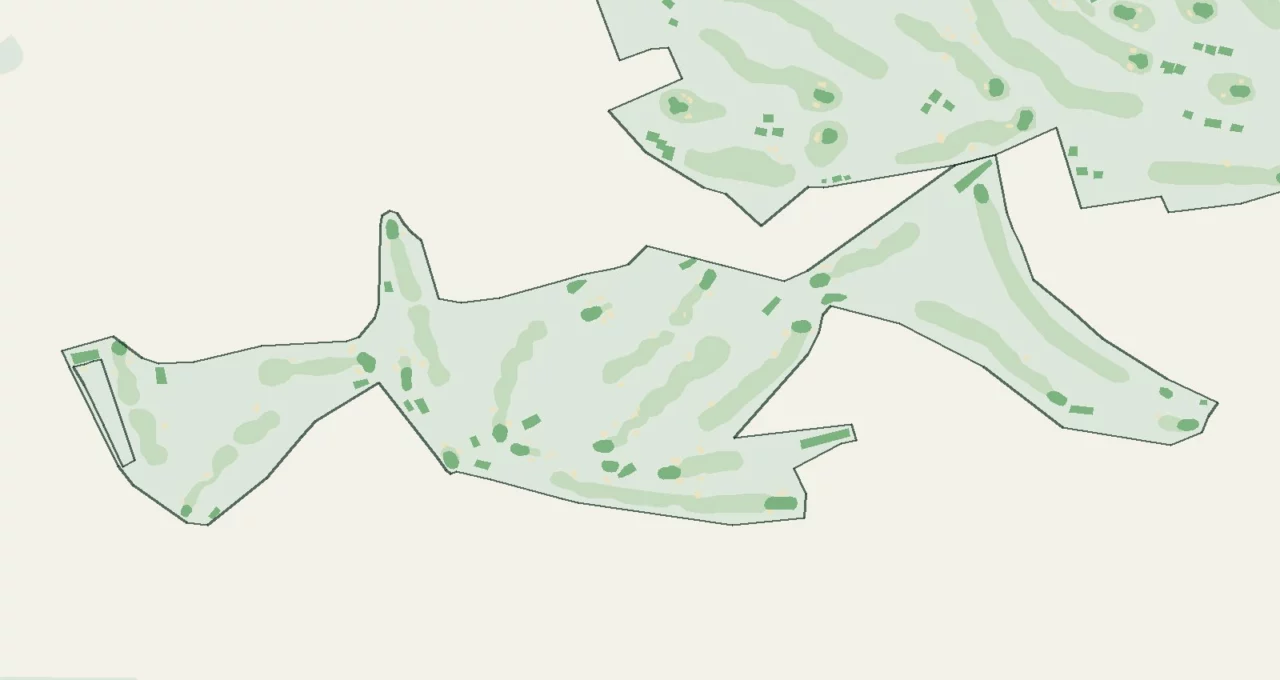
Layout of Guildford Golf Club from OpenStreetMap survey data (ODbL licence).
Guildford Golf Club
Holes
18 (club website)
By
69 for men from the white, yellow and red tees, 68 from the blue; 72 for women (course rating tables published by the club); the club's card prints 68/69
Length
6,117 yards from the white tees, 5,744 yellow, 5,542 red, 5,278 blue (club scorecard); the club's introduction gives 6,160, Wikipedia 6,090
Green fee
—
Best season
Visitors welcome all year round, weekends in the afternoon only; course on free-draining chalk, described by the club as playable all year (club website)
Guildford Golf Club is an 18-hole course on the chalk of Merrow Downs, on the eastern edge of Guildford in Surrey, at the top of Grove Road in Merrow. The club was founded in 1886 and calls itself the oldest golf club in Surrey. Its course was reshaped by J.H. Taylor and his partner Fred Hawtree between 1925 and 1934 and updated again by the course designer Howard Swan, and it measures 6,117 yards from the white tees on the club’s scorecard, par 69 for men according to the course ratings the club publishes. The ground is common land owned by Guildford Borough Council and leased in part to the club, so walkers share it with golfers, and from the highest point the club says you can see four counties and the skyline of London. The club’s website is guildfordgolfclub.co.uk.
It is a members’ club that takes visitors all year round, on weekdays and on weekend afternoons, with an online tee sheet. It is also a course with an unusual second life: an old chalk pit crossed from the 15th tee holds juniper, rare chalk plants and a colony of Chalk Hill Blue butterflies, watched over by volunteers who have walked a butterfly transect across the course since 2016. This page sets out what the published sources say about the club, its history and its holes, and what golfers who have played it report.
Name and location
The club’s name is simply Guildford Golf Club, and OpenStreetMap uses the same name for the outline of the course, with the postcode GU1 2HL, a link to the English Wikipedia article and the Wikidata item Q5615824. That Wikidata item describes it as a golf club in Surrey founded in 1886 and carries coordinates taken from Wikipedia; they fall roughly 850 metres west of the centre of the course as drawn in OpenStreetMap, so the map at the foot of this page uses the OpenStreetMap position. The postal address is Grove Road, Merrow, Guildford, Surrey, GU1 2HL.
Merrow Downs is an area of common land on the North Downs ridge, on the edge of the former village of Merrow, now a suburb of Guildford, and inside the Surrey Hills Area of Outstanding Natural Beauty, according to Wikipedia. The same article says the council leases part of the common to the golf club and that the public keeps its right to roam over it, which is the single most important fact about how the course plays day to day. A narrow tarmac road runs through the course: the club’s local rules describe it as bisecting the ground between the 5th and 9th greens, and its course risk assessment warns golfers to take great care crossing it between the 5th and 6th and between the 9th and 10th. The club’s hole guide refers to the Dorking road beyond the 5th green. Trodds Lane, which the old racecourse crossed and which a hole crossed before the Taylor and Hawtree changes, also runs across the downs here.
History: from a racecourse to the oldest club in Surrey
Long before golf, Merrow Downs was Guildford’s racecourse. The Merrow Residents’ Association, which has written up the history of the site, says Guildford Races, flat and jump, were held each Whitsun week on the downs from 1701 to 1870, that William III gave a King’s Plate there, that the grandstand was pulled down in 1854 and that the last Queen’s Plate was run on 26 April 1870. Its reconstruction of the two-mile circuit traces it across what are now the 3rd, 8th and 10th fairways, across Trodds Lane and back, and places the old grandstand a few yards east of today’s 12th green. The club’s own history page confirms that the land was the site of the local racecourse until 1870 and adds that it was part of the Onslow Estate, which it links to Rudyard Kipling’s Just So Stories: Kipling’s poem Merrow Down, printed with the stories in 1902, is set on these downs.
According to the club, Guildford Golf Club was founded on Merrow Downs in 1886 by three local residents, Colonel W. Bannatyne, Major W. Pontifex and Mr E.L. Hooper, with the support of the Lord of the Manor, the 4th Earl of Onslow. The Top 100 Golf Courses website adds that the Earl became the club’s first Honorary President three years after its formation and that successive Earls of Onslow held the post until 2001, when the first president elected from the membership took over; Wikipedia also records the Earl as president. The club points to an unusual link with France: it says Major Pontifex and two other members, Colonel Hutchinson and Archdeacon Spate, had been founder members of Pau Golf Club, at the foot of the Pyrenees, in 1856, the oldest golf club in mainland Europe.
Wikipedia, citing the Surrey Advertiser of 1886 and the Surrey Times of 1887, gives the founding year as 1886 and says the course opened in June 1887. Its separate article on Merrow Downs says the club has occupied the former racecourse since 1888. These dates are not necessarily in conflict, since a club formed in 1886 could have opened a first course in 1887 and moved onto the racecourse ground a year later, but we have not seen a source that reconciles them.
The first course had six holes. The club says these quickly grew to eighteen, while Top 100 Golf Courses describes a step through twelve holes on the way. By 1901 a new clubhouse had been built on the present site, and over the same period the course was gradually moved eastwards to where it lies today. The club’s history describes two parallel developments in its membership. There was a separate ladies’ course until about 1900, when the men allowed the Ladies’ Club to share their course; Guildford Ladies’ Golf Club remained independent until it merged with the men’s club in January 2010, and it keeps its own identity. In 1919 a second men’s club, Guildford Town Club, was formed for local residents and tradespeople. Until the two men’s clubs amalgamated in 1975 there were two clubhouses, with use of the course and its maintenance costs shared between them.
Wikipedia’s article on Merrow Downs records one more chapter in the life of the downs: from April 1942 a prisoner-of-war camp, Work Camp 57, stood there, holding Italian and later German prisoners until April 1948, after which its huts served as temporary housing until they were demolished in the late 1950s. The article does not say whether the camp occupied any part of the golf course.
Taylor, Hawtree and Swan
The layout was altered constantly in its first decades. In 1925, according to the club, the committee invited J.H. Taylor and his partner Mr Hawtree to recommend improvements. By 1927 they had introduced several new short holes, removed a number of blind shots and added bunkers. They came back in 1934 for one more change, the addition of what is now the 7th hole. Top 100 Golf Courses, which credits the course to J.H. Taylor and Fred G. Hawtree, adds that their work replaced a hole that crossed Trodd’s Lane. Taylor, five times Open champion and one of the Great Triumvirate with Harry Vardon and James Braid, worked as an architect in partnership with Hawtree, whose firm was founded in 1912 and passed down to his son and grandson.
The club says that about seventy years after the Taylor and Hawtree work, the course was updated again under the guidance of the designer Howard Swan; Top 100 Golf Courses dates Swan’s changes to the mid-1990s. More recent work, in the club’s account, has cleared newly grown trees and scrub to recreate the original design and reopen views from some holes, in conjunction with local conservationists, and has renovated the bunkers. One reviewer on Top 100 Golf Courses, writing in 2026, says James Braid completely redesigned the course in the 1930s. No other source we read says so, the club credits that decade’s work to Taylor and Hawtree, and we treat the Braid attribution as a mistake.
Chalk downland and the chalk pit
The club’s page on chalk downland restoration describes the ground as chalk downland, a rare feature in the British landscape, and explains how its head greenkeeper works with Guildford Borough Council, the landowner, to look after it. Headlands around tees, fairways and greens are left to grow long in summer so that flowers and grasses can set seed; patches of bare earth are left for seeds to germinate; scrub and Turkey oak that shade the grassland are cut back; and a wide strip of scrub and trees is being removed to reconnect isolated islands of chalk grassland in the wooded valley. The club mentions orchids, the small blue butterfly and glow worms among the species that benefit, and says the restoration will take many years.
The most detailed document the club publishes is a report by two volunteers, Gillian and Ken Elsom, titled Conservation in the Chalk Pit on Guildford Golf Club 2024-2025. It explains that the course is part of the Merrow to Clandon Downs Site of Nature Conservation Importance and focuses on the chalk pit golfers carry from the 15th tee, a hollow about 75 metres across and up to 5 metres deep. Of the 28 species on the Surrey Rare Plant Register recorded on the golf course, 15 have been found in the pit, including juniper, which on the course grows only there, and carline thistle, which on Merrow Downs grows nowhere else; the report says that for the rarest of them the pit is now the only site in Surrey. Horseshoe vetch, the only food plant of the Chalk Hill Blue caterpillar, grows on the course only on the slopes and floor of the pit, which therefore supports an isolated colony of that butterfly. The Dingy Skipper and the Small Blue, the smallest British butterfly, breed there too.
A butterfly transect of just over three kilometres has been walked across Merrow Downs since 2016, deliberately routed through the pit. The report says 34 species were recorded on it between 2016 and 2024, 29 of them in the pit itself, and that in 2024 the Merrow Downs transect ranked joint second for the number of species among 158 transects walked in Surrey. Chalk Hill Blue and Dingy Skipper numbers in the pit have been rising, Small Blue numbers falling. Volunteer work parties, with Guildford Borough Council, Butterfly Conservation, Surrey Wildlife Trust, the Surrey Botanical Society and the golf club, scraped back slopes to bare chalk in 2013, cleared scrub in 2018 and 2019 and returned in December 2024 and February 2025 to remove gorse, buddleia, saplings and two invasive cotoneasters, one of them a plant it is illegal to cause to grow in the wild.
What it asks of you
The figures below come from the scorecard on the club’s course overview page and from the men’s and women’s course rating tables the club links to, published through the Eagle handicap service. For men, all four sets of tees are rated as par 69 except the blue, at par 68:
- White tees: 6,117 yards; men par 69, course rating 70.3, slope 129; women par 72, 76.3 and 136.
- Yellow tees: 5,744 yards; men par 69, 68.7 and 122; women par 72, 74.4 and 132.
- Red tees: 5,542 yards; men par 69, 67.3 and 122; women par 72, 72.9 and 130.
- Blue tees: 5,278 yards; men par 68, 65.4 and 119; women par 72, 70.9 and 126.
A slope of 129 from the white tees is well above the neutral 113, which says a good deal about a course barely over 6,100 yards. The club’s own introduction and Top 100 Golf Courses both give 6,160 yards, and Wikipedia gives 6,090 yards from the men’s competition tees with a par of 69; the 6,117 yards used here is the total printed on the card.
The card is not entirely tidy. It prints the 8th as a par 4 of 575 yards from the white tees and the 9th as par 4/5, and adds up the men’s total as 68/69. The hole guide describes the 8th as the longest hole on the course, gives it as 579 yards from the whites and says big hitters may get on in two while everyone else should lay up, which reads like a par 5; Top 100 Golf Courses counts two par 5s and five par 3s, which fits the card only if the 8th is a par 5. We report the men’s par as 69, as the rating tables do, and do not reproduce the card’s par hole by hole. The red and blue columns, printed with a separate par of 72 and their own stroke index, correspond to the women’s tables.
The holes, as the club describes them
The club’s online course tour gives a description of every hole, and it sketches a short course that rarely gives a flat lie. Yardages here are from the white tees.
- The 1st (353 yards) starts from an elevated tee with a drive into a valley, then climbs over the ridge to a two-tier green guarded by bunkers on both sides. The 2nd is a par 3 of 123 yards where, the club says, the downland wind and the pin positions make club selection the issue, and a shot drifting right drops into the woods.
- The 3rd is a par 5 of 520 yards, slightly uphill, with woods and scrub on the right and a long two-tier green. The 4th, a short par 4 of 310 yards, is the highest point of the course, from which the club says you can see four counties, the City skyline, Wembley and Heathrow.
- The 5th (406 yards) runs down a sloping fairway to a basin green, with the Dorking road waiting beyond it. The 6th, 433 yards and stroke index 1, is known at the club as the shot-dropper: a dogleg, a long approach and a two-tier green with a drop-off in front.
- The 7th, the hole Taylor and Hawtree added in 1934, is a par 3 of 215 yards played on the line of an Ordnance Survey trig point to an unbunkered green, with a hollow on the left. The 8th is the long hole discussed above, with a camber that pushes the ball right towards trees and a deceptively sloping green. The 9th climbs uphill to a fast two-tier green with bunkers and out of bounds on the right.
- The 10th (372 yards), back across the road, plays into the prevailing wind to an elevated green with a deep bunker on the right. The 11th, a par 3 of 165 yards, sits at a high point of the course, also into the wind. The 12th (400 yards) has six bunkers between tee and green, and the 13th is a par 3 of 199 yards to a green with a severe left-to-right slope that the club rates the trickiest on the course.
- The 14th (374 yards) is an uphill dogleg through trees. The 15th (413 yards) is driven blind over the chalk pit, after which the ball runs downhill towards what the club calls possibly its flattest and most picturesque green. The 16th, 171 yards, is an uphill par 3 with bunkers and two small copses.
- The 17th (395 yards) drives from an elevated tee into the same valley as the 1st and then climbs steeply to a small two-tier green over a centre bunker; the club suggests that par there is worth announcing in the clubhouse. The 18th (341 yards) is played from another elevated tee straight at the clubhouse, with out of bounds on the left and woods on the right.
Top 100 Golf Courses picks out the uphill 3rd, the 6th with its split-level green, the par 3s at the 11th, 13th and 16th, the 15th over the old chalk pit and the 18th, and describes the course as short but tough to play to handicap. The club notes that the free-draining chalk makes the course playable all year, and Wikipedia adds that strong wind across the downs often adds to its difficulty.
Sharing the downs
Because the course is on common land, the club’s course risk assessment reads like a guide to the footpaths. It warns of walkers on paths that cross the 1st, 10th, 12th, 14th and 16th, of a track across the 17th and 18th within range from the tee, and of a blind drive at the 15th, where golfers ring a bell for the group behind and check a mirror to see that the track is clear before teeing off. The visitor page asks golfers to respect walkers and to play only when it is safe. The same document says that in fog the professional’s shop judges whether the course can open by checking visibility from the 3rd tee, and that the club may close the course in winds of 50mph or more because of falling branches.
What golfers say
We read the review summary and the reviews on 18Birdies, the five player reviews on Top 100 Golf Courses, written between 2020 and 2026, and the course descriptions in golf directories. The testimonials on the club’s own website are selected by the club and we have not counted them. On 18Birdies the course scores 4.5 out of 5 from 24 reviews, with value at 4.3 and course condition at 4.1, difficulty rated medium and green speed and pace of play rated fast. Top 100 Golf Courses gives it an overall 3.5, from individual scores ranging from 2.5 to 4.5, and ranks it 26th in Surrey. The points below summarise what recurs. They are other people’s opinions, not ours; nobody from Panxis has played the course, and we name and quote no one.
What comes up in its favour
- The views: almost every review, on both sites, mentions the panorama from the top of the downs over the surrounding countryside, with the London skyline on a clear day.
- The greens, described on 18Birdies as smooth and fast, and the condition of the course from tee to green.
- Its difficulty for its length: reviewers find it hard to play to handicap, with few flat lies, wind on the exposed ground and well-protected short holes on the back nine.
- The opening and closing holes, the 1st, 17th and 18th in particular, with the 6th, 12th and 15th also singled out.
- A friendly welcome, a quick pace of play and, for several reviewers, good value.
What comes up against
- The middle of the round: two Top 100 reviewers felt the course lost its way between strong opening and closing stretches, with some ordinary holes.
- Its character: one reviewer found too many trees and soft greens for a true downland course, another a mixture of downland and parkland.
- Public access: one reviewer who played during the pandemic in 2020 described walkers, dogs and cyclists crossing fairways and greens; others mention that the course can be busy.
- Formality: one 18Birdies reviewer found the club strict over dress and tee times, and one Top 100 reviewer scored the facilities low.
The scores on the two sites diverge, and the number of written reviews is small, so none of these points should be taken as settled.
Playing as a visitor
The club’s visitor information page says visitors are welcome all year round, but at weekends only in the afternoon. Tee times can be booked online up to 10 days ahead through the visitor booking system, and visitors report to the professional’s shop before playing. The page mentions County Card rates on weekdays and does not set out any handicap requirement. Societies of at least 12 players are taken on weekdays only, with packages that include a meal, and the club holds open competitions through the season, from a ladies’ spring invitation to a senior men’s open.
Visitors can use the clubhouse and the practice facilities. The practice facilities page lists a warm-up range with a maximum distance of 150 yards, a six-hole putting green, three practice nets, a three-hole chipping green and a short-game area with a two-tier green and two bunkers; range balls are charged to guests and visitors. An indoor studio called The Bunker offers lessons with a launch monitor and video analysis, and custom fitting. The head professional and director of golf, Andrew Kirk, has been at the club since 2008, and the shop stocks the main brands of clubs and clothing. We found no mention of buggy or trolley hire on the club’s website, so ask before relying on either.
The clubhouse, built in 1901, was extended and refurbished and officially reopened by Peter Alliss in December 1998, according to the club; it has a Gallery Bar, a Lounge Bar and a 19th bar, all recently refitted. The bar opens at 9.30am and closes between 5.30pm in winter and 9.30pm in June and July, and the kitchen serves from 9am to 4pm every day. The dress code asks for recognised golf attire and golf shoes on the course; golf shoes are allowed in the clubhouse only in the locker rooms and the 19th spike bar, smart casual dress, which can include smart denim, is expected elsewhere, and hats, tracksuits, rugby and football shirts and beachwear are not permitted indoors. Phone calls are confined to the car park, the players’ foyer and the shop, and to emergencies on the course.
Getting there and when to go
The club is at Grove Road, Merrow, Guildford, GU1 2HL, on the eastern side of the town. Its directions page sends drivers from the A3 London side off at Burpham towards Merrow, and from the Portsmouth side off at the A25 junction past the Spectrum Leisure Centre, in both cases to Grove Road or the neighbouring High Path Road, which has shops on its corner. The page gives no public transport directions or parking details. The club’s telephone number is 01483 563 941, and the professional’s shop is on 01483 566765; email addresses are on the club’s contact page.
The club advertises the course as playable all year thanks to its free-draining chalk, and Wikipedia calls it a good all-weather course. Its local rules provide for winter greens, and the course can close for fog, thunder or very high wind. Summer is when the chalk grassland is in flower and the butterflies are on the wing in the pit by the 15th; it is also when the club lets the rough grow long to let flowers set seed, which reviewers note can punish a missed fairway. The views that most reviewers mention depend on a clear day.
Green fees
Guildford Golf Club sets visitor rates for weekdays and weekend afternoons, with a County Card rate on weekdays and separate packages for societies: see the club’s website for current prices.
How this page was made
The factual frame comes from public sources: OpenStreetMap for the location, outline, name and postcode of the course; Wikidata for the item linked to it; the club’s website for its history, the founders, the clubs that merged into it, the Taylor, Hawtree and Swan work, the scorecard, the hole-by-hole course tour, the local rules, the course risk assessment, the chalk downland restoration, the visitor, society, practice, clubhouse, professional’s shop, dress code and directions pages, and the open competition calendar; the men’s and women’s course rating tables published by the club through the Eagle handicap service for pars, ratings and slopes; the conservation report by Gillian and Ken Elsom published by the club for the chalk pit; Wikipedia’s articles on Guildford Golf Club and Merrow Downs; the Merrow Residents’ Association for the racecourse; the Kipling Society and Wikipedia’s article on the Just So Stories for the poem Merrow Down; Top 100 Golf Courses for its course description, architects and ranking; and 18Birdies and Top 100 Golf Courses for the opinions summarised above.
Where sources disagree, we say so. The club and Wikipedia give 1886 as the year of foundation, while Wikipedia says the course opened in June 1887 and its article on Merrow Downs dates the club’s occupation of the former racecourse to 1888. The club says the first six holes grew to eighteen, Top 100 Golf Courses that they went through twelve on the way. The length is 6,117 yards from the whites on the card, 6,160 in the club’s introduction and on Top 100 Golf Courses and 6,090 on Wikipedia; Today’s Golfer gives 5,728 yards in a search summary we could not check against the page. The hole guide gives the 8th as 579 yards and the 13th as 200, the card 575 and 199. The card prints a men’s par of 68/69 and makes the 575-yard 8th a par 4, while the rating tables, Wikipedia and Top 100 Golf Courses give par 69. The club dates Howard Swan’s work about seventy years after 1934, Top 100 Golf Courses to the mid-1990s, and one Top 100 reviewer credits a 1930s redesign to James Braid, which nothing else supports. Wikipedia calls the course parkland, Top 100 Golf Courses downland. The Wikidata coordinates are about 850 metres from the OpenStreetMap outline. The 18Birdies figures we report are those shown when we read the page; a search engine summary of the same page showed 4.3 from 16 reviews.
Today’s Golfer returned a payment wall and National Club Golfer’s page held no readable content, so neither has been relied on for any figure. We found no Golfshake, Hole19, GolfPass or forum reviews of this course. The club’s claim to be the oldest golf club in Surrey is repeated by Wikipedia and Top 100 Golf Courses; we have not tested it against other early clubs in the historic county. We found no information on buggy hire, and no source that states whether the wartime camp stood on the course. Green fee amounts are deliberately left out.
The opinion section summarises reviews read in October 2026. We report recurring themes rather than individual voices, and we reproduce no quotations from reviewers. Nobody from Panxis has played or visited this course, and this page is no substitute for a round.
The club has not paid for this page, has not seen it before publication and has no say over its content. This page contains no commercial link and earns us no commission. If you know the course and something here is wrong or out of date, write to us and we will correct it.
Other courses nearby
Closest to this one in our British directory:
- Queenwood Golf Club — 9 mi
- Foxhills Golf Club — 9 mi
- Royal Ascot Golf Club — 14 mi
- The Maidenhead Golf Club — 15 mi
The hole to know
A par 4 of 413 yards from the white tees, driven blind over an old chalk pit (ring the bell and check the mirror for walkers), with a downhill run and a high pitch to what the club calls possibly its flattest and most picturesque green; the pit shelters juniper and Chalk Hill Blue butterflies.