Dusk on links, heathland and parkland: dew, deer, leaves and the nine-hole card before 25 October
Sunset is around a quarter past six in London and twenty past in Edinburgh, and on 25 October the clocks go back. Until then the evening nine is still on, but it plays differently: flat light on the greens, dew, cooling air, leaves under the trees and a handicap procedure that punishes the wrong registration.
In brief
- Sunset falls around 6.15pm in London and 6.20pm in Edinburgh in mid-October, and around 4.30pm in both once the clocks go back on 25 October; allow two hours of daylight for nine holes on foot.
- A links keeps its light longest but the evening wind drops, heathland pines steal the sun early and heather swallows balls, and tree-lined parkland goes dark first and holds the most dew.
- There is no free relief for a ball lost in scattered leaves; only a committee's Model Local Rule F-14 turns piles of leaves into ground under repair.
- In England a general play round must be pre-registered on MyEG and an 18-hole registration cannot be changed to nine, so register nine holes when the light is in doubt and submit before midnight.
Mid-October is the last fortnight of proper after-work golf in Britain. On Sunday 25 October the clocks go back, and the next evening the light will be gone before most people have shut their laptops. Until then there is a small, lovely window: a half-empty course, a sun so low it lights every ripple on the greens, dew settling in the hollows by half past five and, if you are lucky, a deer or two watching from the edge of the wood. Nine holes still fit, just. This guide looks at how that last hour of light changes the way a British course plays, why a links, a heathland and a parkland each go dark in their own way, and how to make sure the card you hand in at dusk still counts towards your handicap.
The light is going quicker than you think
In mid-October, sunset in London comes at about a quarter past six. In Edinburgh it is a few minutes later, at around 6.20pm, because Scotland sits further west even though it is further north. Both cities are losing roughly three or four minutes of evening a day at this point in the year, which is why a tee time that felt generous at the start of the month feels tight by the end of it.
Then comes the clock change. After the clocks go back on 25 October, sunset in London falls at around 4.35pm by the first days of November, and Edinburgh is almost identical at about 4.30pm. For anyone working until five, that is the end of the evening round until the spring. If you have been meaning to squeeze in another nine this year, the next two weeks are it.
There is one small consolation for golfers in the north. The further you are from the equator, the shallower the angle at which the sun sinks, and the longer the dusk lasts. Civil twilight, the stretch after sunset when the sun is less than six degrees below the horizon and there is still useful light outdoors, runs to about half an hour in London in October and closer to forty minutes in Edinburgh. On an open course you can usually see a ball on the fairway for much of that time. You cannot read a putt in it, though, and that is the part of the game that disappears first.
So plan from the sunset backwards. A brisk two-ball can get round nine holes in about an hour and a quarter on a quiet evening; a four-ball on foot is closer to two hours. Take the sunset time for the day you are playing, subtract the time your group really needs, and add a quarter of an hour for the walk to the first tee and the inevitable chat in the car park. That is your latest start. The twilight is your safety net, not part of the plan.
Reading a course in a low autumn sun
An October sun does two very different things to your eyes, one after the other.
For the first part of the evening it is a gift. Light arriving almost sideways picks out every tilt and swale on a green, so a slope you would swear was flat at lunchtime suddenly casts a shadow. Use this window. Walk round the hole on the first few greens, look at where the shadows fall, and you will learn more about your home course’s putting surfaces in twenty minutes than in a month of midday rounds.
The second part is harder. The sun drops behind a belt of trees, a dune or a hill, and in a moment the light flattens. Shadows vanish, the green becomes one even shade, and the borrow you could see a few minutes earlier is gone. This is when to slow down, not speed up. Crouch behind the ball and then look again from below the hole, where your eye picks up a tilt more readily. Feel the slope through your feet as you walk on. If in doubt, give the putt a little more pace and a little less break than you think; firmer putts wander less on a surface you cannot see clearly.
Following the ball also gets harder. On westward-facing holes the low sun is straight in your eyes on the way out; on the way back the ball disappears against a grey sky. A few habits save a lot of searching:
- Choose a marker before you swing, such as a particular gorse bush, a fence post or a gap in the trees, and note where the ball comes down against it.
- Watch every shot in the group, not just your own. From the moment the sun goes, the rule is that nobody tees up until everyone has seen the last ball land.
- Carry a yellow or orange ball for the closing holes. Against wet grass and a fading sky it shows up far better than white.
- Pocket the sunglasses as soon as the sun is behind cover. Lenses that helped at five o’clock make shadows deeper at six.
Where the British dusk plays differently: links, heathland and parkland
The type of course you play changes the last hour more than anything else, because it decides how long the light lasts, how fast the dew comes down and what is waiting in the rough.
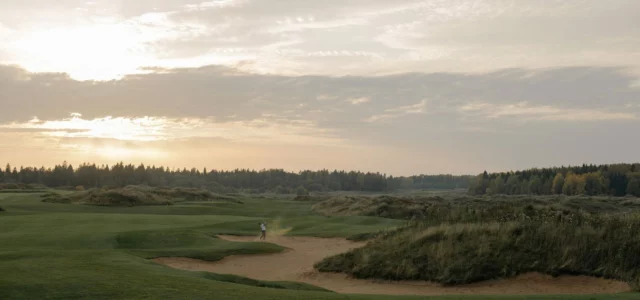
Links. On open ground by the sea there is nothing between you and the horizon, so a links keeps its light longer than any inland course. The sun sets over the water rather than behind a wood, and the big sky stays bright well after sunset. Two things to watch. The first is that the evening wind often drops, so a hole that played as a driver and a 6-iron into the breeze at four o’clock might need a driver and a wedge by six; take a fresh look at every yardage rather than repeating the morning’s clubs. The second is that a links in a low sun is a maze of shadows. Every hump and hollow on the fairway throws one, and a ball resting in a dip can be hard to spot until you are standing over it. Walk to where you saw it finish, not to where you think it went. And on the east coast, keep an eye on the sea: a haar can roll in on a still evening and shut down visibility long before sunset.
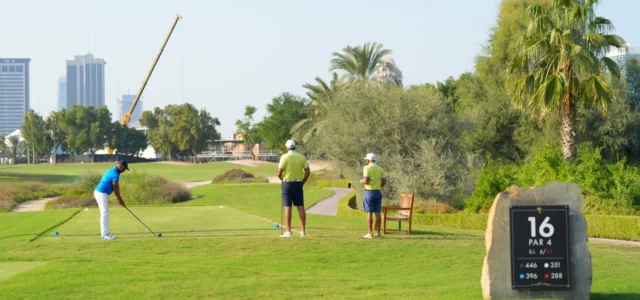
Heathland. Heathland courses, on the sandy soils of Surrey, Berkshire and beyond, combine open heather with tall stands of pine and birch. The trees steal the sun earlier than you expect, so the flat light can arrive on some holes half an hour before it does on others. The heather is the real problem. A ball that drops into it is hard to find at noon; at dusk it is close to hopeless. If a shot heads for the heather, hit a provisional without discussion. The sandy ground drains quickly, so greens and fairways stay firmer into the evening than on clay, and the dew tends to sit on the surface rather than soaking in.
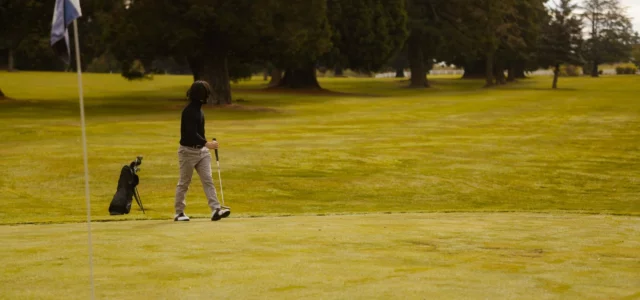
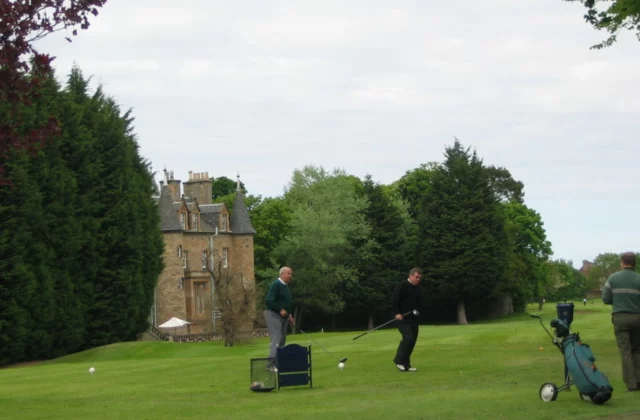
Parkland. Much of England’s golf is parkland on heavier soil, lined with oak, beech and chestnut. These courses lose their light first, because mature trees put the fairways into shade well before sunset, and they feel the dew most, because the air is still and the ground is damp. In October they add a third problem, leaves, which we come to below. On a parkland the honest advice is to tee off earlier than you would on an open course and expect the last two holes to be played in half-light.
Up and down the country, the evening competitions that fill the summer card are winding down now. Many clubs run nine-hole midweek medals and Stableford competitions, informal roll-ups and mixed evening events from late spring until the light gives out, and by mid-October most fixture lists have moved on to winter foursomes and weekend golf. If your club still has an evening slot on the board, it may well be the last of the year.
Dew, damp air and an October ball
On a clear, calm autumn evening the grass cools quickly once the sun is low, and moisture condenses on it. You will see it first in the hollows and on greens in the shade of trees, sometimes an hour before sunset.
A wet green is a slower green. Putts that were finishing past the hole at four o’clock come up a foot short at six, and the change happens gradually enough that most golfers do not adjust until they have left three in a row short. A wet ball off a wet fairway also behaves differently: water between the clubface and the cover cuts spin, so a wedge can come out lower, carry a little further and release instead of checking. Think of it as a flyer lie, even from short grass.
The dew does help in one way. The line your playing partner’s ball leaves on a damp green is an exact map of how the putt broke. You are not allowed to test the surface yourself by rolling a ball or scraping it, but there is nothing to stop you watching their putts closely and learning from the trail.
The air matters too. October evenings in Britain cool sharply once the sun goes, often by several degrees Celsius in the final hour. Cold, dense air and a cold golf ball both cost a little distance. On its own the effect is modest, a few yards with a mid-iron, but combined with soft, wet landing areas that do not give you any run, it adds up. Over the last few holes, take one more club than you would have earlier in the round, and keep a ball in your pocket rather than in the bag so that it is not stone cold when you tee up.
Leaves, deer and a course that is closing for the night
The leaf rule. October is the month when parkland courses start swallowing balls under fallen leaves. Under the Rules of Golf there is no free relief just because you cannot find your ball in leaves: if it is not found within three minutes, it is lost, and you go back under stroke and distance. The R&A’s winter rules guidance points out that a committee can adopt Model Local Rule F-14, which treats large accumulations of loose impediments, such as piles of leaves, as ground under repair. If your ball is known or virtually certain to be in such a pile, you take free relief. The R&A is clear that it covers piles, not a fairway sprinkled with individual leaves, and that it should be limited to the affected holes and withdrawn once conditions improve. So check the notice board before you go out. If no local rule is in force, the friendly agreement to drop without penalty that many groups make in autumn is just that: fine for a bounce game, but the score is not one you can return for handicap.
Deer and other evening visitors. Many British courses border woodland, and roe, fallow and muntjac deer are often out on the fairways at dusk. Rabbits, badgers and foxes appear too. Give them space, wait for them to move on rather than hitting near them, and do not go searching for a ball in thick cover where an animal has just disappeared.
The greenkeeping team. An evening course is not as empty as it looks. Greenstaff may be finishing off the day’s cutting or moving between holes in a utility vehicle, and on many courses the irrigation runs in the evening or overnight. Watch for sprinklers already turning, never assume a fairway is clear because it looks quiet, and if you are walking the last few holes in half-light, wear something pale.
Buggies and the clubhouse. If you hire a buggy, ask when it must be returned; few have lights and many clubs set a cut-off. If you are a visitor, ask too what time the car park gates close.
Making the evening card count for your handicap
Nine-hole scores count under the World Handicap System. England Golf, Scottish Golf and Wales Golf all administer the same R&A rules, but the practical procedure is strict, and dusk is precisely when it catches people out.
Register before you tee off. In England, general play scores have to be pre-registered on the MyEG app before you start the round, and the app checks that you are at the course. You also need a playing partner who holds a handicap and who will verify the score. In Scotland and Wales, ask your club or your national body how the equivalent process works there. England Golf’s procedures add a detail that matters at this time of year: once you have registered an intention to play 18 holes, it cannot be changed to nine. If there is any doubt about the light, register nine holes. You can always play on for fun.
Submit the same day. England Golf asks for scores to be submitted, and verified by your marker, before midnight on the day of play. A registered score that is never returned can lead to a penalty score on your record, so do not let the post-round pint push it to tomorrow.
When darkness stops play. If you started a hole but could not finish it, the Rules of Handicapping ask you to record your most likely score, meaning the strokes already taken plus the number you would most likely have needed to hole out, capped at net double bogey. For an 18-hole round cut short, Scottish Golf’s guidance is that the score can still be accepted for handicap if you have completed at least ten holes, with the system filling in an expected score for those you did not play. This replaced the old practice of giving yourself net par on the missing holes when the WHS was updated in 2024.
Competitions are different. In a stroke-play competition you cannot simply pick up and go home. Only the committee can suspend play for darkness, and a player who stops on his or her own account risks disqualification. If your club’s last evening medal of the year is on a short October evening, read the competition terms before you go out.
Twilight green fees: how to find a fair one
Plenty of British clubs, proprietary courses and municipal venues sell a reduced late-afternoon or twilight rate for visitors, and some offer nine-hole rates as well. These are rarely fixed through the year. The start time usually follows the season, moving earlier as the evenings shorten, and after the clock change some venues drop the twilight rate altogether or fold it into a winter rate.
The only reliable source is the club’s own website or booking page for the current month. Before you book, check four things: the time the twilight rate begins; whether it covers 18 holes, nine holes or simply as many as you can manage before dark; whether buggies are available at that hour; and whether winter conditions, such as temporary greens or fairway mats, have already started. A twilight fee that looks good on paper is less of a bargain if half the course is on mats.
Before your last evening nine of the year
- Look up today’s sunset for your course. In mid-October that is around 6.15pm in London and 6.20pm in Edinburgh; after 25 October it falls to about 4.30pm.
- Allow two hours of real daylight for nine holes on foot. Treat the half-hour or so of twilight as a reserve.
- Use the low sun to read the greens early, then slow down and putt firmer once the light goes flat.
- Expect dew to slow the greens and take spin off your wedges, and add a club when the air turns cold.
- On a links, re-check every yardage as the wind drops; on heathland, play a provisional for anything near the heather; on parkland, tee off earlier.
- Check the notice board for a leaf local rule (Model Local Rule F-14). Without it, a ball lost in leaves is a lost ball.
- Register nine holes, not 18, on MyEG or your national app if the light is in doubt, and submit the score before midnight.
- Carry a bright ball, wear something pale, and watch out for deer, greenstaff and sprinklers on the way in.
Plan it well and the evening nine in October is one of the best rounds of the British golfing year: quiet, beautiful and over before the cold sets in. Make the most of it, because in a fortnight it will be gone until March.