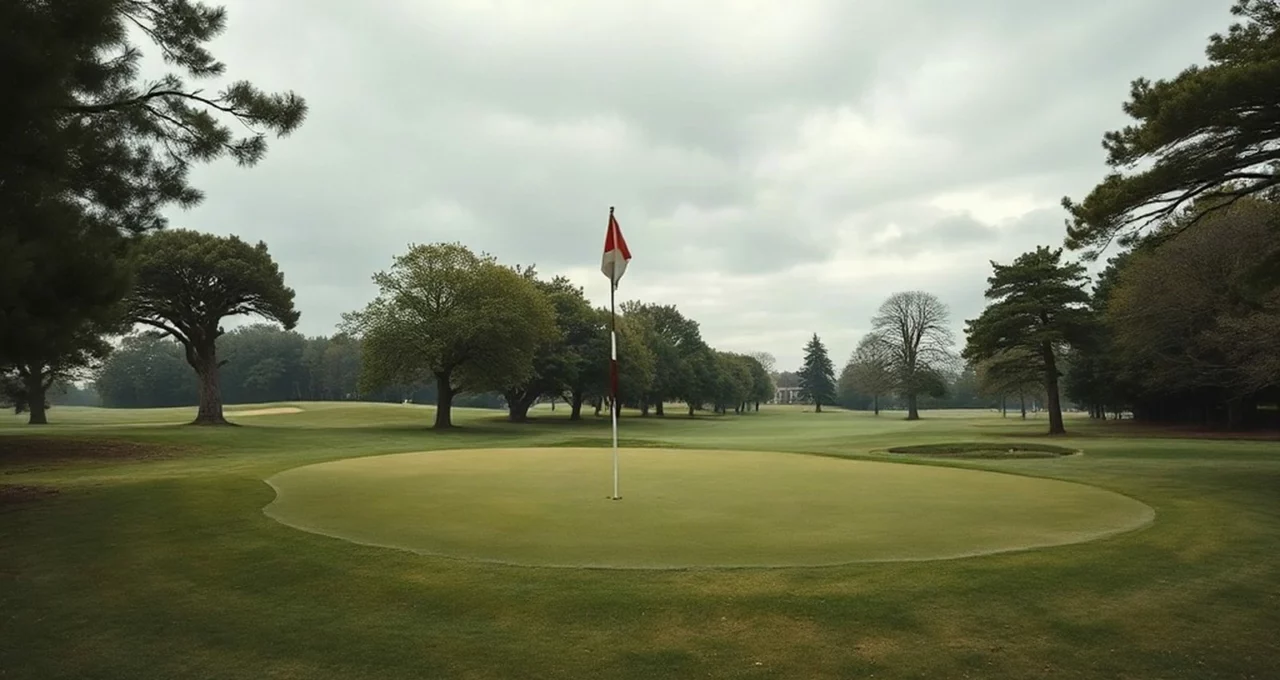
Illustration generated by artificial intelligence. This is not a photograph of this course: no freely licensed image of the site exists to date.
The Blackwell Grange Golf Club
Holes
18
By
71
Length
6,450 yards
Green fee
—
Best season
All year
The club was founded in 1930 with nine holes laid out in the grounds of Blackwell Hall, on the southern edge of Darlington above the River Tees. It took the name Blackwell Grange in 1970.
The estate origins are still legible in the course: the older holes run between specimen trees that were planted as landscape rather than as hazards, and the ground falls gently towards the river. It is one of a small group of County Durham clubs whose course is essentially a park that was repurposed rather than a piece of land bought to build golf on.
What it asks of you
Par 71 over 6,450 yards of parkland, which by modern standards is a medium length and by the standards of the ground is quite enough.
The defence is the trees and the greens. Ninety years of growth has narrowed the corridors well beyond what the original layout intended, so the tee shot has to be placed rather than simply hit. The putting surfaces are small, well bunkered and sited on the natural slopes of the old park, and they are quick.
It is a course where the honest handicapper scores close to their handicap and the wild hitter does not, which is a fair description of what a good parkland club course should be.
What players say about it
Visitors and societies play by arrangement and the review record is modest but consistent. The notes below summarise recurring themes across specialist golf sites, traveller review pages and player discussion threads. They are other people’s opinions, not ours: we have not played the course. We report what comes back repeatedly rather than isolated remarks, and we do not name or quote individual reviewers.
What comes up in its favour
- Conditioning is the strongest and most consistent theme. Fairways described as in top condition and the course as immaculate come up in most accounts.
- The greens are praised for consistency as well as speed, and bunkers are noted as properly sanded, which is rarer than it should be.
- The parkland setting on the old estate is well liked, and the mature trees are treated as the character of the place.
- Value is good for the standard of upkeep, in a part of England where green fees remain reasonable.
What comes up against
- The greens are fast and tricky, and a minority of visitors find them more punishing than enjoyable on a first visit.
- The narrowed corridors frustrate longer hitters, who cannot use the driver on several holes.
- The course is short by modern standards and does not stretch a strong player.
- The review record is thin, and a summary of it, including this one, rests on a small number of accounts.
Getting there and when to go
The club is on the southern edge of Darlington, five minutes from the town centre and close to the A66 and the A1, with Darlington on the main east coast rail line and Teesside airport fifteen minutes away.
The course plays all year. Late spring and early autumn are the best of it, and the parkland is at its most attractive in October. Visitor and society booking is by arrangement.
Green fees
Rates and visitor tee times are handled by the club and vary by day and season. See the club’s own site.
How this page was made
The factual frame comes from public sources: OpenStreetMap for the location, Wikipedia and published coverage for the club’s history, and the club’s own site for the course and for access. The opinion section summarises public reviews and player discussions read in September 2026; we report recurring themes rather than individual voices, and we do not reproduce or attribute quotes.
We have not played this course, and nothing here is a substitute for that. The club has not paid for this page, has not seen it before publication and has no say in what it says. If you know the course and something here is wrong or out of date, write to us and we will correct it.