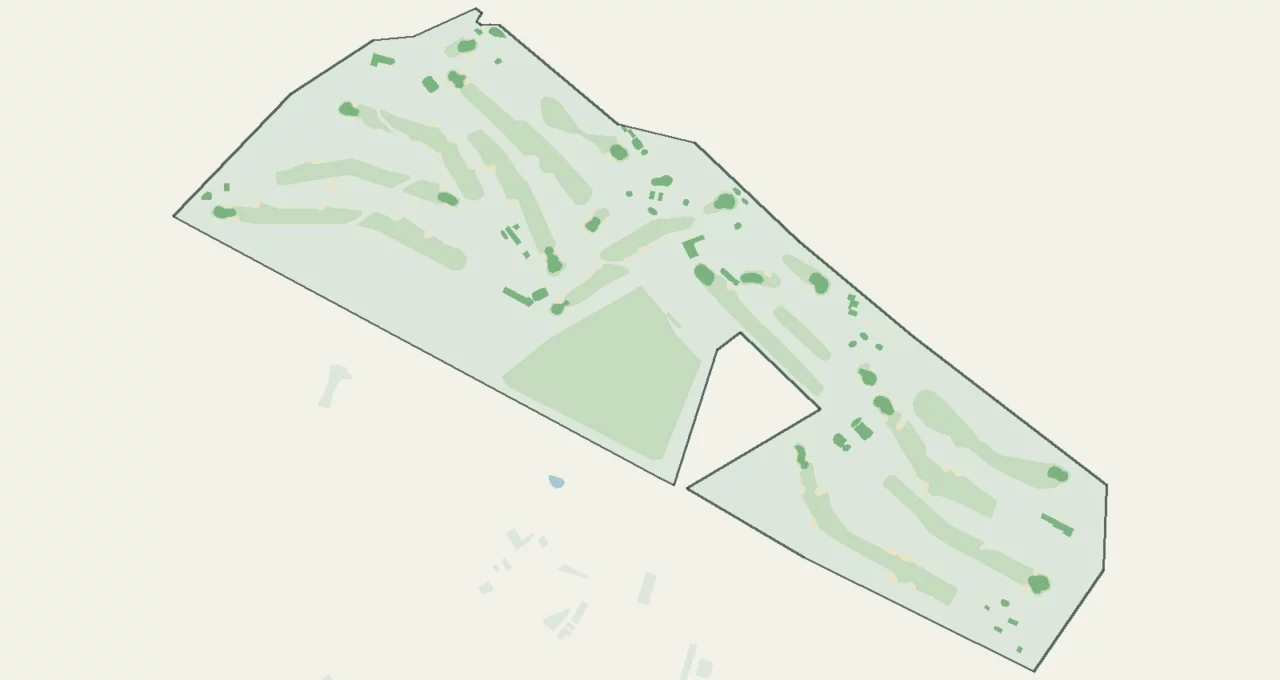
Layout of Hartlepool Golf Club from OpenStreetMap survey data (ODbL licence).
Hartlepool Golf Club
Holes
18
By
70 from the white, yellow and green tees; 71 from the red, ladies' yellow and ladies' orange tees (club scorecard, November 2023)
Length
6,184 yards from the white tees, 5,930 yellow, 5,721 green, 5,450 red (club scorecard, November 2023); older listings give 6,230 from the whites
Green fee
—
Best season
Played all year according to GolfNow; winter tee sets on the club's scorecard, preferred lies and other winter measures shown on the club's course status board
Hartlepool Golf Club is an 18-hole links on the North Sea coast at Hart Warren, on the northern edge of Hartlepool in County Durham, between the coastal railway line and the beach that runs north towards Crimdon. The club was established in 1906 and moved to its present ground in 1907. Willie Park Junior extended the course to 18 holes in 1911, and James Braid reworked several of the central holes in 1929. The club’s current scorecard, last updated in November 2023, gives 6,184 yards and par 70 from the white tees, with a course rating of 70.6 and a slope of 125. The course’s best-known product is Graeme Storm, who learned the game here, won the Amateur Championship in 1999 and still holds the course record of 62. In the summer of 2024 the club co-hosted the English Amateur Championship with its neighbour Seaton Carew. The club’s website is hartlepoolgolfclub.co.uk.
Part of the ground is exceptional in a way that has nothing to do with golf. The dunes next to the course, Hart Warren Dunes, are a Site of Special Scientific Interest that Hartlepool Borough Council describes as the only significant calcareous dune system in the British Isles, because the sand sits on magnesian limestone, and the council notes that the species-rich dune grassland extends into the northern and central parts of the golf course. It is a members’ club that takes visitors through an online tee sheet, with set times for casual green-fee players, and it has a covered driving range, a short game area and a five-hole academy course.
Name and location
The club calls itself Hartlepool Golf Club and gives its address as Hart Warren, Hartlepool, TS24 9QF. National Club Golfer places the course at Hart Old Warren, an older form of the same name; the club and the other sources we read use Hart Warren. OpenStreetMap draws the course as a single outline and links it to the Wikidata item Q5674815, which describes it simply as a UK golf club and carries coordinates taken from the English Wikipedia article. Those coordinates sit less than 100 metres from the centre of the OpenStreetMap outline; the map at the foot of this page uses the OpenStreetMap position.
The course is not to be confused with the other clubs in the town. Seaton Carew Golf Club, whose story Hartlepool’s local history archive traces back to 1874, is a separate links on the coast south of Hartlepool, a little under ten miles away by road according to National Club Golfer. Hartlepool Golf Club lies at the opposite, northern end of the town, where the built-up area gives way to dunes and the beach. Wikipedia notes that a grassed railway embankment screens the course from the town, and reviewers describe reaching it by driving through a housing estate and under the railway through a long tunnel.
History: from Hart village to the dunes
According to the club’s Wikipedia article, which draws on the club’s own website and an archived earlier version of it, golf began in 1906 on a rough nine-hole course at Hart Old Village, inland of the present site, on land rented from W. Purves for £10 a year. Purves was the first captain and John Gardner the first president, and the Gardner Cup is still one of the club’s major trophies. Early members paid a subscription of £1 a year and an entrance fee of £1. In 1907 the club moved to Hart Warren, on the coast, and it celebrated its centenary in 2006. The club’s own homepage carries the words Established 1906.
Two well-known architects then shaped the course. Top100golfcourses.com and Northern Golfer both record that Willie Park Junior extended it from nine to 18 holes in 1911. In the autumn of 1929 James Braid was brought in; Top100golfcourses.com says he was asked to plan the bunkering and that his recommendations were carried out, and both sources say he reworked several of the central holes. Northern Golfer lists the changes: the 9th was turned into a dogleg, the 10th was pushed towards the dunes, the par-3 11th was lengthened and the bunkering of the par-3 12th was changed. The club’s own hole descriptions still credit the 9th, the 10th and the 12th to Braid, and the club takes part in the reciprocal scheme of the Association of James Braid Courses, which offers special rates to golfers from other Braid clubs.
The layout has moved since. Top100golfcourses.com explains that a new clubhouse built after the Second World War required the holes to be renumbered, and that the sale of the old clubhouse took away the former 1st, 17th and 18th holes, which stood on a high plateau in the south of the course. New 2nd and 3rd holes were built in 1963, and the 17th was lengthened in 1983. Northern Golfer adds that new 1st, 17th and 18th holes were created and that much of Braid’s work remains intact. A photograph held by Hartlepool History Then and Now, credited to Hartlepool Museum Service, records the opening of a new clubhouse on 31 July 1961 at a cost of £30,000 in the presence of the mayors of Hartlepool and of West Hartlepool, the club captain and president, and the president of the Durham Golf Union. Top100golfcourses.com also names Jonathan Gaunt among the architects linked to the course without explaining his role, and the club’s description of the 9th says that its green has been extended on the advice of a course architect, without naming him.
The club’s most celebrated member is Graeme Storm. Born in Hartlepool in 1978, he learned the game at the club, according to Wikipedia, and set the course record of 62 on 8 August 1997. Two years later he won the Amateur Championship and played in the Great Britain and Ireland side that won the Walker Cup. As a professional he won the Open de France in 2007 and the South African Open in 2017, the second after a play-off against Rory McIlroy.
In 2024 the club co-hosted the English Amateur Championship with Seaton Carew, which was celebrating its 150th anniversary. Northern Golfer describes a field of 288 men and women playing two rounds of stroke play spread across the two courses, from 28 July, before the leading 64 men and 32 women went on to match play at Seaton Carew; the club’s homepage still mentions its role as co-host. Wikipedia records the men’s title as won by Harley Smith at the 37th hole of the final. Northern Golfer notes that the men’s championship had last been played in the North East in 1972.
The course faces the sea, and the sea is advancing. In December 2022 The Golf Business reported a planning application to Hartlepool Borough Council for what amounted to four new holes, replacing holes described in the application as at high risk of being lost to coastal erosion on the easternmost edge of the course. Holes 2, 3 and 5 were to receive completely new tees, greens, fairways and bunkers, the 1st a new green, and three other holes were to be realigned, with new drainage and irrigation, three seasonal ponds and realigned ditches; all the work was to take place on land already used for golf, including the academy course. A decision was expected in January 2023. We found no report of the outcome or of the work being carried out, and the club’s current scorecard does not say whether any holes have changed, so we cannot tell you whether the holes described below are the old ones or the new.
Dunes, limestone and orchids
Hart Warren Dunes lie south of Crimdon Beck, at the northern end of the course. Hartlepool Borough Council’s page on its nature reserves explains that the dunes rest on Permian magnesian limestone, which makes them calcareous rather than acid, and that the species-rich grassland this produces extends especially into the northern and central areas of the golf course. Damp hollows in the central section hold regionally rare orchids, including the burnt-tip and pyramidal orchids; common rock-rose grows in the dry grassland and feeds the caterpillars of the northern brown argus, known locally as the Durham brown argus; and nineteen species of butterfly have been recorded. At the northern edge near Crimdon, a colony of little terns nests above the high-tide line each summer, inside an area fenced and wardened every year. National Club Golfer describes the seaward side of the course as protected by marram-covered dunes, on sandy soil that drains quickly and carries wildflowers from spring to autumn.
The coast is also public ground. The club’s rights of way page shows a permissive path and the Crimdon to Hartlepool Headland coastal path crossing the course, and asks golfers to give way to walkers, with particular care on the tee shots at the 1st, 8th, 10th and 18th and on the approach to the 13th. The council’s page adds that access to the dunes themselves is limited because of their sensitivity, and that walkers can reach them along the beach from Crimdon or from the Headland.
What it asks of you
The figures below are those of the scorecard and slope table on the club’s course page, last updated on 29 November 2023:
- White tees: 6,184 yards, par 70, course rating 70.6, slope 125.
- Yellow tees: 5,930 yards, par 70, course rating 69.3, slope 121.
- Green tees: 5,721 yards, par 70, course rating 67.8, slope 117; for women 74.0 and 129, par 70.
- Red tees: 5,450 yards, par 71, course rating 72.5, slope 126.
- Ladies yellow: 5,938 yards, par 71, course rating 74.9, slope 139.
- Ladies orange: 5,514 yards, par 71, course rating 72.9, slope 126.
The table also lists winter tees for women, and a short blue course of 3,833 yards in summer and 3,856 in winter, par 66, rated for both men and women. A slope of 125 from the whites is well above the neutral 113 for a course of only a little over 6,000 yards, and the 139 from the ladies’ yellow tees is high by any standard. The card is short on par 5s: there are only two, the 2nd and the 17th, against four par 3s, the 5th, 7th, 11th and 12th, and each nine is par 35, 2,995 yards out and 3,189 home from the white tees.
The card, hole by hole
The yardages are from the white tees; the descriptions follow the club’s own notes, with additions from Northern Golfer and National Club Golfer where they say so.
- 1st, 267 yards, par 4, stroke index 17: a short opener with out of bounds on the left and a pear-shaped green guarded by two deep bunkers. Northern Golfer calls it a birdie chance for those who stay away from the water and the boundary on the left.
- 2nd, 546 yards, par 5, stroke index 5: a dogleg left needing a carry of about 150 yards, with out of bounds down the left, to a large, slightly raised green with small bunkers.
- 3rd, 374 yards, par 4, stroke index 7: falls from tee to green round a dogleg to the right, with heavy rough and a line for long hitters willing to take it on; bunkers left and right of a large green.
- 4th, 401 yards, par 4, stroke index 3: a dogleg to the left with a carry over rough from the tee and an approach across a ditch to a bunkered green.
- 5th, 155 yards, par 3, stroke index 14: played over the dene, the small coastal valley, to a well-bunkered green. The club does not rate it a difficult hole; one Top100golfcourses.com reviewer found its headland green above the beach one of the finest sights on the course.
- 6th, 321 yards, par 4, stroke index 13: a blind tee shot over a grassy mound to a tight fairway, then an approach to a raised, deeply bunkered green.
- 7th, 111 yards, par 3, stroke index 16: across a deep ravine to a green cut into the cliff side, sloping from back to front; a ball through the back leaves an awkward recovery.
- 8th, 447 yards, par 4, stroke index 1: from a high tee in the sandhills with views along the coast, a dogleg needing a good carry and a long, accurate second; the club notes that it used to be a par 5. National Club Golfer counts six bunkers around the green.
- 9th, 373 yards, par 4, stroke index 10: one of Braid’s holes, a slight dogleg along a narrow fairway to a bunkered green.
- 10th, 363 yards, par 4, stroke index 11: Braid’s hole towards the sea, with a blind second over a mound to a large green that Northern Golfer describes as lying between two dunes.
- 11th, 211 yards, par 3, stroke index 8: the hardest of the short holes for the club, uphill, with a carry of 140 to 160 yards and a pot bunker to the right of the green.
- 12th, 180 yards, par 3, stroke index 15: another Braid hole, from one of the highest points of the course, with a ravine waiting for a slice and a mound left of the green.
- 13th, 306 yards, par 4, stroke index 18: a fairway falling from left to right to a plateau green guarded by two pot bunkers.
- 14th, 416 yards, par 4, stroke index 2: from a raised tee with out of bounds along the shoreline on the left; Northern Golfer describes a green without bunkers, framed by dunes.
- 15th, 392 yards, par 4, stroke index 9: a slight dogleg with fairway bunkers and a large green tightly ringed by sand; National Club Golfer counts twelve bunkers in play.
- 16th, 419 yards, par 4, stroke index 4: two full shots south to the edge of the course; the club says it was first designed as a par 5.
- 17th, 513 yards, par 5, stroke index 12: the club calls it a relatively easy par 5, with out of bounds on the left and a tricky raised green. National Club Golfer places it beside the railway, with five bunkers on the fairway and five around the green.
- 18th, 389 yards, par 4, stroke index 6: a carry of about 150 yards from the tee, then a green guarded by a large bunker in front and a smaller one on the right.
Taken together, the notes describe a round of two characters. The opening holes and the closing stretch are played on flatter ground inland, with the boundary and the railway often on the left, while the middle of the round, from the 5th to the 15th, climbs into the dunes and the dene, with blind shots, raised and plateau greens, a run of three short holes in five and the sea on the left at the 14th. Wind off the North Sea is a constant theme in the descriptions we read.
What golfers say
We read the four reviews on Top100golfcourses.com, which give the course an overall 4.0 out of 5, the review by National Club Golfer, which ranks it 9th in one of its England lists, and the course feature in Northern Golfer, the regional golf magazine. Hole19 shows a rating of 4.5 from 58 reviews, but without any text we could read. A search summary of GolfPass gives 4.6 from 39 reviews, but GolfPass refused our requests and we could not check it. GolfNow’s page did not load its reviews. The points below summarise what recurs; they are other people’s opinions, not ours, and nobody from Panxis has played the course.
What comes up in its favour
- The middle of the course, in the dunes, is described as genuine links golf of a high standard, with several reviewers singling out the 6th, the 10th and the 14th; one names the 14th the best hole on the course.
- The short holes are a strength: the back-to-back 11th and 12th, one rising and one falling, and the 5th and 7th played over the dene and into the cliff.
- The greens draw praise for their slopes, contours and variety of shape and size, and the bunkers for being small links pot bunkers.
- Reviewers who played in early spring found the course in good order after a wet winter, and one valued its spare green sites.
- One reviewer found it exceptional value for an early spring round, another praised a warm welcome and a practice area close to the course.
- Several writers present it as a hidden or underrated links, and suggest combining it with Seaton Carew for a two-day trip on the Durham coast.
What comes up against
- The start is the most common complaint: the first three or four holes, on flatter and softer ground, are described as forgettable by one reviewer, though another enjoyed them.
- The finish draws similar comments. The 17th and 18th, built after the clubhouse moved, are judged the weakest holes by one reviewer, who finds the ornamental planting along the 17th out of keeping with the rest of the course and the 18th hemmed in by the car park.
- Holes furthest from the sea are called less interesting, so that the course does not sustain its best moments over all 18 holes.
- The approach, through a housing estate and under the railway, gives little hint of what lies beyond, and the town lacks the hotels of better-known golf destinations, which one reviewer suggests may explain why the course is so little reviewed.
With only a handful of written reviews, none of these points should be taken as a verdict.
Playing as a visitor
Visitors book tee times through the club’s online visitor tee sheet, run on the BRS system. The green fees page sets out separate summer and winter rates, from 1 April to 30 September and from 1 October to 31 March, for weekdays and weekends. Casual visitors can play from 11am on weekdays and from 2.30pm on Saturdays and Sundays. There are categories for juniors under 18, for guests playing with a member, for County Card holders on weekdays only (not as part of a visiting party), and for members of other James Braid clubs from Monday to Thursday. Groups and societies are asked to contact the club, which publishes a menu for visiting parties, and it also runs open competitions, including the Hartlepool Scratch Open.
The clubhouse has a lounge and dining room, a bar with a food menu, televised sport and a full-size snooker table, and a function room seating up to 120 with views over the course and the coast; non-golfers can take social membership. The club’s winter opening hours, published in November 2024, show the bar open every day from 11am and the kitchen from 9am on weekdays and 8am at weekends. The clubhouse dress code is smart casual: no golf shoes, headwear, waterproofs or sports shirts, with smart jeans and trainers accepted.
The professional’s shop is run by a head professional and an assistant, both PGA professionals, who give individual and group lessons with video analysis and launch monitors, and offer custom fitting. The club lists a swing studio opening onto the driving range and an indoor simulator. National Club Golfer and the club’s academy membership page both mention a covered driving range, a short game area, a putting green and a five-hole academy course for new golfers. Northern Golfer lists buggy and trolley hire and GolfNow mentions cart rental, but the club’s own pages do not, so ask before relying on them; the course status board on the homepage can close the course to trolleys or buggies when conditions require.
Getting there and when to go
The club is at Hart Warren, Hartlepool, TS24 9QF, at the northern end of the town near the Headland. Its telephone number is 01429 274398 and its email address admin@hartlepoolgolfclub.com. National Club Golfer notes that the A179 links the area to the A19, that Hartlepool railway station is about two miles south of the club, and that Newcastle International Airport is a little under an hour’s drive to the north. The club’s own directions page gives the address and no more.
The course is a links on free-draining sand and is played through the winter: GolfNow describes it as playable all year, and the club’s scorecard includes winter tee sets. In October 2026 the course status board showed the course open with preferred lies in operation, and it is the place to check for fairway mats or temporary greens before setting out. The North Sea wind is part of the experience whatever the season. Spring and summer are when the dune grassland is in flower, according to the council and National Club Golfer, and when the little terns nest at the northern end of the dunes, where the fenced colony should be left undisturbed.
Green fees
Hartlepool sets separate summer and winter rates for weekdays and weekends, with categories for casual visitors, juniors, members’ guests, County Card holders and James Braid members: see the club’s website for current prices.
How this page was made
The factual frame comes from public sources: OpenStreetMap for the location and outline of the course; Wikidata for the item linked to it; the club’s website for its foundation date, address, contact details, scorecard, slope table, hole descriptions, rights of way, visitor categories, clubhouse, opening hours, dress code, professional’s shop, academy membership and the James Braid reciprocal scheme; the English Wikipedia articles on Hartlepool Golf Club, Graeme Storm and the English Amateur for the early history, the course record, Storm’s career and the 2024 result; Top100golfcourses.com and Northern Golfer for the work of Willie Park Junior and James Braid and the later changes to the layout; National Club Golfer for the setting, the bunkers and the access; Hartlepool History Then and Now for the 1961 clubhouse; Hartlepool Borough Council for Hart Warren Dunes; The Golf Business for the 2022 planning application; Northern Golfer again for the 2024 English Amateur; GolfNow for its tee table; and Top100golfcourses.com, National Club Golfer, Northern Golfer and Hole19 for the opinions summarised above.
Where sources disagree, we say so. The club’s scorecard of November 2023 gives 6,184 yards from the whites, 5,930 from the yellows and 5,450 from the reds, par 71; Northern Golfer, National Club Golfer and GolfNow give 6,230 yards from the whites and 5,968 from the yellows, Northern Golfer and GolfNow 5,511 yards and par 72 from the reds, and Wikipedia 6,202 yards; GolfNow also mentions 6,298 yards from the back tees. These are probably earlier cards, and we use the club’s. Hole lengths vary in the same way: the 11th is 211 yards on the club’s card, 210 for National Club Golfer and 216 for Top100golfcourses.com; the 6th is 321 yards on the card and 332 in one review; one reviewer gives the 7th as 150 yards against 111 on the card and calls the 16th a par 5, which it was originally but is no longer. National Club Golfer names the site Hart Old Warren, the club Hart Warren. National Club Golfer describes the whole area as a Site of Special Scientific Interest, while the council describes the designated site as the dunes, whose grassland extends into the course. Hole19 shows both 4.5 and 4.6 for its rating. The Wikidata coordinates are less than 100 metres from the OpenStreetMap outline.
GolfPass, the Hartlepool Mail and 1golf refused our requests and Today’s Golfer returned a payment wall, so we have not relied on them for anything. We found no club history page with text (the menu entry on the club’s course page is empty), no record of whether the coastal erosion works applied for in 2022 were approved or carried out, no independent confirmation of the role of Jonathan Gaunt, and no reviews with text on Hole19 or GolfNow; we have not filled those gaps. Green fee amounts are deliberately left out.
The opinion section summarises reviews and articles read in October 2026. We report recurring themes rather than individual voices, and we reproduce no quotations from reviewers. Nobody from Panxis has played or visited this course, and this page is no substitute for a round.
The club has not paid for this page, has not seen it before publication and has no say over its content. This page contains no commercial link and earns us no commission. If you know the course and something here is wrong or out of date, write to us and we will correct it.
Other courses nearby
Closest to this one in our British directory:
- Woodham Golf & Country Club — 14 mi
- The Blackwell Grange Golf Club — 20 mi
- Ganton Golf Club — 47 mi
- Fulford Golf Club — 55 mi
The hole to know
James Braid's hole towards the sea: a par 4 of 363 yards from the white tees, with a blind second over a mound to a large green set between two dunes (club website, Northern Golfer).