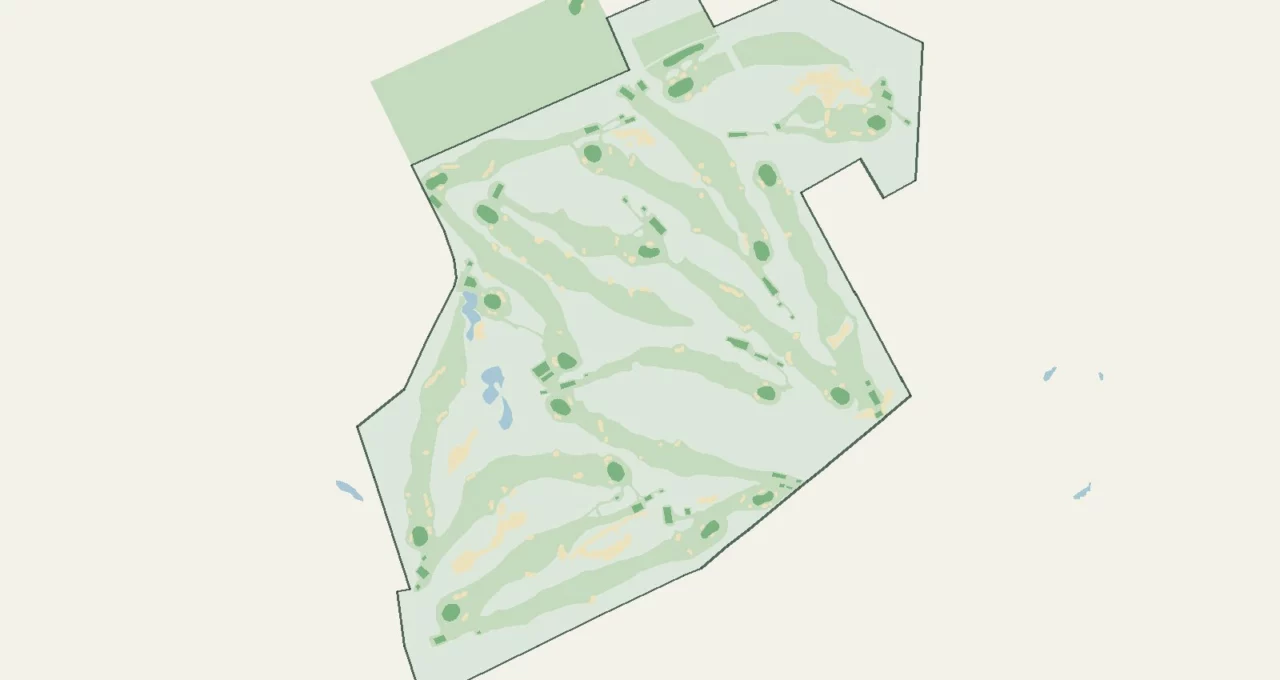
Layout of Ganton Golf Club from OpenStreetMap survey data (ODbL licence).
Ganton Golf Club
Holes
18
By
71 (men); 76 from the red tees (club scorecard)
Length
7,055 yards from the blue tees, 6,761 white, 6,440 yellow, 6,063 red (club scorecard)
Green fee
—
Best season
Visitor rates published for summer and winter; no visitor rounds from 21 December 2026 to 3 January 2027 (club)
Ganton Golf Club is a private members’ club in the village of Ganton, near Scarborough in North Yorkshire, postcode YO12 4PA, a short way off the A64 between York and the coast. Golf has been played here since the summer of 1891, on a course first laid out by Tom Chisholm of St Andrews with the help of Robert Bird, the club’s first professional and head greenkeeper. From the blue tees the Championship Course measures 7,055 yards, par 71, with a course rating of 74.7 and a slope of 138. The site sits in the Vale of Pickering, about nine miles from the sea, on sand left behind by what the club describes as an ancient inlet of the North Sea, which is why Ganton is usually called an inland links, and sometimes a heathland course, and occasionally both in the same sentence.
It is the most decorated inland course in England. Ganton hosted the Ryder Cup in 1949, the Curtis Cup in 2000 and the Walker Cup in 2003, and the club says it is the only inland course to have staged the Amateur Championship, which it did in 1964, 1977 and 1991. Top 100 Golf Courses lists it first in Yorkshire, a place its April 2026 Yorkshire ranking says Ganton has held for four successive editions, and its course page shows it seventh in England and 23rd in Great Britain and Ireland. Wikipedia notes that Golf Digest included it in its list of the world’s top 100 courses in 2019.
Vardon, Ray and a long list of architects
The club began life as Scarborough Golf Club and took the name Ganton Golf Club in 1907, according to Wikipedia. The land was part of Sir Charles Legard’s Ganton Estate, which the club’s own history describes as rough ground covered in whins, grasses and wild flowers. The railway did the rest. The North Eastern Railway line ran past, and Ganton station, a quarter of a mile from the clubhouse according to the club, brought in members from the West Riding. The station closed to passengers in 1930, Wikipedia records, so that particular convenience is now historical.
The club’s reputation was made by its professionals. Harry Vardon arrived in 1896 and stayed until 1903; during those years, the club says, he won the first three of his six Open Championships, and in 1900 he brought the United States championship trophy back to Ganton. His match against J.H. Taylor in 1896 and his 1899 contest with Willie Park Junior first drew wider attention to the course. Ted Ray, later an Open and US Open champion and captain of the first Great Britain and Ireland Ryder Cup team, followed him as professional from 1903 to 1912.
Few courses have been handled by quite so many famous architects. The club’s heritage page credits Vardon, Ray, James Braid and J.H. Taylor with a major redesign in 1905, then lists Harry Colt (1907, 1911 and 1931), Dr Alister MacKenzie (1912 and 1920), Tom Simpson (1934) and C.K. Cotton (1948 and 1952), and adds that extra gorse planted in the late 1930s gave the course much of its present character. Earlier still, Tom Dunn made changes in the 1890s. The detail varies by source, and we set out the differences at the foot of this page. Top 100 Golf Courses, for instance, says Cotton turned the short 12th into a par 4 in 1952, while the architecture site Evalu18 says Colt’s 1907 commission was cut short by ill health and Herbert Fowler finished the job, leaving more than fifty bunkers behind him.
The 1949 Ryder Cup is the event most often recalled. It was played on 16 and 17 September over a course of 6,632 yards, according to Wikipedia. Great Britain led 3 to 1 after the foursomes, then the Americans won six of the eight singles to take the match 7 to 5. Their non-playing captain was Ben Hogan, still recovering from the car accident that had nearly killed him earlier that year; he objected to the depth of the grooves on some British irons, which were altered before play, and his team made headlines by bringing about half a ton of meat across the Atlantic. Half a century later the amateurs had the better of things: the United States won the Curtis Cup at Ganton by 10 points to 8 in June 2000, and Great Britain and Ireland won the 2003 Walker Cup by 12½ to 11½, their third victory in a row.
What the course asks of you
Ganton is not long by modern standards from the forward tees and not short from the back ones. The club’s scorecard gives 7,055 yards from the blue tees, 6,761 from the white and 6,440 from the yellow, all to par 71 for men; the red tees measure 6,063 yards to par 76. The outward half plays 3,576 yards and par 36 from the blue tees, the inward half 3,479 yards and par 35. The ground is gently undulating rather than hilly. The defining hazards are the bunkers, more than a hundred of them according to the club, some vast and some small, many deep enough to need steps, and the gorse that lines a good number of holes. The turf is sandy, and the fairways run firm in a dry summer, which means the ball reaches bunkers that looked out of range from the tee.
The card is built on par 4s: there are thirteen from the men’s tees, with three par 3s and only two par 5s. The front nine from the blue tees runs 370, 447, 349, 419, 170, 469, 436, 413 and 503 yards. The back nine runs 181, 427, 398, 565, 282, 493, 447, 246 and 440 yards. The 6th, a par 4 of 469 yards, is stroke index 1; the 15th, a par 4 of 493 yards from the blue tees, is stroke index 2.
Reviewers mostly agree on the shape of the round. The opening tee shot, played among gorse with a fence and a view across the course, is widely admired, but the first three holes are regarded as a gentle start; the 3rd is a short par 4 that tempts the long hitter. The 4th, 419 yards over a rise to a green framed by the landscape, is where several reviewers feel the course comes into its own. The 5th, 170 yards, is the first of the short holes and the one most often called pretty. The 7th is a dogleg around large sandy areas, and the 8th and 9th feature some of the biggest sand scapes on the course; the 9th, a par 5 of 503 yards, is reachable but rewards a defensive plan.
The back nine opens with the 10th, 181 yards to a narrow green, and the 11th, 427 yards over rolling ground. The 12th, the hole Cotton converted to a par 4, is the one most often singled out as awkward. The 13th, 565 yards, is the longer of the two par 5s, with a bunker in the right half of the fairway that GolfMagic considers the very definition of a hazard. The 14th, 282 yards, is a short par 4 well defended by gorse and sand, the sort of hole that gives and takes in equal measure. Then comes the finish that has made Ganton’s name: the long 15th towards the main road, the 16th, the 17th and the 18th.
The 17th is unusual: a par 3 of 246 yards from the back tee, played across the entrance road to an elevated, false-fronted green with steep run-offs, which more than one reviewer describes as a two-shot hole in a stiff wind. The 18th, 440 yards, turns as a dogleg from a semi-blind, downhill tee shot to a tight fairway lined with trees, and the approach again crosses the road to a green framed by sand and the clubhouse. Evalu18 notes that the club calls its naturalised sandy waste areas pandies, that one large pandy was already in play on the 16th and 17th by 1899, and that recent restoration work has removed gorse, enlarged green sites and returned short grass, with the architect Martin Ebert advising.
What golfers say
Ganton is reviewed in depth on Top 100 Golf Courses, where more than 130 visitor reviews are listed and the overall score is shown at the top of the scale, and more briefly elsewhere: Swyng reports 4.6 out of five from 197 Google reviews, and Your Golf Travel 9.6 out of ten from a small sample of five. GolfMagic and National Club Golfer have published editorial reviews. The points below summarise what recurs. They are other people’s opinions, not ours. Nobody from Panxis has played the course, and we name no reviewer.
What comes up in its favour
- The bunkering, described again and again as among the deepest, widest and best placed in England, and the restored sandy waste areas, which reviewers credit with giving the course its look.
- The condition: firm, fast-running fairways, greens that roll true, and a practice putting green that one editorial reviewer found remarkably quick.
- The strategy. Reviewers say the course rewards thinking over power, and several advise taking a long iron off the tee and accepting a longer approach.
- The closing stretch from the 13th or 15th to the 18th, called one of the strongest finishes in the country; the 16th and the 17th are the holes most often named as favourites, with the 4th and 5th close behind.
- The sense of history: the clubhouse memorabilia from the Ryder, Walker and Curtis Cups, the Vardon connection, and a traditional club that is, by most accounts, welcoming to visitors with a handicap.
What comes up against
- The start. Several reviewers find the first three holes pleasant but short of the drama that follows.
- The 12th, regularly described as an awkward dogleg around rather bland woodland that sits uneasily in the routing; one reviewer would also rank the 6th among the weaker holes.
- The land itself. Some feel the site offers little natural movement, so the course relies on its bunkering rather than its landforms, and variety scores lower than strategy in the detailed ratings.
- Severity. With so much sand and gorse, reviewers warn that high handicappers may find it punishing, and that in a strong wind with thick rough it becomes very hard indeed. Some greens are also hard to read.
- Visits in winter or just after the summer can catch the course soft or recovering, and the traditional style of the club will not suit everyone.
Getting there and when to go
By road, the club is close to the A64, the main road between York and Scarborough; the club puts the drive from York at about 35 minutes, and its history page says Ganton is eleven miles by road from Scarborough. National Club Golfer warns that the entrance off the A64 is easy to miss, and the drive then follows a country lane to the clubhouse. By rail, the club points to regular services from York to Malton, Seamer and Scarborough, none of them within walking distance; York is on the East Coast Main Line. The club gives approximate distances to the nearest airports of 55 miles for Humberside, 60 for Teesside and 62 for Leeds Bradford.
Visitors must hold a World Handicap System index, and the club’s visitor page says green fee rounds are open to members of a golf union in Great Britain and Ireland with a WHS number. Tee times are offered on weekdays and at weekends: from 11 am on weekdays and Sundays and from 1.30 pm on Saturdays during the main season, with twilight play from 4 pm, all subject to availability. They are booked through the club’s online system or by telephoning the secretary’s office. No visitor rounds are available from 21 December 2026 to 3 January 2027, when the course is kept for members. Buggies are available for players who need help getting round and must be booked in advance; the club will consider a personal buggy if its wheels and insurance meet its conditions.
For those who want to stay on site, the Dormy House, named Vardon House, has five en-suite bedrooms sleeping up to eight golfers, with breakfast served in the clubhouse dining room overlooking the 18th green; the club offers stay and play packages. The practice ground is next to the Dormy House. On the question of when to go, the reviews suggest that the course shows its character best when it is firm, from late spring to early autumn, though the club publishes winter visitor rates as well, so the course does not shut when the season ends.
Green fees
Visitor rates vary by season, day and time and are published by the club on its tee times and green fees page.
How this page was made
The factual frame comes from public sources: OpenStreetMap for the location; the club’s website, as read in October 2026, for the address, the scorecard and its ratings and slopes, the history, the architects and their dates, the championships, the bunker count, the visitor conditions, the buggies, the Dormy House and the travel information; Top 100 Golf Courses for the site description, the rankings, Cotton’s change to the 12th and the visitor reviews; Evalu18 for the work of Dunn and Fowler, the pandies and the recent restoration; GolfMagic and National Club Golfer for their editorial reviews and the approach road; Swyng and Your Golf Travel for review scores; the English Wikipedia articles on the club, on the 1949 Ryder Cup, the 2000 Curtis Cup, the 2003 Walker Cup and Ganton railway station; Wikidata for the identifiers. GolfPass refused our request to read its page.
Where sources disagree, we say so. The club’s course page lists four pairs of ratings and slopes (74.7 and 138, 73.6 and 138, 72.2 and 133, 76.8 and 145) without saying which tee each belongs to; Wikipedia attaches 74.7 and 138 to the 7,055-yard card, and we do not assign the others. GolfMagic gives the white tees as 6,778 yards and the yellow as 6,456, against 6,761 and 6,440 on the club’s card. The club dates Simpson’s work to 1934, Top 100 Golf Courses refers to a Simpson report of 1938; the club credits the 1905 redesign to Vardon, Ray, Braid and Taylor, Top 100 Golf Courses to Vardon, Braid and Taylor in 1905 and 1906, and Evalu18 says Ray lengthened the course in 1905. Dunn’s first changes are dated 1893 by Evalu18 and 1894 by Top 100 Golf Courses. Evalu18 credits Fowler with completing Colt’s 1907 work, which the club does not mention. Wikidata places the club in the East Riding of Yorkshire, whereas the club and Wikipedia place it in North Yorkshire. Top 100 Golf Courses does not date the England and Great Britain and Ireland positions shown on its course page.
The opinion section summarises reviews on Top 100 Golf Courses, GolfMagic and National Club Golfer, and the scores shown by Swyng and Your Golf Travel, read in October 2026. We report recurring themes rather than individual voices, and we reproduce no quotations from reviewers. Nobody from Panxis has played or visited this course, and this page is no substitute for a round.
The club has not paid for this page, has not seen it before publication and has no say over its content. This page contains no commercial link and earns us no commission. If you know the club and something here is wrong or out of date, write to us and we will correct it.
Other courses nearby
Closest to this one in our British directory:
- Fulford Golf Club — 28 mi
- Alwoodley Golf Club — 47 mi
- Sand Moor Golf Club — 48 mi
- The Blackwell Grange Golf Club — 48 mi
The hole to know
Par 3 of 246 yards from the back tee, played across the entrance road to an elevated, false-fronted green with steep run-offs; in a stiff wind it can need two shots.