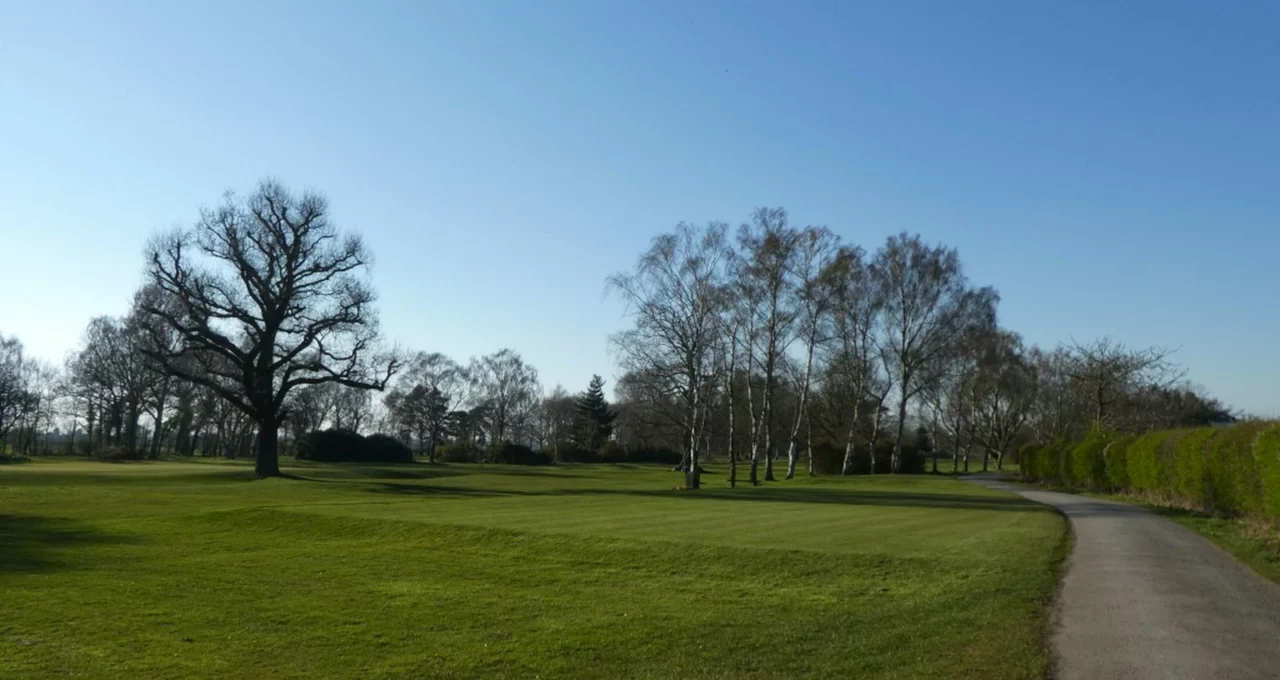
Fulford Golf Club — Photo DS Pugh / Wikimedia Commons, CC BY-SA 2.0
Fulford Golf Club
Holes
18
By
72
Length
6,743 yards
Green fee
—
Best season
All year
Fulford was founded in 1906 and moved in 1935 to its present site on the southern edge of York, a piece of ground approved by James Braid and laid out by Charles MacKenzie, the brother of Alister, and an architect whose small body of work is worth more attention than it gets.
The land is sandy and flat, which is the combination that produces genuinely fast inland greens, and it is the reason Fulford held twenty-three successive European Tour events through the 1970s, 1980s and 1990s when far grander clubs could not stage a tournament in an English spring. The moment everybody remembers is Bernhard Langer at the 1981 Benson and Hedges, playing his third shot from up an ash tree beside the seventeenth green.
What it asks of you
Par 72 over 6,743 yards on ground with very little elevation change, so the defence is entirely in the greens, the bunkering and the trees. The holes mix parkland and heathland in character, with heather in play on some and mature trees lining others.
The putting surfaces are the point: firm, subtly contoured and quick enough that the approach has to finish below the hole. Off the tee the course looks generous, and it largely is; the difficulty arrives on the second shot, where the bunkering is placed to catch the ball played from the wrong side of a fairway.
It is a course that rewards a player who can control trajectory and spin more than one who hits it a long way, which is why it produced good tournament golf at a modest length for two decades.
What players say about it
Visitors are welcome by arrangement and the review record is solid. The notes below summarise recurring themes across specialist golf sites, traveller review pages and player discussion threads. They are other people’s opinions, not ours: we have not played the course. We report what comes back repeatedly rather than isolated remarks, and we do not name or quote individual reviewers.
What comes up in its favour
- The greens are the most praised feature by a wide margin. Reviewers describe them as fast, true and better conditioned than at most inland clubs in the north.
- Bunkering is singled out for both placement and upkeep, which is unusual: bunkers are normally what visitors complain about.
- The tournament history gives the course a standing that its size does not, and the Langer tree is still pointed out.
- The club is repeatedly described as welcoming and traditional in the good sense, which matters to a visitor arriving alone.
What comes up against
- It is hard, and reviewers say so. More than one group has come away reporting that the course was too much for the weaker players in the party.
- The flat ground disappoints visitors who came expecting Yorkshire scenery; the interest here is architectural rather than visual.
- Green fees are at the upper end for a Yorkshire inland club.
- The course no longer holds a professional event, and some accounts note that it feels like a venue slightly out of the spotlight it once had.
Getting there and when to go
The club is on the southern edge of York, ten minutes from the city centre and on the A19, with Leeds Bradford airport around an hour away and York on the main east coast rail line. A golf trip here combines naturally with a weekend in the city.
The course plays all year and the sandy ground keeps it firm through the winter better than most inland courses in the north. Late spring and early autumn are the best of it. Visitor booking is by arrangement.
Green fees
Rates and visitor tee times are handled by the club and vary by day and season. See the club’s own site.
How this page was made
The factual frame comes from public sources: OpenStreetMap for the location, Wikipedia and published architecture and tournament coverage for the history and the design, and the club’s own site for access and booking. The opinion section summarises public reviews and player discussions read in September 2026; we report recurring themes rather than individual voices, and we do not reproduce or attribute quotes.
We have not played this course, and nothing here is a substitute for that. The club has not paid for this page, has not seen it before publication and has no say in what it says. If you know the course and something here is wrong or out of date, write to us and we will correct it.