The great links, and how to actually get a tee time
Famous links do not sell tee times the way an ordinary course does. The date the visitor window opens matters more than anything else in the plan.
In brief
- The St Andrews ballot is drawn two days ahead; the Old Course is shut on Sundays.
- Shoulder months have the same courses, lower rates and availability at short notice.
- Midweek beats the weekend everywhere: mornings belong to members.
- Links land is sand: land approaches short and let the ball run.
- If the headline names are full, the neighbouring links are the better trip.
Every golfer wants to play the Old Course, and most go about it the expensive way. The great British and Irish links are more accessible than their reputation suggests, provided you understand how each one lets visitors on. Here is how the tee sheets actually work.
St Andrews: the ballot, and the six other courses
St Andrews Links Trust runs seven public-access courses: the Old, the New, the Jubilee, the Eden, the Strathtyrum, the Castle and the nine-hole Balgove. Six of them can be booked in the normal way. Only one is a lottery.
For the Old Course, roughly half the tee times go through the daily ballot. It is drawn two days before play, except on Fridays, because the Old Course is closed on Sundays. Entries close at 2pm and results are usually out by 4pm. You enter as a group of two, three or four, giving each player’s name, home club and handicap, with a maximum of 36 for men and women alike. Single golfers cannot enter the main ballot.
The practical advice: enter the ballot for every day of your trip, and book the New or the Jubilee as your guaranteed round. Both are genuine championship links, and you will have played St Andrews either way.
Royal Birkdale, Royal Portrush and the championship rota
The Open venues take visitors, but on their terms: limited days, a handicap limit, a letter of introduction from your home club in some cases, and green fees at the top of the British scale. Book months ahead, not weeks, and expect the tee sheet to close entirely in the run-up to a championship.
Royal Birkdale hosts the 154th Open from 12 to 19 July 2026, with practice days from the 12th to the 15th and the championship itself from the 16th to the 19th. Visitor access around that window will be restricted, so plan a Southport trip for another month.
The links that welcome visitors
Away from the rota, a long list of first-class links takes visitors on ordinary terms and charges a fraction of the famous names. East Lothian, the stretch east of Edinburgh, is the densest concentration in the world. Aberdovey, Nefyn and Royal Porthcawl do the same job in Wales. County Down and County Louth do it in Ireland.
The rule of thumb: the more famous the name, the earlier you book and the more paperwork you need. The less famous the name, the better the round-to-price ratio, and often the better the day.
How the booking windows actually work
The single most useful thing to understand is that famous links do not sell tee times the way an ordinary course does. Most open a visitor window a fixed number of months ahead, release a block of times, and are effectively full within days for the summer. Everything else, cancellations and short-notice availability, happens outside that system.
The practical consequence is that a trip planned in January for June is straightforward and a trip planned in April for June is not. Diaries open in the autumn or the new year for the following season at most of the big names, and the date the window opens is published on the club’s own site.
The second consequence is that the shoulder months are wide open when July is not. Late April, May, September and early October have the same courses in comparable condition at lower rates and with times available at a fortnight’s notice. The weather is less reliable and the golf is not.
And the third is that midweek beats the weekend everywhere. Saturday and Sunday mornings are members’ time at most clubs, visitor access is thinner and dearer, and a Tuesday in May on a course you could not get near in July is one of the better bargains in the game.
What a round actually costs
The spread within one course is wider than the spread between two. Season, day of the week and time of day move the green fee more than the name on the gate does, and the winter rate at a championship links is a fraction of the July rate on the same eighteen holes.
Budget the extras, because they are the part that surprises people. A caddie where one is customary, a buggy where the ground allows it, a bucket of balls before you tee off and a hire trolley if you have travelled by train all add up over four rounds.
Ask about reciprocal and society arrangements, too. Many clubs offer a reduced rate to members of affiliated clubs or to groups above a certain size, and neither is ever volunteered: mention your home club when you book.
What you need to have ready
A word on length: championship links run to 7,000 yards and more from the back tees, and almost nobody should play them from there. Ask which tees the club recommends for your handicap when you book.
An official Handicap Index, because most links ask for one and some ask for a certificate from your home club or golf association on the day. If you are not a club member, iGolf gives you that Index in England for £47 a year. Then a realistic assessment of your game: many links set a handicap limit, and playing a 7,000-yard links off 28 in a crosswind is nobody’s idea of a good day.
Playing well as a visitor
Two things decide how a visitor is judged on a links, and neither is the score. The first is pace: keep in touch with the group ahead, let a faster group through if a hole opens up, and put the bag on the side of the green nearest the next tee.
The second is the ground. Replace divots, repair your pitch mark and one more, and rake bunkers properly, dragging the sand to the low side and entering and leaving at the lowest point. On links land, where the wind moves loose sand about, an unraked bunker is the reason the next player has an unplayable lie.
On the golf itself, play the forward tees. A championship links from the back markers is an endurance test for most amateurs, and the same course from two sets forward is a very good day. The handicap system converts every set correctly through course rating and slope, so there is nothing to lose.
If the famous names are full
They frequently are, and the trip is not over. The second-tier links in every one of these regions are better than the first tier almost anywhere else, they take visitor bookings at short notice, and they cost a fraction of the headline courses.
On the Ayrshire coast, the Northumberland coast, the Gower and the mid-Wales coast, the same ground and the same wind produce the same golf without the queue. A week built on those and one famous round is a better week than four days spent chasing ballots.
How to plan the trip
Two rounds a day only if you are fit and it is midsummer. Otherwise one round and an afternoon on the practice ground, which is where you will actually learn the bump-and-run that links golf demands.
Book the guaranteed rounds first, then enter ballots and take your chances around them. A trip built entirely on lotteries is a trip that can collapse.
What to expect from the golf itself
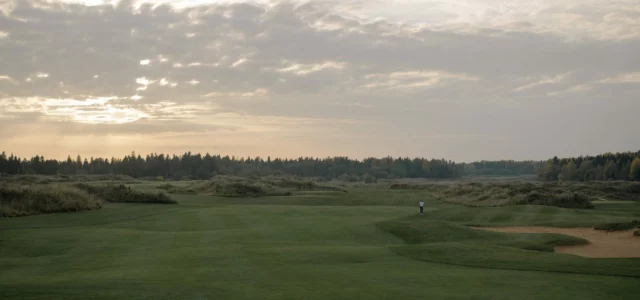
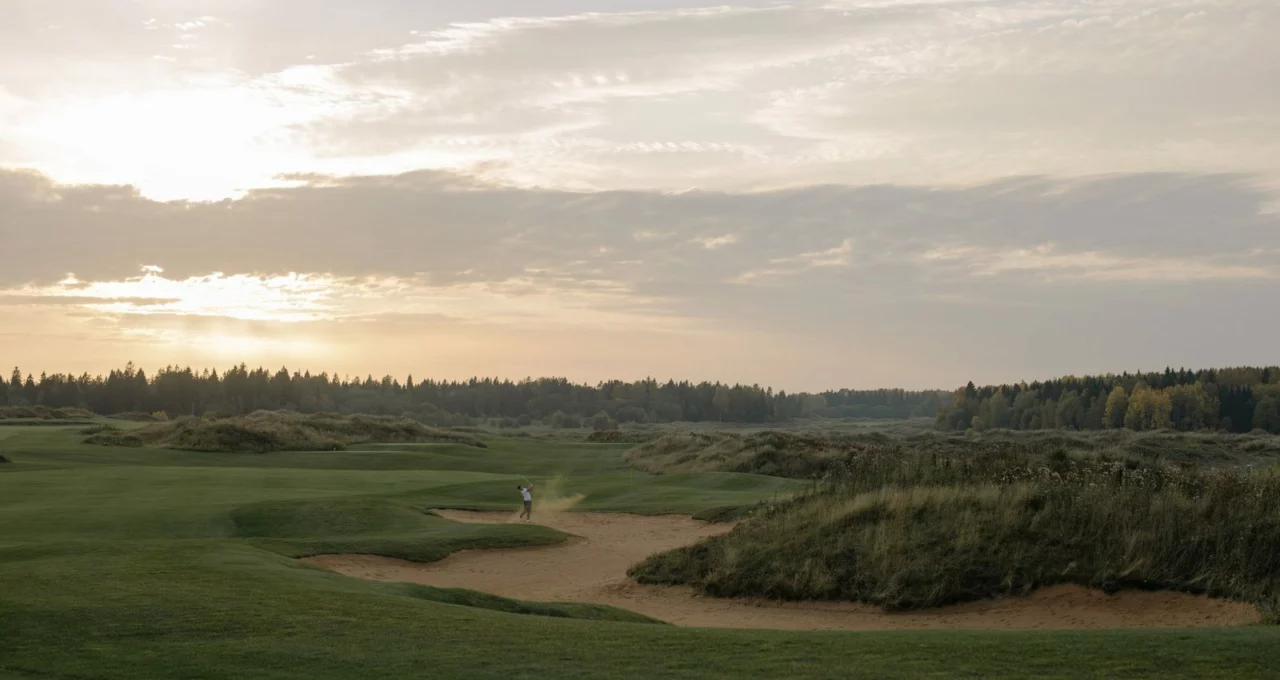
Links land is sand, and it plays nothing like the clay most inland British courses sit on. It drains in hours, stays firm for most of the year, and the ball runs a long way after it lands. A drive that finished at 200 yards inland finishes at 230 here, which puts bunkers into play that were never a consideration.
Approaches want to land short and run, and around the greens the low runner beats the lofted wedge every time on tight lies. The putter from ten yards off the surface has no disaster in it; an open face from the same lie has two.
And the greens are quicker than they look, because wind dries the surface through the day. Ten minutes on the practice green before you tee off is worth more on a links than anywhere else in golf, and the general slope of the site is a better guide than the surface immediately in front of you.
Getting there and staying
Book the tee times before the accommodation, not the other way round. Rooms exist in every links region in Britain; morning tee times at the famous clubs in July do not, and the times you get should decide the shape of the trip.
Most links clusters are drivable in twenty minutes end to end, which is the whole point of choosing a cluster rather than a headline course. Where a trip goes wrong is the day that involves two hours in the car between rounds.
Without a car, more is possible than people assume: East Lothian, Fife and the Lancashire coast all have rail lines running through them, and clubs know the local connection even when it is not on their website. Ask when you book, and ask about hire clubs in the same conversation if you are travelling light.
Where to book
- St Andrews Links: tee times for the seven courses and the Old Course ballot.
- The Open: championship venues and dates, useful for avoiding the weeks when access closes.
- iGolf if you need an official Handicap Index before you travel.
- Scottish Golf and Wales Golf for club directories in each country.
Green fees on the famous links change by season and by day. Confirm the figure when you book, not from a table you read somewhere.