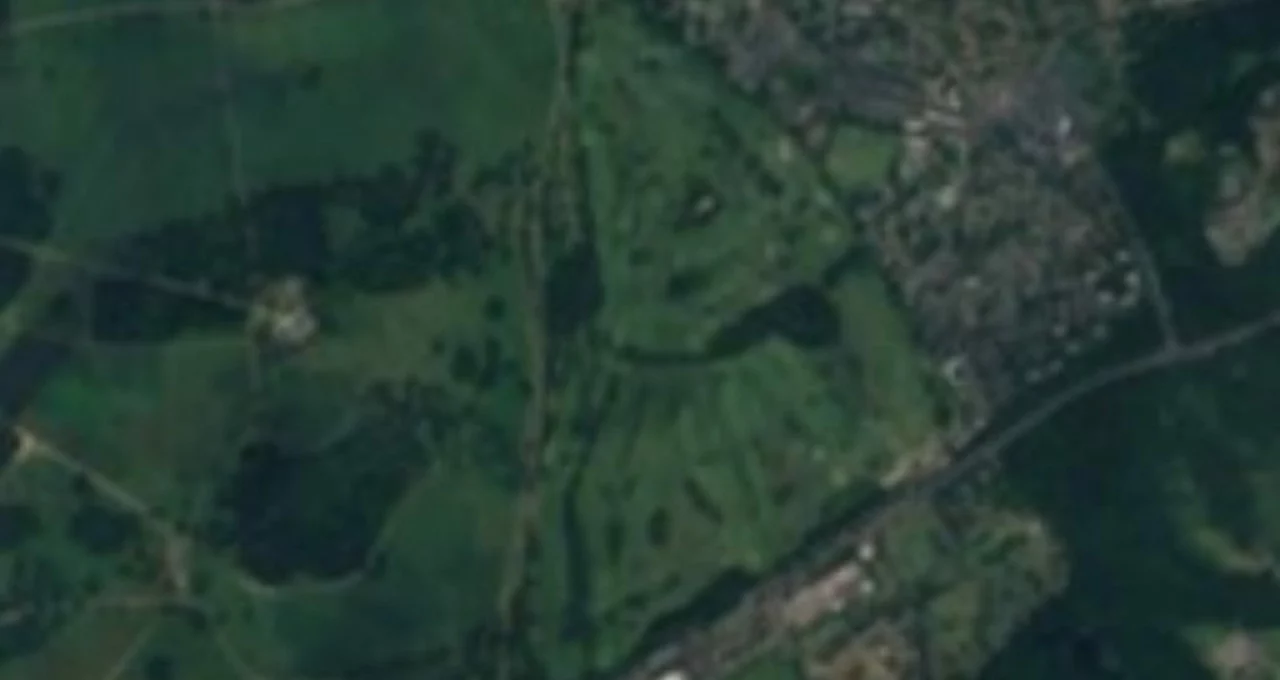
Richmond Park Golf Course from space. Sentinel-2 cloudless 2016 by EOX IT Services GmbH (contains modified Copernicus Sentinel data), CC BY 4.0.
Richmond Park Golf Course
Holes
36: two 18-hole courses, the Prince's (1923) and the Duke's (1925) (operator, members' club, Wikipedia)
By
Duke's: 71 from the white tees, 70 yellow, 74 red; Prince's: 68 white and yellow, 70 red (2022 club scorecards)
Length
Duke's: 6,321 yards white, 5,860 yellow, 5,744 red; Prince's: 5,366 white, 5,092 yellow, 4,916 red (2022 club scorecards); the club's courses page and Wikipedia give 6,359 or 6,369 and 5,487
Green fee
—
Best season
Open all year; clubhouse and courses from 7am on weekdays and 6.30am at weekends until sunset, hours may change in poor weather (operator website)
Richmond Park Golf Course is a public, pay-and-play golf facility of two 18-hole courses inside Richmond Park, the largest of London’s Royal Parks, in the south-west of the capital. The two courses are the Prince’s, opened by Edward, Prince of Wales, in June 1923, and the Duke’s, opened by the Duke of York, the future George VI, in 1925. The land belongs to The Royal Parks; the day-to-day running of the golf is contracted to a commercial operator, which today trades at Richmond Park under the Loyaltee Golf name, part of the Glendale Golf group. No membership is required to play: anyone can book a tee time online or by telephone. On the members’ club’s 2022 scorecards the Duke’s measures 6,321 yards from the white tees, par 71, and the Prince’s 5,366 yards, par 68.
The facility describes itself as one of the most visited golf locations in Europe, and its history explains why. The courses were built in the early 1920s for golfers who could not afford to join private clubs, at a time when the game in and around London was largely confined to them. A century later they still serve that purpose: there is no dress code, dogs on a lead are allowed on the course, and the clubhouse is open to anyone. This page sets out what the public record says about the courses, how they have changed, what the cards ask of a golfer, and what players who have been there report.
Which course is this?
OpenStreetMap maps the ground as Richmond Park Golf Course and links it to the Wikidata item Q7330936 and to the English Wikipedia article of the same name. The Royal Parks, the operator and Wikipedia all use that name for the facility as a whole; the two layouts within it are the Prince’s Course and the Duke’s Course, sometimes written without the apostrophe.
The name invites confusion with at least two other places. The Richmond Golf Club is a private members’ club at Sudbrook Park, on the other side of the park near Petersham, with its own course and history; it is not the subject of this page. Richmond Park Golf Club is the name of one of the members’ clubs that play on these public courses, and its website is the one Wikidata gives as the official website of the facility.
The operator gives the address as Norstead Place, London, SW15 3SA, on the Roehampton side of the park. Reverse geocoding of the OpenStreetMap outline gives Chohole Gate Path, in the London Borough of Richmond upon Thames, with the postcode SW15 3PG; the coordinates Wikidata holds lie some 700 metres north-west of the OpenStreetMap point, near the top of the courses. The courses lie between Roehampton Gate and Robin Hood Gate, east of Beverley Brook, on what Wikipedia describes as the former Great Paddock, an area where deer were fed for the royal hunt. For decades the round began behind the Roehampton Gate car park; since the remodelling of 2013 it starts at a new clubhouse near Chohole Gate, which Wikipedia says gives easier access from the A3. The map at the foot of this page uses the OpenStreetMap position.
History: a royal course for those without a club
According to the history published by Richmond Park Golf Club, the idea of a golf course in the park was first considered in 1921, with the declared aim of serving the golfers who were unable to afford to join private clubs, the artisans of the period’s vocabulary. The club says George V commissioned J. H. Taylor, five times Open champion and one of the Great Triumvirate of early professional golf, to lay out an 18-hole course with the architect Fred Hawtree. The Prince of Wales opened that course, the Prince’s, on 9 June 1923 by driving off the first tee. Golf’s Missing Links, a site that documents lost and historic clubs, calls it London’s first municipal golf course and cites reports of the opening in the Illustrated London News of 30 June 1923 and the Westminster Gazette of 30 July 1923.
The course was so popular that a second was commissioned almost at once. Hawtree designed it, and the Duke of York performed the ceremonial opening drive in 1925, giving the Duke’s Course its name. Golf’s Missing Links credits the first course to Hawtree in collaboration with Taylor, a slightly different emphasis from the club’s account.
Several golf clubs grew up on the public courses, as was the custom on municipal golf in Britain. The members’ club now called Richmond Park Golf Club says it was formed in the spring of 1924 by enthusiasts who had begun playing on the new courses, under the name The Priory Golf Club, and that it took its present name in 1953. Golf’s Missing Links gives the same 1924 foundation but contradicts itself on the club’s later fate, saying in one place that the Priory club disappeared in 1953 and in another that it was renamed. Putney Park Golf Club, founded in 1925, and White Lodge Golf Club, founded in 1928, are still based at the courses; other clubs that once played there, such as Ruskie Hall and Centurion, are no longer active according to Golf’s Missing Links. None of them owns or manages the courses.
The layouts have been modernised more than once. Wikipedia says that in 1985 Martin Hawtree, grandson of the original architect, led a programme of modernisation of both courses; the members’ club’s archive places this about sixty years after the original courses, without a precise year. The larger change came under the current management contract. Wikipedia says Glendale Golf has operated the courses since 2004, and The Royal Parks describes an improvement programme of around three million pounds carried out by Glendale some ninety years after the opening. The new clubhouse, with a roof of acid grassland taken from the park itself, low light and noise emissions and new ponds, opened for business in April 2013 and was officially opened in August 2013, according to Wikipedia, which adds that the remodelling brought seven new greens, eight new tees, a driving range and a golf academy. The Royal Parks dates the reopening of the Duke’s and Prince’s courses after their overhaul of all 36 holes to June 2014. We found no source that reconciles the two dates.
The remodelling also reshuffled the holes between the two courses. Comparing the cards in the members’ club’s archive, which were adopted on 1 April 2005, with the current yardages, several holes appear to have changed course. The last three holes of the 2005 Duke’s card (159, 362 and 246 yards from the whites) match the 11th, 12th and 13th of the Prince’s yardages published today on the members’ club’s website, and the 5th and 6th of the 2005 Prince’s (305 and 309 yards) match the 2nd and 3rd of today’s Duke’s. This is our reading of the figures, not a statement from the operator, but it explains why older hole descriptions rarely fit the present courses.
What it asks of you
The members’ club publishes images of its 2022 printed scorecards on its courses page. They give three sets of tees for each course, with course and slope ratings for men (M) and women (L):
The Prince’s Course
- White tees: 5,366 yards, par 68 (35 out, 33 home); men’s course rating 66.2, slope 117; women’s par 72, rating 71.6, slope 126.
- Yellow tees: 5,092 yards, par 68; men’s rating 65.0, slope 111; women’s par 71, rating 70.1, slope 122.
- Red tees: 4,916 yards, par 70 (36 out, 34 home); men’s par 66, rating 64.3, slope 110; women’s par 70, rating 69.1, slope 118.
The Duke’s Course
- White tees: 6,321 yards, par 71 (35 out, 36 home); men’s course rating 70.7, slope 126.
- Yellow tees: 5,860 yards, par 70; men’s rating 68.2, slope 119; women’s par 73, rating 74.4, slope 127.
- Red tees: 5,744 yards, par 74 on the card’s red column; men’s par 70, rating 67.7, slope 116; women’s par 74, rating 73.9, slope 124.
The same club page also carries text and a hole-by-hole table that do not quite match the printed cards: it gives 6,369 yards for the Duke’s, while its own white-tee hole figures add up to 6,359, and 5,487 yards for the Prince’s. Wikipedia uses 6,359 and 5,487 yards, with ratings of 71.1 and slope 131 for the Duke’s and 66.9 and slope 119 for the Prince’s from the white tees. The printed 2022 cards, which Golfshake and 18Birdies reproduce, are the figures we use on this page. The operator’s own website gives no yardages at all.
The operator calls the Prince’s the popular option and the Duke’s the more challenging one, and the members’ club describes the Prince’s as shorter and more undulating, with elevated views over the park, and the Duke’s as having many water hazards and the park’s ancient brook. Wikipedia makes the same distinction: the Prince’s on higher ground, the Duke’s lower and flatter, crossed by a stream on the 3rd, 4th, 5th, 6th, 12th, 13th and 14th, and generally regarded as the harder of the two.
Because Richmond Park is a Site of Special Scientific Interest and a National Nature Reserve, the courses sit among ancient trees, acid grassland and free-roaming deer. Wikipedia notes a local rule treating fallen trees and dead wood as immovable obstructions.
The Prince’s, hole by hole
The card, with yardages from the white tees, describes a short course that front-loads its length:
- The front nine measures 2,984 yards for a par of 35, the back nine only 2,382 for a par of 33.
- There are five par 3s: the 2nd (162 yards), the 4th (120), the 11th (153), the 13th (243, the longest short hole on either course, stroke index 4) and the 16th (121, the shortest).
- The only par 5 is the 9th, at 476 yards.
- Stroke index 1 is the 7th, a par 4 of 430 yards, followed by the 10th (415 yards, index 2) and the 8th (402 yards, index 3). From the red tees the 7th and the 10th are played as par 5s.
- The closing stretch is a run of short par 4s: the 14th at 256 yards, the 15th at 273, the 17th at 271 and the 18th at 291, all within reach of long hitters in dry conditions, and all with a premium on position rather than power.
The Prince’s thus asks for steady iron play on the outward half, where five par 4s exceed 340 yards, and for accuracy on a homeward half that offers chances. Its yellow-tee slope of 111 is just below the neutral 113.
The Duke’s, hole by hole
The Duke’s is longer by almost a thousand yards from the whites and plays the other way round, with the heavier half at the end:
- The front nine measures 3,051 yards, par 35; the back nine 3,270 yards, par 36 from the whites and 35 from the yellows.
- There are three par 3s: the 7th (177 yards), the 10th (189, cut to 125 from the yellow tees) and the 16th (158).
- The 12th is the longest hole on the property at 520 yards, a par 5 from every tee. The 17th is a par 5 of 489 yards from the whites but a par 4 of 411 from the yellows, which is why the course’s par drops from 71 to 70 between the two tees.
- The hardest holes, by stroke index, are the 14th (433 yards, index 1), the 5th (404 yards, index 2) and the 13th (433 yards, index 3), all par 4s for men. From the red tees the 8th, 13th, 14th and 17th become par 5s, giving the red card its par of 74.
Taken with Wikipedia’s account of the stream, which crosses holes 3 to 6 and 12 to 14, the card shows where the Duke’s earns its reputation: the long run from the 12th to the 15th, with a par 5 and two of the longest par 4s on the course, is also where the water comes into play. A men’s slope of 126 from the whites puts it well above the neutral 113.
Practice
The operator lists a driving range of 20 bays that needs no booking; Wikipedia also gives 20 bays, but The Royal Parks describes a 15-bay range. The range is closed on Tuesday mornings for maintenance, opening at 11am, and dogs are not allowed on it. A putting green and a chipping area with bunkers are mentioned in reviews relayed on the operator’s page.
What golfers say
We read the review summary and ratings on Golfshake, 18Birdies and Wanderlog’s relay of Google reviews, the reviews relayed on the operator’s page, and search summaries of reviews on GolfPass and Hole19. GolfPass refused our requests, so its contents are known to us only through search summaries. On Golfshake the facility scores 3.3 out of 5 from more than 700 reviews, the page itself giving two different totals, with hospitality the best-rated category and pace of play and the course itself the lowest. 18Birdies shows 3.8 out of 5 from 345 reviews, with course condition at 3.5. Wanderlog relays a Google rating of 3.9 from 633 reviews. The points below summarise what recurs. They are other people’s opinions, not ours; nobody from Panxis has played the course, and we name and quote no one.
What comes up in its favour
- The setting: playing among the trees and deer of Richmond Park, a few miles from central London, is the feature most often praised.
- Value for money, especially for a public course in London, and the absence of membership requirements or a dress code.
- A welcoming atmosphere for golfers of every level, with friendly staff; hospitality is Golfshake’s best-scoring category.
- The greens, often described as quick and true, particularly on the Duke’s, which reviewers generally rate above the Prince’s.
What comes up against
- Slow play and crowding are the most frequent complaint, especially on the Prince’s and at weekends; several reviewers advise an early tee time even on weekdays.
- Heavy use shows: unrepaired pitch marks and divots, variable tees and fairways, and soft, wet conditions in winter.
- The rough and the park’s grassland make balls easy to lose.
- The condition of the greens on the Prince’s divides opinion, some reviewers finding them slow or inconsistent, particularly after refurbishment work.
- Some reviewers find the Prince’s too simple, while others, on the Duke’s, find the undulating fairways and bunkering demanding for beginners.
The picture is of a busy, accessible public facility whose setting is its main asset and whose condition reflects the number of rounds it hosts.
Playing as a visitor
Both courses are open to the public without membership. The operator’s pay and play page advises booking ahead because the courses are popular, and says booking online is cheaper than booking in person. Tee times are booked through the online visitor booking system or by telephone on 0208 876 3205. Groups are not paired with strangers, but at busy times single golfers may be asked to book with at least one other player. Prepaid tee times are not refunded but can be moved to another day by telephone.
There is no dress code: the operator recommends comfortable clothes, waterproofs and a warm layer, and golf shoes for grip, though trainers are accepted. Each player should have their own set of clubs, half sets being fine, since sharing slows play. Branded hire sets, electric buggies and Motocaddy power trolleys can be reserved online. The operator’s buggy policy says nobody under 18 may drive a ride-on buggy and that staff may restrict buggies on all or part of a course in wet, frosty or otherwise unsafe conditions, or on Sites of Special Scientific Interest, which the whole park is. Dogs on a lead are allowed on the course, but not on the range.
Players check in at the clubhouse reception and can warm up on the range. The clubhouse, which the operator describes as family and dog friendly, has a coffee shop, bar and restaurant with floor-to-ceiling glazing according to The Royal Parks, and an outdoor lakeside terrace. The operator also sells adult, junior and rolling monthly plans, lessons and golf days for groups; the independent members’ clubs run their own competitions and recruit their own members.
Getting there and when to go
The clubhouse is in Richmond Park near Chohole Gate, at Norstead Place, London, SW15 3SA according to the operator, which also gives the what3words reference race.bricks.rooms. Wikipedia notes that the move to the new clubhouse gave easier access from the A3; Roehampton Gate, where the round used to begin, is a short distance to the north. We did not verify parking arrangements or public transport routes, and we leave them out; the operator’s contact page links to a map.
The courses are open all year. The clubhouse and courses open at 7am on weekdays and 6.30am at weekends and close at sunset, with hours subject to change in poor weather; the operator publishes a live course status page. Reviews suggest the early slots are the best way to avoid queues, and that winter brings soft, heavily used ground.
Green fees
Rates vary with the day and time, and booking online is cheaper than paying at the desk: see the operator’s website for current prices.
How this page was made
The factual frame comes from public sources: OpenStreetMap and reverse geocoding for the location and name; Wikidata for the linked item; the operator’s website (Loyaltee Golf) for the address, opening hours, booking rules, dress code, hire equipment, buggy policy and range; the members’ club’s website for the history since 1921, its own foundation, the 2022 scorecards and ratings and the 2005 archive cards; The Royal Parks for ownership, the improvement programme, the reopening and the clubhouse; Wikipedia for the operator since 2004, the 1985 modernisation, the 2013 remodelling, the location, the Great Paddock, the stream and the local rule on dead wood; and Golf’s Missing Links for the 1923 press reports and the clubs. The opinions summarised above come from Golfshake, 18Birdies, Wanderlog’s relay of Google reviews, the reviews relayed on the operator’s page, and search summaries of GolfPass and Hole19.
Where sources disagree, we say so. The Duke’s is given as 6,321 yards (2022 printed card, Golfshake, 18Birdies), 6,359 yards (Wikipedia, and the sum of the members’ club’s hole table) and 6,369 yards (the same club page’s text); the Prince’s as 5,366 yards (printed card) and 5,487 yards (club page text, Wikipedia). White-tee ratings differ between the printed cards (70.7 and slope 126 for the Duke’s, 66.2 and 117 for the Prince’s) and Wikipedia (71.1 and 131, 66.9 and 119). The range has 20 bays according to the operator and Wikipedia, 15 according to The Royal Parks. The new clubhouse opened in April 2013, officially in August 2013, according to Wikipedia, while The Royal Parks dates the reopening of the remodelled courses to June 2014. The 1985 date for Martin Hawtree’s modernisation comes from Wikipedia; the members’ club gives no exact year. Golf’s Missing Links both says the Priory club disappeared in 1953 and that it was renamed that year; the club itself says it was renamed. The address is Norstead Place, SW15 3SA, for the operator and Chohole Gate Path, SW15 3PG, by reverse geocoding.
GolfPass refused our requests, and its reviews are known to us only through search summaries, which we have not used for any figure. The members’ club’s courses page contains an obvious misprint (3,003 yards on a red tee); we have relied on the printed card. A golf academy course mentioned by one directory is not described by the operator, and we leave it out. We found no reliable account of public transport and parking for golfers, no detailed description of the 1923 and 1925 layouts and no architect named for the 2013 remodelling, and we have not invented them. Green fee amounts are deliberately left out.
The opinion section summarises reviews read in October 2026. We report recurring themes rather than individual voices, and we reproduce no quotations from reviewers. Nobody from Panxis has played or visited these courses, and this page is no substitute for a round.
Neither the operator nor the members’ clubs have paid for this page, seen it before publication or had any say over its content. This page contains no commercial link and earns us no commission. If you know the courses and something here is wrong or out of date, write to us and we will correct it.
Other courses nearby
Closest to this one in our British directory:
- The Richmond Golf Club — 2 mi
- Fulwell Golf Club — 5 mi
- The Buckinghamshire Golf Club — 14 mi
- Foxhills Golf Club — 14 mi
The hole to know
The 12th on the Duke's, the longest hole on the property: a par 5 of 520 yards from the white tees on the 2022 card, on the stretch of the course that Wikipedia says the park's stream crosses.