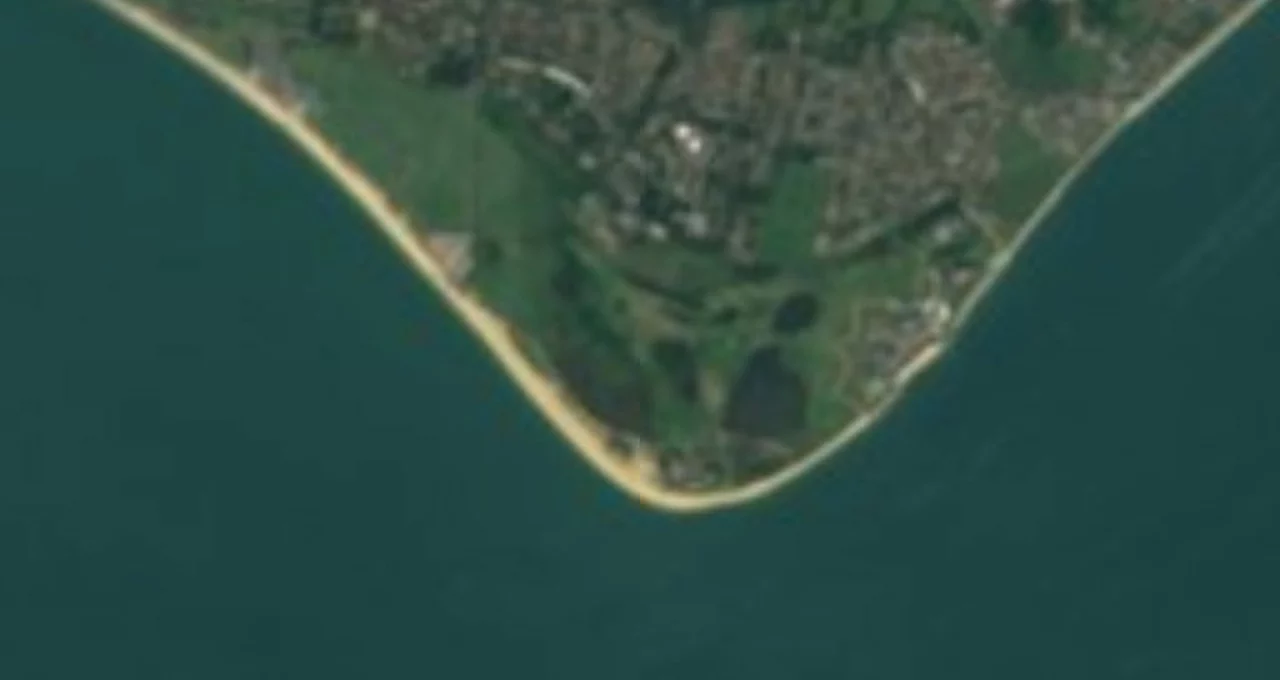
Gosport & Stokes Bay Golf Club seen from space. Sentinel-2 cloudless 2016 by EOX IT Services GmbH (contains modified Copernicus Sentinel data), CC BY 4.0.
Gosport & Stokes Bay Golf Club
Holes
9 holes with 18 tees and 11 greens, played twice as an 18-hole course (club website)
By
71 for men from the white, yellow and red tees, 73 for women from the yellow and red tees, over 18 holes (England Golf certificate and club handicap tables from 31 May 2024)
Length
6,093 yards from the white tees, 5,902 yellow, 5,652 red, over 18 holes (England Golf certificate, 23 May 2022); a temporary rating for February to May 2026 gave 5,810 white; directories give other figures that match no club data
Green fee
—
Best season
—
Gosport & Stokes Bay Golf Club is a nine-hole links on the Solent shore at the south-eastern tip of Gosport, Hampshire, on Fort Road at the Gilkicker end of Stokes Bay. The club was founded in 1885 as the United Services Golf Club, a course for Army and Navy officers stationed around Portsmouth, and it took its present name shortly before the Second World War. Its own description is short and specific: nine holes, 18 tees and 11 greens, with views across the Solent to the Isle of Wight. Played twice round from its separate sets of tees, it makes an 18-hole course of 6,093 yards from the white tees, par 71 for men, according to the England Golf rating certificate the club publishes. The club’s website is gosportandstokesbaygolfclub.co.uk.
It is also the club that golf history credits with giving the game Colonel Bogey. The imaginary opponent who never makes a mistake, and who later lent his name to a famous march and to the score of one over par, was promoted to colonel here in the early 1890s, by a membership made up entirely of serving officers. The course itself is modest in length, squeezed between a protected saline lagoon, an eighteenth-century fort that still belongs to the Ministry of Defence and the shingle beach of Stokes Bay. It is a members’ club that welcomes green-fee players and societies, and it publishes a visitor tee sheet online.
Name and location
The club calls itself Gosport & Stokes Bay Golf Club, and its handicap documents and England Golf certificates use the same name, with one temporary certificate spelling it Gosport and Stokesbay. OpenStreetMap names the ground Gosport & Stokes Bay Golf Course and links it to a Wikidata item, Q28403710, which carries little more than a label and a set of coordinates imported from Wikipedia. Those coordinates sit about half a kilometre north-east of the centre of the course as drawn in OpenStreetMap; the map at the foot of this page uses the OpenStreetMap position. The postal address is Fort Road, Gosport, PO12 2AT. The local tourism site Discover Gosport gives Military Road with the same postcode; Fort Road is the address the club itself prints on every page.
From the United Services Golf Club to Gosport & Stokes Bay
The club’s history page dates its foundation to 1885 and describes it as one of the early golf clubs in the south of England. It was set up as the United Services Golf Club to give officers of the Army and the Royal Navy based at Portsmouth somewhere to play, and the original nine holes were laid out on Haslar Common and on the glacis of Fort Monckton, the sloping open ground in front of the fort’s defences. The Golf’s Missing Links website, which documents lost and renamed clubs from period sources, quotes a report in the Portsmouth Evening News of 23 April 1885 announcing that a golf club for the United Services had been formed at Stokes Bay with 20 members, under the patronage of Admiral Sir G. P. Hornby and Lieutenant General Sir G. Willis, with a doctor from Haslar Hospital as its first honorary secretary. The same page notes that Nisbet’s Golf Year Book of 1905 gives the date of institution as 1886, and that the first handicap meeting was held in February 1886. The two dates are not really in conflict: the club was formed in 1885 and appears to have been fully organised in the following year. We use 1885, as the club does.
The ladies of Alverstoke founded their own club in 1893, with a separate course. According to the club’s history, the ladies’ course was merged with the Services course around the turn of the century to make an 18-hole layout. The Wikipedia article on Haslar gives the date of the merger as 1905 and adds that the two clubs did not share a clubhouse until 1924. Golf’s Missing Links, drawing on the 1905 year book, describes the 18 holes of that era as nine inland and nine by the sea, on gravelly soil with fine grass and good greens, with the ladies starting their round at the 13th.
The club kept the United Services name for more than half a century. Golf’s Missing Links dates the change to 1 February 1939, citing a contemporary press report that explained the new name as a way of ending the impression that only members of the fighting services could play there; Wikipedia’s article on Haslar also gives 1939. The club’s history places the change simply in the years before the Second World War, as more civilians joined.
The 18-hole course did not survive in its old form. The club’s history attributes its reduction to the present layout to land drainage, the filling-in of moats and the sale of Ministry of Defence land. An article on the trade site Greenkeeping EU puts it the other way round, saying the club sold land to the Ministry of Defence; the club’s own wording is the one we follow. Either way, what remains is nine holes on a tight coastal site, made to play as eighteen by using 18 tees and 11 greens. The club celebrated its centenary in 1985 and its 135th anniversary in 2020. No source we read names an architect for either the original course or the present layout.
The home of Colonel Bogey
The story the club tells runs as follows. In 1890 Hugh Rotherham of Coventry Golf Club proposed playing against a ground score, the number of strokes a good player should need on each hole, and the idea spread to other clubs. In 1892 the secretary of Great Yarmouth Golf Club, where the imaginary opponent had become known as the Bogey Man after a popular song of the day, visited Haslar and played at the United Services club. With the honorary secretary he fixed a ground score for the course, and since every member of the club held a service rank, the imaginary player was given one too: being a player who never erred, he became Colonel Bogey. The Greenkeeping EU article credits the remark about rank to Captain Seeley Vidal of the Royal Engineers.
The sources differ on the details. Wikipedia’s article on Haslar presents the 1892 visit as a claim and names the Great Yarmouth secretary as Dr Thomas Browne. Its article on bogey in golf dates the first use of the term to around 1890 at Great Yarmouth, and says it first appeared in print on 28 November 1891 in The Field, in a report on competitions at the United Services Golf Club in Gosport, which would place the Gosport connection a year earlier than the club’s own date of 1892. The same article links the name to the Colonel Bogey March of 1914. Over time, as American golf tightened par, bogey came to mean one stroke over par, which is how it is used today.
A course between a lagoon and a fort
The setting explains a great deal about the course. Immediately to the south and east lies Gilkicker Lagoon, a saline lagoon notified as a Site of Special Scientific Interest in December 1984; Wikipedia gives its area as 4.07 hectares, and Gosport Borough Council says it is also part of a Ramsar site and a Special Area of Conservation. The Friends of Stokes Bay, a local heritage and amenity group, describe the lake as part of the old water defences of Fort Monckton and record that it is fed partly by drainage and seepage from the land occupied by the golf course, that the club has dug ditches connecting to it, and that the middle of the lake was filled in so that golfers could cross between tees. Discover Gosport says the greens sit on either side of Gilkicker Lake. The Friends of Stokes Bay list rare stoneworts, molluscs and the starlet sea anemone among its inhabitants, and dunlin, terns and Brent geese among the birds that feed there.
Fort Monckton, next to the course, was built as a permanent fort from 1780 and completed around 1790, served as a coastal battery until 1956, and is still occupied by the Ministry of Defence as a military training establishment, according to Wikipedia. Further west along the shore stands Fort Gilkicker, built in 1871. One player, writing on the Golf Monthly forum in 2014, noted that military buildings and high wire fencing border much of the course, while the Solent runs along the other side; he enjoyed it all the same. The club’s homepage currently asks golfers not to feed the wildlife on the course.
What it asks of you
The most reliable figures are those of the England Golf rating certificate dated 23 May 2022 and the course handicap tables valid from 31 May 2024, both published on the club’s course handicap table page. They rate the course as 18 holes, that is, two circuits of the nine using different tees on several holes:
- White tees, men: 6,093 yards, par 71, course rating 69.3, slope 117.
- Yellow tees, men: 5,902 yards, par 71, course rating 68.5, slope 113.
- Red tees, men: 5,652 yards, par 71, course rating 66.7, slope 110.
- Yellow tees, women: 5,902 yards, par 73, course rating 73.9, slope 127.
- Red tees, women: 5,652 yards, par 73, course rating 72.3, slope 123.
The certificate also splits the ratings by nine. From the white tees the front nine rates 35.3 with a slope of 119 and the back nine 34.0 with a slope of 115, so the first circuit is rated as the harder of the two from those tees. The certificate lists lengths without naming the unit; we give them in yards, the unit used on English scorecards. A slope of 117 from the whites sits slightly above the neutral 113, while the yellow tees come out exactly at 113 for men. For a club of this length, the women’s slopes of 123 and 127 are relatively high.
The club also published a temporary certificate issued by England Golf for 1 February to 31 May 2026, with shorter lengths and lower ratings: 5,810 yards and 68.0/114 from the whites, 5,679 yards and 67.4/110 from the yellows, and a men’s red table at par 70. It does not say which holes were altered. That period has ended, and the club’s page still offers the permanent tables; the 18Birdies app, however, still shows the temporary white figures of 5,810 yards, 68 and 114.
What 18 tees and 11 greens means on the ground is not set out hole by hole by the club, and we found no scorecard on its website. The homepage notice in October 2026 gives a glimpse of how the holes share ground: with the 5th fairway closed for new topsoil, golfers are asked to walk back down the 4th fairway to the 13th tee and play from there towards the 5th and 14th greens. Holes on the two circuits therefore share fairways and, at least in this case, a target green, with the second nine played from different tees.
The Hole19 app shows a card from the red tees of 5,211 yards and par 73, with four par 3s and five par 5s, the shortest hole a par 3 of 114 yards at the 9th and the longest a par 5 of 484 yards at the 17th. Its total matches none of the lengths on the England Golf certificate, its par of 73 corresponds only to the women’s tables, and two listings on Golfify give yet other cards, so we do not reproduce it hole by hole. Directories such as Today’s Golfer and 1golf list the course as 11 holes, almost certainly a confusion with the 11 greens, and Today’s Golfer’s 6,207 yards and The Social Golfer’s par 72 over 6,374 yards match no current club figure.
The club calls its course a links, and the location bears that out: it lies on low coastal ground directly behind the beach, open to whatever blows up the Solent. The club’s course status board uses the usual markers for winter play, including preferred lies, fairway mats and temporary greens, and in October 2026 preferred lies were in operation. Bunkers were a long-standing problem: according to Greenkeeping EU, stones from the coastal ground kept working their way into them and damaging members’ clubs, until the club rebuilt them with the EcoBunker system between February and April 2018 and changed the sand. Today’s Golfer mentions the investment in new bunkers too. The club’s history adds that an irrigation system has been installed and that drainage and conditioning have improved over the years.
What golfers say
Public reviews of Gosport & Stokes Bay are scarce, and we would rather say so than stretch them. The material we read is the review summary on 18Birdies, the short written reviews and rating on Hole19, one post on the Golf Monthly forum and the descriptions in golf directories. GolfPass, Golf Sherpa and TripAdvisor returned nothing for this club, Golfshake refused our requests, and Today’s Golfer and The Social Golfer show no player reviews. On 18Birdies the course scores 3.9 out of 5 from 18 reviews, with value scored at 4.2 and course condition at 3.5, difficulty rated hard and green speed and pace of play rated medium; the reviews themselves carry no text. Hole19 shows an average of 4.3 from a handful of short reviews. The points below summarise what recurs. They are other people’s opinions, not ours; nobody from Panxis has played the course, and we name and quote no one.
What comes up in its favour
- It is a harder course than its length suggests: 18Birdies users rate it hard, and Hole19 reviewers describe it as tough and tricky but fair.
- Value for money is its best-scored category on 18Birdies.
- Several reviewers describe it as clean and well maintained.
- The views across the Solent to the Isle of Wight are the selling point the club itself puts first, and the forum poster mentions the sea alongside the course.
What comes up against
- Course condition is the weakest of the 18Birdies scores, below value.
- Hazards come up as a source of trouble as well as of interest.
- The military fencing and buildings around much of the course give it an enclosed feel, at least in the eyes of one forum poster.
With so few reviews, none of these points carries much weight on its own.
Facilities and how to play it
The club welcomes green-fee players and prospective members, and its homepage speaks of a comfortable clubhouse. Visitors can book a tee time on the club’s online visitor tee sheet, run on the ClubV1 system. The green fees page sets out separate rates for 18 and 9 holes on weekdays and at weekends, a twilight rate for nine holes after 6pm, and categories for members’ guests, juniors under 18 (on Sundays only after 1pm), County Card holders, members of the armed forces and societies of eight or more. The club says it welcomes societies of all sizes and can arrange catering; it also hires out its rooms for functions and runs social events for members.
The dress code is conventional: golf shoes, collared shirts tucked in, tailored trousers or golf-length shorts worn with predominantly white socks, no jeans, cargo or combat trousers, no football or rugby shirts, caps worn forwards. Golf shoes are not allowed in the clubhouse, and hats come off indoors. Mobile phones are to be kept on silent. Membership runs from junior and intermediate categories by age to weekday, seven-day, senior and social membership, with prices on the club’s website.
The directories disagree on the rest. Today’s Golfer lists no bar, restaurant, pro shop, practice green, buggy or trolley hire, while 1golf lists a clubhouse with restaurant and bar, a practice area and a putting green. Today’s Golfer’s list also says the course has no dress code, which the club plainly has, so its blanks seem to mean that nothing was recorded rather than that facilities are absent. The club’s website mentions neither buggy nor trolley hire, nor a professional, nor a practice ground, so ask before relying on any of them. Its course status board can declare the course closed to trolleys or buggies when conditions require.
Getting there and when to go
The club is at Fort Road, Gosport, PO12 2AT, on the Haslar peninsula at the eastern end of Stokes Bay. Gosport sits on the western side of Portsmouth Harbour, and the passenger ferry from Portsmouth lands at Gosport about a mile and a half north of the course as the crow flies. By road, The Social Golfer notes that the course is near the A32, the main road into Gosport. The club’s telephone number is 02392 587423 and its email address is secretary@gosportandstokesbaygolfclub.co.uk; 1golf gives a different number, but the club’s own is the one to use.
The club publishes no opening hours or seasonal calendar, and we found none elsewhere. The twilight rate after 6pm implies summer evening golf; in winter the course status board shows whether preferred lies, mats or temporary greens are in use, and the club’s homepage is the place to check before setting out, as works such as the closure of the 5th fairway in October 2026 can change the routing. The Solent views the club advertises are best on a clear day, and anyone combining a round with a walk can follow the shore past Fort Gilkicker towards the sea front of Stokes Bay.
Green fees
Gosport & Stokes Bay sets separate rates for 18 and 9 holes, weekdays and weekends, twilight, juniors, societies and other categories: see the club’s website for current prices.
How this page was made
The factual frame comes from public sources: OpenStreetMap for the location, outline and name of the course; Wikidata for the item linked to it; the club’s website for its description, 18 tees and 11 greens, foundation in 1885, history, the Colonel Bogey story, course status, visitor booking, fee categories, dress code, societies, membership categories and contact details; the England Golf rating certificate of 23 May 2022, the course handicap tables valid from 31 May 2024 and the temporary certificate for February to May 2026, all published by the club, for lengths, pars, ratings and slopes; Golf’s Missing Links for the 1885 press report, the 1905 year book and the 1939 renaming; Wikipedia’s articles on Haslar, Bogey (golf), Fort Monckton, Stokes Bay and Gilkicker Lagoon; Gosport Borough Council and the Friends of Stokes Bay for the lagoon; Discover Gosport for the greens beside Gilkicker Lake; Greenkeeping EU for the 2018 bunker work; Hole19, Golfify, Today’s Golfer, 1golf and The Social Golfer for third-party cards and facilities; and 18Birdies, Hole19 and the Golf Monthly forum for the opinions summarised above.
Where sources disagree, we say so. The foundation is 1885 for the club, Wikipedia and a contemporary press report, 1886 in the 1905 year book, and 1894 in one field of The Social Golfer, which gives 1885 in another. The merger with the ladies’ course is placed around the turn of the century by the club and in 1905 by Wikipedia. The renaming is dated to 1939 by Wikipedia and Golf’s Missing Links, and only to the years before the Second World War by the club. The Colonel Bogey episode is dated 1892 by the club and by Wikipedia’s Haslar article, while Wikipedia’s article on bogey cites a report on the United Services club in The Field of November 1891. The club speaks of the sale of Ministry of Defence land, Greenkeeping EU of land sold to the Ministry. Directories give 11 holes, 6,207 yards and par 71 (Today’s Golfer), par 72 and 6,374 yards (The Social Golfer), and 5,211 yards and par 73 from the red tees (Hole19), none of which matches the England Golf certificate; 18Birdies shows the expired temporary rating. Today’s Golfer and 1golf disagree on the bar, restaurant and practice facilities, and 1golf gives a telephone number different from the club’s. Discover Gosport gives Military Road as the address, the club Fort Road. The Wikidata coordinates are about half a kilometre from the OpenStreetMap outline.
Today’s Golfer returned a payment wall to our reading tool and was read from its raw page; Golfify, 1golf, Golfshake and the Friends of Stokes Bay page on the golf club refused our requests or no longer exist, so their contents are known to us only through search summaries, and we have not relied on them for any figure. We found no club scorecard, no hole-by-hole description and no architect’s name, and we have not invented them. Green fee amounts are deliberately left out.
The opinion section summarises reviews and directory descriptions read in October 2026. We report recurring themes rather than individual voices, and we reproduce no quotations from reviewers. Nobody from Panxis has played or visited this course, and this page is no substitute for a round.
The club has not paid for this page, has not seen it before publication and has no say over its content. This page contains no commercial link and earns us no commission. If you know the course and something here is wrong or out of date, write to us and we will correct it.
Other courses nearby
Closest to this one in our British directory:
- Worthing Golf Club — 33 mi
- Sandford Springs Golf Club — 38 mi
- Guildford Golf Club — 42 mi
- Newbury & Crookham Golf Club — 43 mi