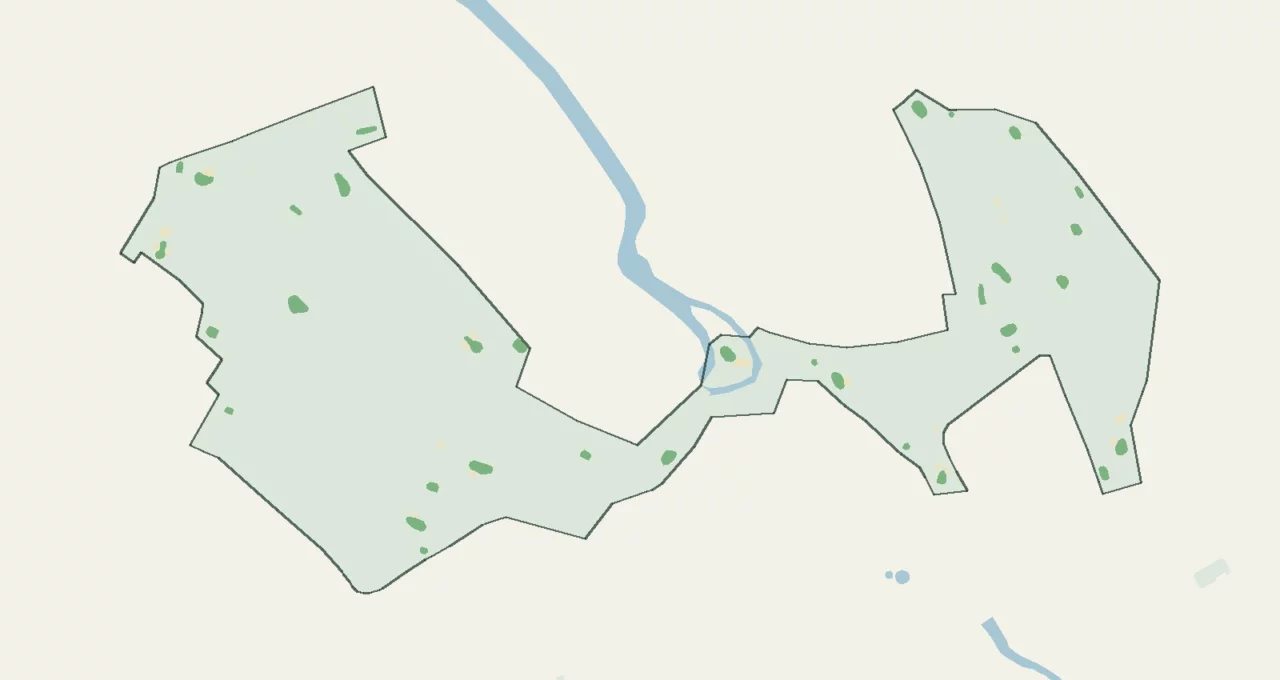
Layout of Moyola Park Golf Club from OpenStreetMap survey data (ODbL licence).
Moyola Park Golf Club
Holes
18
By
71 (men); 72 (women)
Length
6,454 yards from the white tees, 6,238 yellow, 6,081 green, 5,622 red (Golf Ireland certificate, January 2026); 6,383 from the whites on the GolfPass card, 6,519 in the Discover Northern Ireland listing
Green fee
—
Best season
—
Moyola Park Golf Club lies on the edge of Castledawson, a village in south County Londonderry, Northern Ireland, a few miles from the north-western shore of Lough Neagh and close to the market town of Magherafelt. The course is laid out in the old Shanemullagh estate of the Dawson and Chichester-Clark families, and the River Moyola runs through it on its way to the lough. The club’s postal address is 15 Curran Road, Castledawson, BT45 8DG. It is an eighteen-hole parkland course of par 71, measuring 6,454 yards from the white tees on the course rating certificate issued by Golf Ireland with effect from 1 January 2026, with a course rating of 72.4 and a slope of 129. The club credits the design to the golf course architect Don Patterson, assisted by Sam Allen as consultant, and dates the official opening to 9 September 1977.
It is not a famous course outside Northern Ireland, and it appears in none of the national rankings we consulted. Today’s Golfer, which gives it three out of five, calls it one of the best hidden gems among Ireland’s courses and a little-known parkland that flows through an enchanting old estate. What brings visitors back, judging by every source we read, is a short hole near the end: the 17th, a par 3 played across the river to a green on an island.
A golf club on Lord Moyola’s estate
The estate is far older than the golf. According to Wikipedia, Moyola House was built in 1713 by Joshua Dawson, Chief Secretary for Ireland, who had founded the village, originally known as Dawson’s Bridge, a few years earlier. The estate, Shanemullagh, takes its name from the townland, which Wikipedia glosses from the Irish as the old hilltop. Through marriage the property passed to the Chichester-Clark family, and James Chichester-Clark, born at Moyola Park in 1923, was Prime Minister of Northern Ireland from 1969 to 1971 before taking the title Baron Moyola. Wikipedia gives the whole estate as 450 acres and the golf course as 130 acres of mature wooded parkland.
The club’s own history begins elsewhere. In the 1960s, it says, a well-known local businessman, Thomas M. Glass, set out to bring golf to the South Derry community. His committee surveyed sites across the area and settled on the Glenshane Pass, but after long discussions with the Department of the Environment over planning permission the project was judged too great a financial risk and abandoned. In 1975 Lord Moyola approached Mr Glass to gauge local interest in a course on his estate. A meeting at Walsh’s Hotel in Maghera on 27 November 1975 formed a new committee, with Mr Glass as chairman, and the club dates its birth to that night.
Don Patterson was appointed to shape the course out of the estate, with Sam Allen as consultant and Colm Mulholland as contractor. The first club council met in the clubhouse on 17 January 1977, when eleven women also formed the first ladies’ committee. The first nine holes were finished in the spring of 1977 and the first competition was played over them on 7 June. On 9 September 1977 the club was officially opened by Don Moncrieff, followed by an exhibition match with Christy O’Connor Senior, Paul Leonard, Barry Brennan and Norman Drew. By then, the club says, it had 266 members and all eighteen holes were open. Its first pro-am, on 9 August 1979, drew 54 of Ireland’s leading golfers; nobody broke par and the winner, Phil Posnett, returned a level par 72, a figure that suggests the course then played to par 72 rather than today’s 71.
In November 1979 Lord Moyola told the club council he would consider selling the clubhouse and granting a 90-year lease on the course, and on 3 March 1980 the council bought the clubhouse, took the lease and assumed the upkeep of both. The clubhouse, also called Shanemullagh, is described by the club as a Georgian house in its own gardens, with a large function room added at the back. A few months later, on 11 August 1980, Seve Ballesteros came to play an exhibition match and give a clinic, partnered by Royal Portrush’s David Young, Des Smith and Peter McEvoy, in front of a large crowd and the cameras of Ulster Television. The club captain of the day explained that the aim was to put Moyola firmly on the golfing map.
The estate also carries a wartime memory. The club’s history records that American soldiers, the best known of them from the 82nd Airborne Division, were stationed on the Moyola Park estate during the Second World War, with their command post on the ground now occupied by the 13th, 14th and 15th holes in front of Moyola Park House. The 13th is still known as Yankies Garden. A memorial was placed in the garden at Gravesend by permission of the golf club and unveiled on VE Day, 8 May 2005, with veterans travelling from the United States for the occasion.
What the course asks of you
The current figures come from the Golf Ireland certificate of January 2026, published by the club. From the white tees the course measures 6,454 yards, par 71, with the front nine a par 36 and the back nine a par 35; the front nine is rated the harder of the two. The green tees measure 6,081 yards, rated 70.5 with a slope of 127 for men; the yellow tees 6,238 yards; and the red tees 5,622 yards, par 72 for women with a rating of 73.7 and a slope of 130. The club’s handicap tables, dated from 6 May 2026, cover the white, green and red tees. There is also a rated nine-hole version, which for men uses holes 1 to 8 and the 18th.
For individual holes we have only the scorecard published by GolfPass, which totals 6,383 yards from the whites and so appears to predate the current rating; we use it for the shape of the round, not for exact yardages. On that card there are four par 3s, the 4th, 12th, 16th and 17th, and three par 5s, the 5th, 13th and 18th. The opening holes are two solid par 4s of around 400 yards, the 3rd a short par 4 of about 300. The 8th, a par 4 of a little over 400 yards from the back, is stroke index 1, and the 14th, another long par 4, stroke index 2. The round finishes with two par 3s in a row, the second of them very short, followed by the longest hole on the course, a par 5 of more than 550 yards from the whites.
The club’s local rules, which still cite the pre-2019 numbering of the Rules of Golf, give a fair picture of what is out there. Out of bounds lies beyond the boundary fences and walls, in the former orchard at the 4th, in or over the stream alongside the 8th fairway, and beyond the perimeter of the island at the 17th. The river at the 8th is a water hazard, as is the drain to the left of the 15th fairway. A bridge carries play across the river on the 8th, and a wooden fence protects the left of the 5th fairway and the left of the 8th green. A roadway crosses the 5th fairway, and there is no relief from the road alongside the 9th, which the club calls an integral part of the course. Several shots are blind: there are bells to ring for the group behind on the 5th, 6th and 14th, viewing stairs on the 5th so that players can check the group ahead has gone, and a camera on the 6th fairway whose feed golfers can check on their phones before teeing off. Players coming from the 17th green have priority on the 18th tee.
The ground is not flat. Today’s Golfer describes towering oaks, a wooded hill and the river as the course’s beating heart, and notes that the hill carries greens and tees on both nines. The Discover Northern Ireland listing speaks of recent plantings of young trees to make play more difficult, and of accurate driving and constant care in choosing the club and the route between tee and green. It says difficult and easy holes are interspersed, building to what it calls the two feature holes, the 16th and the 18th.
Then there is the 17th. The same listing describes it as a new hole requiring a precise dropping shot across the river to a restricted island green, and says it makes the final three holes a truly vicious challenge. On the GolfPass card it measures 115 yards from all three men’s tees and 94 from the red, which makes it the shortest hole on the course by a distance and stroke index 16. The challenge is not length but precision: anything that misses the island is gone. The club’s local rules call the area beyond the perimeter of the island both out of bounds and a water hazard; we have not been able to establish which applies in practice, and players should check the card or ask in the shop.
What golfers say
The points below summarise the golfer reviews published on GolfPass, which the club itself directs visitors to and which include reviews from 2023 to 2026, together with the short verdict of Today’s Golfer. They are other people’s opinions, not ours. Nobody from Panxis has played the course, and we name no reviewer.
What comes up in its favour
- The 17th, above all. Reviewers repeatedly single it out as one of the best par 3s they have played, and several also pick out the 8th as a signature hole.
- Variety. Golfers describe a layout with a lot of different holes, where course management matters and a driver is not always the right club.
- Condition, in the main: fairways and greens in very good order, and greens described as fast and tricky, or small but rewarding a good shot.
- The welcome and the food. Friendly staff and the meals in the clubhouse bar come up again and again, and several reviewers call the course very good value.
- The setting: a mature parkland of old trees, the river and the estate around the old house.
What comes up against
- Drainage. Some reviewers found wet fairways, temporary greens and poor tees after rain, and one complained that this had not been flagged when booking through GolfNow.
- Mats. One reviewer says the 17th is played from mats all year round, and another mentions golfers using mats on the fairways.
- A long, hilly walk. Several advise a trolley or a buggy because of the climbs between the hills and valleys.
- Occasional organisation problems, such as a pro shop closed late on a Saturday afternoon and no scorecard to be had, or slow play on a bank holiday.
Getting there and when to go
The course is at the north-western edge of Castledawson, about half a mile from the village centre by our measurement on the map, and roughly three miles in a straight line from Magherafelt. The A6 between Belfast and Derry passes the village on its bypass. There is no railway in Castledawson any more: according to Wikipedia its station closed to passengers in 1950. The nearest station we found is Antrim, about fifteen miles away in a straight line, and Belfast International Airport is about sixteen miles away, both rather further by road. Toome, at the north-western corner of Lough Neagh, is a little over four miles to the east.
Visitors book tee times through the club’s online visitor booking page, which is linked from the home page, or by contacting the professional’s shop or the office; the club also points to GolfNow. Discover Northern Ireland, in its listing, gives Tuesdays and Thursdays as the best days for visitors, says restrictions apply on Saturdays, Sundays and Mondays, and says no handicap certificate is required. Societies are welcome on weekdays and on Sundays after 1pm, according to the club’s society page, with prizes from the pro shop and catering from the clubhouse restaurant on request. The shop is run by the club’s PGA professional, Gareth Shaw, and stocks equipment, clothing and electric trolleys, with club fitting and regripping.
Buggies may only be driven by people over 18, must stay at least ten yards from any green and, under the club’s rules, are not allowed during the winter months, November to March, or whenever the greenkeeper or council decides. The club enforces a dress code on the course and in the clubhouse: no denim, tracksuits, cargo trousers or trainers, tailored shorts only, and golf shoes on the course.
The club publishes no season and no opening hours that we could find. Given what reviewers say about drainage, and the buggy ban in winter, the course is likely to be at its best from late spring to early autumn, when the ground is firm and the trees around the old house are in leaf. In wet weather, call the club before setting out.
How this page was made
The factual frame comes from public sources: OpenStreetMap for the location and our distance measurements; the club’s website, read in October 2026, for the address, the history, the Ballesteros exhibition, the course rating certificate and handicap tables, the local rules and course notes, the visitor and society information, the buggy rules, the dress code and the golf shop; Golf Ireland’s certificate of January 2026, published on the club’s site, for the lengths, pars, ratings and slopes; GolfPass for its scorecard, its course details and its golfer reviews; Today’s Golfer for its verdict; Discover Northern Ireland for its course description and visitor days; the English Wikipedia articles on the club, Moyola Park, Castledawson and James Chichester-Clark for the estate, its history and the village. Wikidata identifies the club as Q6927744.
Where sources disagree, we say so. The length from the back tees is 6,454 yards on the Golf Ireland certificate of 2026, 6,383 on the GolfPass card and in Today’s Golfer, and 6,519 in the Discover Northern Ireland listing, which also gives a standard scratch of 71 against today’s rating of 72.4. The green tees are 6,081 yards on the certificate and 6,057 on the GolfPass card, the red tees 5,622 and 5,658. The certificate lists the yellow tees at 6,238 yards with a lower rating than the shorter green tees; we report it as printed. The club and Discover Northern Ireland credit the design to Don Patterson, GolfPass to Jeff Howes. The club dates its foundation to 27 November 1975 and its opening to 9 September 1977, while Wikipedia says it was founded in 1977 by James Chichester-Clark and his wife; the club’s history gives Mr Glass’s committee the initiative and Lord Moyola the construction. Discover Northern Ireland calls the 16th and 18th the feature holes, while Today’s Golfer and reviewers single out the 17th and the 8th. The club’s local rules describe the area beyond the island at the 17th as both out of bounds and a water hazard. The club gives its address as 15 Curran Road, OpenStreetMap as 15 Hillhead Road. Today’s Golfer lists no bar, pro shop or restaurant, which the club’s own pages contradict. In OpenStreetMap the course is linked to the Wikidata item for the Moyola Park estate rather than the club, and the club website linked from Wikipedia now leads to an unrelated site; we have used neither.
The opinion section summarises the golfer reviews on GolfPass and the verdict of Today’s Golfer, read in October 2026. We report recurring themes rather than individual voices, and we reproduce no quotations from reviewers. Nobody from Panxis has played or visited this course, and this page is no substitute for a round.
The club has not paid for this page, has not seen it before publication and has no say over its content. This page contains no commercial link and earns us no commission. If you know the club and something here is wrong or out of date, write to us and we will correct it.
Other courses nearby
Closest to this one in our British directory:
- Turnberry (Ailsa Course) — 78 mi
- Brodick Golf Club — 78 mi
- Colonsay Golf Club — 89 mi
- Prestwick Golf Club — 92 mi
The hole to know
Short par 3, 115 yards from the men's tees on the GolfPass card, described by Discover Northern Ireland as a precise dropping shot across the river to a restricted island green.