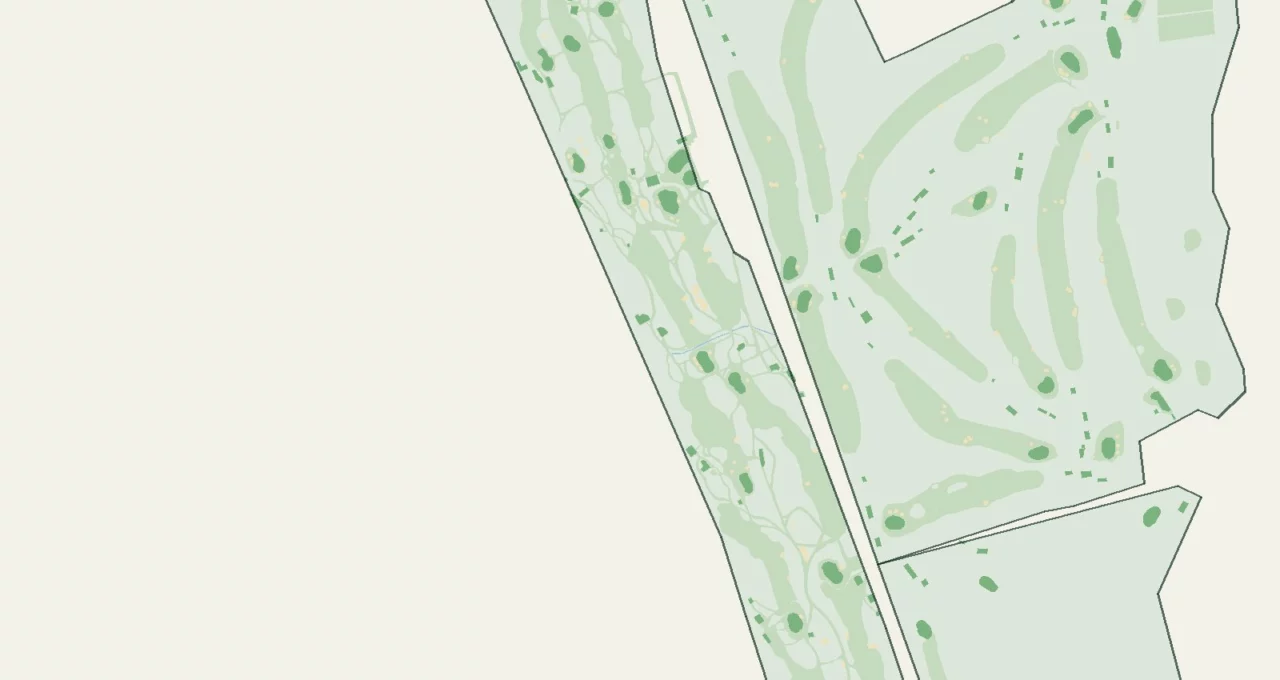
Layout of Western Gailes Golf Club from OpenStreetMap survey data (ODbL licence).
Western Gailes Golf Club
Holes
18
By
71 from every set of tees (club hole pages; Golf Monthly)
Length
7,014 yards from the back tees, then 6,640, 6,106 and 5,441 yards from the three other sets (club hole-by-hole pages; Golf Monthly lists the men's tees as blue, white, yellow and green); Top 100 Golf Courses gives 6,714 yards from the back tees
Green fee
—
Best season
Open all year; the club's visitor times cover the whole year, with winter play on weekdays and longer visitor windows from April or May to September
Western Gailes Golf Club lies on the Ayrshire coast at Gailes, between Irvine and Barassie, on a narrow strip of links land with the Firth of Clyde on one side and the Ayrshire Coast railway line on the other. The club’s postal address is Gailes Road, Irvine, KA11 5AE. It is a private members’ club with a single eighteen-hole links, par 71, which measures 7,014 yards from its back tees and 6,106 yards from the tees most club golfers use, according to the hole-by-hole pages of the club’s website. The club was founded in 1897, and the course is credited to its first greenkeeper, a Mr Morris; no famous architect laid it out, and the club itself says the original designer of its unusual routing is unknown.
Western Gailes has a strong reputation for a club without an Open on its record. Top 100 Golf Courses places it 43rd in Great Britain and Ireland, 16th in Scotland and 4th in Ayrshire and Arran, and Golf Monthly ranks it 46th in its UK and Ireland Top 100 for 2025/26, a position it has held, give or take a few places, since its 2009/10 list. It has staged the Curtis Cup, the PGA Championship and nine Scottish Amateur Championships, and it sits in a stretch of coast crowded with famous links: Glasgow Gailes is its immediate neighbour, Dundonald Links lies across the railway, and Royal Troon is a few miles to the south.
Four Glasgow golfers and a railway line
The club’s history page names four founders, William Johnstone, James Lang, Will G O Lindsay and Andrew McCulloch, all members of golf clubs in Glasgow in 1897. Their idea, the club says, was a course on the Ayrshire coast away from the industrial fog of the city and largely free from the winter frost, so that golf could be played all year round. Top 100 Golf Courses tells the same story more bluntly: four Glaswegians who were tired of muddy parkland.
The land came from the Sixth Duke of Portland, who agreed to lease it to the club and sold it to the club in 1920. A modified element of the Portland coat of arms is still part of the club’s crest, and the club says the Sixth and Seventh Dukes were both Honorary Presidents. The Dutch-language Wikipedia article on the club names the Seventh and Eighth Dukes instead; we follow the club.
The course was built quickly. The club says the first nine holes were ready for play by the spring of 1898, with the second nine following by May, and gives the credit to Mr Morris, whom Top 100 Golf Courses identifies as F. Morris. The sources disagree on the year of the second nine: Golf Monthly dates it to May 1899, and the Dutch Wikipedia article also says the full eighteen came a year after the first nine. The club stresses that the course was allowed to develop naturally from the terrain, and that in spite of later changes it remains largely unmodified from its original layout.
The railway made the club possible. A station was built at the club, the history page explains, and it was the way most members travelled until the 1950s; the last train left Gailes station at Hogmanay 1966. The line still runs beside the course, and it becomes a constant companion from the 14th onwards. A two-storey temporary clubhouse went up within the first year, the first permanent building followed in 1909, major alterations came in 1934 and the dining room extension in 1961. A new entrance was built in the mid 1990s, and a golf shop and new bag drops were added in the spring of 2013. In the main locker room the original lockers are still in place, some of them, the club says, handed down from founding members to their grandsons.
Two episodes reshaped the course. During the Second World War, tank manoeuvres on the links led to modified 10th and 17th holes, according to the club. Later, new 3rd, 4th and 5th holes were built to make way for an access road to Irvine harbour. Top 100 Golf Courses attributes that work to Fred W. Hawtree in the mid 1970s and speaks of four new holes rather than three; the Gazetteer for Scotland also dates Hawtree’s changes to the northern part of the course to the 1970s. The club adds that Tom Simpson probably had at least some influence on the course, and Top 100 Golf Courses notes that Western Gailes appears in the catalogue of Simpson and Company, without knowing what work Simpson actually did.
The most recent changes are the work of Mackenzie and Ebert. In a statement to Top 100 Golf Courses in August 2020, Tom Mackenzie explained that the firm was re-siting and restyling the drive bunkers to make them less severe but more striking to the eye, adding forward tees on some holes so that carries stay consistent in different winds, and reshaping some green surrounds, on the 5th, 9th and 18th among others. A first phase was completed early in 2020 and a second, finishing the bunker work, in the autumn of that year, with further phases possible. Golf Monthly reports that the bunkers have been returned to a more natural state and that some greenside bunkers have been replaced by run-off areas.
The club’s timeline lists the events it has hosted. Harry Vardon won a professional tournament promoted by the club in 1903, the year of his fourth Open title, and the Scottish Professional Championship was played here in 1923, the year the club says Gene Sarazen, then US Open champion, played the course with three other leading professionals. The Scottish Amateur Championship has come to Western Gailes in 1927, 1934, 1953, 1961, 1966, 1974, 1981, 2002 and 2011. England beat Scotland in an international match here in 1946 (the Dutch Wikipedia article says 1947). Tony Grubb won the PGA Championship in 1964, after a Western Gailes member, Billy Jack, had led at halfway. The United States won the Curtis Cup here in 1972 by ten points to eight. The British Seniors Amateur Championship was played in 1984 and 1998, the Scottish Seniors Open in 1996, the European Men’s Amateur Team Championship in 2007, with Rory McIlroy and Shane Lowry in the field and Ireland taking the gold medal, the Boys Home Internationals in 2014 and the Scottish Amateur Strokeplay Championship in 2017. The club’s timeline also records a member, Jack Gow, holing in one at both the 13th and the 15th in the same round in 1989, with the same ball and the same club.
Top 100 Golf Courses and the Gazetteer for Scotland both say the course is used for final qualifying when the Open goes to Troon or Turnberry. That was true in the past, but it is not a fixed rule: for the 2024 Open at Royal Troon, final qualifying took place at Burnham and Berrow, Dundonald Links, Royal Cinque Ports and West Lancashire, according to West Lancashire Golf Club.
What the course asks of you
The routing is the first thing to understand. The clubhouse sits halfway along the strip, which is rare on a links. The first four holes head north beside the railway; the next nine, from the 5th to the 13th, run south along the shore with the sea on your right, passing the clubhouse on the way; the last five turn north again, back along the railway. Golf Monthly notes that the strip is often only two holes wide. The practical result is that the wind changes its angle against you more than once, and on a coast where the prevailing wind is westerly and, according to Top 100 Golf Courses, can swing between south-west and north-west, no two rounds play the same.
The figures below come from the club’s hole-by-hole pages. Each hole is given four yardages, which add up to 7,014, 6,640, 6,106 and 5,441 yards. The club pages do not label the tees by colour; Golf Monthly lists four sets of men’s tees, blue, white, yellow and green, all par 71, with slope ratings of 146, 144, 137 and 129, and for women white, yellow and green tees, also par 71, with slopes of 144, 138 and 131. Par is 36 out and 35 home. There are only two par 5s, the 6th and the 14th, and three par 3s, the 7th, 13th and 15th. That leaves thirteen par 4s, several of them very long: the 5th (500 yards from the back tee), the 11th (477), the 12th (470) and the 17th (470).
The hazards are bunkers, burns and the shape of the ground rather than trees or water. Three burns wind across the strip, Top 100 Golf Courses explains, and many greens sit in folded ground, protected by a burn or tucked into hollows between the dunes. In a line reproduced on the club’s website, Frank Pennink observed that nearly half the greens lie in saucers or bowls that gather the ball, while just as many carry subtle slopes. Golf Monthly compares the course to Royal Lytham, in that the bunkering largely dictates strategy, and notes that the course relies very little on blind shots.
The opening stretch
The 1st, Station, is a short par 4 of 310 yards, and the club’s tip is to favour the right side of the fairway, using the road bridge as a line. The 2nd, Railway, 434 yards and stroke index 3, runs along the line with rough to the left and fairway bunkers to avoid. The 3rd, Arran, 387 yards, narrows the further you hit it, and the club warns that staying left of centre avoids a blind second to a green that slopes away from front to back. The 4th, Irvine, 417 yards, has a fairway that looks flat but gathers to the right towards the bunkers. These are the holes rebuilt for the harbour road, and they are the least seaside part of the round.
Along the shore
The 5th, at 500 yards, is the hardest hole on the card, stroke index 1, and one of the holes whose green surrounds Mackenzie and Ebert reshaped. Then comes the pair the club calls perhaps the finest back-to-back holes in world golf. The 6th, Lappock, 498 yards, is a par 5 that the club describes as the only links par 5 in the world that is all carry on the direct line: the tee shot crosses heather-covered dunes to a fairway running across and away from the tee, and the second has to find a fairway squeezed between two big dunes in front of the green, either laid up just right of the red and white barber’s pole that marks the back right of the green or flown all the way. The club cites Tom Doak’s Confidential Guide to Golf Courses, which rates the 6th and 7th as truly world-class holes.
The 7th, Sea, is the hole most people remember: a par 3 of 198 yards from the back tee and 153 yards from the third set, where the dunes are at their most dramatic. A dune ridge along the beach on the right and a lower one on the left give it, Golf Monthly writes, the feel of an amphitheatre for its whole length, and pot bunkers wait around the green. The club’s advice is simple: hit it dead straight, because anything long and left is lost, and a miss anywhere else usually means a four. The club also points out that it looks as difficult today as in a photograph from 1909.
The 8th, Burn, 393 yards, has a generous green that slopes steeply from back to front, with a burn in front that must be carried, and its tee, like that of the 10th, sits right beside the beach with the best views across to Arran, according to Golf Monthly. The 9th, Halfway, is a short par 4 of 336 yards where it is possible to run out of fairway from the tee; its long, narrow green is guarded by four deep bunkers. The 10th, Ailsa, 349 yards, is another burn-guarded green, and the club warns that going long leaves a fast putt back towards the water. The 11th, Plateau, 477 yards and stroke index 2, is aimed at the railway signal box in the far distance, over a fairway angled from left to right. The 12th, Dyke, 470 yards, is played towards the gable end of the last house, and the 13th, Barassie, is a par 3 of 154 yards where the wind has changed direction, a burn waits short and seven bunkers surround a generous green.
The way home
The turn north at the 14th, Whins, means playing with the prevailing wind, which makes the 592-yard par 5 a temptation for long hitters, and Top 100 Golf Courses notes that numerous bunkers lie in wait. The club still describes it as a difficult tee shot, with the third into a long, narrow green always tricky. The 15th, Heather, is a par 3 of 194 yards with dead ground over the front bunkers that allows a running shot onto a green that gathers the ball. Northern marsh orchids grow in the swale at the 15th and in front of the 16th tee in summer, the club says. The 16th, Camp, 428 yards, demands that you avoid the fairway bunkers, then weigh up a carry over the burn in front of the green.
The 17th, 470 yards and stroke index 4, is the one the club calls among the most testing par 4s in Scotland. The railway is on the right, a fairway bunker almost guarantees a double bogey, the line is the left edge of the clubhouse, and the approach always plays longer than it looks; short and right is lost. The 18th, 407 yards, is played on the starter’s hut to stay clear of the right-hand fairway bunkers, to a green that, the club warns, plays longer than it looks. The club’s pages give the name Ridge to both of the last two holes. The 18th has been reworked recently, and one recent reviewer believes the changes have lifted what was previously the weakest hole.
Visitors should choose their tees with care. One independent reviewer advises players off the white tees to expect many long shots into greens, often into a strong westerly, and recalls the starter’s advice that keeping the ball in play matters more than taking driver on every hole.
What golfers say
The points below summarise the golfer reviews published on Top 100 Golf Courses, the course review and reader comments on Golf Monthly, and an independent review on the UK Golf Guy website, all read in October 2026. Hole19 and Leading Courses show high average ratings, but we did not use the text of their reviews. These are other people’s opinions, not ours. Nobody from Panxis has played the course, and we name no reviewer.
What comes up in its favour
- A pure, traditional links. Reviewers describe firm ground, rumpled fairways, humps and hollows and greens set naturally in the dunes, and several call it the real thing among Scottish links.
- The 6th and 7th. The pair comes up again and again, and some reviewers rank them among the best consecutive holes they have played anywhere.
- The shoreside run. The nine holes heading south along the beach, from the 5th to the 13th, are singled out, as are the views to Arran from the tees beside the sand.
- Variety and no weak holes. Reviewers often say that no two tee shots look alike and that the course stands out less for one famous hole than for the absence of poor ones.
- A fair test. Several find it strategic and demanding without being brutal, with risk-reward decisions around the burns and the bunkers.
- The clubhouse and the welcome. The central clubhouse, full of memorabilia, the old locker rooms and the lunch come up often, and one reviewer says visitors are treated as members for the day.
- Standing. Some reviewers regard it as fit to stand beside the Open courses of the Ayrshire coast, and a hidden gem for visitors who come for Troon, Prestwick and Turnberry.
What comes up against
- No single iconic hole of the kind that defines the very top courses in Scotland, in the view of one reviewer, despite the quality throughout.
- A flatter finish. One returning reviewer found the closing holes flatter than remembered.
- The wind. On a strip this narrow and exposed, the wind can make the course very hard work, and one reviewer warns that from the longer tees there are many long approaches, often into the wind.
- Limited visitor times, a practical point from the club’s own information rather than from reviews. Visitor tee times are restricted to set windows, short ones on Tuesdays, Thursdays and weekends, and the club asks for a non-refundable deposit to guarantee a booking.
- A course for walkers, again from the club’s information. Buggies are only available with a medical certificate, which suits the purist but not every visitor.
Getting there and when to go
The course lies just south of Irvine, on the coast road between Irvine and Troon. The nearest railway stations are Barassie, about one and a half miles to the south in a straight line by our measurement on the map, and Irvine, about two miles to the north; both are on the Ayrshire Coast line from Glasgow, and both are further by road. Glasgow Prestwick Airport is about six and a half miles away in a straight line, and one independent reviewer puts the drive from Glasgow Airport at about 45 minutes. The old Gailes station that brought the first members from Glasgow closed at the end of 1966. Troon, a short drive to the south, is a common base for visitors who also want to play Royal Troon, Prestwick or Turnberry.
Visitors book directly with the club, by telephone, by e-mail or through the club’s online enquiry form. The visitors page, read through an archived copy in October 2026, gives the following windows: Monday, Wednesday and Friday mornings and afternoons; Tuesday and Thursday afternoons from April to September; Saturday afternoons from May to September; and Sunday afternoons. Tee times are strictly kept, and a non-refundable deposit is needed to guarantee a provisional booking. Groups of fewer than four may be paired with others. The handicap limits are 24 for men and 28 for women, and certificates may be requested. Jeans, trainers, non-tailored shorts, round-neck T-shirts and tracksuits are not allowed on the course or in the clubhouse.
Push trolleys can be hired from the club shop and clubs through the club; buggies are available only with a medical certificate. Caddies, who are self-employed, should be booked in advance. The club also takes part in the Gailes Golf Experience, a package with its neighbours. The clubhouse has a main bar and a dining room overlooking the course and the Firth of Clyde towards Arran, and the visitors page notes that the dining room does not serve visitors at weekends, when bar snacks are available instead.
The founders chose this coast for year-round golf, and the club’s visitor information covers the whole year, with winter play on weekdays. The longer visitor windows run from spring to early autumn, and the summer brings the wild flowers: the northern three-quarters of the course is part of the Western Gailes Site of Special Scientific Interest, which NatureScot describes as a stretch of foreshore backed by high fixed dunes, with rare dune plants between the foredunes and the railway. Expect wind at any time of year.
How this page was made
The factual frame comes from public sources, read in October 2026: OpenStreetMap for the location and our distance measurements; the club’s website for the history of the club, the event timeline, the course overview, the hole-by-hole pages with yardages, pars, stroke indexes and playing tips, the pages on the 6th and 7th and on the clubhouse, and the visitor information (without the prices); Top 100 Golf Courses for its course description, its rankings, its account of the architects and the 2020 statement from Mackenzie and Ebert, and its golfer reviews; Golf Monthly for its course review, its key information table with pars and slope ratings, and its ranking history; the UK Golf Guy review; the Gazetteer for Scotland; the NatureScot site management statement for the Western Gailes Site of Special Scientific Interest; West Lancashire Golf Club for the 2024 final qualifying venues; and the Dutch-language Wikipedia article on the club. Wikidata identifies the club as Q14518760 and gives 1897 as its year of foundation.
The club’s website refused our requests directly (HTTP 403), so we read its pages through copies held by the Internet Archive, captured between January 2025 and June 2026. The site appears to have been redesigned in 2026, and some pages may have changed since those copies were made.
Where sources disagree, we say so. The club gives 7,014 yards from the back tees by our addition of its hole pages, and says the course stretches to over 7,000 yards from the championship tees, while Top 100 Golf Courses gives 6,714 yards. The Gazetteer for Scotland gives par 75 from the championship tees; the club’s hole pages and Golf Monthly give par 71. The club’s course overview page shows some yardages from a different tee to its hole pages and lists the 4th as a par 3, which its own hole page contradicts; we used the hole pages. The club says three holes were rebuilt for the harbour road, Top 100 Golf Courses says four. The second nine opened in 1898 according to the club’s wording and in 1899 according to Golf Monthly. The Dutch Wikipedia article dates the Scotland against England match to 1947 and the John Owens seniors title to 1996, where the club’s timeline says 1946 and 1984, and names different Dukes of Portland as Honorary Presidents. Some secondary listings name Tom Simpson or James Braid as architects; the club and Top 100 Golf Courses credit Mr Morris, with possible influence from Simpson and later work by Fred W. Hawtree.
The opinion section summarises the reviews on Top 100 Golf Courses, Golf Monthly and UK Golf Guy. We report recurring themes rather than individual voices, and we reproduce no quotations from reviewers. Nobody from Panxis has played or visited this course, and this page is no substitute for a round.
The club has not paid for this page, has not seen it before publication and has no say over its content. This page contains no commercial link and earns us no commission. If you know the club and something here is wrong or out of date, write to us and we will correct it.
Other courses nearby
Closest to this one in our British directory:
- Dundonald Links — 0 mi
- Kilmarnock (Barassie) Golf Club — 1 mi
- Prestwick Golf Club — 5 mi
- Annanhill Golf Club — 6 mi
The hole to know
Sea, a par 3 of 198 yards from the back tee, played through an amphitheatre of dunes with the beach ridge on the right; the club says it demands the straightest of tee shots, with anything long and left lost and a four the likely score from any other miss.