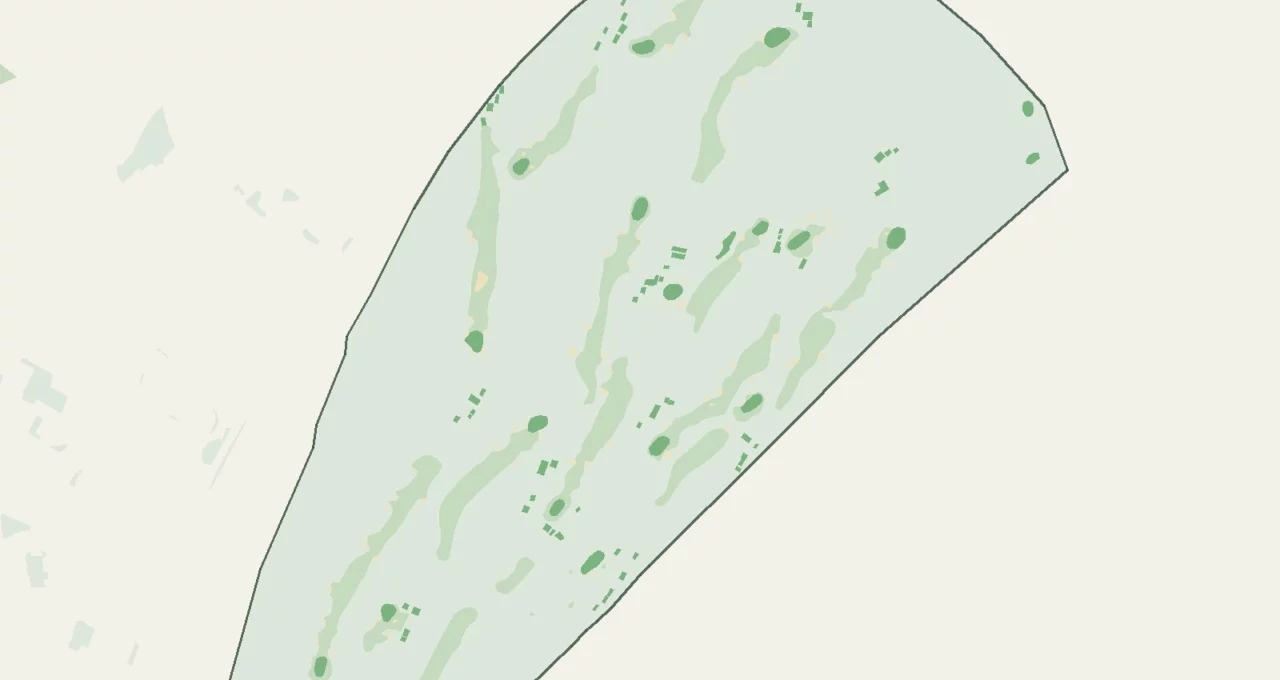
Layout of Royal County Down Golf Club from OpenStreetMap survey data (ODbL licence).
Royal County Down Golf Club
Holes
18 on the Championship Links, plus the 18-hole Annesley Links (club website)
By
71 for men from the blue, white and yellow tees; 76 for ladies from the red tees (club scorecard). Annesley Links: par 67 (club scorecard)
Length
7,206 yards from the blue tees, 6,925 white, 6,668 yellow, 6,249 red (club scorecard); Wikipedia gives 7,186, 6,878 and 6,675
Green fee
—
Best season
Visitor season 20 April to 16 October 2026 and 19 April to 15 October 2027 (club website)
Royal County Down Golf Club is a members’ links club in Newcastle, County Down, on the shore of Dundrum Bay at the foot of the Mountains of Mourne, about 30 miles south of Belfast. It was founded as the County Down Golf Club on 23 March 1889 and received royal patronage from King Edward VII in 1908. It has two 18-hole courses laid out in the same dunes: the Championship Links, the subject of this page, and the shorter Annesley Links. The club’s own scorecard gives the Championship Links 7,206 yards from the blue tees and 6,925 from the whites, with a men’s par of 71. The course lies within the Murlough Nature Reserve, and the club describes its land as a Special Area of Conservation and an Area of Special Scientific Interest. The club’s website is royalcountydown.org.
Few courses carry a reputation of this weight. Golf Digest placed the Championship Links first in its World’s 100 Greatest Golf Courses for 2026 to 2027, its sixth consecutive time at the top of that list according to RTÉ. Golf Monthly ranks it first in the UK and Ireland in its 2025/26 list, and Today’s Golfer moved it to first in its 2026 UK and Ireland ranking, narrowly ahead of the Old Course at St Andrews.
Name and location
The club calls itself Royal County Down Golf Club, and its postal address is 36 Golf Links Road, Newcastle, Co Down, BT33 0AN. OpenStreetMap names the ground Royal County Down Golf Course and links it to the Wikidata item Q1881861 and to the English Wikipedia article on the club. Wikipedia places the club in the district of Newry, Mourne and Down. The map at the foot of this page uses the OpenStreetMap position, at the northern edge of the town between the clubhouse and the dunes that run towards the mouth of Dundrum Bay.
The club’s history credits the railway from Belfast, opened in the 1860s, with turning the fishing village into a seaside resort.
A history in three layers
The club’s history and heritage page dates the foundation to a meeting held on 23 March 1889 in Lawrence’s dining rooms beside the railway station. A nine-hole course was laid out the same year. In July 1889, according to the club, Tom Morris of St Andrews visited and advised on the ground for an expense not to exceed four pounds, and on his advice an 18-hole course was created and ready by the middle of 1890. Top 100 Golf Courses tells the story slightly differently: it credits George L. Baillie with the first nine holes in 1889 and says Old Tom Morris was paid four guineas to extend the course to 18 holes in 1890. The club’s page does not name Baillie.
The land came from the Annesley family. Hugh Annesley, 5th Earl Annesley, agreed to lease the ground nearest the town and became the club’s first president; he died in December 1908. His son Francis succeeded him and was killed in November 1914 when his aeroplane was shot down over the Belgian coast; the club never elected another president. The second course carries the family’s name.
The second layer of the course is the work of a member. Between 1900 and 1912, the club says, George Combe took charge of the links and created two loops of nine holes, helped by the leading professionals of the day: Sandy Herd, James Braid, Ben Sayers, Harry Vardon and J.H. Taylor. By 1912 the second loop was much as it is played today. Combe was also the first honorary secretary of the Golfing Union of Ireland, founded in 1891. Top 100 Golf Courses credits Vardon with modifications in 1908, the year of royal patronage.
The third layer came in 1926, when Harry Colt redesigned the front nine and created new 4th and 9th holes, according to the club; Top 100 Golf Courses says Colt altered the greens and reduced the number of blind drives. Since then the changes have been small. The club records that the 16th was rerouted in 2004, which it calls the only significant change since 1926 apart from added tees. Top 100 Golf Courses lists Donald Steel among the course’s architects and says Martin Ebert reshaped the 16th green and filled in the pond on the 17th in 2021. The club’s hole guide no longer mentions a pond on the 17th, only a sand area out of sight from the tee; a review written in 2013 still describes the pond in the middle of the fairway.
In 1895 the original 1st and 18th holes were given up for a clubhouse and the Slieve Donard Hotel. The men’s clubhouse opened in 1897 and was extended in 1989 and 2004; the ladies’ clubhouse of 1895 was rebuilt in 2025, according to the club.
Championships and players
The club’s history lists a long record of championships. The Irish Open Amateur Championship, first held in 1892, has been played at Newcastle 17 times since 1893, with John Ball winning in 1893 and Harold Hilton in 1900. The Irish Open came in 1928, 1935 and 1939, then returned in 2015 with Rory McIlroy as host, and again in 2024, when Rasmus Højgaard won by one stroke from McIlroy, finishing with three birdies according to press reports. The 2015 edition was won by Søren Kjeldsen.
In amateur golf, Michael Bonallack won his fifth and last Amateur Championship here in 1970, and Graeme Storm won it in 1999. The club hosted the Curtis Cup in June 1968, the first played in Ireland, and the Walker Cup in September 2007; the United States won both, the latter by the narrowest margin. The club also hosted the Palmer Cup in 2012 and the European Ladies’ Team Championship in 2021. The club says the British Ladies’ Amateur has been played at Newcastle a record nine times; Wikipedia counts eight editions from 1899 to 2006 and mentions a further one in 2019, citing an article from 2018. The Senior British Open was played here in 2000 and 2001 according to the club, and Wikipedia adds 2002.
The course record named by the club is 66, set by Jimmy Bruen during the 1939 Irish Open. Harry Vardon won the club’s Irish Professional Tournament in 1898, a few weeks after winning The Open.
What it asks of you
The club’s Championship Links page publishes the current scorecard. It gives four sets of tees:
- Blue tees: 7,206 yards (3,579 out, 3,627 home), men’s par 71, slope 145.
- White tees: 6,925 yards (3,421 out, 3,509 home), men’s par 71, slope 136.
- Yellow tees: 6,668 yards (3,287 out, 3,381 home), men’s par 71, slope 134.
- Red tees: 6,249 yards (3,089 out, 3,160 home), ladies’ par 76, slope 151.
The card shows no course rating. Wikipedia gives a course rating of 75.0 and a slope of 142 from the back tees, with lengths of 7,186 yards from the back, 6,878 from the whites and 6,675 from the yellows, all slightly different from the club’s current card; we follow the club’s figures.
The men’s card goes out in par 35 and comes home in par 36. There are four par 3s, the 4th, 7th, 10th and 14th, ranging from 144 to 229 yards from the blues, and three par 5s, the 1st, 12th and 18th. The rest are par 4s, several of them long: the 3rd is 475 yards from both blue and white tees, the 9th 483 from the blues and the 15th 468. The hardest hole for men by stroke index is the 8th, a par 4 of 429 yards from the blues, followed by the 15th and the 3rd. For ladies, five holes that are par 4s for men become par 5s, the 3rd, 8th, 9th, 13th and 15th, and the 6th is stroke index 1.
Narrow ribbons of fairway thread through high sand dunes. Purple heather and golden gorse line the fairways and punish anyone who strays. The bunkers, which the club calls bearded, have overhanging lips of marram, red fescue and heather. Many greens are fast and domed, and reject any shot lacking conviction. The club presents it as a test of the bump and run.
The card, hole by hole
The club’s hole by hole guide describes every hole. In summary, with yardages from the blue and white tees as printed on the club’s scorecard:
- 1st, par 5, 539 and 523 yards: straight, with Dundrum Bay right and a high dune left, to the longest green on the course.
- 2nd, par 4, 444 and 424 yards: a blind drive, best down the left; an approach missed right kicks into a grassy hollow.
- 3rd, par 4, 475 yards from both: from a raised tee above the bay to a flat green among the fastest and hardest to read.
- 4th, par 3, 229 and 215 yards: one of Colt’s holes, from a high tee over gorse and bunkers to a long, narrow green with severe run-offs.
- 5th, par 4, 440 and 429 yards: a blind drive over a white marker stone, then a well-protected green where three putts are common.
- 6th, par 4, 396 and 369 yards: another blind drive, to a small green shaped like an upturned saucer.
- 7th, par 3, 144 and 135 yards: the shortest hole; anything long falls away sharply.
- 8th, par 4, 429 and 424 yards: stroke index 1 for men, to a fast, narrow green near the highest point of the course, where the wind affects even putting.
- 9th, par 4, 483 and 427 yards: the hole the club calls one of the most photographed in world golf, with a drive over a black post on the line of the mountains and a second over two cross bunkers.
- 10th, par 3, 196 and 188 yards: deep-faced bunkers both sides; the safe miss is left.
- 11th, par 4, 442 and 430 yards: a blind drive over a marker stone into a dogleg right, with dead ground short of the green.
- 12th, par 5, 545 and 525 yards: reachable for strong players, over two bunkers short of a green that falls away on all sides.
- 13th, par 4, 446 and 423 yards: between heather-banked dunes to a green in its own amphitheatre, which the club says produces the most three-putts.
- 14th, par 3, 212 and 202 yards: the last short hole, from a raised tee, bunkers either side of the front.
- 15th, par 4, 468 and 454 yards: the club’s most underrated par 4, uphill over a marker stone to another upturned-saucer green.
- 16th, par 4, 337 and 318 yards: a short par 4 for match play, driveable for long hitters, with a large bunker for those laying up.
- 17th, par 4, 433 and 416 yards: usually into the prevailing wind, with a sand area hidden from the tee and a basin-shaped green.
- 18th, par 5, 548 yards from both: towards the mountains, past 18 bunkers, to one of the toughest greens.
The figures on the card and in the guide do not always agree. The guide gives 525, 478, 469 and 455 yards for the 12th, where the card has 545, 525, 469 and 455, and 454 yards from the yellow tee on the 15th, where the card has 447. The club’s description of the 9th calls it a 486-yard par 4 played from one side of a huge mound down to a fairway some 60 feet below and 260 yards from the tee; the card gives 483 from the blues.
Read together, the guide describes a course of blind or partly blind drives over marker stones and dunes, long par 4s, small and fast greens with steep run-offs, and wind as a constant factor. Golfshake’s review, first written in 2013 and republished in 2024, counts the drives on the 2nd, 9th and 11th among the blind shots and calls the 9th perhaps the most intimidating drive in the game; it adds that some players will not reach the crest and will have to play the hole as a par 5.
The Annesley Links
The club’s second course shares the same dunes and, in the club’s words, the same views of sea, mountains and duneland. It is much shorter: the club’s Annesley Links scorecard gives 4,594 yards from the whites, 4,397 from the yellows and 4,218 from the reds, for a par of 67 (34 out, 33 home), with five par 3s and no par 5. The club credits Martin Ebert with major updates and completely new holes, without giving a date. Wikipedia gives par 66 and 4,617 yards, and Golfshake’s 2013 review also gives par 66; these figures appear to predate the changes. Golfshake suggests playing the Annesley first to learn the shapes of the ground before tackling the Championship Links.
What golfers say
Royal County Down has a large body of public opinion. We read the Top 100 Golf Courses page, with an average of 5.5 out of 6 across 166 reviews and the ten most recent of them, written between February and October 2026; the Google rating relayed by Wanderlog, 4.7 out of 5 from 566 reviews; Golfshake’s course review; and search summaries of GolfPass, Golf Monthly’s forum, National Club Golfer and other reviews, since several of those pages refused our requests. The points below summarise what recurs. They are other people’s opinions, not ours; nobody from Panxis has played the course, and we name and quote no one.
What comes up in its favour
- The setting is mentioned more than anything else: the Mournes behind, the bay alongside, and the views from the high tees on the 4th and 9th.
- The front nine, closer to the sea, is widely regarded as one of the finest stretches of links golf anywhere.
- Condition draws consistent praise, with greens described as fast, true and immaculate.
- The variety and strength of the holes, with several reviewers saying there is no weak hole on the course.
- The caddies are described as knowledgeable and polite, and staff in the shop and clubhouse as friendly; the historic atmosphere of the clubhouse is mentioned too.
What comes up against
- Blind tee shots are the most frequent criticism, although many reviewers defend them as part of the character of the ground; most advise first-time visitors to take a caddie.
- The back nine, which turns inland after the 13th, is often judged weaker than the front, and some find the last two holes slightly weak; others reply that it suffers only by comparison with an exceptional front nine.
- Difficulty: from the back tees the course is called a brute and penal, the bearded bunkers can send a ball sideways and the heather and gorse punish wayward shots.
- Price: the cost of a visitor round comes up in Google reviews, with expectations of service raised accordingly, and one reviewer found the bar service in the visitors’ room less than courteous.
Opinion is overwhelmingly positive; criticism concerns difficulty and price more than condition or welcome.
Playing as a visitor
The club’s booking enquiry page says tee time availability for visitors is exceptionally limited. Visitors request a time through the enquiry form, and the club’s reservations team checks availability. For 2026 the visitor season on both courses runs from 20 April to 16 October, and for 2027 from 19 April to 15 October. The Championship Links is available to visitors on Mondays, Tuesdays, Thursdays, Fridays and Sundays; the Annesley Links on Mondays, Thursdays, Fridays and Sundays.
The conditions are strict. Full payment is required at the time of booking, bookings are non-transferable and non-refundable, and rounds are never held as credit, although the club refunds in full on request if it cancels because of the weather. All play on both courses is in four-balls, and smaller groups may be combined with other golfers. Every group must have at least one caddie; if none has been booked, the club assigns a forecaddie. Caddie fees are paid in cash directly to the caddie at the end of the round, and the club points out that there is no cash machine on site, though there are some in Newcastle within walking distance. GolfPass, according to search summaries, says a caddie is required unless the player has played the course at least three times; the club’s page sets the rule per group. Buggies cannot be accommodated. Hire clubs and electric trolleys are available.
The club’s visitor information page sets out the day itself. Visitors check in at the clubhouse and meet the starter at least ten minutes before their time. There is a staffed practice area, with transport to it, and putting and chipping greens beside the clubhouse. Visitors use the Murlough Room, overlooking the links, with dining and a bar, and a van at the 10th tee sells snacks and drinks.
The dress code is traditional on the course and in the clubhouse: collared shirts, tailored trousers, shorts, skirts and skorts, with sleeveless collared tops acceptable for women; no blue denim, collarless T-shirts, cargo shorts, tracksuits, leggings, flip-flops or slides. Soft-spiked shoes are strongly advised and hats come off indoors.
Getting there and when to go
The club is at 36 Golf Links Road, Newcastle, BT33 0AN. According to its contact page, Newcastle is 30 miles south of Belfast via the A24, about an hour’s drive, and 90 miles north of Dublin via the M1, N1 and A1 to Newry and then the A25, about two hours. The office and reservations can be reached on +44 (0)28 4372 3314 or at golf@royalcountydown.org, and the professional’s shop on +44 (0)28 4372 2419.
Visitor bookings fall between late April and mid-October. Golfshake notes that the course is playable all year and that autumn brings softer fairways and more forgiving greens. The wind, which the club’s guide mentions on the 8th and the 17th, is part of every round.
Green fees
Royal County Down publishes separate visitor rates for the Championship and Annesley Links and for each season, with charges for hire clubs and electric trolleys and caddie fees paid on the day: see the club’s website for current prices.
How this page was made
The factual frame comes from public sources: OpenStreetMap for the location and name of the course; Wikidata for the linked item; the club’s website for its history, championships, scorecards, slopes, hole guide, conservation status, visitor season, booking conditions, caddie rules, dress code and contact details; Wikipedia’s article on Royal County Down Golf Club for its course rating and alternative figures; Top 100 Golf Courses for Baillie, the 1908 and 2021 changes and its review summary; Golf Digest through RTÉ, Golf Monthly and Today’s Golfer for the rankings; press reports for the 2015 and 2024 Irish Opens; and Golfshake, Wanderlog’s relay of Google reviews and search summaries of GolfPass, Golf Monthly’s forum and National Club Golfer for the opinions summarised above.
Where sources disagree, we say so. The club credits Tom Morris with advice in 1889 for no more than four pounds and does not name George L. Baillie, while Top 100 Golf Courses gives Baillie the first nine holes and pays Morris four guineas in 1890. The club dates the only significant change since 1926 to the rerouting of the 16th in 2004, while Top 100 Golf Courses records further work by Martin Ebert in 2021 on the 16th green and the 17th pond. Wikipedia’s lengths (7,186, 6,878 and 6,675 yards) and slope (142) differ from the club’s card (7,206, 6,925 and 6,668 yards; slope 145 from the blues), and the club’s hole guide differs from its card on the 12th and 15th; its own description of the 9th gives 486 yards where the card gives 483. The club counts nine British Ladies’ Amateurs, Wikipedia eight plus one more in 2019; the club lists the Senior British Open in 2000 and 2001, Wikipedia in 2000, 2001 and 2002. The Annesley Links is par 67 over 4,594 yards on the club’s card and par 66 over 4,617 yards on Wikipedia.
Golf Monthly’s course review returned an incomplete page, GolfPass refused our requests, and the individual Top 100 Golf Courses reviews beyond the ten most recent were not read in full; where we rely on search summaries we have said so, and we have not used them for any course figure. We found no course rating on the club’s own card and no date for Martin Ebert’s work on the Annesley Links. Green fee and hire amounts are deliberately left out.
The opinion section summarises reviews and descriptions read in October 2026. We report recurring themes rather than individual voices, and we reproduce no quotations from reviewers. Nobody from Panxis has played or visited this course, and this page is no substitute for a round.
The club has not paid for this page, has not seen it before publication and has no say over its content. This page contains no commercial link and earns us no commission. If you know the course and something here is wrong or out of date, write to us and we will correct it.
Other courses nearby
Closest to this one in our British directory:
- Moyola Park Golf Club — 47 mi
- Holyhead Golf Club — 82 mi
- Turnberry (Ailsa Course) — 86 mi
- Storws Wen Golf Club — 91 mi
The hole to know
The hole the club calls one of the most photographed in world golf: a par 4 of 483 yards from the blue tees (486 in the club's description), with a drive over a black post towards the Mournes down to a fairway some 60 feet below, then a second over two cross bunkers to a raised green; one of the two holes Harry Colt created in 1926.