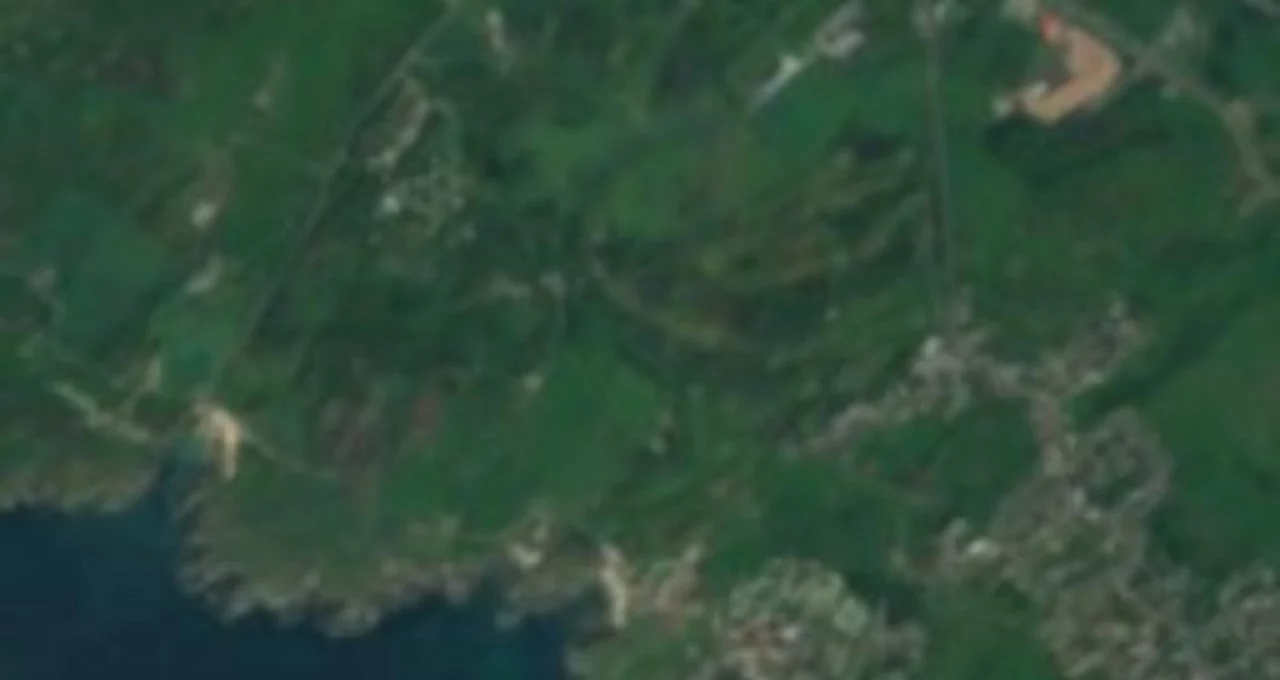
Holyhead Golf Club from space. Sentinel-2 cloudless 2016 by EOX IT Services GmbH (contains modified Copernicus Sentinel data), CC BY 4.0.
Holyhead Golf Club
Holes
18 (club website); opened with 14 holes in 1912, completed to 18 about two years later (club history)
By
71 from the men's white tees, 68 yellow, 67 red; 74 for women from the white and yellow tees, 72 red (club scorecard)
Length
5,999 yards from the white tees, 5,647 yellow, 5,186 red (club scorecard, updated August 2023); directories give between 5,962 and 6,100 yards
Green fee
—
Best season
Visitor rates for a low season in April and October and a high season from May to September; society packages and winter membership also cover November to March (club website)
Holyhead Golf Club is an 18-hole heathland course by James Braid on Holy Island, the small island off the west coast of Anglesey, set on high, rocky ground between the port town of Holyhead and the village of Trearddur Bay. The club was formed in 1912 on the initiative of the London and North Western Railway’s marine superintendent at Holyhead, and its course opened that summer with 14 holes before being completed to 18 about two years later. The club’s scorecard gives 5,999 yards and par 71 from the men’s white tees, with a course rating of 70.6 and a slope of 128, figures that say a good deal about a course that is short on paper and not short in practice. Gorse, bracken and outcrops of rock line the fairways, and several holes are played blind. The club’s website is holyheadgolfclub.co.uk.
It is a members’ club that takes visitors and societies, with online tee booking, a professional’s shop with buggy and trolley hire, a restaurant and bar in the clubhouse, and accommodation on site. It belongs to the Association of James Braid Courses, and it sits in the Top 100 Golf Courses ranking of Welsh courses. In Welsh golf it comes under Wales Golf, the national governing body.
Name and location
Despite the name, the course is not in Holyhead town but on its southern edge, on Lon Garreg Fawr at Trearddur Bay, postcode LL65 2YL, and the club gives both place names in its address. Holy Island, Ynys Gybi in Welsh, is joined to the rest of Anglesey by road and rail causeways, and Holyhead is its main town and the ferry port for Dublin. OpenStreetMap names the course Holyhead Golf Club and links it to the Wikidata item Q24883782, which describes it as a golf course in Anglesey and adds little beyond coordinates and the club website. The coordinates held by Wikidata, by Wikipedia and by Visit Wales all fall within about 250 metres of the centre of the course as drawn in OpenStreetMap; the map at the foot of this page uses the OpenStreetMap position. By that position, Holyhead railway station lies a little over two kilometres to the north as the crow flies, consistent with Visit Wales’s description of the club as about a mile from the port.
History: a railway company’s golf course
The club’s history page is detailed and draws on local newspapers, minute books and census returns. Its starting point is the growth of Holyhead in the nineteenth century as the main mail and passenger route to Ireland: the Chester to Holyhead railway was completed in 1848, the breakwater in 1873 and the new inner harbour in 1880, and by 1883 the London and North Western Railway, the main investor in the port, ran 14 ships from it. Trearddur Bay became a summer retreat for wealthy and influential families, who built what were known locally as the Big Houses, and it was this group, with local professional men, that the club credits with the impetus for golf.
There was golf on the bay before the present club. The history cites an 1893 brochure for a Tre-Arddur Golf Club, run from the Trearddur Bay Hotel, which stood on the links, and admitting that the links were occasionally allowed to get out of order when visitors were few. The club understands this to have been a nine-hole course financed by the hotel, on land leased from the family of Trecastell, near Beaumaris. The hotel was run by the Roberts family, and the 1911 census lists one of the sons, Hugh Cornelius Roberts, aged 25, as a golf professional. In 1910 the Holyhead Chronicle reported that Admiral Burr had presented a cup to be played for on the Trearddur Bay links. Search summaries of the Golf’s Missing Links website, which was offline when we tried to read it, mention a report of a course in the area in 1891; we could not check that page, and we do not rely on it.
In December 1910 a meeting at the Station Hotel in Holyhead discussed establishing a good 18-hole links, and a committee was appointed. According to the club, suitable land had already been identified and the London and North Western Railway promised the money, so the project went ahead at once. The club gives the credit largely to Commander G. E. Holland, superintendent of the railway’s Holyhead Marine Department, who became the first secretary. A biography published by the local history site Holyhead Stories of a Port says the same: that the creation of the golf club was due to his initiative. The same article records that Holland, a former Royal Indian Marine officer who joined the railway in 1907, found work at the golf club for railwaymen during the 14-week Irish goods strike of 1913 rather than see them laid off, and that he died in 1917 as a brigadier general, after directing inland water transport in France.
The land was leased. The largest part, about 86 acres known as the Warren, came on a 30-year lease from Lord Sheffield and included the gamekeeper’s cottage that became the greenkeeper’s cottage and part of Ty Mawr Farm. Another 28 acres, much of it marshland, came from Mr Hope Atkin of Isallt Fawr; the club says this ground now carries parts of the third to seventh holes. A last piece, including the present car park and a small part of the third fairway near the tee, was leased from Lord Boston after difficult negotiations. Top 100 Golf Courses describes the whole as a compact site of 104 acres.
James Braid, who had already worked for the railway company on its Scottish courses, was engaged to lay out the course and first visited in 1911. The club quotes the Holyhead Chronicle on the opening of a temporary course of 14 holes, with Admiral J. Leslie Burr, the club’s captain, driving the first ball, and a foursome in which the admiral and the club professional, Mr Hockey, beat Commander Holland and Mr T. R. Evans by 3 and 1. A contemporary account kept by the club remembers the admiral’s opening drive as a poor one that went only a few yards. Work then continued for two more years before the full 18 holes were finished. In the early years the catering and bar were run by the Station Hotel, and the railway’s hotels department organised parties of golfers and a car to take them from the hotel to the course, with a picnic lunch.
The club’s history does not say how much of Braid’s layout survives unchanged, and we found no record of later redesigns. Top 100 Golf Courses points to old-fashioned features that remain, among them fairways that cross at the 6th and 7th and short par 4s at the 1st and 14th, and National Club Golfer also mentions crossing fairways from the original design.
What it asks of you
The card on the club’s course details page, last updated in August 2023, sets out six sets of figures:
- Men’s white tees: 5,999 yards, par 71, course rating 70.6, slope 128.
- Men’s yellow tees: 5,647 yards, par 68, course rating 69.2, slope 120.
- Men’s red tees: 5,186 yards, par 67, course rating 67.0, slope 117.
- Women’s white tees: 5,999 yards, par 74, course rating 76.3, slope 132.
- Women’s yellow tees: 5,647 yards, par 74, course rating 74.4, slope 128.
- Women’s red tees: 5,186 yards, par 72, course rating 71.6, slope 122.
The par changes with the tee more than on most courses. From the white tees the 3rd (479 yards), the 10th (468) and the 12th (517) are par 5s; from the yellow tees, at 426, 431 and 443 yards, all three become par 4s, which is why the men’s par drops from 71 to 68 for a loss of only 352 yards. From the men’s red tees the 9th, a par 5 of 484 yards from the whites, becomes a par 4 of 381. The result is a men’s yellow course rated 1.2 strokes above its par, and a white course rated close to par despite measuring under 6,000 yards. For women the pars run the other way, with several long par 4s played as par 5s, and the 11th, a par 3 of 224 yards for men from the whites, is a par 4 for women from the white and yellow tees.
The slopes are the clearest sign of the course’s character. A slope of 128 from the men’s whites and 132 from the women’s whites is high for a course of this length; the World Handicap System treats 113 as the neutral value, and the yellow and red tees also rate above it. The ratings point the same way as the descriptions: narrow fairways, penalties close at hand, and a course that plays longer than it measures.
From the white tees there are five par 3s (the 2nd, 4th, 6th, 11th and 13th) and four par 5s (the 3rd, 9th, 10th and 12th). The shortest hole is the 4th at 130 yards, the longest the 12th at 517. The front nine measures 2,749 yards, par 35, and the back nine 3,250 yards, par 36. The stroke indexes place the hardest holes at the 10th (index 1), the 3rd (2) and the 18th (3) for men from the whites, while the 4th is index 18. Several par 4s are very short: the 1st is 275 yards, the 14th 263 and the 8th 285.
The descriptions we read add some detail to the numbers, though none is a hole-by-hole guide from the club. Today’s Golfer, in a profile published without a date, calls the course tame-looking at just over 6,000 yards but describes narrow, undulating fairways with gorse, heather and bracken for rough, and says the greens have a reputation as the best in north Wales. It singles out the short 2nd, often described as worthy of a championship course, and the elevated 10th, which it says gives a 360-degree view over Snowdonia and the Lleyn Peninsula. Top 100 Golf Courses also mentions the panoramic views from the elevated 10th tee and fairways bounded by bracken and broom, with some heather and fern.
National Club Golfer’s profile names holes too: an opening hole with gorse down the left, a semi-blind par 5 at the 3rd that it rates the hardest on the front nine, a tight drive at the 7th with a gorse-covered hill on the left and water on the right, the 10th as the hardest hole on the course, a drivable 14th guarded by four greenside bunkers, and an 18th with the B4545 road down the left, so that anything wayward is out of bounds. Some of its yardages (277 yards at the 1st, 125 at the 4th, 270 at the 14th, 450 at the 16th) differ slightly from the club’s current card, which suggests they come from an earlier card. The club’s own green fees page reminds visitors that any ball hit over the boundaries must be reported in an incident book kept in the bar.
Wind is the other factor. The course lies close to the west coast of Holy Island, open to the Irish Sea, and visitors’ reviews keep returning to the effect of a westerly on the opening holes. Braid’s habit of giving holes more than one teeing ground, at different angles, is mentioned by one reviewer at the 4th, and the club’s course status board has the usual codes for winter play, among them preferred lies, fairway mats, no trolleys, no buggies and temporary greens. The status shown on the club’s website when we read it was dated 1 May 2026 and said simply that the course was open.
The club publishes a flyover video for each of the 18 holes on its course flyovers page, which is the nearest thing to a hole-by-hole guide from the club itself.
What golfers say
The fullest set of written reviews we could read is on Top 100 Golf Courses, where ten visitors’ reviews published between 2010 and 2025 give the course an average of 3.5 on that site’s six-point scale. National Club Golfer shows a single review by one of its panellists, rating it 5 out of 5. GolfPass blocked our requests; search summaries of its page give an average of about 4.4 out of 5 from 67 reviews, with friendliness and layout its best-scored categories and course conditions the lowest, and another snapshot gives 4.2 from 76 reviews, so we treat those figures as approximate. We found no review pages for the club on TripAdvisor, Golfshake, Hole19 or 18Birdies. The points below summarise what recurs. They are other people’s opinions, not ours; nobody from Panxis has played the course, and we name and quote no one.
What comes up in its favour
- It is harder than the card suggests. Reviewers repeatedly warn that the short total yardage is misleading once the wind blows off the Irish Sea, and that the gorse punishes anything offline.
- The views are the most consistent compliment: the Irish Sea on one side, and Snowdonia across Anglesey on a clear day.
- The character of the holes. Reviewers single out the par-3 2nd, played to a raised green with steep drop-offs, the 3rd along a ridge, the short 4th, the blind drive at the 10th and the steep, narrow 14th, and several enjoy the blind shots, changes of level and outcrops of rock.
- Greens are described as fast and true in summer reviews, and one winter visitor found the course surprisingly dry.
- Value for money, a friendly welcome and good catering are mentioned by several visitors.
What comes up against
- Lost balls. Thick gorse along many holes makes it an unforgiving course for crooked hitters, and in a strong headwind some carries over gorse were out of reach for higher handicappers.
- Condition has varied. A review from early spring 2014 found the course boggy after rain and the greens slow, and a 2015 review felt it had declined; later reviews are more positive about condition.
- Some holes are thought less interesting than others, with one reviewer naming the 12th, 15th and 16th, close together at the northern end of the course, as rather similar.
- Some well-travelled reviewers rank it below the leading courses of Wales, while still recommending it as part of a trip to north Wales.
With ten written reviews on one site and only scores on the others, none of these points carries much weight on its own.
Playing as a visitor
Visitors can book a tee time through the club’s online booking system, or by telephone on 01407 763279 (option 1) or by email to info@holyheadgolfclub.co.uk. The green fees page divides the visitor season into a low season in April and October and a high season from May to September, with separate weekday and weekend rates for a round, a day ticket, members’ guests, juniors, twilight golf, open competitions, a weekly ticket and a reduced rate for members of other James Braid courses. Captains, secretaries, PGA professionals and head greenkeepers who are members of BIGGA may be offered complimentary golf on proof of their post. The club does not say on its website whether visitors need a handicap certificate; one directory says so, and it is worth asking when booking.
Societies of 12 or more are offered packages combining golf with breakfast or meals, priced by season, and these include a winter season from November to March. The club also lists open competitions on HowDidiDo and runs a pro-am.
The professional’s shop sells equipment, repairs clubs, is a custom-fitting centre for Titleist and Mizuno, and hires out buggies and trolleys; the green fees page adds hire clubs and electric as well as pull trolleys. Coaching by PGA professionals is offered all year, and the club’s professional is Steve Elliott, whom the club credits with more than 30 years’ coaching experience. National Club Golfer lists a driving range and a short game area; Today’s Golfer says there is no practice green; the club’s website does not mention practice facilities, so ask if you need them.
The clubhouse has a bar open every day, a restaurant called the Par 5 Lounge, open daily except Wednesdays, for which booking is advised, and rooms that the club hires out for functions, seating up to 100. It also has a full-size snooker table and a pool table. On site accommodation is described differently in different places: the club’s website has a page headed apartments without further detail; Top 100 Golf Courses describes a dormy house with seven twin-bedded rooms; Today’s Golfer says the dormy house sleeps up to 14, which amounts to the same; and Visit Wales mentions packages combining dormy accommodation, breakfast, dinner and golf.
The dress code asks for collared, roll-neck or turtle-neck golf shirts with sleeves, tailored shorts of mid to knee length worn with sports socks, and no denim, beach or football shorts, tracksuits, T-shirts or sports shirts. The club calls itself fairly relaxed and says golf clothing is usually fine in the clubhouse after a round. Mobile phones may not be used on the course except in an emergency, and elsewhere only in the locker rooms, on the patio or in the car park.
Getting there and when to go
The club is at Lon Garreg Fawr, Trearddur Bay, Holyhead, LL65 2YL. The A55 North Wales Expressway runs across Anglesey to Holyhead, and National Club Golfer notes that the course is just off it. Holyhead railway station, which National Club Golfer says has services to Crewe, Cardiff Central and London Euston, is a little over two kilometres to the north. The port’s ferries to Dublin make the club an easy stop for golfers crossing to or from Ireland, a point that both National Club Golfer and Top 100 Golf Courses make. The nearest airports with regular flights, according to National Club Golfer, are Liverpool and Manchester, about two hours away by road.
The club does not publish a closing season. Its visitor rates cover April to October and its society packages run through the winter, and its membership list includes a winter membership from October to March, so the course is in play all year, subject to the winter conditions shown on the course status board. Reviews suggest that the views are best on a clear day and that the course is at its most demanding in a strong westerly, which can make the difference between the white and yellow tees worth thinking about before setting out. Trearddur Bay itself, with its beaches and sailing club, is a few minutes away.
Green fees
Holyhead sets separate weekday and weekend rates for low and high season, with day, twilight, junior, members’ guest, weekly and James Braid rates, and society packages for groups of 12 or more: see the club’s website for current prices.
How this page was made
The factual frame comes from public sources: OpenStreetMap for the location, outline and name of the course; Wikidata for the item linked to it; the club’s website for its history, scorecard, ratings and slopes, course status, visitor booking, fee categories, societies, professional’s shop, catering, dress code, membership categories and contact details; the biography of G. E. Holland on Holyhead Stories of a Port; Wikipedia’s article on the club; Top 100 Golf Courses, National Club Golfer and Today’s Golfer for course descriptions, rankings and facilities; Visit Wales for its listing; GolfPass and GolfNow for third-party ratings; and the reviews on Top 100 Golf Courses, National Club Golfer and GolfPass for the opinions summarised above.
Where sources disagree, we say so. The club’s history quotes the Holyhead Chronicle of 26 June 1912 as reporting the opening of the 14-hole course on Monday 22 June 1912; Top 100 Golf Courses gives 22 July 1912. In 1912, 22 June fell on a Saturday and 22 July on a Monday, so one of the dates in the club’s quotation is probably a transcription slip, and July may be correct; we give the opening simply as the summer of 1912. Top 100 Golf Courses dates the completion of the 18 holes to August 1914, the club to two years after the opening. Wikipedia says the course was originally a nine-hole Braid design of 1912 that opened in 1914; the club and National Club Golfer describe a 14-hole course in 1912, and Top 100 Golf Courses says Braid extended an original nine holes to 14. Top 100 Golf Courses calls Commander Holland a superintendent of the London Midland and Scottish Railway, a company formed only in 1923; the club and Holyhead Stories of a Port name the London and North Western Railway. Lengths and pars vary from source to source: 5,999 yards and par 71 on the club’s card, 6,090 yards and par 71 in Wikipedia, about 6,100 yards and par 71 in National Club Golfer, 6,077 yards, par 71, rating 70.3 and slope 119 from the whites on GolfNow, 5,962 yards and par 68 in Today’s Golfer, and about 6,000 yards in Top 100 Golf Courses. We follow the club’s card, while noting that it was last updated in August 2023 and that the club’s separate course rating documents could not be opened. Today’s Golfer files the club under Gwynedd rather than Anglesey, and Visit Wales gives an email address different from the one on the club’s website. National Club Golfer and Today’s Golfer disagree on practice facilities.
Golf’s Missing Links was offline and GolfPass, 1golf and rhosneigr.co.uk refused our requests, so their contents are known to us only through search summaries, and we have not relied on them for any figure. Today’s Golfer returned a payment wall to our reading tool and was read from its raw page. We did not find a Wales Golf page for the club with course data. We found no detailed account of Braid’s original routing, no record of later changes to the course and no club description of individual holes beyond the flyover videos, and we have not invented them. Green fee amounts are deliberately left out.
The opinion section summarises reviews read in October 2026. We report recurring themes rather than individual voices, and we reproduce no quotations from reviewers. Nobody from Panxis has played or visited this course, and this page is no substitute for a round.
The club has not paid for this page, has not seen it before publication and has no say over its content. This page contains no commercial link and earns us no commission. If you know the course and something here is wrong or out of date, write to us and we will correct it.
Other courses nearby
Closest to this one in our British directory:
- Storws Wen Golf Club — 16 mi
- Abersoch Golf Club (Clwb Golff Abersoch) — 33 mi
- Holywell Golf Club — 58 mi
- Royal Liverpool Golf Club — 60 mi
The hole to know
Stroke index 1 for men from the white tees: a par 5 of 468 yards from the whites, a par 4 of 431 from the yellows, from an elevated tee with wide views towards Snowdonia, starting with a blind drive onto a fairway that narrows before opening out near the green (club scorecard, Today's Golfer, reviews).