Golf lessons in the UK: choosing a PGA pro and making the money count
Lessons fail less often because of the coach than because of what surrounds the hour. Pick a qualified professional, bring your scorecards, book a series, and plan the fortnight after each session as carefully as the session itself.
In brief
- PGA Play lists around 8,000 PGA Professionals, searchable by location and specialism.
- Give the coach a score target and the shots you are losing, not a feeling.
- Book three or four sessions; many PGA Professionals discount a series.
- Expect a change to feel wrong for weeks, and make big changes in winter.
- Twenty balls three times a week beats a hundred once.
A familiar British pattern: the slice returns in May, you book a single half-hour with the pro, hit balls in the rain for a week, and by the club medal you are back where you started. The lesson did not fail. The way it was bought and used did.
Coaching is one of the better-value purchases in golf. It usually costs less than a round at a well-known visitor green fee and a fraction of a new driver. The return depends on four things that happen outside the hour itself: who you choose, what you ask for, how you practise and when you go back.
Start with the right professional
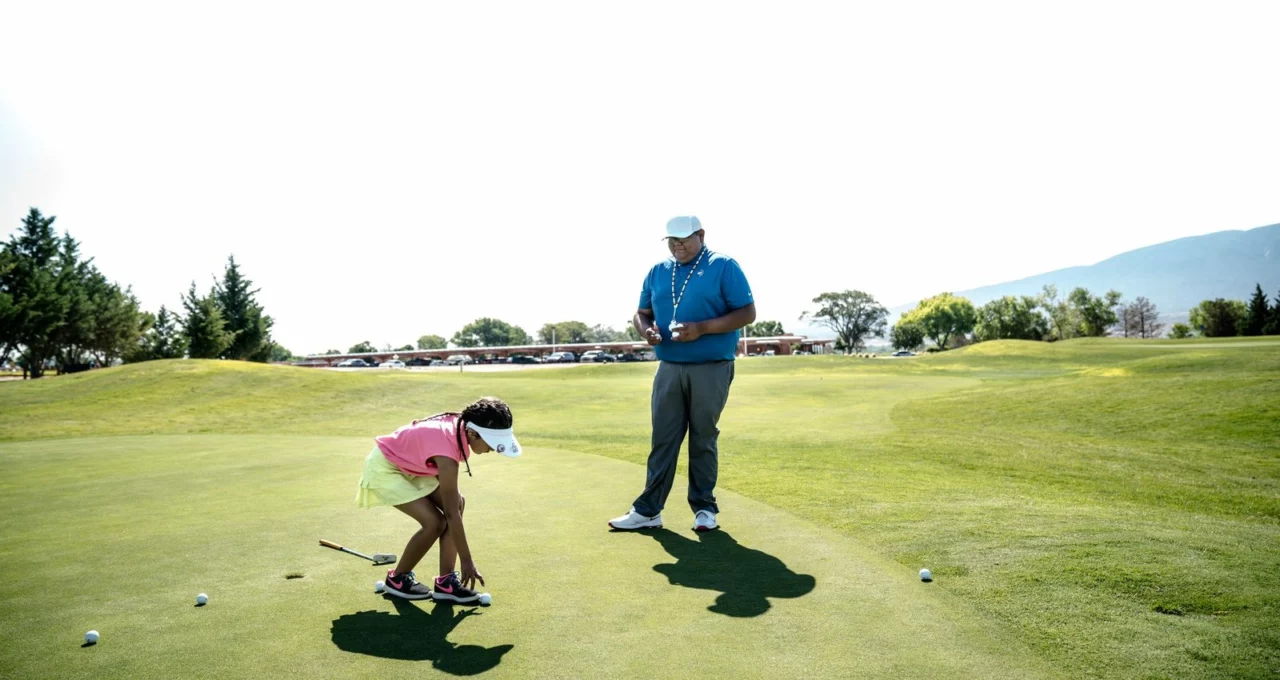
In Britain and Ireland the credential to look for is simple. The PGA, the association for club and teaching professionals, says only coaches with “PGA” after their names are fully qualified, having completed its PGA Training Programme. Its lesson-finding service, PGA Play, lets you search a directory of around 8,000 PGA Professionals by location, each with a profile setting out their coaching and contact details.
The directory also has filters, so if your problem is specific, short game for example, you can narrow the search to professionals who list it as a specialism. PGA Play says your enquiry goes to the professional by email and text, and that you should expect a reply within 72 hours, since most are busy teaching or running a shop.
Credentials are the floor, not the decision. Before booking, ask three things. How do you assess a new pupil? What does a typical run of lessons look like? How will we both know it is working? Listen for a process. An answer built around a single swing method suggests you will be moulded to the method rather than the other way round.
Then ask around. Whether you hold a club membership or play pay-and-play, other golfers will tell you who they use. The revealing question is not “is he any good?” but “what changed after you went?”
Finally, check the professional regularly teaches golfers like you. Someone who spends the week with county juniors may not be the best fit for a 22-handicapper who plays a Sunday four-ball.
Arrive with a number, not a feeling
“My swing feels off” gives a coach nothing to measure. “I play off 18, I lose three or four shots a round to a slice on the tee, and I want to be under 15 by the end of the season” gives them a target, and gives you both a way to judge the result.
Bring evidence. A handful of recent scorecards, your handicap record, or a simple tally over five rounds of penalty drops, three-putts and lost balls. What takes a coach twenty minutes to discover on the range, a scorecard can tell them in seconds.
Expect the goal to be challenged, and welcome it. Hearing that the shots you need will come from better wedge distances rather than a longer drive can be the most valuable sentence of the session.
Buy lessons in blocks
Very little worth changing is fixed in one visit. A run of three or four sessions over five or six weeks lets the coach check whether the change has held, adjust it and spot the new compensation you have invented in between.
The PGA’s own guidance notes that many PGA Professionals discount a series of lessons, and some sell coaching on a subscription. Ask about both before booking a one-off.
The awkward middle weeks
A genuine change feels wrong for a few weeks and often makes your ball flight worse before it improves. That is how motor learning works, not evidence that the advice was bad.
Your old swing, however flawed, came with a set of compensations that produced a predictable result. Change one part and those compensations stop working, while the new movement is not yet reliable. For a while you have neither, and shots appear that you have not hit in years.
This is the window in which most pupils give up. A good coach will warn you about it in the first session and book the follow-up inside it. If nobody has mentioned it, ask how long the change should feel uncomfortable.
It also tells you when to make big changes. In Britain that means the winter months, when competitions are fewer, the course may be on temporary greens and a poor fortnight costs you nothing. The same rebuild in June can cost you the club championship.
Winter is the coach’s quiet season
Teaching diaries at many clubs thin out once the clocks go back, which is exactly when a professional has time for a thorough assessment. Covered, floodlit ranges keep lessons going in the dark evenings. Trafford Golf Centre in Manchester, for example, has 53 range bays with Toptracer, the ball-tracking system that shows carry and shape on a screen, so you can see the numbers change as the lesson goes on.
Winter is also a sensible time to book a fitting alongside coaching, so that the clubs are adjusted to the swing you are building rather than the one you are leaving behind.
Keep a record
Ask the professional to summarise the change on your phone’s camera in the last few minutes. Then, before you start the car, write three lines: what we changed, what it should feel like, what to practise.
Within a week the feeling will have faded for everybody. The notes and the clip are what remain, and a season of them lets you see how April’s work led to August’s scores. Ask for one slow-motion clip of a good repetition as a reference to compare against.
Practise the way you were told
Leave every lesson with three specifics: the drill, how many balls, and how often. Without them a lesson is entertainment.
Twenty balls three times a week beats a hundred in one go, because skill develops through repetition spread across days rather than volume in a single session. It is one of the most consistent findings in motor learning, and the one club golfers most readily ignore.
Early on, repeat the same shot to the same target until the new movement has some shape. Then move to varied practice sooner than feels natural: a different club and a different target every ball, the way the course asks. Ask your coach when to make that switch; a golfer who only practises in blocks becomes very good on the range and no better at the weekend.
Book a playing lesson once a season
Nine holes with your professional reveals what no range can: the club you choose on a narrow par 4, the routine that shrinks under pressure, the heroic recovery through a gap in the gorse. For golfers whose technique is adequate but whose scores are not, this is often the most useful session of the year.
Ask the pro to stay silent for the first three holes and simply watch. Nine holes is enough, and your own club professional has the advantage of knowing exactly which holes on your course are costing you.
Where to find coaching in the UK
PGA Play. The PGA’s directory is the obvious starting point for individual lessons in Britain and Ireland, and the only one built around the PGA qualification. Its FAQ is candid that lesson prices vary with the type of lesson and the coach’s expertise, so compare what is included, such as video and launch monitor data, rather than just the headline rate.
Get into Golf. For complete beginners in England, England Golf’s campaign lists beginner activities at clubs and facilities across the country through getintogolf.co.uk. Learning fundamentals in a group is cheaper per hour and entirely suitable at that stage.
Driving ranges and golf centres. Most have resident professionals and publish their rates in the shop. Those with ball-tracking bays give you data to take home between sessions.
Your club professional. If you are a member, the person who knows your course best is already in the pro shop, and for playing lessons that knowledge is decisive.
Panxis Golf has no commercial relationship with any coach, venue or association named here, and earns no commission.
A checklist for your next booking
- Choose a PGA Professional who teaches golfers at your level, and ask how they assess new pupils.
- State the goal as a score and name the shots you are losing.
- Book a block of three or four, with the second session inside three weeks.
- Make big changes in winter, not in the middle of the competition season.
- Film the summary, write three lines, and leave with a drill, a ball count and a frequency.
- Once a season, swap a range hour for nine holes with the pro.
Whether lessons work is rarely down to the coach. It is decided in the fortnight after you drive home.