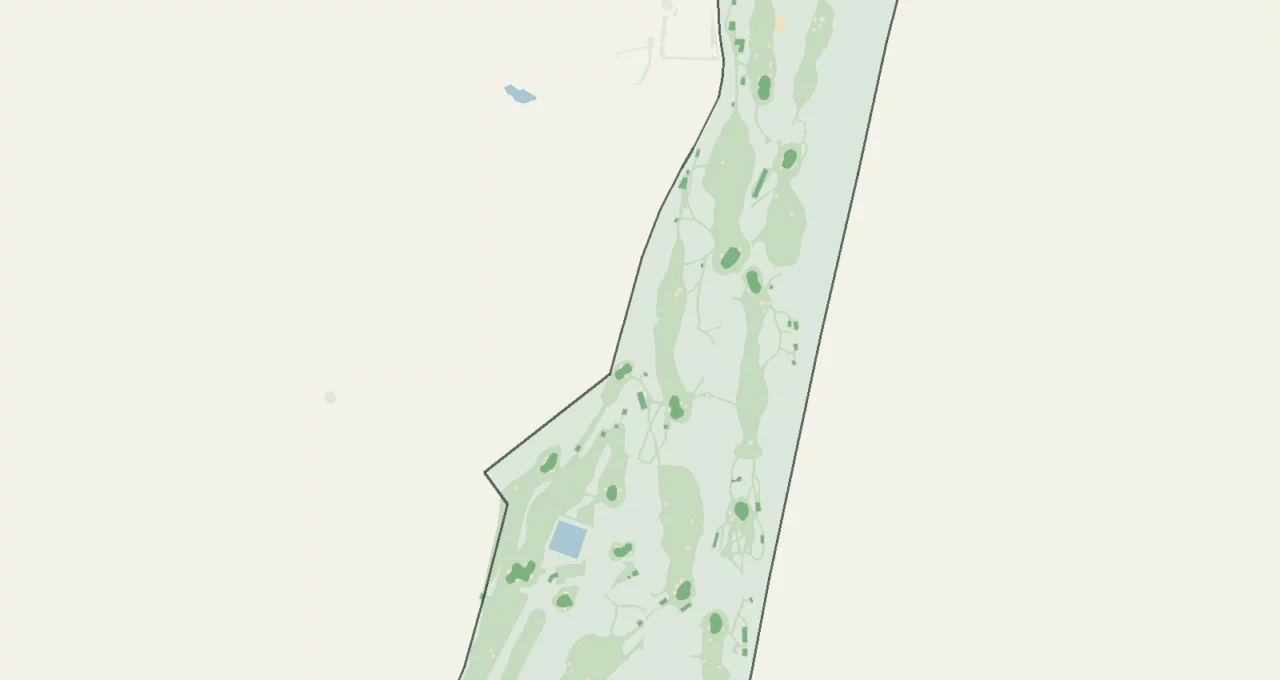
Layout of Royal Aberdeen Golf Club from OpenStreetMap survey data (ODbL licence).
Royal Aberdeen Golf Club
Holes
18
By
71
Length
6,918 yards
Green fee
—
Best season
All year
The Society of Golfers at Aberdeen was formed in 1780, which makes this the sixth oldest golf club in the world. It became the Aberdeen Golf Club in 1815 and received royal patronage in 1903. The society’s early contribution to the game was procedural rather than architectural: it is credited with the five-minute limit for searching for a ball.
The Balgownie links, laid out in the dunes on the north bank of the Don, was designed by the Simpson brothers, Archie and Robert of Carnoustie, and later re-bunkered and lengthened by James Braid. It has held the Senior Open, the Scottish Open and the Walker Cup.
What it asks of you
Par 71 over 6,918 yards, in two halves that behave quite differently. The outward nine runs north along the shore in a valley between two dune ridges, hole after hole framed by sandhills, with the sea in view and the wind rarely doing the same thing twice. It is regularly named among the finest opening nines anywhere in the game, and a number of reviewers go further than that.
The homeward nine returns on higher, more open ground. It has a reputation as the weaker half, which most people who have played it in a wind dispute: it is more exposed, it takes the full force of whatever is blowing, and every hole needs two good shots to reach the green in regulation. The reputation is about drama rather than difficulty.
The turf is firm and tight, the bunkers are deep, and the ball runs. This is old-school links golf without any softening, and it is one of the hardest courses in Scotland when the wind gets up.
What players say about it
Visitors are welcome by arrangement with a handicap of 24 or better, so the review record is substantial. The notes below summarise recurring themes across specialist golf sites, traveller review pages and player discussion threads. They are other people’s opinions, not ours: we have not played the course. We report what comes back repeatedly rather than isolated remarks, and we do not name or quote individual reviewers.
What comes up in its favour
- The front nine is the star of nearly every account. The stretch through the dune valley is called as good a run of links holes as exists anywhere.
- Conditioning is praised across the board: tees, fairways, bunkers and greens, helped by an irrigation system that keeps the course playing properly through a dry spell.
- Authenticity is the word that recurs. Big dunes, firm turf, wind and sea, with nothing manufactured about any of it.
- Value comes up more than one might expect for a course of this standing. Several accounts describe the green fee as reasonable next to comparable links.
What comes up against
- It is genuinely hard, and reviewers are blunt about it: a high handicapper will lose balls and time, and more than one account says plainly that this is not the course to play if your game is off.
- The back nine draws the recurring criticism of being less memorable than the front, even from people who accept it is the tougher half.
- Wind exposure on the homeward holes makes a bad-weather round punishing rather than merely difficult.
- Aberdeen is a long way from the main Scottish golf circuits, and the location is the practical objection most visitors raise.
Getting there and when to go
The club is at Bridge of Don, on the northern edge of Aberdeen, ten minutes from the city centre and around twenty from Aberdeen airport. Cruden Bay is forty minutes further north and Trump International is closer still, which makes a two- or three-course trip on this coast straightforward.
The course plays all year. May to September gives the best of the weather and the long northern evenings; the wind is a factor in every month. Booking is by arrangement and a handicap of 24 or better is required.
Green fees
Rates and visitor tee times are handled by the club and vary by season. See the club’s own site.
How this page was made
The factual frame comes from public sources: OpenStreetMap for the location, Wikipedia and published architecture and championship coverage for the history and the design, and the club’s own site for access and handicap requirements. The opinion section summarises public reviews and player discussions read in September 2026; we report recurring themes rather than individual voices, and we do not reproduce or attribute quotes.
We have not played this course, and nothing here is a substitute for that. The club has not paid for this page, has not seen it before publication and has no say in what it says. If you know the course and something here is wrong or out of date, write to us and we will correct it.