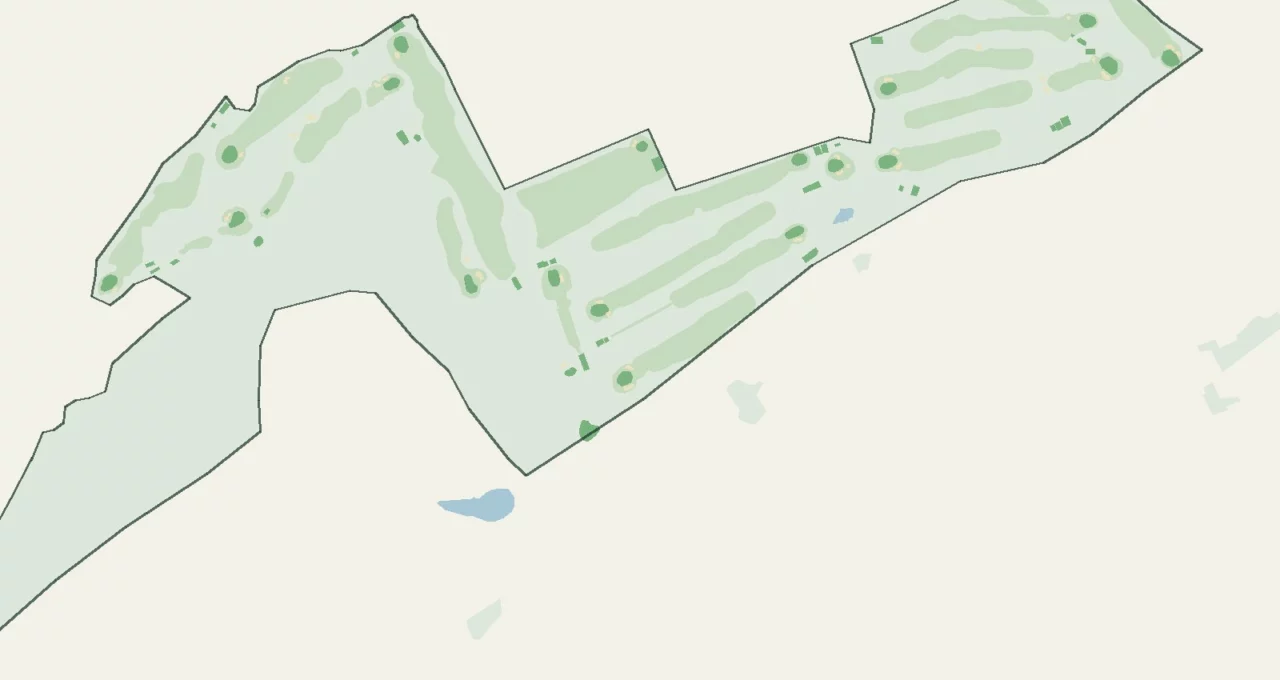
Layout of Dullatur Golf Club from OpenStreetMap survey data (ODbL licence).
Dullatur Golf Club
Holes
36 (two 18-hole courses: Carrickstone, Antonine)
By
70 (Carrickstone); 69 (Antonine), men's cards
Length
Carrickstone 6,134 yards from the white tees, 5,933 yellow, 5,516 red; Antonine 5,850 white, 5,610 yellow, 5,173 red (club cards)
Green fee
—
Best season
Year-round (club)
Dullatur Golf Club stands on the hillside above the old village of Dullatur, on the northern edge of Cumbernauld in North Lanarkshire, at 1a Glen Douglas Drive, G68 0DW. Founded in 1896, it has two eighteen-hole parkland courses. The Carrickstone, the senior of the two, grew from the original course, was extended to eighteen holes in the 1920s with the involvement of James Braid and was remodelled in the 1990s by the Welsh former Ryder Cup player Dave Thomas; it plays to 6,134 yards and par 70 from the white tees, with a course rating of 70.4 and a slope of 129. The Antonine, mostly new holes by Thomas from the same period, plays to 5,850 yards and par 69, rating 69.0 and slope 128. From the higher ground both look north across the valley to the Kilsyth Hills and the Campsie Fells.
The setting carries a long history. The line of the Antonine Wall, the Roman frontier of the second century, passes just north of the village, and two Roman marching camps were found at Dullatur between the forts at Croy Hill and Westerwood. The name of the place is an anglicised form of the Gaelic dubh leitir, the dark hillslope. The village itself owes much to the railway: a station opened at Dullatur in 1842 to attract commuters, villas followed, and among the first recreational clubs were the golf and lawn-tennis clubs, both still in being. The station has long since closed. The golf club, with two courses, a buggy fleet, a professional’s shop and a clubhouse restaurant, describes itself as one of the best golfing facilities in central Scotland.
One course becomes two
The club’s own course history, which draws on a report written as the new holes were being built and on David Kerr’s history of the club, describes how the present arrangement came about. The old course was of the play-the-land-as-it-lies type, influenced among others by Braid, who designed its extension from nine to eighteen holes in the 1920s. In the 1990s Dave Thomas, who had also laid out the neighbouring Westerwood course with Seve Ballesteros, was engaged to add new holes, and the old and new were divided between two courses rather than kept as one.
The Carrickstone takes its name from a landmark at the east end of the property. As built, it began at the old 15th and combined twelve holes of the old course with six new ones, one of the old holes being formed by joining what had been the 4th and the 5th. The Antonine, named after the Roman wall, combined thirteen new holes with five from the old course. The result is a contrast that the club describes plainly: one course of old-fashioned ground, the other partly modern, with broad bunkers and land shaped by mounding. Thomas was busy in this corner of Scotland at the time, and Today’s Golfer counts Dullatur among his works of the 1990s.
The club’s page also records the original yardages, 6,309 for the Carrickstone and 5,940 for the Antonine, both par 70. The courses have been re-measured and re-rated since, and the current figures come from the cards the club publishes for each course and each set of tees.
What the courses ask of you
The Carrickstone opens with a short hole, 166 yards from the white tees, and its front nine, par 36 and 3,148 yards, has both of the course’s par 5s back to back at the 8th, 477 yards, and the 9th, 514. The 4th, a par 4 of 372 yards, is stroke index 1. The back nine is a par 34 of 2,986 yards with no par 5 at all: two short holes, the 12th at 203 yards and the 15th at 145, and a run of par 4s that ends with the 16th, 431 yards and index 2, the 17th, 385, and the 18th, 395. From the yellow tees the course measures 5,933 yards and from the red 5,516, with par 72 for women on all three sets. Reviewers on Hole19 describe a good test with a fair number of blind shots and enough variety to require some tactical thinking.
The Antonine is shorter but not easier, and the club’s history makes the point that its greater difficulty compensates for its length. Its front nine is a par 34 of 2,943 yards from the whites, with the 9th, a par 4 of 431 yards, as index 1. The back nine, par 35, includes the 12th, a par 5 of 495 yards, and three par 3s, the longest of them the 17th at 228 yards. The hole most often singled out is the 16th, a par 5 of 523 yards and stroke index 2, which Today’s Golfer calls the course’s signature hole and describes walking off with a par there as always a good result. From the yellow tees the course measures 5,610 yards and from the red 5,173.
Both courses are on sloping ground. The higher holes give the views; the hillside between them makes for climbs that several reviewers mention, and a buggy is worth considering for those who prefer not to walk. The club keeps a fleet of eighteen buggies for hire, and its course status notice warns of restrictions such as no trolleys, no buggies, fairway mats or temporary greens when the weather calls for them. The club says both courses are open all year round.
What golfers say
Dullatur is reviewed mainly on golf apps: the Carrickstone has an average of 4.7 out of five from 48 reviews on Hole19, the Antonine 4.2 from 62, and the club 4.5 from 34 reviews on 18Birdies, where users rate the course hard and the greens fast. The points below summarise what recurs. They are other people’s opinions, not ours. Nobody from Panxis has played either course, and we name no reviewer.
What comes up in its favour
- The test. The Carrickstone in particular is described as excellent and very challenging, with a variety of holes that rewards thought rather than length.
- The Antonine is liked for the opposite reason: a shorter course where a brave player can score low, with plenty of danger for a poor shot.
- The views over the Kilsyth Hills and the Campsie Fells, mentioned by reviewers and by the club alike.
- The facilities: two full courses on one site, practice areas with a short game area and putting green, a professional’s shop and coaching, and food in the clubhouse that reviewers rate well.
- Value. Users on 18Birdies rate value highly, and the club’s society guests, in comments published by the club, report a day that suited golfers of mixed ability.
What comes up against
- The hills. Even favourable reviews call the Carrickstone quite hilly, and the walking is a factor on both courses.
- Condition outside the summer. Reviews of the Antonine from the spring describe a course soaked through and greens in poor condition for the time of year, with some fairways below standard.
- The Antonine is rated noticeably lower than the Carrickstone on Hole19, and its reviews are the more mixed of the two.
- Small practical points recur, such as the placing of sand bottles for divots.
Getting there and when to go
The club is reached through the streets of Dullatur on the northern side of Cumbernauld, about eleven miles north-east of the centre of Glasgow as the crow flies. The nearest railway station is Croy, on the Glasgow to Edinburgh via Falkirk line, eleven and a half miles from Glasgow Queen Street; by our measurement it is a little under a mile from the course in a straight line, more by road. Westerwood, the other Thomas course, is next door, and Kilsyth Lennox and Palacerigg are among the other courses close by.
Visitors are welcome as individuals, small groups and societies, and tee times for visitors are booked online through the club’s booking page. The club runs open competitions through the season, with entries also taken online. Both courses are open all year, but given the reviews, the drier months from late spring to early autumn are the safest time to go. Buggies are available to visitors, subject to the course status of the day.
Green fees
Visitor rates for each course are set by the club and shown when booking on its visitor booking page. Directory listings quote figures that are years out of date, and we do not repeat them.
How this page was made
The factual frame comes from public sources: OpenStreetMap for the location and the address; the club’s website for the 1896 foundation, the course history, both scorecards with their ratings and slopes, the buggy fleet, the practice facilities, the views, the year-round opening, the course status codes and the booking arrangements; Today’s Golfer for Dave Thomas’s work of the 1990s and the 16th of the Antonine; Hole19 and 18Birdies for reviews and ratings; the English Wikipedia articles on Dullatur and on Croy railway station for the village, the Roman camps, the Gaelic name, the railway and the distances by rail; Wikidata for the identifiers. The distance from the station is our own measurement on the map, as is the straight-line distance from Glasgow.
Where sources disagree, we say so. The club’s history page gives the Carrickstone as 6,309 yards and the Antonine as 5,940, both par 70; its current cards give 6,134 yards and par 70, and 5,850 yards and par 69. Hole19 still gives the Antonine as par 70 and 5,940 yards, and 18Birdies as 5,892 yards with a longer 1st hole; Today’s Golfer also gives 5,892. Hole19’s red card for the Carrickstone, 5,044 yards, is shorter than the club’s 5,516. Today’s Golfer calls the Carrickstone an 1896 James Braid course; the club’s history credits Braid with the extension to eighteen holes in the 1920s, and its visitors page calls both layouts James Braid courses although the Antonine is largely Thomas’s work. We follow the club’s history.
The opinion section summarises reviews on Hole19 and 18Birdies, read in October 2026. We report recurring themes rather than individual voices, and we reproduce no quotations from reviewers. Nobody from Panxis has played or visited these courses, and this page is no substitute for a round.
The club has not paid for this page, has not seen it before publication and has no say over its content. This page contains no commercial link and earns us no commission. If you know the club and something here is wrong or out of date, write to us and we will correct it.
Other courses nearby
Closest to this one in our British directory:
- Glasgow Golf Club — 12 mi
- Kirkhill Golf Club — 12 mi
- Erskine Golf Club — 19 mi
- Lanark Golf Club — 22 mi
The hole to know
Antonine Course, par 5 of 523 yards and stroke index 2, the hole Today's Golfer calls the signature of the course.