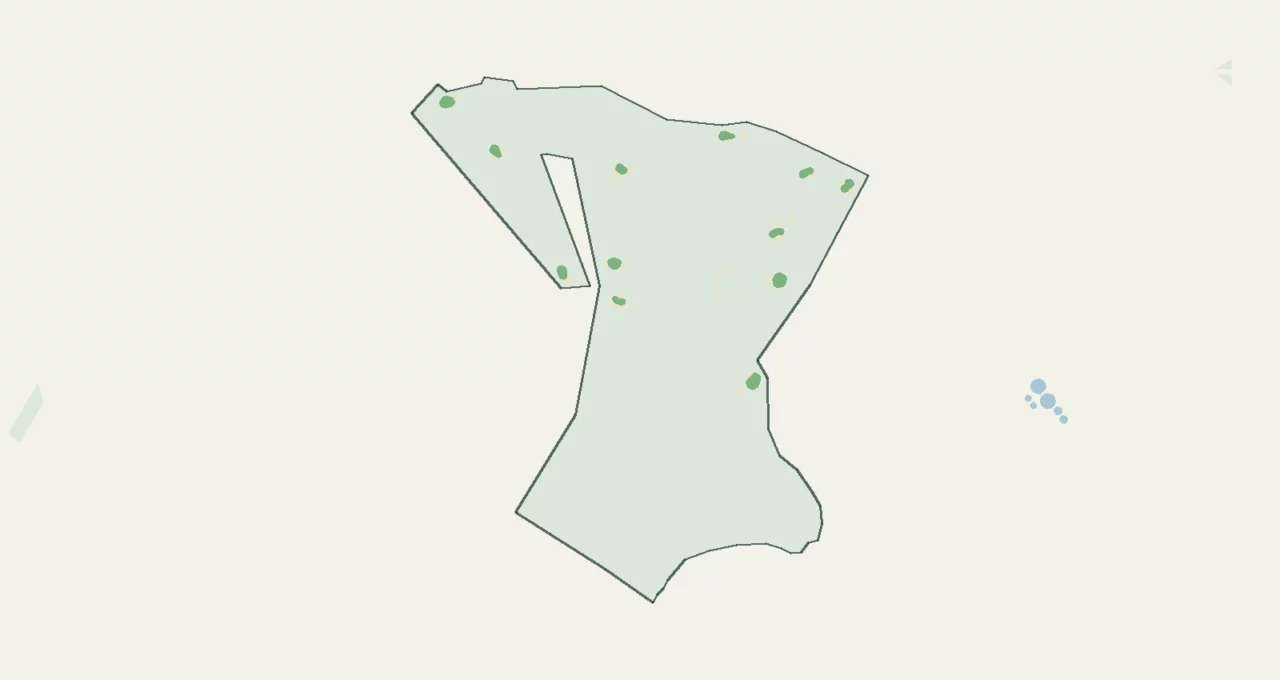
Layout of Ballochmyle Golf Club from OpenStreetMap survey data (ODbL licence).
Ballochmyle Golf Club
Holes
18
By
70 for men from the white and yellow tees, 68 from the red; 71 for women (club's hole pages)
Length
5,972 yards from the white tees, 5,672 yellow, 5,077 red (club's hole pages); another directory gives 5,990 yellow and 5,097 red
Green fee
—
Best season
Open all year; reviewers report that the course gets wet in winter
Ballochmyle Golf Club is an 18-hole parkland course on Catrine Road, just outside Mauchline in East Ayrshire, in the stretch of the county that Scots call Burns Country. It lies inland, some 10 to 12 miles from the Ayrshire coast by the club’s own reckoning, within reach of the Open Championship links at Royal Troon, Prestwick and Turnberry, but it is a very different kind of golf: trees, slopes and short, tight par 4s rather than dunes and wind off the Firth of Clyde. The club keeps its own website at ballochmylegolfclub.com, with a page for each hole, online tee booking and a page on its facilities.
From the white tees the club’s hole pages add up to 5,972 yards and a par of 70. That makes Ballochmyle one of the shorter 18-hole courses in the county, and it carries only one par 5 for men, the closing hole. What it lacks in length it tries to make up with elevation changes, tree-lined fairways and greens that reviewers repeatedly describe as tricky. The club is a members’ club, but its tee sheet is open to visitors through the website.
A course on the braes of a Burns estate
The club tells its story through the land rather than through the golf. Its history page explains that the Ballochmyle estate first belonged to Sir John Whitefoord, third Baronet of Blairquhan and a close friend of Robert Burns. Whitefoord lost his fortune in the collapse of the Ayr bank of Douglas, Heron and Company and sold the estate in 1783 to Claud Alexander. Burns marked the sale with the song “Farewell to the Braes o’ Ballochmyle”. In the summer of 1786, walking on the estate where the course now lies, he saw Wilhelmina Alexander, Claud’s sister, and wrote “The Bonnie Lass o’ Ballochmyle”. The club says the Alexander family still owns the estate, and that the eldest unmarried daughter of the family is traditionally known as the Bonnie Lass o’ Ballochmyle.
The family has left its mark on the club in another way. The elephant on the club crest, the club explains, is taken from the coat of arms of the Alexanders of Ballochmyle House. The crest’s motto, “Ariston Metron”, is given as Greek for the golden mean, which the club translates, with some humour, as keep it down the middle. On a course this narrow, that is sound advice.
The Burns theme runs through the card. The holes carry Scots names, several of them borrowed from the poet’s verse: the 12th is Aft Agley, from the line in “To a Mouse” about the best-laid schemes going awry, and the 15th is Rashes O’, after “Green Grow the Rashes, O”. Others name local places, such as Howford Brig at the 5th and Catrine Woods at the 6th, and the 18th, Waurslin Hame, is a Scots way of saying struggling home.
When the golf began
The club’s website does not give a foundation date. Golf Today and Top 100 Golf Courses both give 1937, and Top 100 Golf Courses adds detail: the Alexander family turned part of the estate over to golf, and a 9-hole layout was formally opened on 22 June 1937 by Mrs R. J. Dunlop of Barskimming. The Dutch Wikipedia article on the course gives 1937 in its information box and 1938 in its text, citing an archived golf directory. We found no source for the year in which the course grew from nine holes to eighteen, and we do not guess at it. No source we read names an architect.
Ballochmyle was not Mauchline’s first course. Golf’s Missing Links, which documents lost courses from old newspapers and maps, records a Mauchline Golf Club that opened a nine-hole course at Bogwood in May 1909, moved to Temple Bogwood around 1914 and disappeared at the time of the First World War. None of the sources we read connects that club with Ballochmyle, which appears to have been a fresh start on different ground two decades later.
What it asks of you
The club’s hole pages list three sets of men’s tees, white, yellow and red, and two sets for women, yellow and red. The distances carry no unit on the club’s pages; Golfshake gives the same totals in yards, and the metre figures on the Dutch Wikipedia scorecard convert to the same totals, so we give them in yards. From the whites the course measures 5,972 yards, 3,109 out and 2,863 home, with a par of 35 on each nine. The yellows measure 5,672 yards, also par 70, and the reds 5,077 yards. Par from the red tees is 68 for men, because the 10th becomes a par 3 and the 18th a par 4, and 71 for women, who play the 5th and the 18th as par 5s.
There are three par 3s, at the 3rd, 14th and 17th, and the longest is the first of them, 196 yards from the whites. Most of the challenge lies in the par 4s, many of which are short on paper. Five of them measure under 310 yards from the white tees, and two of the hardest holes by stroke index, the 15th and the 2nd, are well under 400. Several reviews describe the fairways as tight and lined with trees, with a ball off the short grass likely to find timber, and the greens as well kept but full of borrows. A golf forum thread warns that the course gets wet in winter.
Official handicap figures were not available to us from the club, whose course rating page links only to a handicap calculator. Golfshake gives a standard scratch score of 69 from the white tees and 71 from the red. The golf app directories we found disagree with one another: Stymie gives a course rating of 69.7 for the white tees with a slope of 124 in one place and 128 in another, while Golfify gives a red-tee rating of 70.4 and a slope of 117. Treat any of these as a rough guide and check the current card at the club.
The front nine
Yardages below are from the club’s hole pages, white tees first, then yellow and men’s red. Descriptions draw on published reviews; the club’s hole pages carry videos but no written notes.
- 1st, Play awa: par 4, 370 yards (352, 303). Men’s stroke index 7. The opening tee shot is blind, down to a green at the bottom of a slope, and a golf forum thread notes out of bounds all the way down the right.
- 2nd, Lauth’s Delight: par 4, 380 yards (366, 310). Men’s stroke index 3.
- 3rd, Lang Short: par 3, 196 yards (190, 192). Men’s stroke index 11.
- 4th, Lea Rig: par 4, 355 yards (341, 297). Men’s stroke index 13. A reviewer describes the green as well bunkered.
- 5th, Howford Brig: par 4, 468 yards (452, 456). Stroke index 1 for men and the longest par 4 on the card. From the red tees women play it as a par 5.
- 6th, Catrine Woods: par 4, 279 yards (254, 260). The shortest par 4 on the course and stroke index 17. A reviewer describes a dogleg right with woodland alongside the fairway.
- 7th, Windy Rig: par 4, 370 yards (360, 368). Men’s stroke index 5.
- 8th, The Tryst: par 4, 401 yards (389, 273). Men’s stroke index 9. The biggest gap between tees on the course: 401 yards from the whites against 273 from the reds.
- 9th, Pawkie Skelp: par 4, 290 yards (275, 250). Men’s stroke index 15. A short par 4 that bends right and runs downhill to a small, heavily contoured green, by one reviewer’s account a good end to the outward half.
The back nine
- 10th, Stey Brae: par 4, 272 yards (267, 185). Stroke index 18. Short but uphill to a well-bunkered green; from the red tees men play it as a par 3 of 185 yards.
- 11th, Clootie’s Corner: par 4, 413 yards (387, 301). Stroke index 4. A reviewer describes the tee shot through a narrow gap in a line of trees before the hole turns sharply right and downhill to the green.
- 12th, Aft Agley: par 4, 304 yards (286, 282). Men’s stroke index 14. A two-tiered green that slopes from left to right, awkward with some pin positions.
- 13th, Ballochmyle: par 4, 280 yards (264, 261). Men’s stroke index 16. A short par 4 played uphill with a wall down the right side, by one reviewer’s description.
- 14th, Wee Bogle: par 3, 170 yards (159, 157). Men’s stroke index 8. The middle-length par 3.
- 15th, Rashes O’: par 4, 341 yards (333, 297). Stroke index 2 despite its modest length. It drops to a landing area that turns right and climbs to a well-bunkered green set into the hillside.
- 16th, Silver Birkies: par 4, 422 yards (378, 377). Men’s stroke index 6. The longest par 4 on the back nine.
- 17th, Ca’Cannie: par 3, 164 yards (132, 122). Men’s stroke index 10. Played slightly uphill to a green protected by bunkers at the front and on the right.
- 18th, Waurslin Hame: par 5, 497 yards (487, 386). Men’s stroke index 12. See below.
The stroke indexes above are those on the club’s current hole pages. They differ markedly from those on the older scorecard reproduced by Wikipedia, which gives the 1st as stroke index 9, the 3rd as 17 and the 18th as 6; the order of difficulty has clearly been reworked since.
The 18th, Waurslin Hame
The closing hole is the only par 5 on the men’s card from the white and yellow tees, 497 yards from the back, and Top 100 Golf Courses notes out of bounds all down its right side. Coming at the end of a round built on short, positional par 4s, it is the one hole that asks for length. Its green sits in front of the clubhouse: the club describes its bar and lounge as giving a front row seat to watch golfers close out their round on the 18th green, so a finish here tends to have an audience.
What golfers say
Ballochmyle is reviewed on Golfshake, Hole19, Top 100 Golf Courses and in golf forums. Scores vary widely by platform: the app and directory reviews are generally warm, while the single critic’s review on Top 100 Golf Courses is more reserved. The points below summarise what recurs. They are other people’s opinions, not ours; nobody from Panxis has played the course, and we name and quote no one.
What comes up in its favour
- Staff and members are often described as friendly and helpful, and the club as relaxed and sociable.
- The food from the clubhouse kitchen is one of the most consistently praised aspects of a visit, and on Golfshake it is the highest-scoring category.
- Fairways and greens are frequently described as well maintained, and the greens as tricky.
- Reviewers find the course a fair test for all handicaps, with interesting doglegs and attractive scenery.
- Value for money and pace of play are rated well.
- The back nine, and the 15th in particular, draw the most enthusiasm from those who rate the holes individually.
What comes up against
- The front nine, and especially the blind opening hole, strike some visitors as unremarkable compared with the inward half.
- Course condition scores lower than other categories on Golfshake, and the course is said to get wet in winter.
- The clubhouse is described by some as in need of redecoration.
- Practice facilities score below most other categories.
- A minority of reviews criticise the layout itself, or the welcome from members.
Facilities and how to play it
Visitors book tee times through the club’s online booking system, and the club can also be reached by telephone on 01290 550469 or by email to ballochmyle.secretary@ballochmylegolfclub.com. The club says packages are available for visiting parties through the secretary, and it runs open competitions listed on its website, and its website has a page on a Texas Scramble series in which it takes part. Golfshake lists buggy hire and club hire subject to availability, and advises calling ahead.
The clubhouse has a bar and lounge with views over the course and the 18th green, available for private functions. Chloe’s Kitchen, the clubhouse kitchen, serves everything from a morning roll before a round to a three-course meal, with weekly and weekend specials. There is also a games room with snooker, pool and darts, which the club recommends for wet winter days, and a social membership for non-golfers. Golfshake lists changing rooms but says it is not aware of a pro shop or a driving range. The Dutch Wikipedia article, citing a 2008 directory, mentions a driving range; we found nothing recent to confirm one, so ask the club before relying on it.
Getting there and when to go
The course is on Catrine Road, Mauchline, postcode KA5 6LE. Golf Today places it about a mile south of Mauchline, reached by the B705 from the A76, the road between Kilmarnock and Dumfries. The coastal courses at Troon, Prestwick and Ayr are within easy reach to the west, which makes Ballochmyle a natural inland round on an Ayrshire trip, especially on a day when the wind makes the links hard work. Mauchline itself has strong Burns associations, and the poet’s verse about the estate gives the round a literary backdrop that few courses can match.
The club’s online booking shows tee times available throughout the year, including in autumn. Given what golfers say about winter wetness, late spring to early autumn is the most reliable window; in winter, check the course status on the club’s home page before travelling.
Green fees
Visitor rates are set by the club and shown when booking: see the club’s tee booking page for current prices.
How this page was made
The factual frame comes from public sources: OpenStreetMap for the location and outline of the course; Wikidata for the identifiers and the administrative area; the Ballochmyle Golf Club website for the estate history, the Burns connection, the crest and motto, the hole names, pars, stroke indexes and distances, the clubhouse, kitchen and games room, contact details and booking; Top 100 Golf Courses for the 22 June 1937 opening of a 9-hole layout, the out of bounds at the 18th and a hole-by-hole critic’s review; Golf Today for the 1937 date, the inland parkland description and directions; the Dutch Wikipedia article for its older scorecard in metres and its 1937 and 1938 dates; Golf’s Missing Links for the earlier Mauchline Golf Club; Golfshake for its yardages, standard scratch scores, facility listing and review scores; Stymie and Golfify, as shown in search results, for course and slope ratings; and Golfshake, Hole19, Top 100 Golf Courses and a Golf Monthly forum thread for the opinions summarised above.
Where sources disagree, we say so. The foundation year is 1937 in Golf Today, Top 100 Golf Courses and the Wikipedia information box, and 1938 in the Wikipedia text; the club’s site gives no year. Par for women from the red tees is 71 on the club’s pages and the Wikipedia card, while men from the red tees play a par of 68. Golfshake lists the yellow tees once at par 70 and once at par 71, and gives a higher standard scratch score from the yellow tees than from the whites, which looks like an error. The 1golf directory, as it appears in search results, gives the yellow tees as 5,990 yards and the red as 5,097, against 5,672 and 5,077 on the club’s pages. Stroke indexes on the club’s current pages differ from those on the older Wikipedia card. Course and slope ratings in the app directories do not agree with one another, and we found no official figure. Sources disagree on whether there is a driving range. We could not establish when the course was extended to 18 holes, nor who laid it out. The 1golf directory and the bunkered course guide refused our requests, so we could not compare their content.
The opinion section summarises reviews on golf apps, directories and a forum, read in October 2026. We report recurring themes rather than individual voices, and we reproduce no quotations from reviewers. Nobody from Panxis has played or visited this course, and this page is no substitute for a round.
The club has not paid for this page, has not seen it before publication and has no say over its content. This page contains no commercial link and earns us no commission. If you know the course and something here is wrong or out of date, write to us and we will correct it.
Other courses nearby
Closest to this one in our British directory:
- Caprington Golf Club — 8 mi
- Annanhill Golf Club — 10 mi
- Prestwick Golf Club — 11 mi
- Kilmarnock (Barassie) Golf Club — 12 mi
The hole to know
Waurslin Hame: the only par 5 on the men's card from the white and yellow tees, 497 yards from the back, with out of bounds all down the right and a finish in front of the clubhouse bar and lounge.