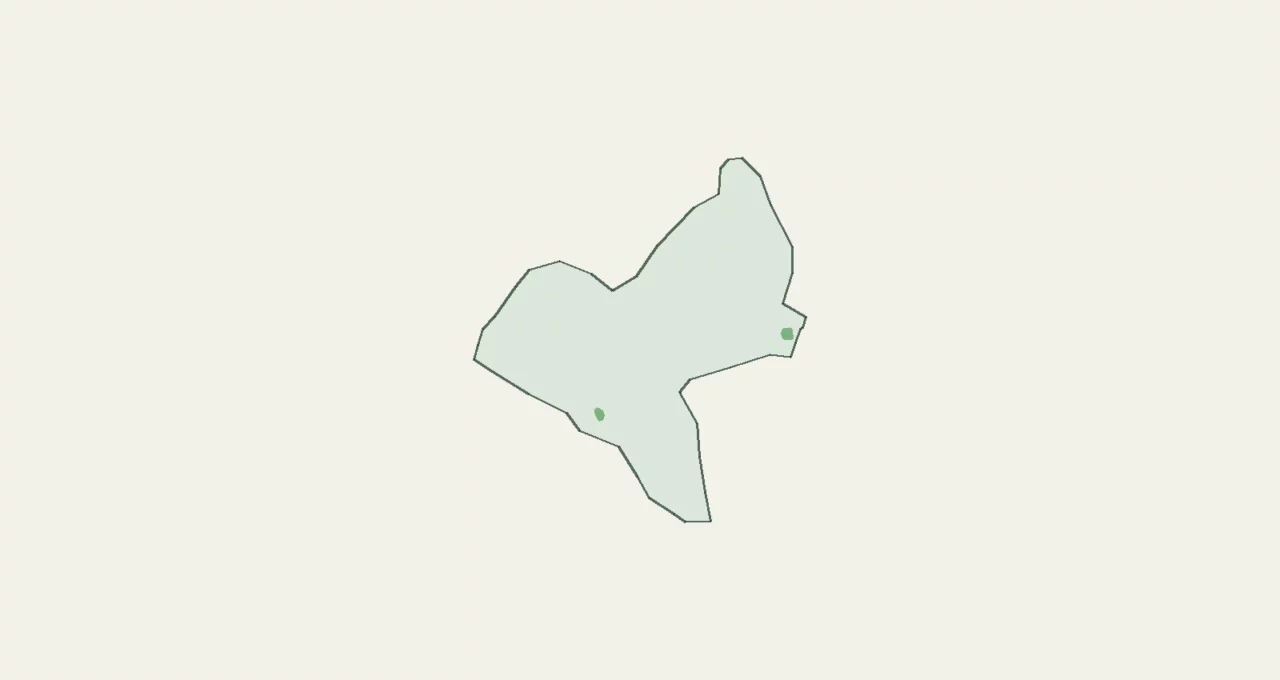
Layout of Blairmore and Strone Golf Club from OpenStreetMap survey data (ODbL licence).
Blairmore and Strone Golf Club
Holes
9 (OpenStreetMap, Golfshake, Hole19, Dutch Wikipedia); Scottish Golf records 18, the nine played twice
By
31 (OpenStreetMap, Hole19, Golfify, Dutch Wikipedia); 32 (Scottish Golf); 62 for the nine played twice (Golfshake, LinksGolf)
Length
1,896 yards from the yellow tees (2013 blog “Scottish golf courses, all of them”, Golfify); 2,144 from the back tees and 1,843 from the red (Golfify); the club's description gives 2,112 yards (Golfshake), Scottish Golf 2,176; Hole19 and the Dutch Wikipedia give 1,933, in yards and metres respectively
Green fee
—
Best season
Played all year by members: summer competitions, then a Winter Cup and monthly medals from October to March (ArgyllBute24, 2025 and 2026)
Blairmore and Strone Golf Club is a nine-hole hill course above the village of Strone, on the Cowal Peninsula in Argyll, a few miles north of Dunoon. The course sits on the slope where the north shore of the Holy Loch turns into the Firth of Clyde and the mouth of Loch Long, inside the Loch Lomond and The Trossachs National Park. The directories give 1896 as the year it opened, and most credit the design to James Braid. On the scorecard most often quoted it is a par 31 of 1,896 yards from the yellow tees, with five par 3s and four par 4s, and no hole longer than about 300 yards. The figures that circulate elsewhere vary a great deal, and we set them out below.
It is a small members’ club. Scottish Golf, the national federation, records 27 members, 21 men and 6 women. It is very much alive: in October 2026 the local news site ArgyllBute24 reported the end of its summer season, with the Dougie Hamilton Open, a “Back to Front” competition and a winter programme of medals and a Winter Cup to come. What follows sets out what the public record says about the club, what the course asks of a golfer, what published reviews report, and how a visitor can get a game.
Which club is this?
OpenStreetMap maps the course as Blairmore and Strone Golf Club, on High Road, and links it to the Wikidata item Q14849491, which describes it as a golf course in Argyll and Bute. The only Wikipedia article about it is in Dutch, on nl.wikipedia.org. The club’s federation record is on the Scottish Golf website, under the name Blairmore & Strone Golf Club, with High Road, Strone, as its location.
The club has no working website of its own at the time of writing. The address that Golfshake and the Dutch Wikipedia still give, blairmoregc.co.uk, no longer belongs to the club: on 5 November 2026 it redirected to a domain backorder service. LinksGolf, updated in January 2026, also notes that the club does not appear to have a website, and Scottish Golf’s record points to a directory page instead. We also found a site on a developer hosting platform that presents itself as the club’s, but we could not establish who runs it, so we have not used it.
The name joins two neighbouring villages. Wikipedia places Blairmore on the western shore of Loch Long, about a mile north of Strone; the course lies on the hill above Strone, which the reverse geocoder of OpenStreetMap confirms. Directories file the club under Strone, Blairmore or Dunoon, the postal town. They also give at least four different postcodes (PA23 8JJ, 8TH, 8RT and 8RY), and an OpenStreetMap contributor has marked PA23 8JJ, the most widely quoted, as not being the course’s postcode. For satellite navigation, the coordinates are more reliable than any of them.
History: a hill course from the steamer age
Strone grew up in the nineteenth century as a promontory of villas, served by a pier built in 1847 and by the Clyde steamers, according to Wikipedia. The golf course belongs to that world. The Dutch Wikipedia, citing The Official Guide to Golf in Scotland (2012), gives the opening date as 6 April 1896 and says a new clubhouse was opened on 17 June 1933. The description the club supplied to Golfshake and to Scotland Where Golf Began says simply that it was opened in 1896.
The attribution to James Braid deserves a caution. OpenStreetMap, Golfshake, Scotland Where Golf Began, LinksGolf, Golfify and the Dutch Wikipedia all name him as the designer, and several write that he designed it in 1896. But Braid’s own Wikipedia article says he turned professional in 1896, before his career as an architect, and it does not list Blairmore and Strone among his courses. None of the sources we read says whether Braid laid out the original course or revised it later. We report the attribution as the directories give it, without the date.
From 1961 to 1992 the Holy Loch below the course was a United States Navy base for ballistic missile submarines, according to Wikipedia. We found no history of the club itself beyond these dates, and no record of who owns the ground.
What it asks of you
Length is not the test here; the hill is. The Golfshake reviewers describe the first four holes as steep climbs, then four holes that level off, and a downhill par 4 to finish. The description the club gave to Golfshake calls the course “a mixture of hilly and some flatter parkland” that is a challenge despite its short length, and GolfCourse.Wiki adds that large areas of deep rough border most fairways. A blogger who set out to play every course in Scotland, writing in June 2013, called it a very hilly moorland course with absolutely tiny greens that were hard to read, where a ball that lands on the green can still run off down the slope. ArgyllBute24’s report of the 2026 “Back to Front” competition speaks of carries over dense bracken and heather and rows of mature trees.
The tees
No card from the club is online, and the published figures disagree:
- Yellow tees: 1,896 yards, par 31, on the card quoted by the 2013 blog; Golfify gives the same hole lengths under the name “White”, with a nine-hole course rating of 30.5.
- Back tees: 2,144 yards, par 31 (Golfify, “Blue” tees). Red tees: 1,843 yards, par 31, rating 31 (Golfify).
- 2,112 yards over nine holes, in the description from the club reproduced by Golfshake, Scotland Where Golf Began and GolfCourse.Wiki.
- 2,176 yards and par 32, in Scottish Golf’s description, which The Social Golfer repeats.
- A different card, with holes of 238, 132, 200, 141, 164, 214, 267, 283 and 294, totalling 1,933 and par 31: in yards according to Hole19, in metres according to the Dutch Wikipedia.
Golfshake lists the course as par 62 and 4,224 yards, with a yellow card of 3,792 yards and SSS 61, and LinksGolf also gives par 62 and 4,224 yards with a slope of 100. These are the nine holes played twice, which is also why Scottish Golf records 18 holes. OpenStreetMap, Hole19, Golfify, the Dutch Wikipedia and the 2013 blog give par 31 for the nine.
The course, hole by hole
The lengths below are from the yellow tees, as quoted in the 2013 blog and matching Golfify’s card; the descriptions come from that blog, the Golfshake reviews and ArgyllBute24. Stroke indexes differ from one card to the next, so we give them only where a source names one.
- 1st, par 4, 205 yards. Slightly uphill. The flag is visible from the tee but not the stick, which makes the distance hard to judge, and a ball that runs past the hole can finish well down the slope.
- 2nd, par 3, 130 yards. Innocent to look at, but missing the green is costly.
- 3rd, par 3, 210 yards. Named “Bla’ Weary” on the card the blogger saw, and stroke index 1 on it: the biggest and steepest climb on the course. LinksGolf describes a steep approach with a deceptive slope.
- 4th, par 3, 154 yards. Just as steep and completely blind. The blog’s advice is to stay right of the marker pole and take two clubs more than the yardage suggests.
- 5th, par 3, 130 yards. Uphill to the highest green on the course, with a slope that carries the ball from right to left. Scottish Golf calls it the signature hole, for its view over the Clyde.
- 6th, par 3, 234 yards. Slightly downhill to a tiny green that, according to the blog, looks further away than it is.
- 7th, par 4, 248 yards. Steeply downhill and semi-blind, and drivable for a straight hitter. A Golfshake reviewer names it among the fun drivable par 4s.
- 8th, par 4, 304 yards. The longest hole on that card, steeply uphill; the blog calls it a really tough hole.
- 9th, par 4, 281 yards. A very steep downhill closing hole, described below.
The 9th
The finishing hole is the one every source remembers. From the tee you see only the top half of a black and white marker pole and the clubhouse roof; the 2013 blog gives the line as over or just left of the marker, almost straight at the roof. The slope is such that the club has a local rule: a ball that plugs and is lost after being seen to land within the confines of the 9th fairway may be replaced without penalty. The green sits just above the car park, so the approach is a short chip that lets gravity do the work; a fuller shot brings the parked cars into play. Golfshake reviewers count it among the drivable par 4s, and the 2012 review mentions a good chance of driving the green. In the club’s “Back to Front” competition the round starts here, played up what ArgyllBute24 calls the precipitous ninth fairway.
Practice and facilities
We found no reliable source for practice facilities. Golfshake says it is unaware of a driving range, pro shop or buggy hire. ArgyllBute24 reported in April 2025 that club hire is available for adults and juniors. The club has a clubhouse with a bar, which CAMRA lists as a club bar that may be open to members only; one Golfshake reviewer found the clubhouse usually closed midweek.
What golfers say
There is little published opinion on so small a club. We read the two Golfshake reviews (2012 and 2016; average 3.8 out of 5, with value for money rated 4.5 and facilities 2.5), the Hole19 page (4.5 out of 5, with one review shown, from May 2025), the 2013 account on the blog “Scottish golf courses, all of them” and the local news reports of ArgyllBute24. The pages of Leading Courses, GolfPass, bunkered and the Albrecht Golf Guide refused our requests. The points below summarise what recurs. They are other people’s opinions, not ours; nobody from Panxis has played the course, and we name no reviewer.
What comes up in its favour
- The views over Loch Long, the Holy Loch and the Firth of Clyde, mentioned by every reviewer and in the club’s own description; one warns against being distracted by them.
- A course much harder than its yardage, with small, undulating par 3 greens that demand accurate iron play.
- The drivable par 4s, the 7th and the 9th in particular, which reviewers find great fun.
- Greens in good condition in high season, according to a Golfshake reviewer and the 2013 blog.
- Good value, in the words of both Golfshake reviewers and the blogger.
- A quiet course and friendly people: one visitor had it to himself several times in a week and was invited by locals to join them.
What comes up against
- The climbs: the first four holes and the 8th are steep, and the walk is tiring.
- Tiny greens that are hard to read, where a well-struck shot can run off the putting surface and down the hill.
- Blind shots at the 4th, 7th and 9th, and lost balls in the bracken and heather.
- Few facilities: payment by honesty box, and a clubhouse one reviewer found usually closed midweek. Facilities are the lowest-rated category on Golfshake.
- The course is hard to find. The blogger reported no road signs, no entry on his satellite navigation and a narrow single-track High Road that seemed to lead nowhere.
- Heavy rain can make it difficult: in autumn 2026, after almost ten days of rain, the greenkeepers needed a final inspection on the morning of the Dougie Hamilton Open before declaring the course playable.
Playing as a visitor
Visitors can play. ArgyllBute24 reported in April 2025 that the AGM had kept visitor fees unchanged, and the Golfshake reviewers describe paying at an honesty box. We found no tee booking system: Scottish Golf’s record has no booking link, and no source mentions one. The open competitions, such as the Dougie Hamilton Open in 2026, attract players from Cowal, Innellan and elsewhere, according to ArgyllBute24.
Members play cup competitions on Saturday mornings in summer and Texas Scrambles on Sundays; in winter, the Winter Cup is played on the third Saturday of each month and the monthly medal on the last Saturday, according to ArgyllBute24. Scottish Golf gives the club’s telephone number as 01369 840676, as does OpenStreetMap, and its email as blairmoreandstrone@gmail.com. Other directories print 01369 860307 or 01369 705673; we could not tell which of these is current.
Getting there and when to go
The course is on High Road, on the hillside above Strone, which lies on the A880 according to Wikipedia. From the Glasgow side, Western Ferries runs a year-round car ferry from McInroy’s Point, near Gourock, to Hunters Quay, near Dunoon (western-ferries.co.uk). The 2013 blogger’s advice still stands: High Road narrows to a single-track lane, and the course is further along it than you expect. The pin on our map comes from OpenStreetMap.
The members play through the year, with a winter programme from October to March. The ground can be wet after long spells of rain, as in autumn 2026, so in winter it is worth checking conditions with the club before travelling.
Green fees
We do not publish amounts. The club has no website on which to check them, so ask the club before travelling, by telephone or email.
How this page was made
The factual frame comes from public sources: OpenStreetMap for the location, name, par and designer; Wikidata for the identity of the club; Scottish Golf’s club record for the membership figures, the contact details and its description; the Dutch Wikipedia, citing The Official Guide to Golf in Scotland (2012), for the opening date of 6 April 1896 and the clubhouse of 1933; the English Wikipedia for Strone, Blairmore, the Holy Loch, James Braid and Western Ferries; Golfshake, Scotland Where Golf Began, GolfCourse.Wiki, LinksGolf, Golfify, Hole19 and The Social Golfer for the club’s description and the scorecards; the 2013 blog “Scottish golf courses, all of them” for the hole descriptions and the local rule at the 9th; CAMRA for the club bar; and ArgyllBute24 (April 2025 and October 2026) for the club’s current activity, competitions and club hire. The opinions summarised above come from Golfshake, Hole19 and that blog.
Where sources disagree, we say so. The length is given as 1,896 yards from the yellow tees (2013 blog, Golfify), 2,112 (the club’s description on Golfshake), 2,144 from the back tees (Golfify), 2,176 (Scottish Golf) and 1,933 on another card, in yards (Hole19) or metres (Dutch Wikipedia). The par is 31 almost everywhere, 32 for Scottish Golf, and 62 where the nine is counted twice. Scottish Golf records 18 holes for the same reason. The course type is parkland for Golfshake and Scottish Golf, moorland for the blog and park-heath for LinksGolf. Stroke indexes differ between the cards of the blog, Golfify and Hole19. Postcodes and telephone numbers vary between directories. The attribution to James Braid is universal in the directories but not supported by his Wikipedia biography, and no source explains it. We did not establish who owns the course.
The pages of Leading Courses, GolfPass, bunkered and the Albrecht Golf Guide refused our requests and have not been used. Green fee amounts are deliberately left out.
The opinion section summarises reviews read in November 2026. We report recurring themes rather than individual voices. Nobody from Panxis has played or visited this course, and this page is no substitute for a round.
The club has not paid for this page, seen it before publication or had any say over its content. This page contains no commercial link and earns us no commission. If you know the club and something here is wrong or out of date, write to us and we will correct it.
Other courses nearby
Closest to this one in our British directory:
- Erskine Golf Club — 16 mi
- Glasgow Golf Club — 24 mi
- Dalmally Golf Club — 29 mi
- Dundonald Links — 30 mi
The hole to know
The closing par 4 of 281 yards from the yellow tees, very steeply downhill: from the tee only the top of a marker pole and the clubhouse roof are visible, a local rule allows a free replacement for a ball lost after plugging on the fairway, and the car park sits just behind the green (2013 blog “Scottish golf courses, all of them”; Golfshake reviews).