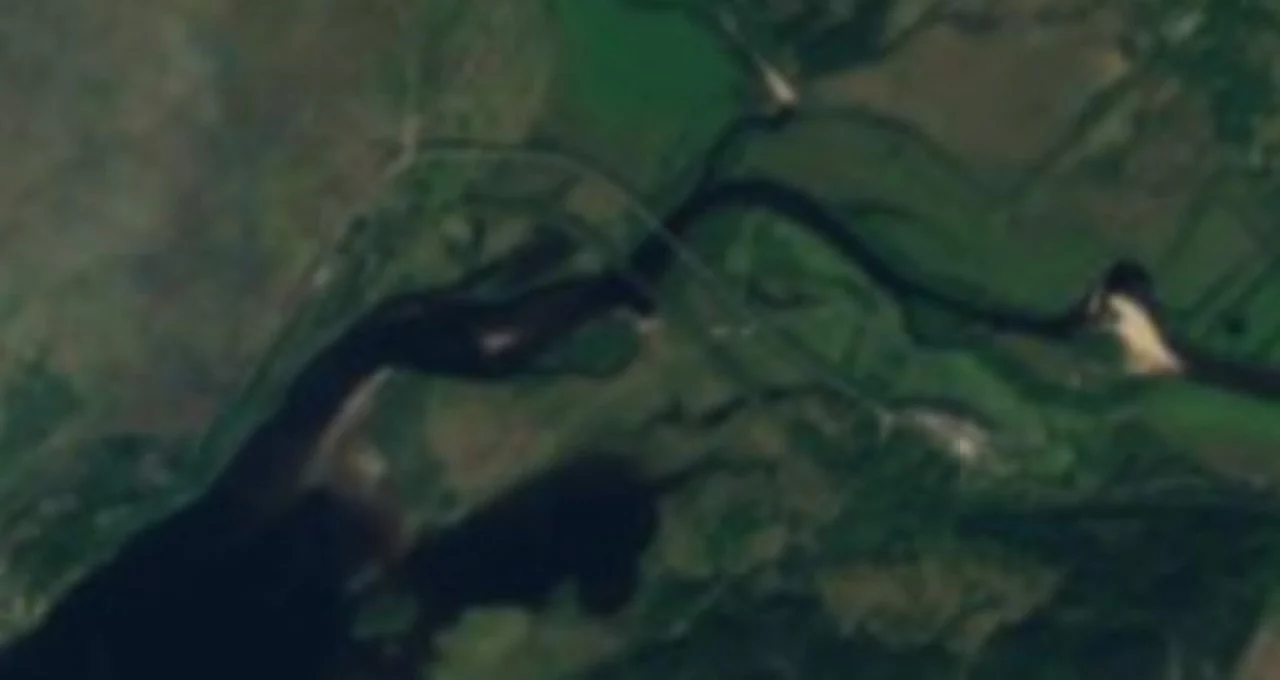
Dalmally Golf Club from space. Sentinel-2 cloudless 2016 by EOX IT Services GmbH (contains modified Copernicus Sentinel data), CC BY 4.0.
Dalmally Golf Club
Holes
9 (played twice from different markers for 18)
By
64 for men, 66 for women, over 18 holes (club card)
Length
4,427 yards from the white markers over 18 holes, 4,146 yellow, 4,249 red (sum of the club card)
Green fee
—
Best season
—
Dalmally Golf Club lies on the flat valley floor of Glen Orchy, on the western edge of the village of Dalmally in Argyll and Bute, with the River Orchy along one side of the course and the A85 along the other. The club’s address is the Old Sawmill, Dalmally, PA33 1AE. It is a nine-hole parkland course, played twice from different markers for an eighteen-hole round, set between two of the bigger mountains of the southern Highlands: Ben Cruachan to the west and Ben Lui to the east. The river reaches the head of Loch Awe a short way downstream.
This is a small, volunteer-run club. The course in its present form dates from the 1980s, the first committee was formed at a meeting in the Old Church Hall in 1985 and the club played its first formal competition in 1987, the year Wikidata records as its foundation. On the club’s own card the eighteen holes play to 4,427 yards from the white markers and par 64 for men, with eight par 3s and ten par 4s. It is short, and the club does not pretend otherwise; what it offers instead is a round in scenery that reviewers rank as its main attraction, on ground that is easy to walk, and a welcome for visitors, juniors and dogs on leads.
A course made by its village
Golf at Dalmally is older than the present club. The Golf’s Missing Links archive, which documents lost courses from newspaper records, has a Loch Awe and Dalmally Golf Club founded in 1907 on Castles Farm, with a nine-hole course reported at the time to have been laid out by Charles Hunter of Prestwick. Its holes ran from 140 to 300 yards. In 1914 it had fifty members and no Sunday play, and the nearest station was Lochawe, a mile away. That club faded during the First World War. A second nine-hole course opened in Glen Strae in July 1934, described then as the only course between Oban and Killin, and the club was still mentioned in 1947. The present club’s history confirms that there was golf on the Castles estates before the First World War, and it treats the modern course as a fresh start.
That start came in the 1980s, from the idea of Calum MacFarlane-Barrow of Craig Lodge, who saw the potential of the riverside land and drew the first design. Members and villagers built the course themselves. The club rented the ground at first and bought it in the mid-1990s, and lottery funding later paid for new greens, tees and bunkers. The first clubhouse was a donated caravan. The second was a former Territorial Army hut that the council offered the club in Oban: members took it down over several weekends, carried it to Dalmally and rebuilt it on the present site, finishing in 1992. It is still the clubhouse, with a patio added since that looks over the green shared by the 9th and 18th. The club remains run by volunteers, with competitions through the season for men, women, mixed pairs, singles, doubles and teams, and a published membership scale that starts with free golf for children of members.
What the course asks of you
The club describes the course as flat parkland, testing for the best player and fair for the beginner, and both halves of that are true for the same reason: the holes are short, but they are tight, and accuracy counts for more than length. The nine holes alternate neatly between par 3s and par 4s. The first time round, from the white markers, they measure 161, 338, 172, 295, 132, 280, 151, 298 and 405 yards, which adds up to 2,232 yards and par 32. The second nine reuses the same greens from different tees, at 161, 348, 164, 292, 123, 273, 151, 298 and 385 yards, for 2,195 yards. Played as eighteen holes from the whites, that is 4,427 yards and par 64; from the yellows 4,146 yards; and for women par 66, with the 9th and 18th played as par 5s.
The 3rd is the hole the club itself has chosen to single out. It is a par 3 of 172 yards from the white markers and 157 from the yellow, and it is the index 3 hole for men on the first nine, which on a course where most holes are short tells you how much trouble it holds. An earlier description written for the club, still reproduced on a sports directory, named it the Orchy Splash and called it a true test of skill; the name says plainly enough what is at stake. One reviewer singled out the par 3s in general, one played over a long pond and another next to a lily pond, as the strongest part of the course.
The 9th is the longest hole, a par 4 of 405 yards from the white markers on its first pass and 385 from different tees as the 18th, and it is index 1 for men. It brings the round back to the green below the clubhouse patio. The 2nd, 338 yards and index 5, is the other hole that asks for two full shots. Elsewhere the par 4s run from 270 to 300 yards, where the challenge is a tee shot placed rather than hit hard, and the par 3s from 111 to 172 yards.
The ground is level and the walking easy, which makes Dalmally a natural course for older golfers and for families. Do not judge it by the yardage alone. One of the few written reviews makes the point more bluntly than we could: any deviation from the straight and narrow and you will drop shot after shot.
What golfers say
Dalmally is reviewed only lightly online. We found three reviews on Golfshake, written in 2007 and 2014, two short reviews on Hole19, where the course has an average of 4.5 out of five, and nothing yet on The Social Golfer. The points below are what those reviews and the general visitor comments have in common. They are other people’s opinions, not ours. Nobody from Panxis has played the course, and we name no reviewer.
What comes up in its favour
- The setting, first and almost always. Reviewers speak of mountains on every side, and the club itself frames the course between Ben Cruachan and Ben Lui.
- The par 3s, described as interesting and varied, with water in play on more than one of them.
- The welcome. A visitor travelling round Scotland recommended it for the friendly reception, and the club presents itself as relaxed, informal and dog friendly.
- A course that suits everyone in a mixed group: short enough for beginners and juniors, tight enough to keep a single-figure player honest.
- A natural stop on the road between Oban and Perth, as one reviewer used it, with the A85 running past the gate.
What comes up against
- The length. At under 4,500 yards for eighteen holes, played over the same nine greens twice, it is not a course for anyone who wants to use every club in the bag.
- The facilities are modest. The clubhouse is a rebuilt hut run by volunteers, and directory listings disagree on whether there is anything for sale beyond refreshments; we found no reference to a driving range, a professional or a shop.
- There is very little written about the course, so the condition on a given day is hard to judge in advance, especially after rain on a riverside site.
- The online information is inconsistent. Yardages, pars and even the telephone number vary between directories, which matters when planning a visit from a distance.
Getting there and when to go
The course is on the A85 at the western end of Dalmally, the road that runs from Tyndrum and Crianlarich to Oban past the head of Loch Awe. Kilchurn Castle and the Cruachan Dam are both nearby, and the village sits on the Oban branch of the West Highland Line. Dalmally station, managed and served by ScotRail, is a little over a mile from the course by our measurement on the map, with trains towards Glasgow Queen Street in one direction and Oban in the other. The nearest other courses are at Taynuilt and Inveraray, which makes a two- or three-course trip along Loch Awe and Loch Fyne easy to put together.
Visitors are welcome. Tee times can be booked through the club’s online booking page, which shows slots through the day, and the club publishes its open competitions on its website, among them seniors’ opens for golfers aged 55 and over and summer team and strokeplay opens. The club’s facilities page shows golf carts, bags and trolleys as available without giving terms, so ask when booking if you need one. Pets on leads are welcome on the course. The club’s website does not give a season or winter rules, and we leave that open; late spring to early autumn is the obvious time to go, with long evenings and the hills at their best.
If you are touring the west, our page on Colonsay, another Argyll course, may help to plan the rest of the trip.
Green fees
Visitor rates are set by the club and shown when booking on its tee booking page. Directory listings quote figures of uncertain date, and we do not repeat them.
How this page was made
The factual frame comes from public sources: OpenStreetMap for the location and the address; the club’s website for the course description, the hole-by-hole card, the club’s history from the 1985 meeting to the rebuilt clubhouse, the competitions, the membership and the booking arrangements; Golf’s Missing Links for the clubs of 1907 and 1934 and the newspaper reports they cite; Golfshake and Hole19 for reviews and directory data; a PlaySport listing for the name of the 3rd hole and the welcome for pets; the English Wikipedia articles on Dalmally and Dalmally railway station for the village and the railway; Wikidata for the 1987 foundation date and the identifiers. Distances from the station are our own measurement on the map.
Where sources disagree, we say so. Our yardages are the sum of the club’s own hole-by-hole card: 4,427 yards from the white markers, 4,146 from the yellow and 4,249 from the red. Golfshake gives 4,528 yards and par 64 from the white, with standard scratch scores of 62 from the white, 61 from the red and 60 from the yellow; Hole19 gives 3,885 yards and par 66 from the red; The Social Golfer gives 4,750 yards and says the club was established in 1980, against 1985 for the first meeting and 1987 for the first competition in the club’s history. Golfshake gives the telephone number as 01838 200370; the club and other directories give 01838 200619. Golfshake lists no clubhouse or buggies; the club has both a clubhouse and, by its own icons, carts. On the club’s card the red markers are longer than the yellow on several holes, which we report as published.
The opinion section summarises reviews on Golfshake and Hole19, read in October 2026. We report recurring themes rather than individual voices. Nobody from Panxis has played or visited the course, and this page is no substitute for a round.
The club has not paid for this page, has not seen it before publication and has no say over its content. This page contains no commercial link and earns us no commission. If you know the club and something here is wrong or out of date, write to us and we will correct it.
Other courses nearby
Closest to this one in our British directory:
- Erskine Golf Club — 39 mi
- Glasgow Golf Club — 44 mi
- Dullatur Golf Club — 49 mi
- Colonsay Golf Club — 53 mi
The hole to know
Par 3 of 172 yards from the white markers, index 3 for men, named the Orchy Splash in an earlier description written for the club.