Frost, temporary greens and the two-temporary handicap rule: winter putting on links and parkland
Frost bruises a frozen leaf and a half-thawed green can shear its own roots, which is why most clay parkland courses send you to temporaries while Gullane keeps its greens open. Here is what greenkeepers are protecting, what the Rules let you do, how many temporaries a handicap card can carry in England, and how to putt until spring.

In brief
- BIGGA explains that frozen grass bruises underfoot and dies from the inside, and that a green thawed on top but frozen below can shear its roots. The damage often shows only in spring.
- Policies differ by soil and grass: Parkstone keeps everyone off frosty greens, Northamptonshire County uses frost holes, and Gullane told BIGGA it does not close its greens for frost.
- England Golf allows no more than two temporary greens in an 18-hole acceptable score, one on nine holes. Since October 2025, E-2, E-3 and E-12 are used between 1 October and 30 April.
- You may not brush frost off your line (Rule 8.1a) or tap down hollow-tine holes (Rule 13.1c), and on a temporary the main green is a wrong green. Putt firmly on soft greens and gently on frozen ones.
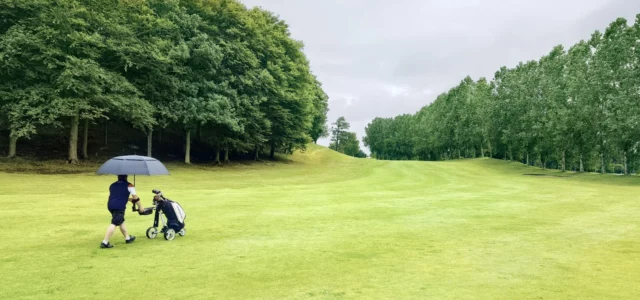
You turn up for the Saturday roll-up, the car thermometer says minus two, and the board by the pro shop tells you the course is open on temporary greens until further notice. Half the field grumbles that the greens look perfectly fine. Then on the first tee somebody mentions that a links club an hour up the road plays its proper greens straight through a frost, and the grumbling gets louder. British golfers spend more of the year on winter greens than they like to admit, and the rules around them, from the Rules of Golf to the handicap guidance from England Golf, are a mystery to most members. This guide explains what the greenkeeper is protecting, why clubs a few miles apart reach opposite decisions, what you are allowed to do on a frosty putting surface, when a winter card still counts for your handicap, and how to putt and chip on the surfaces you will actually meet between now and April.
What frost does to a green that you cannot see
The damage that keeps you off the main greens happens inside the grass. When the leaf freezes, the water in its cells expands and puts the cell membranes under great pressure, as BIGGA, the greenkeepers’ association, explained in its Your Course magazine. Tread on that frozen leaf and you bruise it. The walls between the cells break, the plant dies from the inside, and the dead patches only turn brown once the green thaws. A trail of footprints across a white green on a December morning can still be visible in March.
The hours after the thaw are, if anything, riskier. Once the top layer has softened but the soil below is still frozen, the roots can shear where the two layers meet when golfers walk across the surface. The green looks playable, it even feels soft, and the harm is done below ground where nobody can measure it. That is the honest reason a course manager keeps you on temporaries until well into the morning, and why the answer to “but the sun is out” is often still no.
Not every agronomist reads the evidence the same way. A study at Oregon State University, funded by the USGA and published in its Green Section Record in March 2024, found no damage from foot traffic on annual meadow-grass greens on eight frosty mornings, although a single buggy pass over frosted bentgrass did visible harm and rolling on frost hurt green quality. The researchers’ advice was for each course to trial its own turf before changing anything. Most British clubs have not run that trial, which is why caution remains the norm.
Why one club closes its greens and the next one stays open
Members love comparing frost policies, and the comparison is rarely fair, because the grass and the soil are different. When BIGGA asked several course managers about it for Your Course in 2019, the answers ranged from total protection to none at all.
At Parkstone, the heathland course in Dorset, the greens are treated as the club’s most valuable asset and nobody plays them while they are frosty or frozen. The greenkeeper decides when play goes back to the main surfaces. Northamptonshire County keeps the course open but moves the flags to frost holes, and its written policy separates a light frost, which it says causes no lasting leaf damage, from a heavy one that can shear roots. At Eyemouth in the Scottish Borders, a small club that relies on visitors driving more than an hour for a winter game, there was no frost policy and winter greens had never been used. Their greens recovered after a cut and a roll once the frost had gone.
Two details from that BIGGA survey are worth remembering when you are stuck on a temporary. Dale Housden, then course manager at Hollywood Golf Club, reckoned that without temporaries his main greens would end up three to four weeks behind in the spring. He also checked the thaw with an eight-inch metal probe, and if it could not go all the way down by 1pm, play stayed on the temporaries for the rest of the day. And a second greenkeeper made the point that grass type decides a great deal. Fine links greens made up of fescues and bents need protecting from frosty play, he said, while greens dominated by annual meadow-grass had coped at his club as long as the aeration kept up.
What the Rules say on a frosty or frozen green
The Rules of Golf do not change for winter, but a few of them only really bite between November and March.
You may not brush frost off your line. Rule 8.1a forbids removing dew, frost or water when it improves the conditions affecting your stroke, and the putting green exception in Rule 13.1c covers only sand, loose soil and damage. Frost is none of those. On the teeing area, Rule 6.2b(3) lets you clear dew, frost and water before you play, so the tee is the one place where you can tidy up.
Snow and natural ice are different. The Rules let you treat them either as loose impediments or, when they lie on the ground, as temporary water, whichever suits you. A lump of ice on your line can be moved, and a covering of snow on the green can give you free relief under Rule 16.1d. Frost and dew fall into neither category, which is where the confusion usually starts.
Hollow-tine holes stay as they are. Rule 13.1c says that aeration holes and grooves from vertical mowing are not damage, so you cannot tap them down. A Committee may bring in Model Local Rule E-4, which gives free relief if your ball lies in or touches an aeration hole on the green, though not for holes that only sit on your line, and the Local Rule is meant to come off once the holes have healed.
You still cannot roll a ball across the green during the hole to see how fast it is. Rule 13.1e forbids testing the surface. Once you have holed out you may roll a ball on the green you have just played, which is the legitimate way to get a feel for the pace.
Temporary greens follow Model Local Rule D-2. The temporary is defined as the putting green for that hole and the main green becomes a wrong green, so if your ball comes to rest on it, or it gets in the way of your stance or swing, Rule 13.1f makes you take free relief. You are not allowed to putt it out on the proper surface, however tempting the flag on the back of the old green looks.
Preferred lies never reach the putting green either. Model Local Rule E-3 applies to parts of the general area cut to fairway height or less, and the R&A’s winter rules FAQ for 2025 to 2026 says the decision to use it rests with the Committee and that it should end as soon as conditions improve.
Does a winter round still count for your handicap?
Great Britain and Ireland do not use an inactive season, unlike parts of North America where the golf association closes score posting for the winter. Guidance from CONGU says golf is meant to be played all year here, while warning that the way a course is set up in winter can mean a score is not acceptable.
For clubs affiliated to England Golf, the key number is two. The England Golf Adverse/Extreme Weather Reference Guide, as quoted by National Club Golfer, allows no more than two temporary greens in an 18-hole score, and only one on a nine-hole course, for that score to stay acceptable. Temporary tees have limits too. Under Appendix G of the Rules of Handicapping, the front of the teeing area should sit no more than 10 yards from the permanent measurement point, and the overall length of the course must stay within 100 yards of its measured length, either way.
The window for the main weather Local Rules has moved about. In October 2024 England Golf said preferred lies no longer had a defined season. A year later, as National Club Golfer reported on 2 October 2025, it brought back the traditional window. Clubs may use E-2 (cleaning the ball), E-3 (preferred lies) and E-12 (compulsory fairway mats) between 1 October and 30 April when they are absolutely necessary, and outside those dates they need permission from their county. If your club is on four temporaries this weekend, ask at the desk whether the computer has the course switched off for handicap purposes before you post the card.
Putting on winter surfaces
The greens you play in November are rarely the greens you played in August. They are slower, often wetter and sometimes still sandy from the autumn topdressing. In BIGGA’s Your Course in October 2024, the agronomist Noel MacKenzie warned against chasing summer speeds into the autumn and asked golfers to accept that a course may look and play a little differently in winter. That is the right frame of mind for the first green.
On a soft, slow green the ball takes less break than you expect, because it is moving faster through the part of the putt where it would normally turn. Give each putt enough to finish a foot or so past the hole and play less borrow than the slope suggests. On hollow-tined greens a firmer strike also helps the ball hold its line over the sand. After you hole out, use your legal practice roll on the green you have just finished, which tells you more than the practice green did at 8am.
A temporary green is a different animal again. It is usually cut out of the fairway or the apron, with a bumpier surface than any proper green. Most golfers do better treating it as a long chip-and-run target rather than a real putt, picking the straightest line and rolling the ball firmly enough that the bumps matter less.
When the main greens are frozen but open, the surface works the other way. It is hard and quick, the ball does not pitch-mark, and downhill putts can run a long way. Watch what your partners’ approach shots do. If they bounce high and keep going, shorten your stroke on the long ones. Our guide to winter chipping on links, heathland and parkland covers the shots into those greens in more detail, and our piece on cold balls, frost and fairway mats explains why your approaches are coming up short in the first place.
Where the winter green depends on the soil: links, heathland and parkland
Links. Sand-based links courses drain quickly and often stay open when inland clubs are shut, which is why they fill up with visitors at weekends. Stewart Duff, superintendent at Gullane in East Lothian, told BIGGA in 2022 that Gullane does not close its greens when it is frosty. He said he had not seen clear damage from two or three frosty mornings, and that he would only think about temporaries after three, four or five days of continuous frost without a thaw. Expect true main greens on a links in most of the winter, firm and a little bumpy, and a ball that releases a long way after landing.
Heathland. Heathland courses on sandy soil, common in Surrey, Berkshire and Dorset, drain well too, but many of them carry fine bent and fescue greens that their greenkeepers guard closely. Parkstone’s line, no play on frosty or frozen greens until the greenkeeper is happy, is typical. Plan on a later start on a clear morning, and on firm surfaces once you do get out.
Parkland on clay. This is where most British members spend their winter, and it is where the temporaries live. Clay holds water, so greens can stay soft for weeks, and the thaw after a hard frost is exactly the moment BIGGA’s greenkeepers describe as the one that shears roots. You will meet temporary greens, fairway mats and sometimes winter tees on the same card. Putts on the main greens, when you get them, will be slow and grabby, and approach shots will stop where they land or plug. Fly the ball closer to the hole than you would in summer and repair every pitch mark properly, because a soft green marks deeply.
A checklist for the next frosty Saturday
Look at the club’s website or app before you leave the house and see whether the course is on temporaries, mats or a frost delay. If the night was clear and still, assume a later start than the one you booked. On a temporary, roll the ball firmly at the hole. On the proper greens in winter, give every putt a chance and read a touch less break than you see. Leave the frost on your line, leave the aeration holes alone and keep your test rolls for the green you have just finished. If you are on more than two temporaries, find out whether the round counts before you post the score.
And the next time the greens look perfectly fine at 9am, remember the probe that has to go eight inches into the soil. The greenkeeper who keeps you off them in January is the reason they will be worth putting on in May.