Frost delays, temporary greens and closing day: cold-weather putting from Ontario ice to B.C. rain
The last weeks of a Canadian season bring frost delays, sanded greens and cups cut in the fairway. Here is why your course is so strict, what you may and may not do on a cold green, when your province stops counting scores, and how to adjust your putting before the course closes.
In brief
- USGA Green Section guidance says frosted grass is brittle, a foursome takes 300 steps or more on each green, and recovery can take more than a month. A 2024 Oregon State study found walking on frosted annual bluegrass did no harm, but courses are told to test before changing policy.
- Frost stays on your line (Rule 8.1a), aeration holes are not damage you may repair (Rule 13.1c), and lift, clean and place under Model Local Rule E-3 never reaches the green.
- BC Golf lists an active posting season of March 1 to November 15 in British Columbia and April 15 to October 31 in Ontario and Quebec. Inactive-season rounds can be entered but do not count toward your index.
- Ice is the Ontario and Prairie worry: Golf Canada reported greens under ice for more than three months in 2014. On the B.C. coast, wet greens and frost delays are the winter routine.
The last weeks of a Canadian season have a rhythm of their own. The tee sheet fills up for noon, because nobody gets out before the frost lifts. The greens you were holing out on in August are suddenly slow and grainy with sand, and one Saturday you arrive to find a cup cut in the middle of the fairway, 30 yards short of where the flag used to be. For most of the country this is the end of the line until April. For golfers in the Lower Mainland and on Vancouver Island, it is just the start of a long, wet winter of play. Either way, a cold green asks for a different stroke and raises a few questions about the Rules that never come up in July. Here is what is going on under your feet, why your course is so strict about it, and what you can and cannot do once you reach the putting surface.
A green in late fall is a different surface
Bentgrass and annual bluegrass, the grasses on most Canadian greens, slow down as the soil cools. Less growth means less mowing, and the dew that burns off by eight in summer can sit on the surface until late morning. The ball rolls out less. It also bobbles more, because many clubs aerate and topdress in the fall, and you are often putting through small holes and loose sand for the last few weeks of the season.
Superintendents do this on purpose. Agronomists at the USGA Green Section, whose guidance Canadian turf managers read closely, explain that fall is when greens recover quickly from aeration and head into winter with healthier roots. They also caution that punching holes once the soil is too cold can leave the damage in place until late spring. So the bumpy surface you curse in October is, in part, the price of a decent green next May.
Then the nights get colder. A green that freezes overnight plays like a tabletop in the morning, firm enough that an approach shot takes one big hop and keeps going. By early afternoon the top layer can thaw while the soil below is still frozen, and that is the most fragile state of all. The surface is greasy and soft, it takes footprints, and USGA agronomists warn that traffic on it can tear the roots where the thawed layer meets the frozen one. You will not see that damage for months.
The frost delay, explained by the people who call it
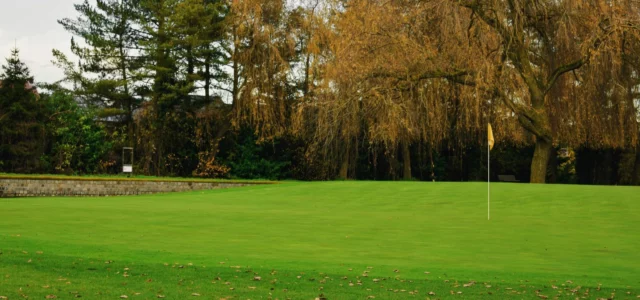
A frosty green looks harmless, and that is the problem. Frost is ice inside and on the grass blade, and it makes the plant brittle. The USGA Green Section’s advice to golfers puts it plainly: footsteps on frosted turf can injure the grass, the damage may take a while to show, and recovery can take more than a month. The same guidance notes that a foursome typically takes 300 steps or more on each green, and a single shaded hole can keep a whole course closed, since you cannot send players out to a hole that is still white.
Research is chipping away at some of that. In a USGA-funded study at Oregon State University, published in March 2024, foot traffic on frosted annual bluegrass greens over eight February mornings caused no visible harm, though one pass of a golf cart on frosted bentgrass did, and so did rolling the greens. The authors did not tell courses to drop their policies. They suggested that each course test its own turf first. Until yours has done that, the delay stands, and arguing with the starter will not melt anything.
A practical tip from the pro shop side of things is to look at the overnight low and the sky. A clear, calm night that dips near zero is the classic recipe for frost, and the first tee time of the day becomes a guess. Book a little later in November, or call before you drive.
What you are allowed to do on a cold green
Golf Canada plays under the same Rules of Golf as the rest of the world, and none of them change in November. A few, though, start to matter much more.
Leave the frost on your line. Rule 8.1a says you may not remove dew, frost or water if that improves the conditions for your stroke. You can deal with them in the teeing area, where Rule 6.2b(3) allows it, but not on the green. What you may remove there, under Rule 13.1c, is sand and loose soil, and you may repair damage. Frost is neither. A sweep of the towel across your putting line is a breach.
Snow and natural ice give you a choice. The Rules let you treat them, frost excepted, either as loose impediments or as temporary water when they lie on the ground. A loose shard of ice on your line can come off. A green under a skiff of snow is temporary water, with free relief under Rule 16.1d.
Aeration holes stay as they are. Rule 13.1c lists the damage you may fix on a green, ball marks and spike marks among them, and it specifically excludes aeration holes and vertical mowing grooves, along with anything caused by rain or other natural forces. Your Committee can adopt Model Local Rule E-4, which gives free relief when your ball lies in or touches an aeration hole on the green. It does not help when the holes are only on your line, and it is meant to be withdrawn once they have healed.
No test rolls while the hole is in progress. Rule 13.1e bars you from rubbing the green or rolling a ball to test it. Once you have holed out, you may roll a ball on the green you just finished, as long as you do not hold up play.
Lift, clean and place has limits. When a club announces winter rules, it usually means Model Local Rule E-3. It covers a ball in the general area cut to fairway height or less, and the R&A’s winter guidance repeats that it is generally meant for the fairway and should end once conditions improve. The putting green is not part of it.
Temporary greens and the scorecard in your pocket
When the greens are frozen, thawing or simply being rested, many Canadian courses switch to temporary greens for the closing stretch. In a competition, the Committee would use Model Local Rule D-2, under which the temporary green becomes the putting green for that hole and the regular green turns into a wrong green. If your ball comes to rest on that wrong green, or it gets in the way of your stance or swing, Rule 13.1f requires you to take free relief. In a casual round, just agree on the first tee that the fairway cup is the hole and that the real green is off limits.
Whether a round on temporary greens counts for your Handicap Index is a separate matter. Under the Rules of Handicapping, the authorized association decides whether scores made under temporary conditions are acceptable, so the answer comes from your provincial association and your club. The calendar matters even more. Provincial associations set the active posting season, and the dates on BC Golf’s handicap page show how wide the country is. British Columbia runs from March 1 to November 15, Alberta from March 1 to October 31, and Ontario, Quebec, Saskatchewan, Manitoba and Nova Scotia from April 15 to October 31. Rounds played in the inactive season can still be entered in your Golf Canada account, but they do not count toward your index. Head to Arizona in February, though, and the round must be posted, because the course you played is in its active season.
Where the season ends, and where it never quite does, across Canada
Ontario and the Prairies. Here the end of the season is about ice as much as frost. Turf researchers at Olds College in Alberta found that annual bluegrass survives far less time under ice than creeping bentgrass, and the spring of 2014 showed what that means. Golf Canada reported that ice had covered greens at many Ontario courses for more than three months, about twice what most annual bluegrass can withstand. One Toronto club played on seven temporary greens that spring, and a course in Etobicoke resodded all its greens with bentgrass. That is why superintendents close greens early, put covers on some of them and keep you off a surface that looks perfectly playable in late November.
Atlantic Canada. The trouble on the East Coast is the swing between snow, rain and thaw. A superintendent at Fox Meadow in Stratford, P.E.I., told Turf & Rec in 2017 that he watches for ice forming as the course thaws and refreezes, because it can kill the plant at the crown. If your course closes early after a run of mild days, that is usually why.
British Columbia. On the coast, winter golf is normal and the greens are rarely frozen for long. Wet weather is the bigger issue, so expect soft greens that take deep ball marks and a regular diet of frost delays on clear mornings. A real freeze can still shut things down. In the winter of 2016 and 2017, Vancouver’s three city courses, Fraserview, Langara and McCleery, which only close for extreme weather, stayed shut for seven weeks, their longest closure in twenty years, because repeated freezing and thawing left the greens too soggy for foot traffic.
Adjusting your putting before the course closes
On a slow, damp green, most misses are short. The ball loses speed early, so it takes less break than you read, and golfers who play the summer line end up below the hole and short. Pick a target a foot or so past the cup and roll the ball there. Read a touch less break. On a sanded green, a slightly firmer stroke also helps the ball hold its line as it crosses the topdressing.
The frozen morning green is the reverse. If your playing partners’ approaches are bouncing high and running through, trust that and take speed off, especially going downhill. Use the legal test roll after you hole out to feel the pace, and remember that the green will soften as the sun gets on it, so the 10th may play nothing like the 1st.
Around the green, land chips short of a frozen surface and let them run, and carry them closer to the hole on a wet one, where they stop dead. Our guide to the shoulder-season short game goes into more detail. Cold also takes yards off your irons, and our piece on golf balls over a Canadian winter looks at how much.
Your last rounds of the year
Check your course’s frost and temporary-green policy before you leave the house, and book later if the night was clear. Know your province’s posting dates so you are not surprised when a November score vanishes from your index. On the green, leave the frost alone, putt over the aeration holes and save your test rolls for after you hole out. Give every putt enough to reach the cup. If you live on the coast, keep fixing your ball marks all winter, because the greens you play in January are the ones everybody else will be putting on in April.