Wet-weather golf: how to play, and enjoy, a round in the rain
Wet golf in Britain is not an exception to be endured; it is a large share of the season. The players who score in it are the ones who stay dry.
In brief
- Dry hands first: two gloves, a towel kept inside the bag.
- Soft fairways take the run away: a club or two more on approaches.
- Greens receive, so aim at the flag rather than the middle.
- Wet sand is firm: stand closer, open the face less, take less club.
- Preferred lies are a local rule written on the card, not a courtesy.
Rain does not cost you shots. Being unprepared does. A properly equipped, methodical golfer loses two or three shots on a wet round; one who discovers at the third hole that his grips are slipping loses eight. Here is what matters, in order.
Keep your hands dry, everything follows
The single point of failure in wet golf is the connection between hand and grip. Carry two spare gloves in a sealed bag, or a pair of rain gloves, which grip better wet than dry. Keep one towel inside the bag, dry, and one on the outside for the club face. The outside towel will be soaked by the sixth hole; the inside one is the one that saves the round.
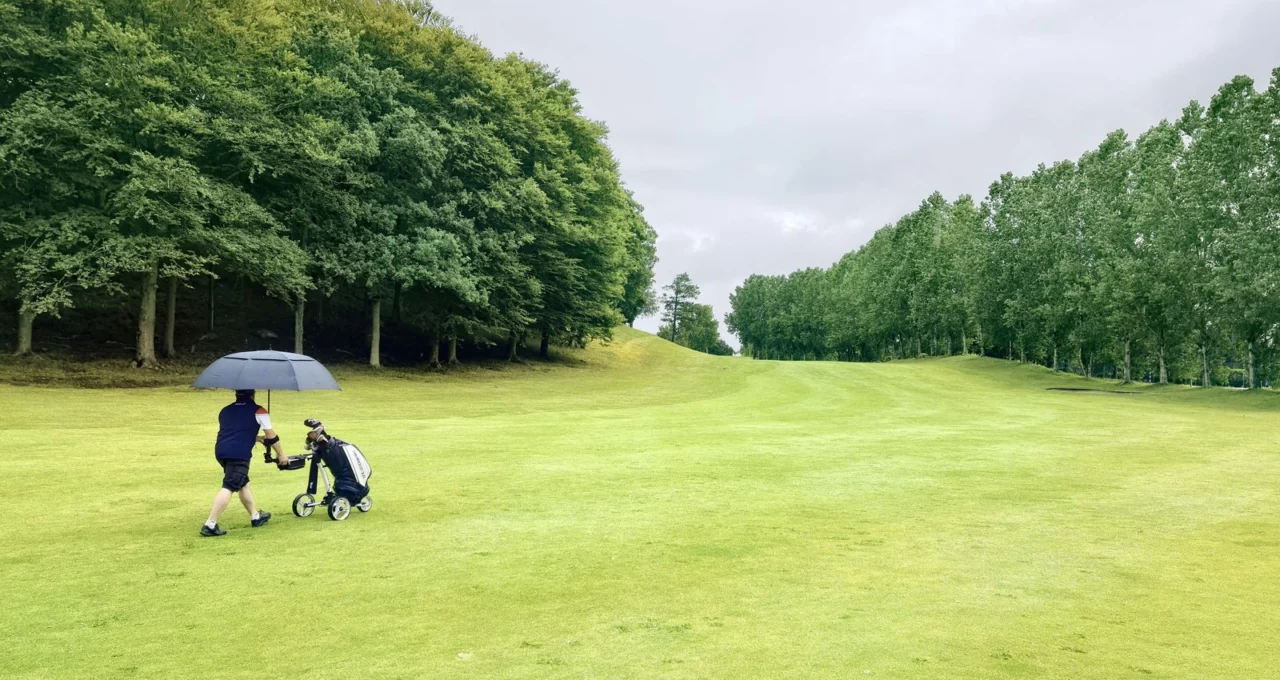
An umbrella is not for you, it is for the bag. Park it over the clubs between shots and your grips stay usable.
What the ball does in the wet
Wet fairways mean no run: a drive that normally finishes 240 yards out stops at its landing point, your drive stops where it lands, so you are playing a longer course than the card says. Take that into account before you reach for a club you cannot hit off a soft lie.
Water between the face and the ball reduces spin on full shots, so approaches fly further and land hotter than expected, then stop dead in soft greens. The net effect is that distance control gets harder in both directions. Aim for the middle of the green and take the two-putt.
Club selection changes
Off a wet fairway, the ball sits down. Long irons and fairway woods become difficult, hybrids become easy. Take one more club than the yardage suggests and swing at eighty per cent: a controlled strike out of a wet lie beats a full swing that catches turf first.
Around the greens, the ground game stops working. Wet approaches check rather than run, so pitch to the flag rather than landing short and hoping.
Kit that earns its place
Waterproofs you can actually swing in, tested before the day rather than in the car park. Spikes with grip left in them: worn soles on wet slopes are how people fall over. A bag hood, or at minimum a plastic bag over the clubs. And a hat with a brim, which keeps rain off your glasses and out of your eyes better than any hood.
What the course does when it is wet
Soft fairways take the run away entirely, which is worth more than most golfers allow for. A drive that finished at 220 yards in August finishes at 195 in a wet April, and an approach that needed a 7-iron in summer needs a 6 or a 5.
Greens receive, which is the compensation. A ball that released six metres past the flag in July stops within two of its pitch mark in the wet, so aim at the flag rather than the middle when the surface is soft, and expect putts to be slower than they look.
Bunkers change too. Wet sand is firm, the bounce of the club skids off it rather than digging, and the ball comes out faster and lower than expected. Stand a little closer, open the face less, and take slightly less club than you would from soft sand.
Preferred lies and the rules in winter
Most British clubs put preferred lies in place for the winter, which lets you lift, clean and place the ball within a specified distance on closely mown areas. It is a local rule rather than a courtesy, and it is written on the card or on the notice board at the first tee.
Read it rather than assuming. The distance allowed, the areas it applies to and whether temporary greens are in play change from club to club and from week to week, and so do out-of-bounds and the status of a ditch that is dry in July and a stream in January.
Frost is the one that is not negotiable. Walking on frozen grass destroys the plant rather than the blade, and the two hours you spend in the clubhouse in January are what makes the green playable in May.
The mental half
Everyone in the group is playing the same weather. The player who complains from the second hole plays worse than the one who accepts it, and this is measurable in scores rather than mystical.
Adjust your target: on a wet round, level with your handicap is a good day and anything better is a story. Play for the middle of greens, take bogey when it is offered, and let the others chase.
Looking after the course, and yourself
Wet ground is the condition in which a course is most easily damaged and most easily protected. Keep trolleys off soft areas and on the paths where they are signed, because compaction is precisely the problem greenkeepers spend the following summer aerating out. Replace divots properly, and repair your pitch mark and one more: a mark left in soft ground takes weeks to heal.
For yourself, the practical items are unglamorous. A second glove in a plastic bag, a spare pair of socks in the car, and a towel kept dry inside the bag rather than hanging off it. Cold, wet hands destroy feel in the short game faster than anything else, and no amount of technique compensates.
And eat and drink on a schedule even though you do not feel like it. Cold weather suppresses thirst while the body burns more energy keeping warm, which is why the back nine falls apart on a wet April morning.
When to stop
Standing water on the greens, lightning within earshot, or a course that has closed the buggies and is asking you to lift and place: those are signals, not challenges. Ring the pro shop before you drive over on a bad morning, because a course that is playable at nine may be under water by eleven.
Two paces of play worth knowing
Wet rounds are slower for everyone, and the two habits that recover the most time cost nothing. Announce a provisional ball whenever there is any doubt, because the walk back to the tee is longer and colder in the rain than it ever is in July. And write the card on the next tee rather than on the green.
If the group behind is on you and there is space in front, let them through. It takes three minutes and it removes the pressure that otherwise decides the last six holes.
Where to get the kit
- Specialist golf chains with stores across the UK and Ireland, for waterproofs, rain gloves, umbrellas and bag hoods.
- Your club professional, who will have rain gloves in stock on exactly the day you need them and can dry-fit waterproofs so you can swing in them.
- An online second-hand golf specialist for a spare bag or a second-hand carry bag to keep as a wet-weather setup.
Wet golf in Britain is not an exception to be endured; it is a large share of the season. The players who score in it are not tougher, they are drier, and they have decided in advance to take one more club and aim at the middle.
Panxis Golf has no commercial relationship with these retailers and earns nothing from your purchases.
Where this shows up on a course
Three courses from our directory that hold up outside the summer.
- Royal Ascot Golf Club: Named by Queen Victoria in 1887 and played inside the racecourse for 118 years, the club moved in 2005 to a par 70 of 6,294 yards on Crown land in Windsor Great Park.
- Alwoodley Golf Club: Alister MacKenzie’s first course, founded in 1907 north of Leeds: a par 71 of 6,914 yards cut out of heather and gorse, with the greens he would become famous for.
- Stoke Park: Colt and Alison, 1908, on a Capability Brown estate five miles from Windsor: the par-3 seventh of Goldfinger, closed in 2021, restored and reopened in 2025 as pay-and-play.
We have not played these courses; each page says what it is based on.
How this page was put together
The retail availability mentioned above (waterproofs, rain gloves, umbrellas, bag hoods and second-hand bags) refers to American Golf and Golfbidder in the UK. Panxis has no commercial link with these retailers.