Bump and run, pitch or lob: chipping on firm links turf and soft winter parkland
Most club golfers chip with too much loft. On firm links turf and muddy winter parkland alike, a bump and run with an 8 or 9-iron should be the default, a standard pitch the next option, and the lob a rehearsed exception.
In brief
- Ask two questions before choosing a club: how much green is there, and what is the ball sitting on.
- Make the bump and run with a mid-iron your choice for roughly two chips in three.
- Plan a standard pitch as half carry, half roll, and keep the club accelerating.
- Keep the high soft shot for short-sided lies with grass under the ball.
- If winter mats are in force, a putter from the apron is exempt from the mat rule.
Watch a club four-ball on a firm links in August and you will see the same thing on nearly every green: someone reaches for a lob wedge from a perfectly tight lie, tries to land the ball beside the flag, and watches it skip twenty feet past. The golfer who quietly takes a 9-iron and bumps it into the bank usually gets down in two.
Chipping in Britain rewards a small, boring repertoire. Three shots are enough for almost everything you will face: a low running chip, a mid-height pitch that carries and rolls in roughly equal parts, and a soft, high shot kept for emergencies. The skill is choosing between them, and most club golfers choose too much loft far too often.
Our turf was made for the ball on the ground
The running game was not invented as a safe option for nervous players. It came from the ground itself. Links land is sandy coastal soil that supports browntop bent and red fescue grasses, and together they make firm turf on which the ball runs a long way after landing. Players on links traditionally land the ball short of the green and let it roll on.
Inland, the picture changes with the calendar. A parkland course that is soft and muddy in midwinter can be hard and fast by the end of a dry summer, so the same chip from the same spot can therefore need a different club in February and in August. The three shots below cover both situations; what changes is how often you pick each one.
Before you choose a club, ask two things
First: how much putting surface is there between you and the flag? Second: what is the ball sitting on?
Lots of green and a tight or clean lie point towards a ball that rolls for most of its journey. Very little green, or a bunker or a steep bank in between, means it has to fly. A ball nestled down in wet rough restricts everything, however much green you have to work with.
The club follows from those answers, not from habit. For a month, say them out loud before every chip, “plenty of green, tight lie”, and you will find your hand goes to a different club far more often than before.
Shot one: the bump and run
This is the default, and it should account for roughly two out of every three chips you play.
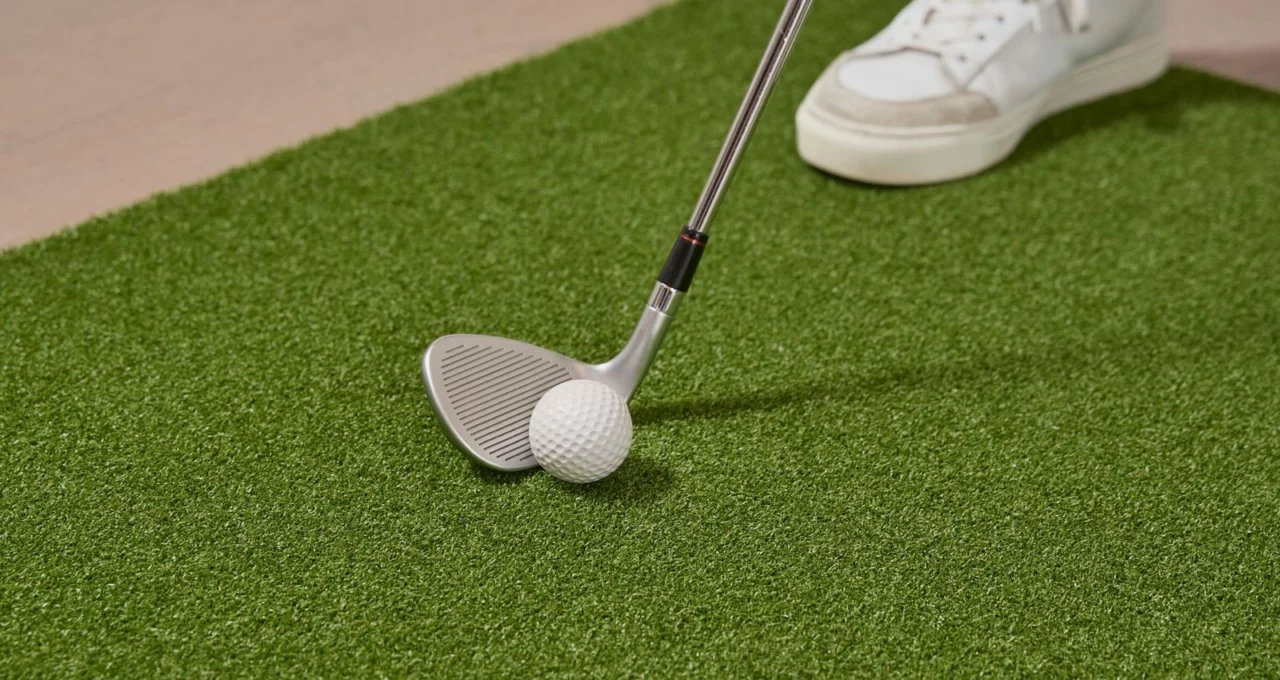
Take an 8-iron or 9-iron. Ball back of centre, about 60 percent of your weight on the lead foot and left there throughout, hands a little ahead of the ball. Now make what is essentially a firm putting stroke. The ball pops out low, lands a yard or two onto the green and rolls out to the hole.
It is the most forgiving shot around the green because the club never has to slide beneath the ball. Catch it slightly heavy and the ball still travels most of the way; do the same with a 60-degree and it moves a few feet. On a links in summer, or on any closely mown apron, this should be your first thought, and the only question is which iron gives the right ratio of carry to roll.
Tour players use it far more than highlights suggest. Television shows the spectacular flops; the scoring is done with shots that barely leave the ground, because a rolling ball is easier to judge than a flying one.
Shot two: the everyday pitch
When the flag is further on, or there is a strip of rough to carry, add loft. A pitching wedge or a wedge around 52 degrees, ball in the middle of your stance, and a longer motion in which the arms and chest turn together instead of the wrists flicking.
As a planning rule, expect the ball to fly about half the distance and roll the rest. This is the shot for the normal miss, a few yards off the green with some grass to clear, which is what most of us face several times a round.
The fault to watch for is slowing down. Golfers make a big backswing, sense that it is too much and ease off into the ball, which produces the familiar pairing of a fat one followed by a thin one. Choose where the ball should land, make a backswing that suits that distance, and keep the club moving through. The loft will lift the ball; you do not need to help it.
Shot three: the high, soft one
Sometimes you genuinely need height: short-sided, a pot bunker between you and a flag cut close to the edge, a green running away from you. Now the lofted shot earns its place.
Open the face of a 56 or 60-degree wedge first, then take your grip. Widen your stance slightly, play the ball forward of centre, and swing along the line of your feet while keeping the face open through impact. The ball climbs quickly, lands softly and stops without much run.
It needs a lie with some grass under the ball, and it needs rehearsal before you try it with a card in your pocket. From a bare, firm lie on a links or a frosty winter fairway, there is no cushion for the club to slide on, and the bump and run is nearly always the wiser choice even if it leaves a longer putt.
Pick a landing spot the size of a dinner plate
Most club golfers look at the flag. Better chippers look at where the ball should first touch down and let the roll take care of the rest.
Choose that spot, look at it during your rehearsal swing, then hit to it. Your distance control improves with no change in technique, because judging a carry of eight yards is far easier than judging a flag thirty yards away with roll to allow for. On a firm links approach the landing spot might even be short of the green, on the fringe or the bank, which is exactly how the ground was designed to be played.
When your wedge keeps digging
The curved sole of a wedge, its bounce, is meant to glide through turf rather than cut into it. Lean the shaft too far forward at address and you take that protection away, leaving the leading edge to dig.
On standard chips, keep the shaft nearer vertical than feels natural, particularly on soft winter ground. If the club still digs whatever you do, the bounce may not suit your turf: lower bounce generally suits firm, sandy ground and tight lies, higher bounce suits soft conditions and a steeper strike. A fitter can usually tell from a few divots. On current UK shelves, a single wedge is not cheap: Cleveland RTZ 2 wedges are listed at £159 and TaylorMade Hi-Toe 5 models at £179 by a UK online golf retailer, so it is worth being sure of the loft and bounce before buying.
If you would rather keep things simple, a chipper does the bump and run job with very little technique to learn; a MacGregor ZT Plus chipper is listed at £49.95 at a UK online retailer.
Winter rules that change your chip
British winter golf brings two situations worth knowing about.
Many clubs protect their fairways in cold weather with a Local Rule on fairway mats. Under The R&A’s Model Local Rule E-12, when your ball lies on a part of the general area cut to fairway height or less and you are not using a putter, you must place the ball on a mat and play from it. A chip off a mat behaves differently: the club bounces off rather than cutting through, so thin strikes become more likely. Note the exception, though. If you use a putter from the apron, the mat rule does not apply, which is another good reason to roll it.
Clubs also use temporary greens in winter. The R&A’s committee guidance notes that a temporary green is typically part of the general area when not in use, and a committee may declare it a wrong green. A small, roughly cut temporary green favours the low runner even more, because a lofted shot has nowhere soft to land.
Where to practise it in Britain
The short-game area at your own club is the obvious place, and at many courses it is available to visitors on a green fee. Check the signs first: plenty of practice putting greens do not allow chipping at all.
The Rules give you a little extra practice during a round too. Between holes you may practise chipping on or near the green you have just finished, as long as you are not playing from a bunker and are not holding up play (Rule 5.5b). Some committees switch that off with a Local Rule, so read the card. On the morning of a stroke-play competition you may chip near your first tee or on any practice area, but not elsewhere on the course.
At home, a patch of lawn and a target are enough for the bump and run, the shot you should be hitting most. A small net helps if the garden is short: a UK online golf shop lists a three-ring chipping net from Me And My Golf at £17.95. Ten minutes three evenings a week will shift your up-and-down rate faster than any membership decision.
For the equipment side, a PGA professional can check your wedge set-up and your technique in the same hour; The PGA’s PGA Play directory lists around 8,000 of them. Panxis Golf has no commercial relationship with any facility, retailer or coach mentioned here.
A week of short-game homework
- Drop three balls in one spot by the practice green and play each with a different club: 8-iron, pitching wedge, 56-degree. Watch how the roll changes.
- Hit twenty bump and runs before you pick up a lob wedge.
- Choose a landing spot out loud before every chip for one round, even if it lands on the fringe or the bank.
- Ask the two questions, how much green and what lie, before touching a club.
- If your club uses winter mats, spend ten minutes chipping off a mat before you meet one on the course, and try the putter from the apron.
None of this demands a new swing. Two of the three shots simply ask for less loft than instinct offers. On British turf, especially when the bunkers are deep and the ground is firm, that decision alone will save more shots than any technique.
How this page was put together
Prices for the wedges, the chipper and the chipping net were taken from Golf Online (UK). Panxis Golf has no commercial relationship with this retailer.