Setup basics for British golfers: hands, stance and aim in all weathers
Most persistent ball flights start before the club moves, in how you hold it, stand to it and aim it. Fixing the setup costs nothing but a fortnight of discomfort, so do it in winter, and keep the grip dry while you are at it.
In brief
- See about two knuckles on the lead hand; more hooks the ball, fewer slices it.
- Hold at four or five out of ten, and dry the grip before every shot in the rain.
- Rule 4.3a(5) allows a plain glove, drying agents and a towel wrapped round the grip.
- Hinge from the hips and use three ball positions for the whole bag.
- Aim the face at a spot just ahead of the ball; alignment sticks stay on the range under Rule 10.2b(3).
Ask a club golfer in Britain what is wrong with their game and you will hear about the swing: the takeaway, the hips, the follow-through. Ask a PGA Professional what they fix first and the answer is usually duller. How the player holds the club, how they stand to it and where they are aimed.
These are the setup basics, and they decide a remarkable share of what your golf ball does before the club has moved. They cost nothing, need no flexibility or strength, and they are where most self-taught faults begin. They are also neglected, because correcting them makes your golf worse for a couple of weeks. Do it anyway, ideally over the winter.
Why the hands come first
The clubface returns roughly where your hands put it. If your grip is turned so that your hands, returning to their natural position at impact, leave the face a few degrees open, every shot starts right. Every fix you invent for that, from aiming left to flipping the wrists, becomes a second fault stacked on the first.
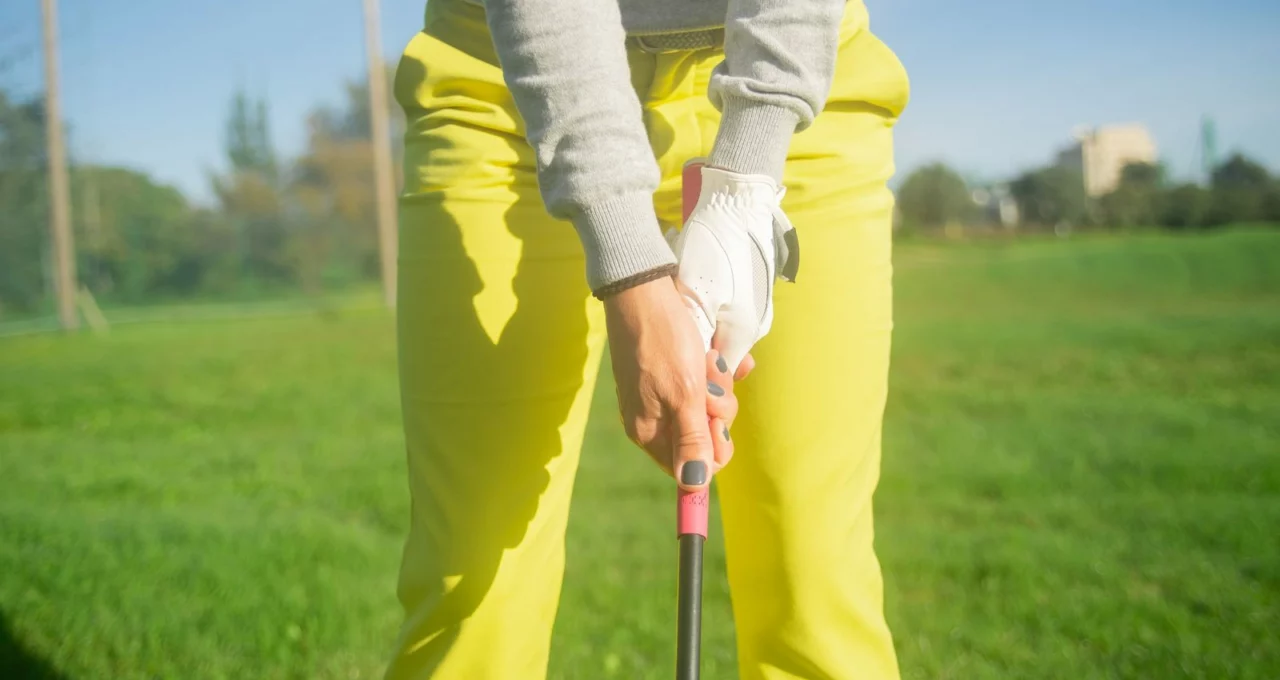
A neutral starting point: look down at address and you should see about two knuckles of your lead hand, with the V between thumb and forefinger pointing roughly at your trail shoulder.
- Three or four knuckles showing is a strong grip. The face tends to arrive closed, and the misses are hooks and low pulls.
- One knuckle or none is a weak grip. The face tends to stay open, and the result is the slice so many golfers fight for years with everything except their hands.
A corrected grip feels wrong, often a little feeble, for a fortnight or so. That is precisely the sensation that sends golfers back to the old one by the third hole of the Saturday medal, which is why a change like this belongs in the quiet months rather than the competition season.
Overlap, interlock or ten fingers
The style matters less than its reputation. All three are sound. Interlocking tends to suit smaller hands, overlapping larger ones, and the ten-finger or baseball grip is a perfectly respectable choice, particularly for juniors, seniors and anyone with weaker hands.
Two things matter more. The club should run across the fingers of the lead hand, not sit in the palm, because a palm grip cannot hinge freely and costs both speed and control. And the hands should work as a unit rather than against one another.
How hard to hold on
On a scale of one to ten, most coaches ask for about four or five. Grip at nine and the forearms lock, the wrists stop hinging and the club cannot release. Grip at two and the club twists in your hands, so the face position at impact becomes a lottery.
A quick check with a playing partner: hold the club out in front and let them tug it gently. If it slides out, you are too light. If your forearm muscles are standing out, you are too tight.
The more common fault is not the pressure at address but a squeeze during the swing, usually at the top, when you decide to hit at the ball rather than swing through it. Sore hands after a round are the giveaway.
Cold, wet British hands
Much of the year, holding a golf club in this country means holding a wet one. A grip that slips makes you squeeze, and squeezing ruins everything described above. A few habits help:
- Keep a dry towel under the umbrella or inside the bag hood, and dry the grip before every shot, not just the hands.
- Carry a spare glove in a plastic bag. A soaked glove is worse than no glove.
- Keep your hands warm between shots in winter. Cold fingers lose feel and grip tighter without realising.
The Rules of Golf are on your side here. Under Rule 4.3a(5), The R&A allows a plain glove that meets the Equipment Rules, resin, powders and other drying agents, and wrapping a towel or handkerchief around the grip. What you may not use is equipment that gives an unfair advantage with hand position or grip pressure.
Grip size is a workshop job
Too thin a grip lets the hands become overactive through impact, and the ball tends to go left. Too thick, and the hands struggle to release, which shows up as blocks and fades. Clubs usually leave the factory with a standard size, which fits some hands and not others.
Glove size is a rough guide. A professional can measure your hand properly in a minute, and replacing grips costs a small fraction of the clubs they are fitted to. Worn, shiny grips also slip more in the wet, so if yours have lost their tackiness, the new grips and the size check can be done in one visit.
Posture: hinge from the hips
Stand up straight, put your hands in your hip creases and push the hips back so the upper body tilts forward from there. Let the arms hang down naturally. That is the position.
Built this way, the hands hang beneath the shoulders where the arms can swing freely, your weight settles over the middle of the feet, and the spine keeps its natural shape. Bending from the waist with a hunched upper back puts the arms out in front of you and leads to the early stand-up through impact that so many golfers try to cure with swing thoughts.
Two quick checks from side-on. Your shoulders should sit roughly above the balls of your feet. And your knees should be flexed slightly, not squatting: a deep knee bend may feel athletic but it restricts the turn of the hips.
Three ball positions cover the bag
Driver opposite the lead heel. Mid irons a couple of ball widths ahead of centre. Wedges just behind centre. Everything else falls on a line between those points.
The reason is the low point of the swing arc, which stays in a fairly consistent place relative to your body. Moving the ball changes where in the arc you meet it. A driver played from the middle gets struck on the way down, producing a low, spinny drive that dies in a soft winter fairway. A wedge played off the front foot is caught thin.
Aim the face first, then build the stance
Set the clubface to the target, then arrange your feet, hips and shoulders parallel to that line.
Most golfers do the reverse by instinct, pointing their body at the flag. Because the ball sits some distance from your feet, that leaves the face aimed right of target. Your brain notices and pulls the club across the ball to compensate, and a slice has been built from nothing more than good intentions.
Choose an intermediate target, a divot or a darker patch of grass a couple of feet ahead of the ball on the line, and aim the face at that rather than at a flag 150 yards away. On a links with a blind tee shot, that spot is often the only reliable reference you have.
What the Rules allow on the course
On the range, lay a club or alignment stick along your toe line every session, because alignment drifts gradually and you cannot feel it happening. On the course, leave it in the bag. Rule 10.2b(3) says a player must not set an object down to help with aiming or taking a stance, such as a club placed on the ground to show where to aim or put the feet, and removing it before the stroke does not avoid the penalty.
The same Rule stops a caddie standing on an extension of your line behind the ball to help you aim once you begin taking your stance. Your partner can help you on the practice ground as much as you like.
Where to get your setup checked in Britain
You cannot reliably judge your own grip, posture or aim, because what you feel and what you do drift apart. Someone else, or a camera, sees it in seconds.
A PGA Professional. The PGA’s lesson finder, PGA Play, lists around 8,000 PGA Professionals by location. A single session dedicated to setup is often worth more than several on the swing itself, and a lesson usually costs less than many a weekend visitor green fee.
A fitting centre. Some retailers put professionals on the shop floor, and some run a custom fitting centre where grip size can be looked at alongside the rest of your specification.
Your own phone. Prop it against your bag on the range, camera at hand height, pointing down the target line from behind the ball. Compare the footage with the checklist below. It will not replace a coach, but it will show you whether the thing you think you are doing is the thing you are doing.
Panxis Golf has no commercial relationship with any coach, retailer or association named here.
Setup checklist
- About two knuckles of the lead hand visible, the Vs pointing at the trail shoulder.
- Grip pressure around four or five out of ten, with no squeeze at the top.
- A dry grip and a dry glove before every shot in the wet.
- Hinge from the hips, arms hanging, weight over the middle of the feet.
- Driver at the lead heel, mid irons just forward of centre, wedges just behind it.
- Face to an intermediate spot first, then the body parallel; alignment sticks stay on the range.