Building your golf setup in seven steps, sweaty summer hands included
Most ball-flight problems start before the club moves: in the hands on the handle and the body over the ball. Build the setup in seven steps, then deal with what heat, sweat and sunscreen do to your grips between October and March.
In brief
- Hold the handle in the lead-hand fingers and look for two knuckles: one means slice, four means hook.
- Grip pressure at four or five out of ten; in humid heat, dry the hands instead of squeezing.
- Wash grips through summer and replace them once they stay slick; a Tour Velvet was A$19.99 at a Perth golf retailer in September 2026.
- Hips back, arms hanging, three ball positions for the whole bag.
- Aim the face at a mark half a metre ahead, then set the body parallel, and film it to check.
Ask a PGA coach at any Australian club what they fix first in a new pupil, and the answer is rarely the backswing. It is the hands on the handle and the body over the ball. Both are set before anything moves, both decide much of what your golf ball does, and neither needs strength, flexibility or a new driver.
This guide walks through the setup in the order you build it on the tee, and adds the part most coaching books leave out: what an Australian summer does to your grips and your hands.
Step one: the lead hand, in the fingers
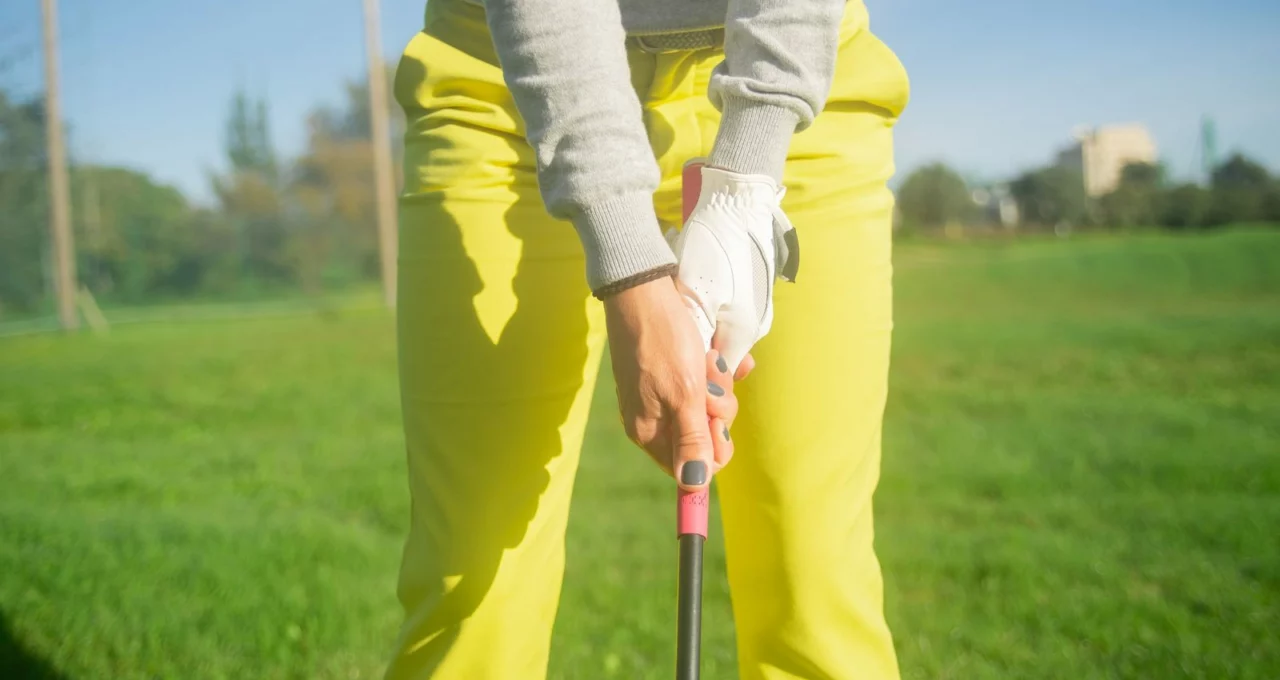
Lay the handle across the base of the fingers of your lead hand, the left for a right-hander, running diagonally from the middle joint of the index finger to just under the heel pad. Close the hand. The club should feel held by the fingers, not buried in the palm. A handle in the palm locks the wrist, and a wrist that cannot hinge costs you speed and control at the same time.
Now look down. You want to see about two knuckles of that hand. The crease between thumb and index finger forms a V, and it should point roughly towards your trail shoulder.
Step two: the knuckle count is your ball flight
This is the single most useful check in golf, because the clubface returns to impact roughly where your hands put it.
- One knuckle or none (weak): the face tends to arrive open. The ball starts right and curves further right. This is the classic amateur slice.
- Two, sometimes two and a half (neutral): the face can return square without any help.
- Three or four (strong): the face tends to arrive closed, and the misses are hooks and low pulls.
A player who slices with a weak grip will try everything else first: aiming left, swinging harder, a new driver. Every one of those becomes a second fault layered on the first. Rotating the lead hand a little to the right on the handle is usually the fix, and it feels awful for about a fortnight. Expect that, and do not give up on it after one bad Saturday.
Step three: join the trail hand, any style you like
Overlap, interlock or ten fingers? It matters far less than golf forums suggest. Interlocking tends to suit smaller hands and shorter fingers. Overlapping, with the little finger of the trail hand resting on top of the lead hand, suits larger ones. The ten-finger or baseball grip is a legitimate choice for juniors, seniors and anyone with arthritic hands.
The rule that does matter: the trail palm covers the lead thumb, and the two hands work as one unit. If you can see daylight between them, they will fight each other during the swing.
Step four: grip pressure, and heat
On a scale of one to ten, hold the club at about four or five. At eight or nine your forearms stiffen and the club cannot release. At two, it twists in your hands and the face angle becomes random.
Try this on the practice tee: hold the club out in front of you and let a playing partner pull it slowly away. It should come out with resistance, not slide free and not require a tug of war.
Heat changes the equation. On a humid February morning in Brisbane or a 35-degree afternoon in Adelaide, sweaty hands on a slick handle tempt you to squeeze harder, and a tighter grip means a stiffer swing. The solution is dry hands and grippy handles, not more pressure. Carry two towels, keep one dry for your hands, and wear a glove if you do not already.
Grips wear out faster in an Australian summer
A rubber grip that has gone shiny and hard slides in the hands, and a slipping handle is exactly what makes golfers squeeze. Sweat, sunscreen on your palms and clubs left in a hot car boot all age grips. Wipe them with warm soapy water, rinse and towel dry every few weeks through summer, and replace them when they feel slick even after a clean.
Size matters as much as condition. A grip too thin for your hands lets them work too actively and tends to produce hooks. One too thick restricts the release and tends to produce blocks and fades. Clubs come off the shelf with standard grips, which fit an average hand, not necessarily yours.
Where to get grips checked and replaced in Australia
Grip prices are modest next to any club. At a Perth golf retailer, a Golf Pride Tour Velvet grip was listed at A$19.99 in September 2026, the Golf Pride MCC at A$32.99 and the CP2 Wrap at A$31.99, with standard, midsize and oversize options. Some specialist stores also offer regripping through a club-making workshop. A second retailer lists SuperStroke Traxion grips in undersize, standard and midsize, from A$17.95.
For humid or wet conditions, many golfers prefer a half-cord grip such as the MCC, where the rougher texture under the top hand holds better when the hands are damp. Players with sore or arthritic hands often go the other way, towards a softer and larger grip. Ask the workshop to size the grip against your hand, not against the box, and ask about layers of build-up tape if you fall between sizes. Many club pro shops will regrip a set as well.
For the technique half, a lesson with a PGA professional at your club or local public course is the most efficient spend. If you are new to the game, Golf Australia’s Get Into Golf program, typically five one-hour group sessions with a PGA professional and equipment provided, teaches the full swing, chipping, pitching, bunker play and putting from scratch, grip included. Panxis Golf has no commercial relationship with any retailer, coach or program mentioned here.
Step five: bend from the hips
With the grip on, stand tall holding the club in front of you. Push your hips backwards, as if closing a car door with your backside, until your chest tilts towards the ball. Let your arms hang straight down from the shoulders. Soften the knees just a little.
Check from side on, in a shop window or on a phone: your shoulders should sit roughly above the balls of your feet and your hands hang below your chin, not reaching out in front. A rounded back and a waist bend put the arms in front of the body, and the usual consequence is standing up through impact. A deep knee flex feels sporty but stops the hips turning.
Step six: three ball positions cover the bag
Keep it simple. Driver opposite the inside of the lead heel. Mid irons about two ball widths ahead of centre. Wedges in the middle or just behind it. Every other club sits on a line between those points.
The reason is the low point of your swing, which stays in much the same place relative to your body. Move the ball, and you move where in the arc you meet it. A driver played too far back is struck descending and spins too much. A wedge too far forward catches the ball thin. On firm, fast Australian fairways in summer, a thin wedge will scoot through the green, so ball position matters even more there.
Step seven: aim the face, then set your feet
Walk in from behind the ball. Choose a mark on the target line, a leaf or a divot about half a metre in front of the ball, and square the clubface to it. Only then set your feet, knees, hips and shoulders parallel to that line.
Most golfers reverse this and point their feet at the flag. Because the ball sits away from your body, lining your body on the flag aims the club to the right of it. Your brain then pulls the swing left to rescue the shot, and the result is a slice you created before you swung. Aiming at a mark half a metre away is far more precise than aiming at a flag 140 metres off.
Film it, because you cannot feel it
Grip, posture and alignment are almost impossible to judge from inside your own body. What feels square often is not. Prop your phone on your bag, camera at hand height, pointing down the target line from behind, and record five swings. Then film from face on. Compare the pictures with the checklist below.
At the range, lay an alignment stick or a spare club along your toe line for every session, because aim drifts slowly and silently. A single setup lesson will teach you more than a season of swing tips, and it costs less than many metropolitan green fees.
Setup checklist for the first tee
- Handle in the fingers of the lead hand, two knuckles visible, V towards the trail shoulder.
- Pressure around four or five out of ten, hands dry, towel and glove in summer.
- Grips clean and tacky; replace them once they stay slick after washing.
- Hips back, arms hanging, shoulders over the balls of the feet.
- Driver at the lead heel, mid irons two balls forward, wedges central.
- Face to a mark half a metre ahead, then the body parallel.
How this page was put together
Grip prices were taken from GolfBox (Perth, September 2026) and Drummond Golf. Panxis has no commercial relationship with these retailers.