Chipping through a Canadian season: bump and run, pitch, or high soft shot
Around the green, club golfers lose strokes by reaching for the lob wedge by default. Three shots cover nearly every lie, the choice comes from two questions, and the Canadian season changes how each one behaves.
In brief
- Ask two questions before every chip: what is the ball sitting on, and how much green do you have?
- Make the bump and run with an 8-iron or 9-iron your first choice whenever there is green to work with.
- Save the open-faced high shot for short-sided lies with grass under the ball.
- In spring, soft ground and slower greens call for less loft and more carry; in summer, let the ball roll.
- Pick a landing spot the size of a dinner plate, and check that your practice green allows chipping.
Stand beside a practice green at almost any Canadian course on a Saturday morning and you will see the same thing: golfers with a lob wedge trying to land the ball softly beside the hole, from ten yards off the green, with twenty yards of open putting surface in front of them. Half the balls come up short in the fringe, a few shoot across the green, and the golfer concludes that chipping is hard.
Chipping is not hard. Choosing the wrong shot is. Three shots cover almost every situation around the green, and the choice between them comes from two things you can see before you touch a club: how the ball lies, and how much green you have to work with. In Canada there is a third factor worth adding, which is the time of year.
Two questions, then one club
Before every chip, answer these, out loud if it helps:
- What is the ball sitting on? Tight fairway turf, fluffy rough, a bare patch, soft spring ground?
- How much green is there between the edge and the hole? Lots, some, or almost none?
A clean lie with plenty of green means the ball should roll most of the way. Very little green, or a bunker in between, means it has to fly. A ball buried in thick grass limits your options whatever the green looks like. The club follows from those answers, not from habit.
Shot one: the bump and run
When: a decent lie and at least a third of the distance to the hole is putting surface. This should be your first choice most of the time.
Club: an 8-iron or 9-iron; a 7-iron when the hole is a long way across the green.
Set-up and stroke:
- Narrow stance, ball back of centre.
- About 60 percent of your weight on the lead foot, and it stays there.
- Hands a little ahead of the ball.
- A putting-style stroke with firm wrists, rocking the shoulders.
The ball pops out low, lands just onto the green and runs like a putt. Its advantage is forgiveness: the club never has to slide under the ball, so a strike slightly heavy or slightly thin still sends the ball roughly the right distance. With a lob wedge, the same mis-hit leaves the ball at your feet or sends it over the green.
A simple way to find the right club: with an 8-iron, many golfers see roughly one part carry to two or three parts roll on a flat green. Check your own ratio on the practice green, because green speed changes it.
Shot two: the pitch-and-roll
When: you have missed the green by a normal margin, there is some green to work with, but a bit of rough or fringe must be carried first.
Club: pitching wedge, gap wedge or a 50 to 52-degree wedge.
Set-up and stroke: ball in the middle of the stance, weight still favouring the lead side, and a longer swing in which the arms and chest turn together. No flick of the hands.
As a starting point, expect the ball to fly roughly half the way and roll the rest. The killer here is deceleration: a backswing that is too long, a moment of doubt, and a slowing club that digs or blades. Choose a backswing that fits the distance and accelerate through the ball to a finish at least as long as the backswing.
Shot three: the soft high chip
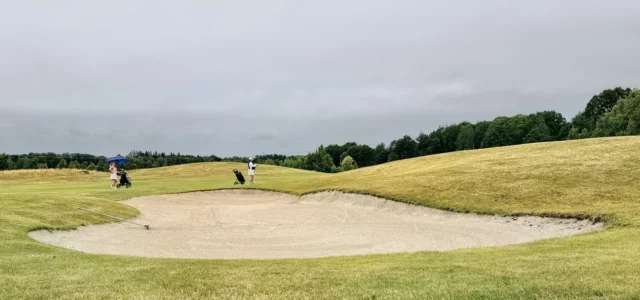
When: you are short-sided, the flag is just over a bunker, or the green runs away from you. There is simply no room for roll.
Club: 56 or 60-degree wedge.
Set-up and stroke: open the clubface first, then take your grip; stance slightly wider and a little open; ball forward of centre; swing along the line of your body and keep the face pointing at the sky through impact.
The ball climbs quickly and lands softly. It is also the least forgiving shot around the green and needs grass under the ball. From a tight, bare or wet lie, it is a gamble. Accept a longer putt and play shot one or two instead, unless you have practised this one many times.
What the Canadian season does to your chips
The same shot from the same spot behaves differently in April, July and October, and golfers who play a short season rarely adjust.
Right after opening. When courses open in spring, the ground is often soft and wet from snowmelt, and greens are usually slower than in midsummer. A lob wedge digs easily, the ball checks quickly, and chips come up short. Use a less-lofted club than you would in July, carry the ball a little further onto the green, and let the bounce of the club skim rather than dig.
Midsummer. Firm, faster greens and dry fringes mean more release. This is when the bump and run is at its best, and when the high shot becomes harder to stop.
Autumn mornings. Dew makes the fringe and the green slower and wetter early in the day. By early afternoon the same green can be noticeably quicker. If you practise on a dewy morning, remember the ball will run more after lunch.
Winter trips south. If you head to Florida or Arizona in February, expect different grass around the greens. Many southern courses use Bermuda grass, which is dense and grabs the club, particularly into the grain. The low runner is the safer shot there too. Our guide to a winter golf trip from Canada covers the destinations.
The bounce question
The sole of a wedge is rounded so that it skids through the turf. Push the shaft far forward at address and you tilt the leading edge into the ground and take that protection away.
On standard chips, keep the shaft close to vertical, especially on soft Canadian spring turf. If your wedge still digs whatever you do, it may be the wrong bounce for your conditions and your strike: lower bounce suits firm ground and tight lies, higher bounce suits soft turf and a steeper swing. A club fitter or your professional can look at your divots and tell you quickly. For more on how wedges differ, see our guide to choosing your wedges.
Aim at a spot, not the hole
The single habit that improves distance control fastest: pick the spot where you want the ball to land, a patch about the size of a dinner plate, and look at that spot during your practice swing. Your brain can judge a carry of eight yards far better than a total distance of 25 yards with an unknown amount of roll.
For one round, name the landing spot before every chip. It feels silly for a hole or two and then becomes automatic.
Where to practise chipping in Canada
Your own course. Most clubs have a practice green, but not all of them allow chipping onto it. Look for the sign, or ask in the pro shop. A dedicated short-game area with a bunker is worth seeking out.
Municipal courses. City-run courses usually list their practice facilities. In Calgary, for example, the city lists a practice green at Confederation Park, Lakeview, Maple Ridge and McCall Lake, with 2026 regular green fees from $30 at the nine-hole Lakeview to $65 at the 18-hole courses. Ask whether chipping is allowed before you drop a bag of balls.
In winter. Indoor centres and domes let you keep the stroke going on mats and artificial greens. Mats are fine for rehearsing set-up and the bump and run, but they hide heavy contact. Re-check your strike on real grass as soon as courses open.
At home. A patch of lawn and a few old balls are enough for the bump and run. Ten minutes three times a week does more than one long session a month.
Coaching. A short-game lesson with a PGA of Canada professional is often the best-value hour of instruction for a club golfer. The Find A Pro search on the PGA of Canada website lists coaches near you.
Panxis Golf has no commercial relationship with any course, facility or coach mentioned here.
A week of short-game homework
- From one spot beside a practice green, chip with an 8-iron, a pitching wedge and a 56-degree wedge, and watch the roll change.
- Hit twenty bump and runs before you pick up the lob wedge.
- Ask the two questions, lie and green to work with, before every chip on the course.
- Name a landing spot every time for a full round.
- In spring, take less loft and fly the ball further on; in summer, let it roll.
Most club golfers do not need a new chipping technique. They need to put the lob wedge back in the bag more often, and to read the Canadian season as carefully as they read the green.