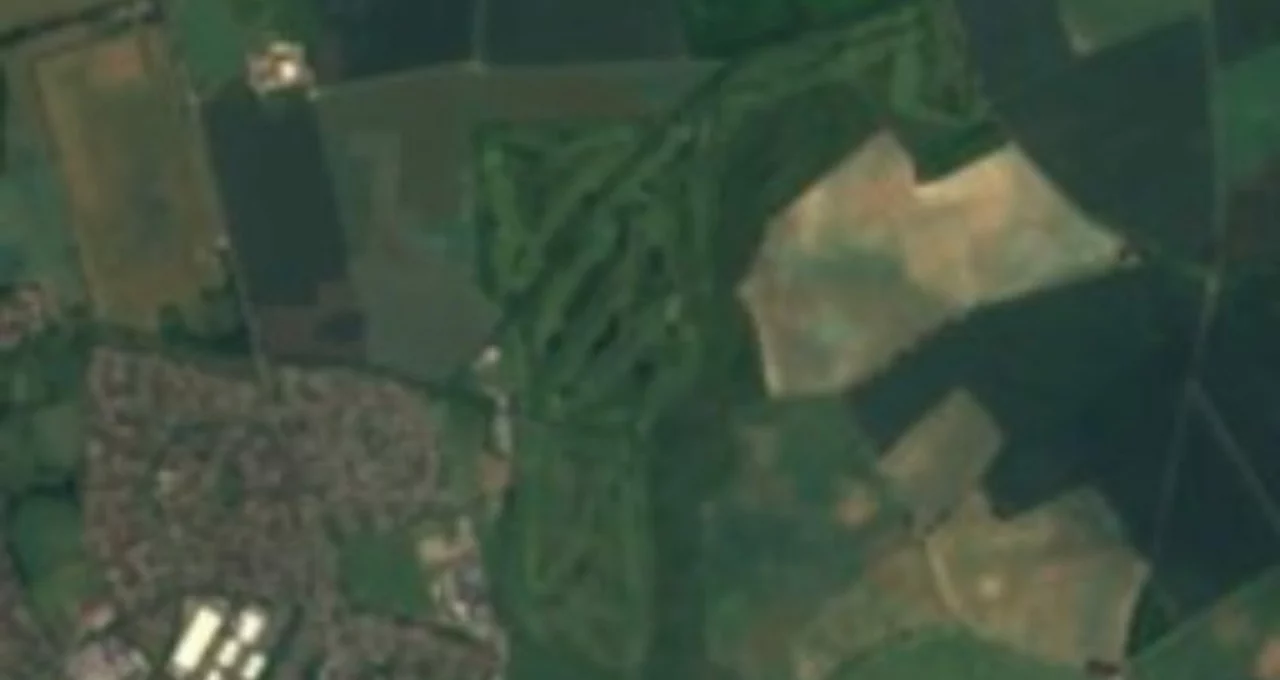
South Beds Golf Club from space. Sentinel-2 cloudless 2016 by EOX IT Services GmbH (contains modified Copernicus Sentinel data), CC BY 4.0.
South Beds Golf Club
Holes
27 (Galley Hill, 18 holes; Warden Hill, 9 holes)
By
Galley Hill: 71 (white and yellow tees), 72 (red tees); Warden Hill: 32 for nine holes from the white tees, 34 from the red
Length
Galley Hill: 6,401 yards from the white tees, 6,040 yellow, 5,558 red (club scorecard); Warden Hill: 4,794 yards for eighteen holes played twice round from the white tees, 4,704 red (club scorecard)
Green fee
—
Best season
Open all year; the club says its fast-draining chalk downland means it is rarely closed, with winter tees in use when the course manager advises
South Beds Golf Club sits on the northern edge of Luton, in Bedfordshire, at the foot of Galley Hill and Warden Hill, two chalk summits at the northern end of the Chilterns. The club’s postal address is Warden Hill Road, Luton, LU2 7AE. It is a members’ club with twenty-seven holes: the eighteen-hole Galley Hill course, a chalk downland layout of par 71 that measures 6,401 yards from the white tees on the club’s scorecard, and the nine-hole Warden Hill course, a par 32 made up of full-length par 3s and par 4s. The club dates its foundation to 1892.
This is not a famous championship venue, and it does not appear in the national rankings we consulted. Top 100 Golf Courses, which calls Galley Hill an established County Championship layout, places it seventh in its list of the best courses in Bedfordshire. What sets it apart from most clubs around a large town is the ground it plays over: open, wind-swept chalk downland next to a protected nature reserve, with views over Luton and the surrounding countryside, and an Iron Age earthwork running through the course.
A club that walked round two hills for eighty years
The club tells its own story in a short illustrated history, Course Development since 1892, drawn from a centenary book by John Kingham, South Beds Golf Club: the first 100 years. According to that document, the club started life in 1892 as Warden Hill Golf Club, with nine holes laid out on common land just north of Luton. The common was well-grazed meadow with few obstacles, and the greens were about twelve feet square and ringed with wattle fences, because nobody was sure whether bunkers could be dug on common land. The club’s web page on its history adds that these were sheep hurdles, used in place of bunkers.
The first clubhouse went up in 1895, together with stables for half a dozen horses and a carriage yard; the history records twenty carriages in the yard on opening day, and two tennis courts that would later become the 18th green. The original nine holes were revised into a new nine-hole layout with help from founder members of Cromer Golf Club. After going through several names, Warden Hill Golf Club, Luton (South Beds) Golf Club and Luton Golf Club among them, the club became South Beds Golf Club in 1897. Its first president was Lord Battersea, who as Cyril Flower had been the Liberal Member of Parliament for the South Beds constituency in 1892; the club says he was elected president in 1894 and that the Battersea Cup, first played for in 1898, is its oldest trophy.
The course was extended to eighteen holes in 1898. The scorecard of that first eighteen-hole layout, reproduced in the club’s history, adds up to 5,590 yards. Women were admitted in 1895, with restricted playing times, and at that point the club had a hundred members, forty of them women; there was no golf on Sundays and women could play only on weekdays. The first professional, William Fletcher, came from Bushey Hall on 1 August 1902; he was a club maker and held several course records until after the First World War.
Two of the Great Triumvirate visited early on. The club says that Harry Vardon and James Braid played the course in 1904, that Vardon was a regular visitor before and after that match and held the course record for many years, and that several holes still in use were designed on his advice. During the First World War the course became a rifle range and opened only at weekends; Sunday golf was introduced in 1915, and women were allowed to play at weekends from then on.
In 1921, the club’s history says, the course was redesigned by Colt, MacKenzie and Alison, the firm of Harry Colt, Alister MacKenzie and Charles Alison, who removed some of the hard climbs to the summit of Warden Hill. The club notes that remnants of that course are still visible on the hill, but that no record of its layout survives. The land was then a mixture of common and private ground belonging to the Putteridge estate. In 1933 Sir Felix Cassel sold estate land to the Crown Estate, which made fifty acres north of Drays Ditches available, and the club began moving its course north, away from the common and the Warden Hills. The work began in the 1930s, carried on through the Second World War and was finished in 1950, when the scorecard showed eighteen holes of a little over 6,300 yards, much of which the club says is still recognisable today. The club’s history page says that on two occasions parts of the course had to move further north as Luton grew, and that the land is still owned by the Crown, although the club owns its clubhouse and the ground it stands on.
The present arrangement dates from the 1970s. In 1971 the club accepted an offer for the eight and a half acres of Home Field, which held the old clubhouse and the 9th and 18th greens, for development on Links Way, and a special general meeting voted by a single vote to redevelop the existing site rather than move to a new course. The old clubhouse was vacated and the new one opened in 1976. On 20 October 1978 the club captain, John Hadfield, opened the two new courses, Galley and Warden, which reused eight of the old greens on the Warden course and six on the Galley course. Scrub was cleared to create new holes, a pond was landscaped, and three new holes were built on a triangle of land beside the public bridleway. Apart from the removal of the pond, the club says, the courses have stayed in that configuration ever since.
What the course asks of you
The Galley Hill course
The figures below come from the scorecard published on the club’s website. From the white tees Galley Hill measures 6,401 yards, par 71, with an outward nine of 3,335 yards and par 36 and an inward nine of 3,066 yards and par 35. The yellow tees measure 6,040 yards, par 71, and the red tees 5,558 yards, par 72, because the 13th becomes a par 5 from the forward tee. The club gives a course rating of 70.6 and a slope of 126 from the whites, 68.9 and 124 from the yellows, and 72.4 and 124 from the reds. Its visitor information says that men may play from the white or yellow tees according to ability and that women play from the red tees.
The round is unusual from the first shot. It opens with a par 3, the 1st, called Bramingham, 197 yards from the whites, which the club professional, Michael Davis, describes in the club’s hole guide as a challenging long par 3 with a green sloping from front to back, where a three is a good start. There are five par 3s in all, at the 1st, 5th, 12th, 15th and 17th, and four par 5s, at the 8th, 9th, 14th and 18th. The outward nine closes with two par 5s in a row, as Top 100 Golf Courses points out.
The ground does most of the work. The course climbs from the flat land by the clubhouse up the slope and back on the front nine, then works around the foot of the hills on the back nine. The club’s hole guide is full of warnings about slopes: the approach to the 2nd, a par 4 of 434 yards and stroke index 2, plays longer than it looks because the green sits up a rise, and the professional advises players to check the wind on the 1st because it cannot be felt down in the dip of the 2nd fairway. The 4th, a short par 4 of 320 yards called Cowslips, has a blind tee shot to a fairway that cambers from right to left. The 5th, Pheasant Roost, is a par 3 of 214 yards to a large green where putts from the back run away quickly.
The par 5s are where a round can go wrong. The 8th, Bridle Way, 522 yards, is stroke index 3, and the professional recommends playing it as a three-shot hole, short of the cross path from the tee and to the top right-hand corner of the fairway with the second, leaving a pitch of a hundred or so yards down to the green. The 9th, Coach Road, is the longest hole on the course at 564 yards, a slight dogleg from right to left with a fairway bunker that the longest hitters can try to carry. The 7th, The Pond, is a short par 4 of 343 yards around a dogleg, where the safe play is to the corner and the brave can go for the green.
On the back nine, the 13th, Galley Lee, 418 yards, is stroke index 1, and the club calls it the toughest hole on the course: a long par 4 with a long green and a bank on the right that catches approaches pitched short. The 12th, Little ‘Un, is a par 3 of only 104 yards from the whites, played uphill to a small green. The 16th, Drays Ditches, is a short par 4 of 323 yards played uphill to a shallow green with a bunker in front and a hedge behind, and takes its name from the ancient earthwork that crosses this part of the course. The finishing hole, Spruce Valley, is a par 5 of 554 yards whose green, the professional warns, slopes deceptively from front to back.
The hole most people remember is the 17th, Westward Ho!, a par 3 of 198 yards from the whites. The club’s professional writes that most consider it the signature hole: a long carry with a big club to a green guarded by a bunker and a couple of grassy hollows, from a tee sheltered by trees where the wind is hard to read. His advice is to look at the flag on the 13th green to see which way it is blowing.
Wind is the constant. The club describes Galley Hill as a downland course never played in the same conditions twice, because the wind sweeps down off the hills. The ground is chalk, which drains quickly, and the club says the course is rarely closed. Out of bounds is in play on several holes, for instance close to the left of the 6th green and around the 11th, according to the hole guide. Rounds start from either the 1st or the 10th tee, as shown on starting boards by the putting green and the trolley store.
The Warden Hill course
The second course is a nine-hole layout, par 32 from the white tees, made up of five par 3s and four par 4s. The club describes it as a course of full-length par 3s and par 4s for new and experienced golfers alike, and says that trainers are acceptable on it, which is not the case on Galley Hill. Its scorecard is set out for eighteen holes played twice round, with some holes changing length on the second loop, and totals 4,794 yards and par 64 from the white tees and 4,704 yards and par 68 from the red tees, where the 7th and 9th become par 5s. On the first nine, the holes run from a par 3 of 135 yards at the 6th to a par 4 of 404 yards at the 9th, which is stroke index 1. The club publishes two sets of rating figures for it without saying which tee they belong to: a course rating of 63.1 with a slope of 112, and 67.8 with a slope of 114. According to the club’s history, eight of its nine greens were carried over from the course in use before 1978.
What golfers say
The points below summarise the golfer reviews published on Top 100 Golf Courses, dated from 2020 to 2026, together with the club’s own descriptions where they bear on the same themes. Hole19 shows a high average score from several dozen ratings, but we could not read the text of those reviews and have not used them. These are other people’s opinions, not ours. Nobody from Panxis has played the course, and we name no reviewer.
What comes up in its favour
- The setting. Reviewers describe a genuine chalk downland course hugging the foot of the two hills, with wide views across the countryside, especially late in the day.
- The ground. Several mention firm, fast conditions and the quick drainage of the chalk, with the course said to close only for snow.
- The use of the slopes. The changes in elevation, the earthwork of Drays Ditches in play on several holes and the closing stretch from the 12th onwards come up as highlights, and the 2nd, 8th, 13th and 16th are singled out as strong holes; one reviewer names the 8th the best on the course.
- History. Reviewers note the age of the club and the number of original holes still in use.
- Width. One reviewer praises the course for having largely resisted the tree planting that has narrowed many downland layouts.
What comes up against
- A rough-around-the-edges feel, and a course some find fairly straightforward apart from a handful of memorable holes.
- Recent planting. Newer trees and shrubs are criticised on the 7th, where they hide the flag and push most players into a safe line, and across the 17th.
- The 12th. One reviewer finds the very short uphill par 3 squeezed in, with a long walk back to the 13th tee.
- Greens a little slow on one visit, and ratings for facilities and green complexes that sit in the middle of the Top 100 scale.
- Not a destination. One reviewer thinks it worth the trip from within about three quarters of an hour’s drive, but not from much further.
Getting there and when to go
The club is on Warden Hill Road on the northern edge of Luton, about three miles north of the town centre in a straight line by our measurement on the map. The A6, Barton Road, runs north out of Luton less than a mile to the west. The nearest railway station we found is Leagrave, on the line between London and Bedford, roughly two and a half miles away in a straight line; Luton station is about three miles to the south, and London Luton Airport lies on the far, south-eastern side of the town. All of these are further by road.
Next to the course is the Galley and Warden Hills Site of Special Scientific Interest, which Luton Borough Council describes as the town’s first nature reserve: chalk downland with a great variety of wildflowers and more than twenty species of butterfly, grazed by cattle in autumn and winter. The council says Drays Ditches were first dug in the Bronze Age as tribal boundaries and built up in the Iron Age to control traffic on the Icknield Way, and that two Bronze Age barrows survive near the top of Galley Hill. The club’s own conservation page describes chalk grassland on the course with orchids in spring, scabious and knapweed in late summer, chalkhill blue butterflies and red kites overhead. The hills are crossed by public footpaths, and walkers climb them for the views; keep an eye out for them on the holes near the paths.
South Beds is a members’ club, but the club says green fees are available throughout the year when they do not conflict with members’ competitions. Visitors can book through the club’s visitor tee booking page or through the pro shop, and all fees are paid at the shop before play. On the Galley Hill course, the club’s green fee table marks weekend play before 2pm as members only. Societies of twelve to forty players are taken by enquiry through the club’s societies page, and the club pitches its fast-draining chalk as a reason to come in winter. The shop is run by the head professional, Michael Davis, who has held the post since 2008 according to the club, and who also gives lessons and custom fitting.
The clubhouse has a bar and lounge with a balcony overlooking the course and Warden Hills; the club gives the bar’s hours as 10am to 6pm and the kitchen’s as 10am to 4pm, and serves Sunday lunch on selected Sundays. Golf attire and golf shoes are required on Galley Hill, smart casual dress in the clubhouse, and mobile phones may only be used on the course in an emergency. We found no information on buggy hire on the club’s website; ask the pro shop.
The course is open all year, and winter tees are used when the course manager advises. For the views, the wildflowers and the butterflies the club and the council describe, late spring and summer are the obvious time, but a downland course on chalk is also one of the better options in the area in wet weather. Expect wind at any time of year.
How this page was made
The factual frame comes from public sources: OpenStreetMap for the location and our distance measurements; the club’s website, read in October 2026, for the address, the two courses, the Galley Hill scorecard with its ratings and slopes, the Warden Hill scorecard, the hole-by-hole guide by the club professional, the visitor information and dress code, the green fee conditions (without the prices), the societies page, the clubhouse, the professional and the wildlife page; the club’s history page and its illustrated history, Course Development since 1892, for the history of the club and its courses; Luton Borough Council for the Galley and Warden Hills Site of Special Scientific Interest and Drays Ditches; Golf’s Missing Links for the early years of the club; Top 100 Golf Courses for its course description, its county ranking and its golfer reviews; the English Wikipedia article on the club. Wikidata identifies the club as Q7566291.
Where sources disagree, we say so. The club gives 1892 as its foundation year and says it started as Warden Hill Golf Club; Golf’s Missing Links dates the club to 1893 as Warden Hills Golf Club, citing a report on its formation in the Luton Reporter of 22 April 1893, and Wikipedia gives 1892 in its infobox and 1893 in its categories. The club’s history page says the present two-course layout took shape in the mid-1970s, while its illustrated history dates the opening of the two courses to 20 October 1978. The same document says the original clubhouse was replaced by the current one in 1974 and that the new clubhouse opened in 1976; we report 1976. The club’s history credits the 1921 redesign to Colt, MacKenzie and Alison and says Harry Vardon advised on several holes, while Top 100 Golf Courses names Vardon as the architect. Top 100 Golf Courses gives the 12th as 96 yards, against 104 on the current scorecard, and ranks the course seventh in Bedfordshire, while Wikipedia, citing the same website, says fourth. The club’s wildlife page associates Drays Ditches with medieval cultivation terraces, whereas Luton Borough Council describes a Bronze Age and Iron Age earthwork. The scorecard spells the 4th Cow Slips and the hole guide Cowslips, and the 7th is still called The Pond although the club’s history says the pond has been removed. The Warden Hill card repeats stroke index 8 on two holes, and its published ratings are not attributed to a tee.
We could not open the Today’s Golfer page on the club, which was behind a paywall, and could not read the text of the Hole19 reviews, so neither has been used. The club’s website gives no information on buggies, and no architect for the 1978 layout; we have left both out.
The opinion section summarises the golfer reviews on Top 100 Golf Courses, read in October 2026. We report recurring themes rather than individual voices, and we reproduce no quotations from reviewers. Nobody from Panxis has played or visited this course, and this page is no substitute for a round.
The club has not paid for this page, has not seen it before publication and has no say over its content. This page contains no commercial link and earns us no commission. If you know the club and something here is wrong or out of date, write to us and we will correct it.
Other courses nearby
Closest to this one in our British directory:
- The Millbrook Golf Club — 9 mi
- Harpenden Common Golf Club — 9 mi
- Aspley Guise & Woburn Sands Golf Club — 11 mi
- Bedfordshire Golf Club — 15 mi
The hole to know
Westward Ho!, a par 3 of 198 yards from the white tees on the Galley Hill course, which the club professional calls the signature hole: a long carry to a green guarded by a bunker and grassy hollows, with the wind hard to judge from a sheltered tee.