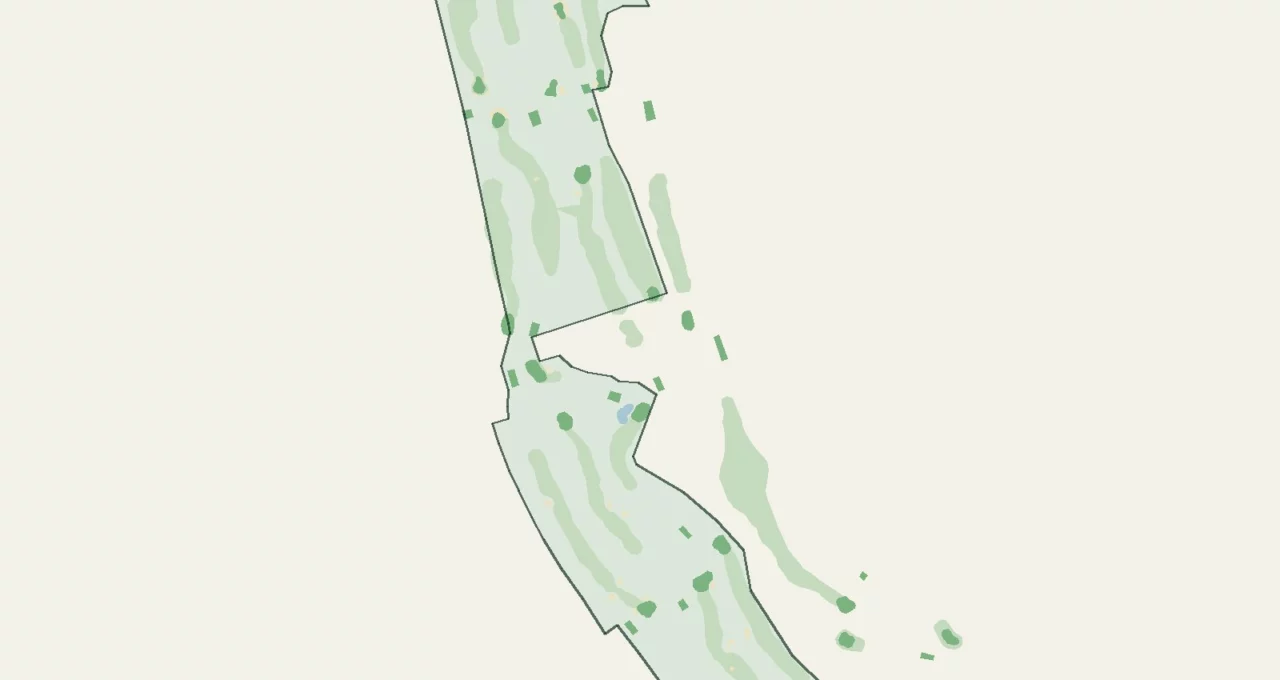
Layout of Harpenden Common Golf Club from OpenStreetMap survey data (ODbL licence).
Harpenden Common Golf Club
Holes
18
By
70
Length
6,001 yards from the white tees, 5,707 yellow, 5,391 red (club card); visitors play from the yellow and red tees
Green fee
—
Best season
Year-round; the club says the course drains well and stays open in all but the most extreme weather
Harpenden Common Golf Club is a private members’ club on Cravells Road, East Common, Harpenden, Hertfordshire, postcode AL5 1BL, on the southern edge of the town and a few miles north of St Albans. Its course is 18 holes and par 70, and it measures 6,001 yards from the white tees on the card the club publishes today, with a course rating of 69.8 and a slope of 121. Visitors play from the yellow tees, 5,707 yards, or the red, 5,391. The unusual thing about it is in the name. Eleven of the eighteen holes are played on Harpenden Common itself, public land shared with walkers, dog walkers, riders, cyclists, two public roads and, on summer Sunday afternoons, a cricket match. The other seven lie on a private field the club bought in the 1990s.
This is not a course that features in national rankings, and it does not pretend to. Top 100 Golf Courses places it 26th in Hertfordshire. What it offers is a short, well kept parkland round in a setting that has hosted golf since the 1890s, a modern clubhouse, and the occasional need to look both ways before you hit.
A common, a racecourse and two clubs
Golf on the Common is older than the club. The English Wikipedia article dates the first golf there to 1895; the Harpenden local history society, whose pages we could read only in search excerpts, says that enthusiasts, several of them Scots, asked Sir John Bennet Lawes, the lord of the manor, for permission to form a club in 1894, and that a nine-hole course was laid out on the upper part of the old racecourse, south of Cravells Road. The same society says the course was redesigned to eighteen holes after 1918, as membership grew again. The club itself states only that golf has been played on the Common for more than 120 years.
The year on the club’s crest is 1931, and it needs a word of explanation, because Harpenden has two golf clubs with confusingly similar names. In 1931 the original Harpenden Golf Club left the Common for a new private course at Hammonds End, on the other side of town; the local historians mention the weekend picnic crowds on the Common among the reasons. Wikipedia says Harpenden Common Golf Club was founded in that year, when the old club moved. Wikipedia also notes that the likeness of the two names has confused more than one visiting golfer. If you are booked at Harpenden Common, you want Cravells Road, not Hammonds End.
The club’s history page says the new club’s opening was marked by a match between W.A. Peters and Abe Mitchell, the Ryder Cup player who was Samuel Ryder’s personal golf tutor and, according to the club, the figure modelled on top of the Ryder Cup. Peters’s son later served the club for many years as professional and secretary. Top 100 Golf Courses also records Mitchell’s exhibition match in 1931, but describes what was opened as a nine-hole layout, which does not sit easily with the local historians’ eighteen holes after 1918. We found no document that settles the point.
The modern course dates from 1996. The club says that members bought a piece of land known as the Jockey Field, that its seven holes opened that year, and that the whole course was substantially revised at the same time under the guidance of Ken Brown, the former Ryder Cup player and European and PGA Tour winner, who is an honorary member. Wikipedia adds that Brown joined the club as a junior in 1969, worked there as a greenkeeper and won the Hertfordshire Boys’ Championship in 1973; he is the member whose name viewers of BBC golf coverage may recognise. Top 100 Golf Courses credits the course to Ken Brown and Martin Gillett, and quotes Brown as saying the aim of the work was to get rid of some of the smaller, duller holes of the old layout while adding length and a new practice area. Wikipedia lists the original designer as unknown.
After the Jockey Field came new changing rooms and an administration block, and then a two-storey clubhouse, completed in 2013. Wikipedia says it was officially opened in May of that year by Ken Brown, with the mayors of Harpenden and St Albans in attendance. The building has glass from floor to ceiling on both levels and a first-floor balcony that looks straight down the 18th.
What the course asks of you
The club describes the course as well manicured common parkland, lined with mature trees and gorse, and says it drains well enough to stay open in all but the most extreme weather; it also holds a Green Flag award. The Common section, eleven holes, runs through woodland with gorse and heather; the seven Jockey Field holes, says the club, now have mature tree-lined fairways of their own. According to Wikipedia, the holes on public common land are the 1st to the 5th, the 8th to the 11th, and the 17th and 18th. Top 100 Golf Courses describes the whole property as a narrow tract of about 100 acres.
The card is balanced: two par 3s and a par 5 on each nine, the rest par 4s, 35 out and 35 in. From the white tees the front nine runs 320, 372, 529, 179, 138, 379, 292, 456 and 383 yards for 3,048 yards; the back nine 301, 365, 469, 350, 363, 405, 172, 384 and 144 yards for 2,953. The yellow tees play 5,707 yards to par 70, with a rating of 68.3 and a slope of 119; the red tees 5,391 yards, with a women’s rating of 71.7 and a slope of 121. It is not long, and nobody who has reviewed it claims otherwise. The difficulty lies in small greens, narrow exits from several tees, out of bounds near the roads and the general traffic of a public open space.
The club’s course tour carries a tip from the head professional, Rob Leonard, for each hole, and it gives a fair outline of the round. The 1st is a gentle start to a small green, where accuracy matters more than length. The 2nd, stroke index 5, has a narrow exit from the tee and, according to Wikipedia, an approach played across Cross Lane, a public road. The 3rd, the only par 5 on the front nine at 529 yards from the whites, takes its line from the cricket pavilion: the fairway includes the square of Bamville Cricket Club, and Wikipedia says that when cricket is being played on Sunday afternoons from May to September, the hole is shortened to a par 3 played from beyond the pitch. The professional warns of out of bounds on or over the road.
Then come two short holes in a row, which Wikipedia describes as a rarity in British golf. The 4th, 179 yards from the whites, is the one the professional calls the club’s signature hole: a narrow funnel out to the green, where accuracy is everything and laying up short is a respectable option. The 5th, 138 yards, plays longer than it looks, and the tip is simply to take more club. The 8th, 456 yards from the whites and stroke index 1, is the hole for the driver; the tee shot crosses Cross Lane, and a drive over the road still leaves a long iron or fairway wood, with out of bounds on the right and hidden bunkers short and left of the green. The 9th, 383 yards, is a tight drive across Limbrick Road. The club’s visitor information asks that one member of each group walk ahead to the road, stand behind the tree by the tee and act as lookout until the road is clear. Top 100 Golf Courses reviewers make the same point in their own way: this is not a course to play alone.
The Jockey Field holes in the middle of the back nine are the newer part of the course. The 12th, a par 5 of 469 yards from the whites, takes its line from a white house, and the professional notes that with the wind behind, the fairway bunker comes into play and the right side gives the best angle in. The 15th, 405 yards and stroke index 2, has two deep fairway bunkers waiting for a good drive; the left side of the fairway is the way in, and the depth of the green is deceptive. The round ends with a short hole: the 18th, 144 yards from the whites on the current card, is described by the professional as a typical Common green, small and well protected, with the ball exposed to the breeze once it rises above the trees. It is played in full view of the clubhouse balcony, which Wikipedia suggests is rather the point.
The visitor information sheet adds a few practical details: yardage markers are on the sides of the fairways and measured to the centre of the green, flag colours show the pin position (red front, yellow middle, white back), and there is a toilet and water refill by the greenkeepers’ shed at the 12th tee. Visitors can telephone the clubhouse from the 8th or 17th tee to order food to collect at the turn.
What golfers say
Harpenden Common is lightly reviewed. Top 100 Golf Courses has two reviews, scored 4.0 and 4.5 out of five, the more recent written in September 2026; GolfPass shows about half a dozen reviews with an overall score a little above four out of five, according to search excerpts, as its pages refused to load for us; a golf directory, GolfN, adds a brief rating. Search excerpts from a booking platform show a larger number of short ratings, but we could not open the page and do not rely on it. The points below summarise what recurs. They are other people’s opinions, not ours. Nobody from Panxis has played the course, and we name no reviewer.
What comes up in its favour
- Condition. Both Top 100 Golf Courses reviewers praise the greens and fairways, one of them after a winter visit, when he had expected rather less.
- The welcome. Friendliness is the highest of the GolfPass sub-scores, and GolfN also notes it.
- Value and playability. Reviewers find the course fairly forgiving, suitable for less experienced golfers, and good value; GolfPass rates value well.
- The clubhouse and facilities, described as good, with food around lunchtime and a building that suits society days.
- A sense of place. One reviewer liked the way the course feels part of the town and its community; holes named as best include the 7th, the 8th and the 18th, along with a good range of holes, plenty of bunkers and subtle greens that are tricky to read for pace.
What comes up against
- Walkers. Sharing the Common with the public is mentioned as a mild irritation, though reviewers found it manageable.
- Roads. Holes divided by lanes mean somebody has to watch for passing cars before the tee shot, which some find awkward.
- Length. The course is short, and reviewers say so, more as an observation than a complaint.
- Pace of play is the lowest of the GolfPass sub-scores, and GolfN calls it poor.
- Parking is reported as limited on busy days.
Today’s Golfer, whose page we could read only in excerpts, gives the course a rating of 2.5 out of five.
Getting there and when to go
The club is on Cravells Road at East Common, on the southern side of Harpenden, and a directory listing based on the club’s own description places it three miles north of St Albans on the A1081. By rail, Harpenden station is on the Thameslink route on the Midland Main Line, 24 miles and a little more down the line from London St Pancras, according to Wikipedia; by our own measurement on the map, the course lies a little over a mile south of the station as the crow flies. The club has its own car park, which reviewers describe as limited on busy days, and which the visitor sheet lists among the places where a stray ball must be reported to the shop.
The club says visitors are welcome throughout the week except on Wednesdays, with limited availability on weekend afternoons. Tee times can be booked online up to seven days ahead or by telephoning the professional’s shop. Visitors play from the yellow and red tees only, unless the shop authorises otherwise, and are asked to follow the club’s dress code. Buggies are available, subject to availability, at an extra charge. Practice is modest: a putting green and short game area near the clubhouse, with your own balls, and nets behind the Tour Shed, the club’s indoor studio, which offers a simulator, lessons and club fitting. The kitchen serves from mid-morning on weekdays and from early morning at weekends.
The course is open all year, drainage permitting, and the club posts its daily course status on its home page; in early October 2026 it was open with preferred lies. A summer visit brings the cricket on Sunday afternoons and the most walkers. A weekday out of the holidays is the quiet choice.
Green fees
Visitor rates vary by day, time of day, season and category of player, and are published by the club on its visitor green fees page.
How this page was made
The factual frame comes from public sources: OpenStreetMap for the location; the club’s website, read in October 2026, for the address, the 1931 foundation and the opening match, the Common and Jockey Field holes, Ken Brown’s role in 1996, the clubhouse, the scorecard with its ratings and slopes, the head professional’s hole tips, the visitor days, booking, tees, buggies and practice facilities, and the visitor information sheet; the English Wikipedia article on the club for the 1895 date, the split with Harpenden Golf Club, the holes on common land, the road crossings, the cricket on the 3rd, the clubhouse opening and Ken Brown’s early years at the club; the English Wikipedia article on Harpenden station for the railway; Top 100 Golf Courses for the county ranking, the architects, the acreage and two reviews; the Harpenden local history society, through search excerpts only, for the years 1894 and 1918; GolfPass, GolfN and Today’s Golfer, through search excerpts only, for ratings; Wikidata for the identifiers. The distance from the station is our own measurement on the map.
Where sources disagree, we say so. Wikipedia gives the course as 6,074 yards from the whites and 5,819 from the yellows, on a men’s card it says was updated in January 2026; the club’s current card gives 6,001 and 5,707, and we use the club’s figures. The hole-by-hole pages of the club’s course tour carry older yardages that differ by a few yards from the card, for example 189 yards for the 4th and 152 for the 18th, the figure Top 100 Golf Courses also quotes for the last hole. Golf began on the Common in 1894 for the local historians and in 1895 for Wikipedia. Top 100 Golf Courses describes the course opened in 1931 as nine holes, expanded to eighteen in the 1990s, while the local historians speak of eighteen holes after 1918 and the club of eleven Common holes plus seven on the Jockey Field; one other account speaks of six holes added. Top 100 Golf Courses credits Ken Brown and Martin Gillett as architects, the club credits Brown with guiding the 1996 revision, and Wikipedia gives the original designer as unknown. Today’s Golfer lists no shop, bar or restaurant, which the club’s own pages contradict. Some directories give a second web address for the club, which we did not use.
The opinion section summarises reviews on Top 100 Golf Courses, read in October 2026, and ratings on GolfPass, GolfN and Today’s Golfer seen in search excerpts. We report recurring themes rather than individual voices, and we reproduce no quotations from reviewers. Nobody from Panxis has played or visited this course, and this page is no substitute for a round.
The club has not paid for this page, has not seen it before publication and has no say over its content. This page contains no commercial link and earns us no commission. If you know the club and something here is wrong or out of date, write to us and we will correct it.
Other courses nearby
Closest to this one in our British directory:
- South Beds Golf Club — 9 mi
- Moor Park Golf Club — 13 mi
- Denham Golf Club — 16 mi
- Beaconsfield Golf Club — 17 mi
The hole to know
Par 3 of 179 yards from the white tees, first of two short holes in a row on the Common: a narrow funnel to the green that the head professional calls the club's signature hole.