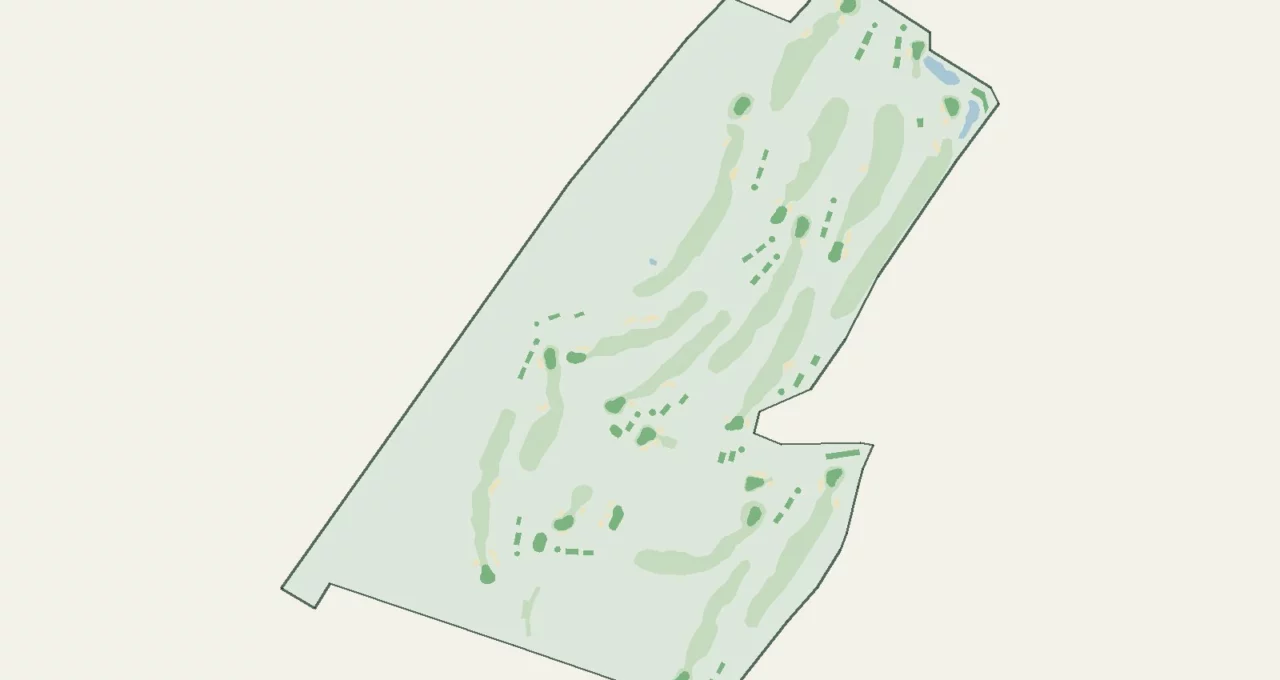
Layout of Bedfordshire Golf Club from OpenStreetMap survey data (ODbL licence).
Bedfordshire Golf Club
Holes
18
By
70
Length
6,560 yards from the Black tees (club scorecard); 6,202 White, 6,065 Yellow, 5,565 Red
Green fee
—
Best season
—
Bedfordshire Golf Club sits on the hillside east of Stagsden, a village of around 400 people some four miles west of Bedford town centre, on the far side of the A422 from the village itself. The entrance is off Spring Lane, and the club gives its postal address as Spring Lane, Bedford, MK43 8SR. It has two courses: the 18-hole Stagsden course, par 70 and 6,560 yards from the Black tees on the club’s own scorecard, and a nine-hole Academy course, par 28. A 22-bay floodlit driving range, a swing studio and a pro shop complete the golf side.
The club was founded in 1891 and calls itself the oldest in the county, a claim Wikipedia repeats on the strength of the 1906 edition of The Golfing Annual. The course, however, is much younger than the club. The Stagsden layout was designed by Cameron Sinclair and officially opened on 30 September 2000 by Laura Davies. This page is about that club and that course. It should not be confused with Bedford and County Golf Club at Clapham, north of the town, or with The Bedford Golf Club at Great Denham, a separate course which Top 100 Golf Courses lists as closed since 2020.
From Brickhill to Biddenham to Stagsden
The club’s history page, written for members, gives the outline. In 1891 Guy Pym and others founded the club and played on fields beside Brickhill Farm, about a mile from the centre of Bedford. Membership was capped at 150. That first course had nine holes. By 1895 the club had moved to Biddenham, west of the town, and was playing an 18-hole course there.
The Biddenham course used whatever the farmland offered as hazards: hedges, cart roads, ponds and ditches, alongside the bunkers. According to the club, the land stayed almost treeless for roughly three decades, and sheep kept the grass down. Bill Moore was appointed the club’s first professional in 1922 and stayed for more than 40 years. A clubhouse was built in the 1930s, a period in which, the club notes, the annual subscription had risen to five guineas.
During the Second World War, the 11th, 12th and 13th holes at Biddenham were turned over to the Dig for Victory campaign. In 1954 the clubhouse burned down, and most of the club’s records were lost with it. Members used Nissen huts until a new clubhouse opened in 1956; the club records that it was opened by Henry Longhurst, the golf writer and broadcaster.
The club stayed at Biddenham for more than a century. Top 100 Golf Courses writes that a new housing estate and the construction of a major road eventually forced it out; the club’s history page puts the relocation down to residential development at Biddenham and dates the move to the period from 1998 to 2000. The Stagsden course opened in September 2000. The Wikipedia article on Stagsden describes it as a millennium project, built on the hillside facing the village.
Cameron Sinclair’s design
Cameron Sinclair, the architect of the Stagsden course, had worked in the 1980s with the design firm Cotton, Pennink, Lawrie and Steel, according to Top 100 Golf Courses. That site publishes an account from the architect in which he contrasts the new ground with the old: Biddenham was flat, while Stagsden has far more movement. He describes spending a long time on a routing that used the natural landforms so as to avoid major earthworks, while making some alterations of his own so that the result would flow and look natural.
In the same account Sinclair says the course is not built around water. Lakes were created only at the 14th and 15th. He names the 17th as probably his favourite hole: it plays across a natural sweeping valley and doglegs slightly to the right with the fall of the ground, and a natural fold on the inside of the dogleg provides the setting for some bold bunkering. The club’s own hole guide mentions a pond on the 2nd as well, so there is at least one more stretch of water on or near the line of play than the architect’s summary suggests; whether that pond predates the course, the sources do not say.
The club describes the course as using the natural topography and blending into its surroundings rather than imposing on them. Reviewers and directories call it open parkland on undulating ground, with oak trees, woodland and gorse. The club’s sustainability page adds that the greenkeepers manage woodland areas where bluebells and cowslips grow, have planted native shrubs and trees where gorse was taken out, and record kingfishers, herons and, on several occasions, an otter.
What it asks of you
The Stagsden course is a par 70 with four sets of tees on the club’s scorecard: Black at 6,560 yards, White at 6,202, Yellow at 6,065 and Red at 5,565. The par is the same from every tee. The front nine and the back nine are both par 35, each with two par 3s, one par 5 and six par 4s. The club publishes the following ratings: for men, 72.0 with a slope of 127 from the Black tees, 70.0 and 118 from the White, 69.1 and 119 from the Yellow and 66.5 and 120 from the Red; for women, 76.5 and 134 from the Yellow and 72.0 and 129 from the Red. A course rating two strokes above par from the back tees, and a slope of 127, put the Black tees well above the average difficulty a slope of 113 represents.
The length is not extreme, but the ground makes the course play longer than the card. Several holes climb: the club’s hole guide describes the 5th as nearly all gently uphill, and the 10th, 17th and 18th as uphill approaches where you need to take enough club. Many greens are tiered, with the guide warning of two-tiered greens at the 1st, the 10th and the 17th. Wind is the other factor most often raised: reviews describe the hillside as exposed and a stiff test from the back tees when it blows, particularly in winter.
The front nine
Yardages below are from the Black tees, with the White in brackets, from the club’s scorecard; the stroke index is the club’s.
- 1st: par 4, 351 yards (334), stroke index 13. The club calls it a deceptive opener, with big oak trees and a bunker to avoid from the tee and a long, two-tiered green.
- 2nd: par 5, 557 yards (532), stroke index 5. A dogleg where long hitters can cut the corner, but the club warns that everything kicks left towards a pond and out of bounds.
- 3rd: par 4, 354 yards (335), stroke index 15. A short par 4 that rewards position from the tee; a bunker on the right can block the line to some pin positions.
- 4th: par 4, 405 yards (385), stroke index 3. The first of two demanding par 4s in a row; the right half of the fairway gives the best angle, over bunkers to a green you do not want to be above.
- 5th: par 4, 419 yards (398), stroke index 1. Rated the hardest hole on the card. Almost all uphill, so most players will not reach the brow of the hill from the tee, with bunkers on both sides.
- 6th: par 3, 164 yards (149), stroke index 17. The first short hole, with a green well protected by bunkers.
- 7th: par 4, 417 yards (402), stroke index 11. A dogleg with gorse on the left for anyone trying to cut the corner, and a long green on which the ball keeps running.
- 8th: par 4, 377 yards (356), stroke index 7. The ground tilts towards trouble on the right, but the right side of the fairway gives the better angle to an elevated green.
- 9th: par 3, 223 yards (203), stroke index 9. The longest of the four short holes. Top 100 Golf Courses notes its green slopes from left to right; the club’s advice is simply to play safe.
The front nine measures 3,267 yards from the Black tees and 3,094 from the White. The run from the 4th to the 5th, two long par 4s holding stroke indexes 3 and 1, is where the card is most likely to come under pressure early.
The back nine
- 10th: par 4, 368 yards (349), stroke index 12. An uphill dogleg left where, according to the club, a drive too tight to the left leaves no shot to the two-tiered green.
- 11th: par 4, 381 yards (362), stroke index 18. The easiest hole on the index and the only one the club describes as having no bunkers; plenty of room from the tee, with the right side favoured.
- 12th: par 4, 443 yards (418), stroke index 4. The longest par 4 on the card. The club says a good drive is needed to reach in two, aimed up the right.
- 13th: par 3, 184 yards (163), stroke index 16. A well-guarded green that calls for a cleanly struck tee shot.
- 14th: par 5, 578 yards (547), stroke index 2. The longest hole, played downhill. The club describes it as a risk-and-reward hole: the tee shot kicks towards out of bounds, and a greedy second can find the water.
- 15th: par 3, 165 yards (154), stroke index 10. A short hole with the pin just over water, out of bounds on the right and a bunker beyond the green; there is room to bail out on the left.
- 16th: par 4, 365 yards (346), stroke index 14. A drive to the top of the hill sets up a second that, the club warns, plays shorter than it looks.
- 17th: par 4, 397 yards (379), stroke index 8. Sinclair’s favourite: an uphill hole across a valley, bunkers on the right of the tee shot and a two-tiered green.
- 18th: par 4, 412 yards (390), stroke index 6. An uphill dogleg back towards the clubhouse, whose first-floor balcony overlooks the 18th green according to The Golf Guide; the club suggests hugging the left-hand bunker from the tee.
The back nine is 3,293 yards from the Black tees and 3,108 from the White. It holds the two stretches of water the architect built, at the 14th and 15th, back to back. A drive that finds the out of bounds on the 14th and a tee shot that comes up short on the 15th can undo a good round in two holes, which is presumably why the club calls the 15th the hole where many a card has been ruined.
From the White tees, the course is 358 yards shorter than from the Black, and the yardages drop by 15 to 30 yards per hole rather than changing the character of any hole. The scorecard gives the 6th the same 149 yards from both White and Yellow tees. From the Red tees, at 5,565 yards, the 2nd and 14th are still both over 480 yards.
The Academy course
The nine-hole Academy course measures 1,273 yards and has a par of 28, according to the club: eight par 3s and a par-4 9th. The club pitches it at beginners, at better players working on their short game and at anyone without time for 18 holes, and it has a more relaxed dress code than the main course. A golf directory gives a longer total of 1,354 yards; this page follows the club.
What golfers say
The Stagsden course has been reviewed on golf rating platforms, directories and travel sites. On Golfshake it carried an average of 4.1 out of 5 from 121 reviews when we read them, and Top 100 Golf Courses ranked it fifth in Bedfordshire. The points below are the themes that recur across those reviews. They are other people’s opinions, not ours, and we name no reviewer.
What comes up in its favour
- Course condition is the most frequent compliment. Reviewers describe well-presented greens, tees and fairways, and one recent review remarks on its condition in January.
- Drainage is singled out: reviewers describe the course as one of the few genuinely playable all year, without temporary greens or tees in winter.
- The layout is described as varied and challenging for a range of abilities, with good use of the valley and the rolling ground, and a stern test when the wind is up.
- The setting draws praise: views across open countryside, mature oaks and woodland, and a course that reviewers say is maturing as the trees planted since 2000 grow.
- Staff, the clubhouse and the catering are often described as friendly and well run, and society feedback quoted by The Golf Guide praises the organisation of golf days.
- The practice facilities, including the covered floodlit range and the short course, are often listed as a reason to visit.
What comes up against
- The bunkers are the most consistent complaint. Several reviewers describe heavy, coarse sand and inconsistent depth from one bunker to the next.
- The climbs make it a tiring walk for some, and the Black tees are described as too long for many senior golfers.
- Some reviewers question value for money compared with the course’s quality, while others find it fair.
- Pace of play draws occasional criticism, though not consistently.
- Older reviews say the course still looked young, with trees not yet mature enough to define the holes; that point recedes in more recent reviews.
Getting there and when to go
The club is on Spring Lane, just off the A422 between Bedford and Milton Keynes. The club’s directions from Bedford are to take the A428 towards Northampton and, at Bromham, about three miles from central Bedford, turn left on to the A422 towards Milton Keynes. After about a mile, turn left into Spring Lane, signed Kempston Church End, and then immediately left into the club entrance; the drive climbs to the car park on the right. From the M1, leave at junction 14 and take the A509 north towards Olney and Wellingborough, turn right after three miles on to the A422 towards Bedford, follow it for six miles and turn right into Spring Lane. The club points out that it is within easy reach of the M1 and the A1, and of Bedford, Milton Keynes, Northampton, Luton and Wellingborough.
Visitors are welcome on both courses. The club’s visitors page says visitors can play the Stagsden course from 11 a.m. from Monday to Thursday and after 2 p.m. from Friday to Sunday, and the Academy course at any time during daylight hours. A golf directory gives different times, weekdays and after 1 p.m. at weekends, with a handicap required; the club’s page does not mention a handicap requirement, so follow the club and ask when booking. Tee times are booked by phone through the pro shop on 01234 822555 (extension 3); the club does not offer online visitor booking on its website. Under-14s must be accompanied by an adult on both courses. Dress codes, separate for each course, are published on the visitors page. County cards are accepted by prior arrangement. Buggies can be hired; one directory recommends booking them in advance.
The club does not publish a season. Reviewers describe the course as playable all year thanks to its drainage, and the range is open seven days a week, from 8 a.m. to 9 p.m. on weekdays and from 7 a.m. to 8 p.m. at weekends according to the club. The exposed hillside means winter rounds can be windy and cold, and the walking is easier on firm summer ground; spring to autumn is the comfortable window, but the course is not one to write off between November and March.
Green fees
The club publishes its visitor rates, including buggy hire, on its own page: see the club’s visitors and green fees page.
How this page was made
The factual frame comes from public sources: OpenStreetMap for the location and outline of the course; the club’s website for the address, the courses, the scorecard and ratings, the hole-by-hole descriptions, the Academy course, the history from 1891 to 2000, the visitor times, the directions, the range and the wildlife; Wikipedia and Wikidata (Q4879241) for the founding date and its 1906 source, the architect and the description of Stagsden; Top 100 Golf Courses for the move from Biddenham, the opening date, the architect’s background, his account of the design, the county ranking and the closure of The Bedford Golf Club; and the Golf Sherpa, where2golf, Golfshake and The Golf Guide directories for their yardages, ratings and facilities.
Where sources disagree, we say so. Top 100 Golf Courses gives the 2nd as stroke index 1; the club’s current scorecard gives it stroke index 5 and the 5th stroke index 1. Golf Sherpa, where2golf and Golfshake give yardages of 6,565, 6,208 and 5,595 yards, which do not match any tee on the club’s current card (6,560, 6,202, 6,065 and 5,565), and Golf Sherpa gives a men’s rating of 70.1 from the White tees where the club gives 70.0. Golfshake lists the Academy course as par 72, which cannot be right for nine holes; the club gives par 28 and 1,273 yards, where2golf 1,354 yards. The club counts 22 range bays, The Golf Guide 24. Top 100 Golf Courses places the move at the end of the 1990s; the club, Wikipedia and the opening ceremony date the new course to 2000. The architect says water features only at the 14th and 15th, while the club’s description of the 2nd mentions a pond. Visitor times differ between the club and where2golf.
The opinion section summarises reviews on golf rating platforms, directories and travel sites, read in October 2026. GolfPass and Tripadvisor refused our requests, so their reviews are not reflected here except through search-engine summaries. We report recurring themes rather than individual voices, and we reproduce no quotations from reviewers. Nobody from Panxis has played or visited this course, and this page is no substitute for a round.
The club has not paid for this page, has not seen it before publication and has no say over its content. This page contains no commercial link and earns us no commission. If you know the club and something here is wrong or out of date, write to us and we will correct it.
Other courses nearby
Closest to this one in our British directory:
- Bedford & County Golf Club — 4 mi
- Aspley Guise & Woburn Sands Golf Club — 9 mi
- Moor Park Golf Club — 35 mi
- Beaconsfield Golf Club — 36 mi
The hole to know
The architect's favourite: a par 4 of 397 yards from the Black tees, played uphill across a natural valley, doglegging slightly right, with bold bunkering in a fold on the inside of the dogleg and a two-tiered green.