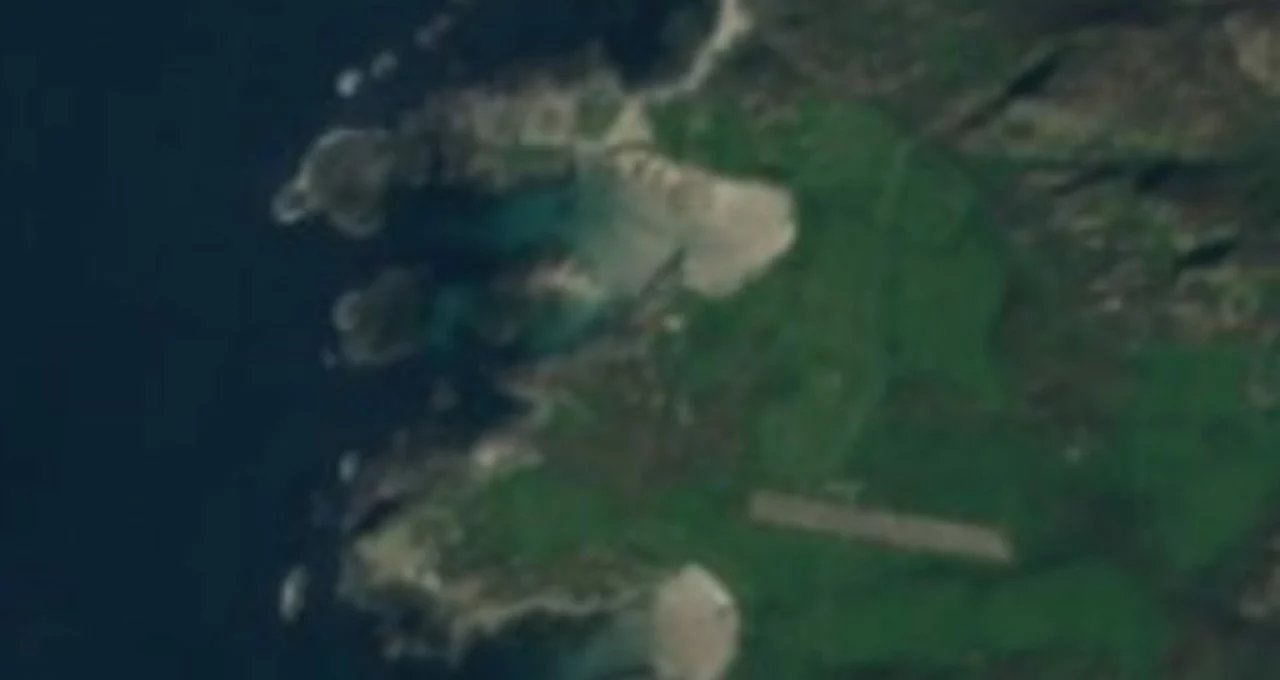
Colonsay Golf Club from space. Sentinel-2 cloudless 2016 by EOX IT Services GmbH (contains modified Copernicus Sentinel data), CC BY 4.0.
Colonsay Golf Club
Holes
18
By
70
Length
4,752 yards (Colonsay Estate, Colonsay Holidays, Golfshake); out 2,500, in 2,252
Green fee
—
Best season
April to October
Colonsay Golf Course lies at Machrins, on the west coast of the Isle of Colonsay in the Inner Hebrides, Argyll and Bute. It is an 18-hole links on indigenous machair, the short grass on sandy soil that underlies the finest Scottish links courses, with two sandy bays forming its western edge, two burns crossing it from east to west and no bunkers at all. The course is owned and managed by Colonsay Estate; the Colonsay Golf Club, with an active membership on an island of 117 people at the 2022 census, organises competitions through the season and welcomes all visitors to them. The card measures 4,752 yards, par 70, with four par 5s, eight par 4s and six par 3s. Golf is said to have been played here since 1775.
This is not a course to be judged by the standards of the mainland, and the people who run it do not pretend otherwise. There are no defined fairways, no yardage markers and no clubhouse, only a hut. The greens are mown and rolled during the season, with help from the sheep and hindrance from the rabbits, as the estate’s own description puts it. The green fee is paid by scanning a code on the bench by the first tee, where the scorecards wait in a plastic envelope, and the island’s website notes that the honesty box has been removed. In return, the estate says, you will most likely have the entire course to yourself, with nobody slow in front and nobody fast behind. Reviewers who have made the crossing describe the place as golf in the raw, and they mean it as both warning and recommendation.
Two centuries of golf on the machair
The estate’s account, repeated by the island’s community website and by most guides, is that the course is reputedly over 200 years old, having first been played on in 1775, and that golf was a recorded feature of island life by the late nineteenth century. The present layout, according to the estate, was laid out by a professional in the 1930s and remains much the same today, apart from alterations made to accommodate the airstrip. The Dutch-language Wikipedia article on the course, citing the Official Guide to Golf in Scotland, adds that the course was long maintained by the nearby hotel, that after the First World War a group of islanders gave the holes their names and used a neighbouring farm as a clubhouse, that the course closed during the Second World War to make way for a small military base, and that it reopened in 1978. The airstrip left by that base is still there, inside the course; the English Wikipedia article on Colonsay records that it was given a hard surface in 2006, and Hebridean Air Services now flies scheduled services to it. One directory gives 1979 as the founding year of the club, which fits a reopening in 1978 well enough.
The hole names are part of the pleasure of the card. The 1st is the Road Hole, the 2nd Westward Ho!, the 3rd The Burn, the 5th Machrins, the 6th Vikings’ Grave, the 7th The Fank, the 8th Ardskenish, the 9th Reekin’ Kelp, the 10th Port Lobh, the 12th Dubh Hearteach after the lighthouse that can be seen from the course on a clear day, the 13th Dun Ghallain, the 16th Muckle Carry and the 18th Kilchattan. Machrins was an early Norse settlement, and the island’s holiday-cottage company notes archaeological evidence on the ground going back more than a thousand years.
The club’s calendar has two fixed points. The Colonsay Open International All-Comers Golf Championship is played on the third Saturday in August, the one day of the year when the course is busy; a 2015 report in the island newsletter describes a scratch competition, a handicap competition, children’s prizes and an evening presentation and buffet at the hotel, and the estate notes that nearest the hole tends to become nearest the green. The club also holds a summer ceilidh, runs a winter league, and has revived an old tradition of crossing to Islay to play the Machrie, a course the island newsletter reckons about a thousand yards longer than its own and a good deal less forgiving.
What the course asks of you
The card, as published by the estate and the island’s accommodation company, runs 2,500 yards out and 2,252 back, par 35 each way. The par 5s are the 7th at 391 yards, the 14th at 376, the 18th at 370 and the 16th at 341; the estate says plainly that these would normally be par 4s and carry par 5 because of the difficulty of the ground. The par 3s range from the 17th, Air Adhart, at 124 yards, to the 9th, Reekin’ Kelp, at 206, a downhill hole where anything through the green is lost or in the marsh. The par 4s run from the 8th at 238 yards to the 12th at 324.
The 7th, The Fank, is the hole everyone writes about. From the tee the player faces the out-of-bounds airstrip, thick rough, a burn and a swamp in front of the green that are hard to see from the tee, a sheepfold, and a tight out-of-bounds fence behind the green; the fank is the sheepfold. The 14th, The Rushes, is stroke index one, with rabbit holes, rough and marsh before the green, and the 18th, Kilchattan, is stroke index two, climbing steeply to a blind second shot and a small green in a rocky hollow near the first tee; one review notes that the green is hard to find, and the club says the hole has caused many an eleventh-hour scoring collapse.
The local rules are a guide to the conditions. Preferred lies are allowed on all fairways, and a ball lost in a rabbit hole or taken by a raven may be dropped without penalty. There are no bunkers; the hazards are sheep scrapes, rabbit scrapes, marsh, burns and the fence. Tees are not level, the greens are small, round, bumpy and liable to carry hoofprints, daisies and what the sheep leave behind, and reviewers doubt that the holes are moved more than once in a season. A good score here is a matter of keeping the ball in play on ground where the line is not always obvious, accepting that putting is a lottery, and looking up often enough to notice where you are.
What golfers say
Colonsay has few reviews on the course-rating platforms, where most entries are empty, and the material that exists consists of a handful of blog accounts and course-guide write-ups from people who have played it, mostly between 2014 and 2019. The points below summarise what recurs. They are other people’s opinions, not ours; nobody from Panxis has played the course, and we name no reviewer.
What comes up in its favour
- The setting is what every account leads with: two bays, a hill, the Atlantic, outstanding views from almost every hole and in particular from the mound of the 3rd tee, and a sense of isolation that one reviewer calls breathtaking.
- The layout is praised for its use of the ground, with criss-crossing holes, blind shots and a strong run from the 12th onwards; the approach to the 14th is singled out as the best shot on the course.
- The rough-and-ready character is, for most visitors, the attraction rather than the problem: primeval golf, a bucket-list course, a fun round for very little money.
- An evening round for the sunset is recommended more than once.
- The island itself is described as beyond beautiful, and reviewers advise staying more than one night.
What comes up against
- The greens are the main complaint: small, bumpy, marked by animals and daisies, and hugely difficult to putt on.
- There are no real fairways and no yardage markers, so picking a line from the tee can feel like hitting into the void.
- Sheep share the course and sometimes have to be moved before a shot, rabbit holes are numerous on some holes, and the length of the grass depends on the weather and on how hungry the flock is.
- Marshy ground and a swamp on the 7th claim balls, and the 7th and 18th are called the hardest holes for the wrong reasons as well as the right ones.
- Facilities amount to a hut, and getting here takes a day each way; one reviewer would not make the trip for the golf alone.
Getting there and when to go
Colonsay is reached by sea from Oban. Caledonian MacBrayne’s ferry takes two hours and twenty minutes to the pier at Scalasaig on the east coast, sails seven days a week between April and October and four days a week in winter, with additional connections via Islay on Wednesdays and Saturdays in summer, according to the island’s website. By air, Hebridean Air Services flies from Oban’s airport at Connel to the island’s airstrip on Thursdays, with a morning and an afternoon service that currently route via Tiree. The course is at Machrins on the west coast, across the island from the pier; the island is eight miles long and three wide at its broadest.
The season runs from April to October. The green fee is paid by scanning the QR code on the bench by the first tee, at the Estate Office at Colonsay House or through the links on the estate’s website, and players are asked to show proof of payment if asked. Annual membership, which includes a tag for the bag, is arranged by email with the estate’s holiday-cottage office; forms are no longer left at the first tee. The club secretary can be reached by telephone for details of competitions, and club fleeces, shirts and hats are sold on the island. There is one hotel on Colonsay, which is also its only pub, overlooking the harbour at Scalasaig, and a range of estate cottages; book before you book the ferry.
Green fees
The daily green fee and the annual membership are set by Colonsay Estate and published on its golf page; the island’s community website carries the same arrangements.
How this page was made
The factual frame comes from public sources: OpenStreetMap for the location; the Colonsay Estate’s golf page for the 1775 tradition, the 1930s layout, the airstrip alterations, the maintenance of greens and fairways, the local rules, the par-5 policy, the description of the 7th, the Open, the payment arrangements and the scorecards; the Colonsay Community Development Company’s website for the club’s competitions, the ceilidh, the membership arrangements, the removal of the honesty box and the ferry and flight details; Colonsay Holidays for the hole-by-hole card, the season and the Norse settlement; the Dutch-language Wikipedia article on the course for the hotel, the naming of the holes, the wartime closure and the 1978 reopening; the English Wikipedia article on Colonsay for the population, the size of the island, the airstrip surfacing in 2006, the airline, the hotel and the ferry routes; Golfshake for the club’s own notes on the 7th and 18th; the island newsletter The Corncrake for the 2015 Open and the Islay trip; Wikidata for the identifiers.
Where sources disagree, we say so. The estate, Colonsay Holidays and Golfshake give 4,752 yards and par 70; the Dutch Wikipedia article gives a metric card whose pars add to 71; one directory gives 5,100 yards and par 72, and another describes the course as nine holes, which it is not. Golfshake states that play is restricted to members, which contradicts the estate and the island website, and we have followed the latter. The green fee and the membership subscription have changed several times in the sources we read, which is why we give no figure and refer to the estate’s page. The 1930s professional is not named by the estate, and we have not found who it was.
The opinion section summarises blog accounts and course-guide reviews published between 2014 and 2019 and read in October 2026. We report recurring themes rather than individual voices, and we reproduce no quotations from reviewers. Nobody from Panxis has played or visited this course, and this page is no substitute for a round.
Neither the estate nor the club has paid for this page, seen it before publication or has any say over its content. This page contains no commercial link and earns us no commission. If you know the course and something here is wrong or out of date, write to us and we will correct it.
Other courses nearby
Closest to this one in our British directory:
- Dalmally Golf Club — 53 mi
- Brodick Golf Club — 54 mi
- Erskine Golf Club — 68 mi
- Western Gailes Golf Club — 70 mi
The hole to know
The Fank, par 5 of 391 yards: the out-of-bounds airstrip, thick rough, a burn and swamp in front of the green that are hard to see from the tee, a sheepfold, and an out-of-bounds fence tight behind the green.