Seven clubs and a pencil bag: twilight nines in Britain before the clocks go back on 25 October
Sunset slides from twenty to seven to before five this October. How to pick seven clubs from the scorecard, what an autumn evening asks you to carry, how to get a nine-hole score counted, and what owners say about the Ping Moonlite pencil bag.
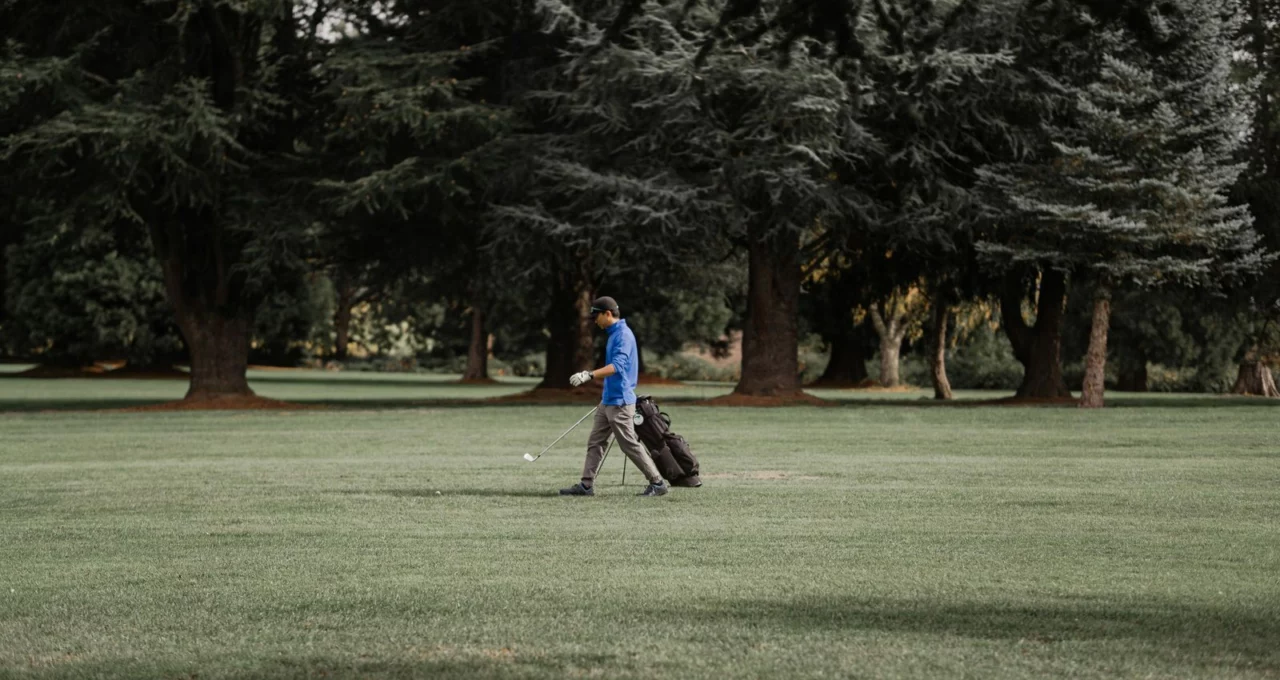
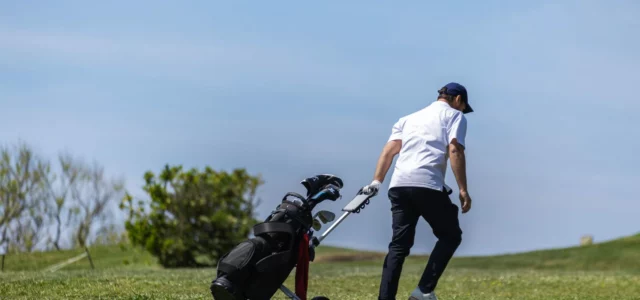
The clocks go back on Sunday 25 October, and until then most of Britain still has light after work. In London the sun sets at roughly twenty to seven in the first week of the month; by the last week it is gone before five. That leaves a short window for the after-work nine, and a full trolley bag, fourteen clubs and a waterproof suit are a poor way to spend it. A light pencil bag with seven or eight clubs gets you from the car park to the first tee in a couple of minutes and round nine holes before the dew settles. This page covers how to choose those clubs from the scorecard, what an October evening asks you to carry, how to get your score counted, and what owners say about one popular carry bag.
Our example is the Ping Moonlite, stocked by most British golf shops and backed by a specification sheet on Ping’s UK site. The figures below are Ping’s, the price was read at a British retailer in October 2026, and nobody at Panxis has carried this bag round a course. It is a buying guide and a summary of public opinion, not a review.
Fourteen is a limit, not a target
Rule 4.1b of the Rules of Golf caps the bag at fourteen clubs and sets no minimum. A round with a putter and a single iron is a perfectly legal round. The World Handicap System, as run by England Golf, Scottish Golf and Wales Golf, accepts nine-hole scores, so an evening loop can feed your Handicap Index just as a Saturday medal does, provided you follow the registration steps described further down.
Leaving half the set at home also does something useful to your game. Most club golfers lean on a few favourites anyway: the club they trust off the tee, a seven or eight for the approach, a wedge, the putter. Without the others, you stop dithering on the tee, you walk at a better pace, and you are forced to play the three-quarter shots that the full set lets you dodge. If you want to see where your current set overlaps, our guide to gaps, twins and the 14-club rule is a good place to start, and the wider question of bag types is covered in stand bag, trolley bag or pencil bag.
Pack from the scorecard backwards
Rather than starting from your favourite clubs, start from the card of the nine you are about to play. Three questions settle most of the set.
- How long are the par threes? If the short holes measure 140 and 175 yards, you need the two clubs that cover those carries in still air, plus one more for a breeze in your face. Those clubs are non-negotiable.
- Is there a par five, or a par four you cannot reach in two? If so, one club that moves the ball a long way off the fairway earns its place: a fairway wood or a hybrid.
- How tight is the first tee shot? On a nine bordered by trees or out of bounds, a hybrid or a long iron off the tee keeps the evening moving. The driver can stay in the boot unless the course gives you two or three wide-open holes.
After that, the putter and one lofted wedge, usually 54 to 58 degrees, go in whatever the card says. That wedge handles the bunker, the short pitch over a mound and the chip that has to stop quickly. Fill what remains with alternate irons, so that each club covers twenty to thirty yards instead of ten to fifteen.
The table below shows three typical seven-club sets. Treat them as starting points, not prescriptions.
| Your game | Long end | Middle | Short end |
|---|---|---|---|
| Long hitter, wide parkland nine | Driver, 4 hybrid | 6 iron, 8 iron | Pitching wedge, 56 degree wedge, putter |
| Steady mid-handicapper, tight course | 5 wood or 3 hybrid | 5 hybrid, 7 iron, 9 iron | 56 degree wedge, putter |
| Newer golfer or short par-3 loop | 5 hybrid | 7 iron, 9 iron | Pitching wedge, sand wedge, putter |
If your short game is where you score, swap the second long club for a second wedge; our guide to nine wedge distances for British conditions explains how two wedges and a clock system cover most of the ground inside 100 yards.
Shots between clubs on soft October turf
With every other iron gone, you will regularly find yourself at a yardage your set does not quite match. Say 130 yards to the flag, with a nine-iron that carries 120 and a seven that carries 145. In autumn the choice is shaped by the ground.
- Parkland in October is soft. The ball pitches and stops, so the run-up shot that works in a dry July rarely does. Take the longer club, grip down an inch or so and make a smoother, shorter swing; the ball flies a little lower and lands close to its carry.
- Links and heathland drain faster. On sandy ground the ball still releases, and a punched mid-iron that lands short of the green and chases on is often the percentage shot, especially into a sea breeze.
- Leaves change the short game. Around the greens, a chip that must roll through a carpet of leaves is a lottery. Fly it further onto the putting surface with more loft.
- Pick the safe miss. Between clubs, take the one that leaves you on the side of the flag with the most room. A bunker at the front argues for the longer club; trees or out of bounds behind argue for the shorter.
None of this is wasted on a Saturday with the full set. The in-between shot is the one that saves you in wind and on poor lies all winter.
What an October evening asks you to carry
Pencil bags are small on purpose, and that suits a nine-hole outing. The useful test is simple: if you have not touched it in your last five rounds, it stays in the car.
Worth the space:
- Four or five balls (fallen leaves hide more of them than you would expect), a handful of tees, a pitch-mark repairer, a marker and one glove.
- A towel. Grass is already wet with dew by the sixth tee in October, and a damp grip on a cold evening is no fun.
- A light windproof or thin waterproof layer: the temperature falls fast once the sun dips behind the trees.
- Phone, keys and wallet in a zipped pocket, and a bottle of water. Our page on eating and drinking on a British golf course explains why even a short round deserves it.
- A rangefinder if you use one, since the pocket for it is often the reason people choose this type of bag.
Better left behind: the umbrella, full waterproof trousers, a spare glove collection, iron covers and the sleeve of balls that has lived in the bottom pocket since spring. If the forecast justifies full rain kit, the evening nine can be played another day.
On the shoulder, not on the trolley
A pencil bag has no rigid base and no legs, and most are too slim to sit securely on a push or electric trolley. They are designed to be carried, which is the whole point on a short loop. A few habits make that easier:
- Swap shoulders every couple of holes, because a single strap loads one side.
- Wear the bag high, behind the hip, so it does not knock against the back of your legs as you walk.
- Put it down on the side of the green nearest the next tee, away from the fringe, and keep it out of standing water. In October that matters: with no legs, the bag lies flat and the clubheads rest on wet grass.
- If you have a back or shoulder problem, ask a physiotherapist or your GP before carrying, even a light load.
The Ping Moonlite on paper
The Moonlite name has been around for years; the version Ping currently sells, introduced in 2025, is smaller than its predecessors. Ping’s UK product page lists:
- Weight: 2 lbs, about 0.9 kg.
- Capacity: 7 to 9 clubs, which Ping pitches at par-3 rounds and practice sessions.
- Top: a two-way divider, so two compartments.
- Pockets: three, with 7 litres of pocket volume in total, including a rangefinder pocket and an insulated water-bottle pocket that Ping notes is not waterproof.
- Strap: a single strap.
- Extras: a Velcro glove patch.
- Colours: four colourways on the UK site at the time of writing.
Ping does not publish dimensions on that page, so we give none. Price read in October 2026 at a British retailer: £79, against £99 on Ping’s own UK shop.
Do not confuse this bag with older Moonlites, which had a four-way top, double straps on some versions, and room for a full set. Second-hand listings often mix the generations under the same name. The current model is built for a half set and nothing more.
What golfers are saying about the Ping Moonlite
Forum threads, published reviews and buyer comments on retailer sites keep returning to the same handful of points about the current model.
Praised:
- How little it weighs. Owners describe forgetting it is on their shoulder, and review round-ups of carry bags single out its lightness.
- The soft, unstructured build. With no frame or legs, it folds into a car boot, a locker or the cupboard under the stairs, and several owners say that is exactly why they bought it.
- Quiet walking. Because the clubs sit close together in a narrow body, they knock against each other less, and the bag rattles far less than a larger one.
- Easy zips and a simple layout that does not need thinking about.
Criticised:
- A narrow opening. With eight or nine clubs, grips crowd the top and pulling one out can drag its neighbours with it.
- Clubs sliding out. With nothing heavy at the bottom, some owners report clubs slipping when the bag is tipped or laid down at an angle.
- Heads on the ground. With no legs, the clubheads rest on the turf when the bag is put down, which means wet headcovers on a dewy evening and scuffs on a gravel car park.
- Small pockets. Balls, tees, phone, keys and a bottle fill them, so a jacket or snacks will not fit.
- A limited choice of colours compared with some rival carry bags.
- Reduced capacity. Long-standing Moonlite owners point out that the old four-way version took a full set, while this one tops out at nine clubs.
Where to play an evening nine in Britain this October, and where to find the bag
The round. Many British clubs sell a twilight green fee to visitors after a set time in the afternoon, and that time moves earlier as the evenings shorten. Some clubs advertise a nine-hole rate outright; at others you simply pay the twilight fee and play as far as the light allows. Nine-hole courses, par-3 layouts and municipal courses are the most natural fit for a half set: our guide to nine holes and par 3s in Britain lists the formats you are likely to meet. Members have an extra option at many clubs, where a nine-hole loop or a short evening competition runs through the autumn. Times, prices and visitor access vary from club to club, so check the website or ring the pro shop rather than turning up.
Getting the score counted. In Great Britain and Ireland, a general play score only counts for handicap if you register your intention before you tee off. England Golf members do this in the MyEG app, which checks you are at the course; Scottish Golf and Wales Golf members follow their own union’s process. For a nine-hole round, the score cannot be submitted until an hour after registration, and a playing partner who saw every shot must verify it. Submit it the same evening, before midnight.
The light. Look up sunset for your town before you book the last slot, and allow roughly two hours for nine holes walking. After 25 October, with sunset before five in the south of England and earlier further north, a nine has to start by about three o’clock to finish in daylight. For most people that ends the after-work round until spring, and the pencil bag moves to Saturday afternoons and the range. Our guide to closing the British golf season covers what comes next.
The bag. There are four places to look, each with something to ask.
- Your club’s pro shop may have a couple of pencil bags in stock. Ask to load your own seven or eight clubs into one before you buy and see how crowded the top feels.
- Large golf stores put several makes side by side, the quickest way to compare weight, strap padding and pocket layout. Take your longest club in with you.
- Online shops are often cheaper. Check the returns policy, and whether the listing is for the current model or an older one with the same name.
- Second-hand is tempting for a bag with so little to wear out. Inspect the zips, the strap stitching and the base for holes, and confirm the model year, since a Moonlite from a few seasons ago is a different bag.
Whichever you choose, ask how long the warranty covers zips and straps. There is no commercial link on this page and no commission.
Before you leave the office
- Read the scorecard: the par threes pick two clubs, a par five may earn a wood.
- Putter and one lofted wedge go in regardless; the rest is every other iron.
- Pack a towel and a warm layer, leave the umbrella and the spare balls in the boot.
- Register the round in your union’s app before the first tee if you want it to count.
- Check sunset, and remember the clocks go back on 25 October.
Seven clubs on one shoulder will not change your Handicap Index overnight. They will get you onto the first tee more often on weekday evenings this autumn, and that is how a better winter starts.
How this page was put together
This page is a buying guide and a summary of public opinion, not a test. The weight, capacity, top, pockets, pocket volume, strap, glove patch and number of colourways of the Ping Moonlite come from the product page Ping publishes for the current model on its UK site and its European shop; where Ping gives no figure, as with dimensions, we give none. The price of £79, against £99 shown on Ping’s UK shop, was read in October 2026 on the website of Golf Online, a British golf retailer. What golfers say was read on the GolfWRX forum, in MyGolfSpy’s review of the Moonlite and its round-up of Ping bags, and in public buyer reviews on retailer sites; nobody is quoted by name, nothing is counted, and no impression is presented as a statistic. The rules points come from the Rules of Golf (Rule 4.1b) and from England Golf’s guidance on registering general play scores under the World Handicap System.
Nobody here has carried this bag or played these clubs for this page. There is no commercial link on this page, no affiliate arrangement and no commission of any kind. If a piece of content on this site is ever paid for by a brand, it will carry an advertising notice at the top of the page, before the first line.