Gaps, twins and the 14-club rule: building a British golf bag that covers every yardage
Rule 4.1b sets a limit of fourteen clubs, not a target. Build a carry chart, look for holes and twins, check the loft on your pitching wedge, and choose bounce for the turf you play from November to March as well as in July.
In brief
- A 15th club costs two strokes a hole in stroke play, capped at four; foursomes partners may share up to 14.
- Chart carry distances, ten balls a club, and look for jumps over fifteen yards.
- A 43-degree pitching wedge beside a 56-degree sand wedge leaves a hole of thirty yards or more.
- Soft winter parkland wants more bounce; firm links and heathland want less.
- Twelve clubs with no gaps beat fourteen with a hole in the middle.
Rule 4.1b allows fourteen clubs, and nowhere does it say you have to carry that many. Look inside the average club golfer’s bag on a Saturday medal and you usually find the full fourteen, perhaps nine that get used, two that go the same distance and one yawning hole between the pitching wedge and the sand wedge. Sorting that out costs far less than a new driver and saves more shots.
What the Rules actually say
The R&A’s wording is short. You must not start a round with more than 14 clubs or have more than 14 during it. If you start with fewer, you may add clubs up to the limit, but you cannot replace a club that you lose during the round.
The penalty depends on the format. In stroke play it is two strokes for each hole where the breach happened, capped at four strokes for the round. In match play the match score is adjusted by deducting a hole for each hole played in breach, to a maximum of two holes. Either way, as soon as you notice, you must clearly take the extra club out of play before your next stroke, and using it afterwards means disqualification.
The usual culprit is innocent: a demo hybrid left in the bag after a fitting, or a child’s club slipped in on the practice ground. Counting the bag on the first tee takes ten seconds.
One wrinkle matters for British golf in particular. In foursomes and four-ball, partners may share clubs as long as they have no more than 14 between them, which is how a pair can turn up to a foursomes match with one bag each and share a putter without penalty.
Step one: a carry chart you believe
Every decision about the bag rests on one list: how far each club carries in the air, on an ordinary swing. Not the 7-iron that ran forty yards down a baked fairway last August.
Hit ten balls with each club, strike out the two longest and two shortest, and average the rest. Carry is the number that matters because approach shots are decided by where the ball lands; roll on a British course changes too much between a wet February and a dry July to be useful.
There are three ways to get the list:
- A launch monitor bay. Driving ranges with ball-tracking technology show the carry of every shot. Hoebridge Golf Centre in Woking has a floodlit Trackman range, and Trafford Golf Centre in Manchester has 53 bays with Toptracer. A single hour with a launch monitor gives you a full chart.
- A shot tracker over a season. Devices that record every shot you play build the chart from real rounds, which includes cold mornings and wet lies. The Shot Scope V5 was £239 at a UK golf retailer in September, with no subscription for the course data.
- A field and a rangefinder. Your own balls, an empty practice ground early in the morning and a laser. Slow, but free.
Range balls are the weak point of the first option: they tend to fly shorter and less consistently than your own ball, so trust the gaps between clubs more than the absolute numbers. A well-planned range session is still the fastest way to see those gaps.
Step two: read the chart for two faults
Lay the numbers out from driver down to your highest-lofted wedge. You are looking for two things.
Holes. Any jump of more than about fifteen yards between neighbouring clubs at the scoring end of the bag. Further up, where you are rarely aiming at a flag, twenty yards is tolerable.
Twins. Two clubs within eight yards of each other. Common pairs are a 3-wood and 5-wood that both launch low, or a 4-iron and a hybrid that land in the same place.
A hole costs you a shot when the yardage falls into it; a twin wastes a slot that could have filled a hole. Most bags have one of each.
The wedge gap nobody told you about
Iron lofts have become stronger over the years, and the pitching wedge has moved with them. Take one current set on sale in Britain: the TaylorMade Qi irons, £539 for 6-iron to pitching wedge at a UK retailer on 17 September 2026. The published lofts are 28 degrees for the 7-iron and 43 degrees for the pitching wedge, with a matching approach wedge at 49 and sand wedge at 54.
Now picture that 43-degree pitching wedge next to the 56-degree sand wedge many golfers already own. Thirteen degrees separate them, which for most amateurs means a gap of thirty yards or more, sitting exactly where a lay-up or a par-5 third shot tends to finish.
The fix is a gap or approach wedge at around 48 to 52 degrees, with four to six degrees between each wedge after that. Loft is stamped on most wedge soles and listed in every iron set’s specification, so check the number rather than the letter on the club. The wedge distances you then build for each club are where scoring improves.
It need not be expensive. On 17 September a large British golf chain listed the Wilson Deep Red Maxx wedge at £59 and the Fazer XR5 at £49, alongside the Mizuno T24 at £109 and the Titleist Vokey SM11 at £179.
Bounce for British turf
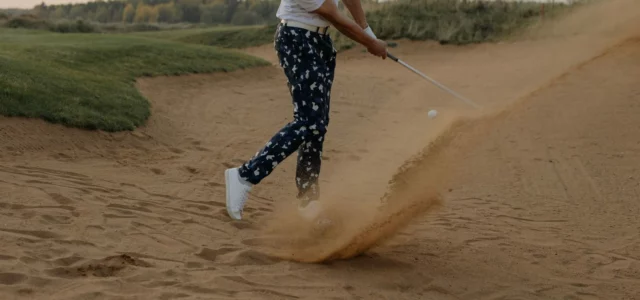
Bounce, the angle that keeps the leading edge from digging, matters more in Britain than the catalogue suggests, because the same golfer may play soft winter parkland and firm summer links within months.
- Higher bounce, around ten degrees and up, helps on soft, wet turf, in fluffy sand, and for a steep swing.
- Lower bounce, roughly four to eight degrees, suits firm, tight lies, hard-packed bunkers and a shallow sweep.
If your home course is heavy clay that stays wet from November to March, err towards more bounce: a fat wedge costs more than a thin one. If you play mostly on sandy heathland or links where the ball sits down tight, less bounce lets you nip it.
The top end: be honest about fairway woods
The question to ask of every long club is simple: would you hit it off a tight fairway lie, into a stiff breeze, on a hole that matters? If not, it is a tee club, and one tee club besides the driver is plenty.
Low-lofted fairway woods need speed to launch from the turf. A 5-wood or 7-wood, or a hybrid of similar loft, gets airborne far more easily for most club golfers, and the higher flight lands more softly on a green. The trade-off is wind: a higher ball is more exposed on an exposed links, which is why some strong players keep a long iron or a driving iron for windy days.
For everyone else, replacing the 4-iron and 5-iron with hybrids is the most reliable swap in the bag. The wider sole slides through rough rather than snagging, which counts for a lot on courses where the rough is wet for half the year.
Then remove something
Add a gap wedge and a hybrid and two clubs must go if you are already at fourteen. Usual candidates: the second fairway wood, the long iron you have not hit well since you bought it, or a 60-degree lob wedge that produces one good shot in five.
Twelve or thirteen clubs with no holes beats fourteen with one. A lighter bag is also easier to carry on a wet eighteen, and fewer choices on a windy day can be a quiet advantage.
Winter and summer bags
British conditions change the maths through the year. Cold air, heavy ground and winter mats all take distance away, so the carry chart you made in June will flatter you in January. Some golfers keep a slightly different line-up for winter: an extra hybrid in place of a long iron, and a higher-bounce wedge for soft lies. It is worth repeating the chart once in each season.
Where to check your gaps in Britain
One free check worth knowing about: some specialist golf shops offer a complimentary 15-minute club diagnostic, walk-in with no appointment, covering grip wear, a loft gap check and lie angles. Check the opening hours before travelling.
Some large golf chains offer a free custom fitting in store, and a fitting is a natural moment to look at the whole bag rather than just the club you came in for. Others fit with GCQuad or Trackman launch monitors, with the fitting fee refunded against a custom-fit purchase.
Your club’s PGA professional can also check lofts and lies, and for the narrow question of gaps between clubs that is often all you need. Panxis Golf has no commercial relationship with any of these retailers, ranges or fitters and earns no commission.
Before your next medal
- Make a carry chart for every club, ten balls each, best two and worst two discarded.
- Mark any gap over fifteen yards and any pair within eight.
- Read the loft on your pitching wedge before buying another wedge.
- Choose bounce for the turf you play most, not the course you saw on television.
- Take a club out for every club you add, and count to fourteen on the first tee.
How this page was put together
Prices were recorded in September 2026 (17 September for the irons and wedges) at Clubhouse Golf and American Golf in the UK. Panxis has no commercial link with either retailer.