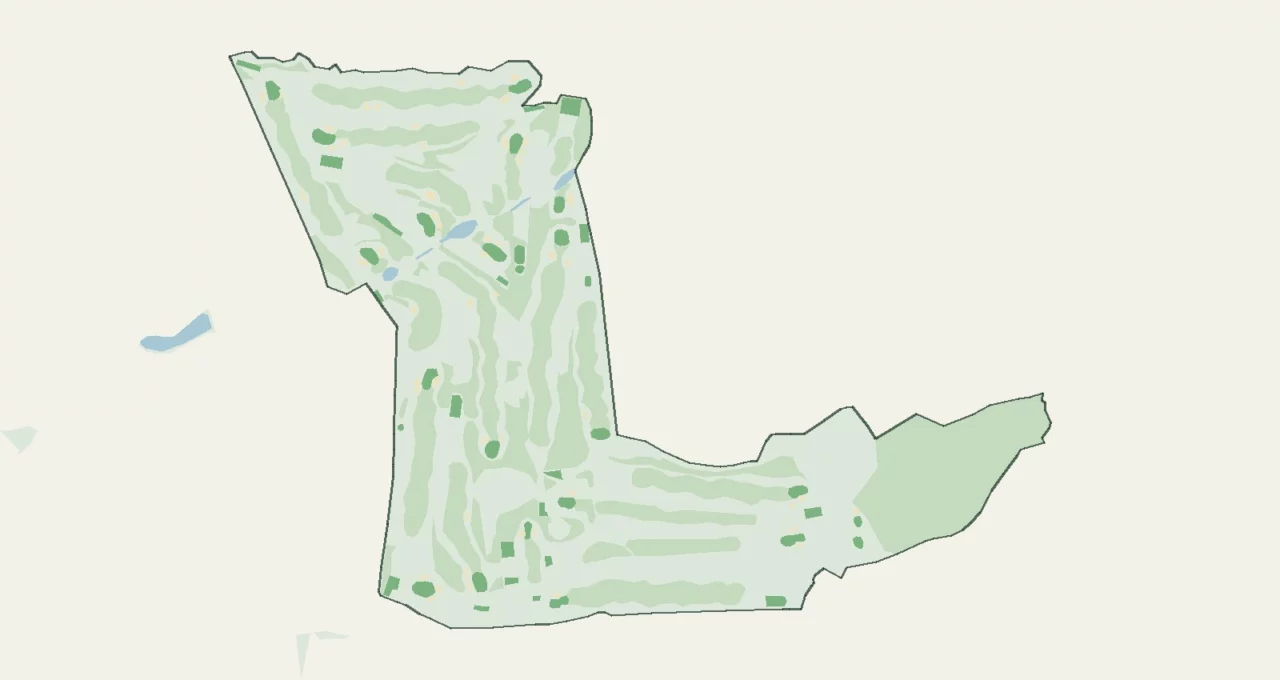
Layout of Enmore Park Golf Club from OpenStreetMap survey data (ODbL licence).
Enmore Park Golf Club
Holes
18
By
71 for men from all three tee sets; 73 for women on the club's course page, 74 or 76 depending on the tee on its hole-by-hole tour and GolfNow
Length
6,434 yards for men on the club's course page (6,428 from the back tees adding up its hole-by-hole figures, 6,153 middle, 5,643 forward); other sources give 6,411 to 6,454 yards
Green fee
—
Best season
Open all year (GolfNow); clubhouse 9am to 9pm in summer, 10am to 5pm in winter; pro shop from 8am (club website)
Enmore Park is a private members’ golf club with an 18-hole parkland course in the village of Enmore, on the lower slopes of the Quantock Hills a couple of miles west of Bridgwater, Somerset. The club’s own description puts the course at par 71 and 6,434 yards for men, laid out in two loops of nine that both start and finish at the clubhouse, with a brook and three ponds in play on five holes and views, from the highest ground, over the surrounding hills and across the Bristol Channel to Wales. Visitors are welcome and can book tee times online. The club’s website is enmorepark.co.uk.
The club is older than the course. It was founded in 1906 as Cannington Park Golf Club, a nine-hole course about six miles to the north, moved to Enmore in 1932, and only became an 18-hole club in 1972, when a layout by the architects Fred Hawtree & Co. opened on land bought with a gift from a local businessman. It has since hosted national amateur championships, including the English Women’s Amateur Stroke Play Championship in 2009 and, jointly with Burnham & Berrow, the R&A’s Boys Amateur Championship in 2011. Top 100 Golf Courses currently ranks it sixth in Somerset.
From Cannington to Enmore
The club’s history page, the most detailed account we found, tells the story in some depth. Cannington Park Golf Club opened on Easter Monday 1906 as a nine-hole course of 2,200 yards with a bogey score of 38. Some of the original holes can still be made out beside Cannington Quarry, according to the club. The ground was tended with horse-drawn mowers, the horses wearing leather shoes to spare greens that had a reputation for speed. The course closed during the First World War, when the land was used to graze army mules. A new pavilion went up in 1926, but there was no room to expand, and the club began looking for a new site.
It found one in the former park of Enmore Castle. The castle was built in the 1750s for John Perceval, 2nd Earl of Egmont, partly underground and surrounded by a dry moat; most of it was demolished in the nineteenth and twentieth centuries, and what remains, now divided into two houses, has been Grade II listed since 1987, according to Wikipedia. The English Wikipedia article on the castle notes that the golf club was built on part of its parkland, and the article on the village describes the club, which arrived in 1932, as one of Enmore’s main attractions, close to the village centre.
The new course was opened at 3pm on Saturday 24 September 1932 by R. P. Croom-Johnson, KC, MP, who also hit the first tee shot; the club says the ball, mounted with a small silver plaque, is in its trophy cabinet. It was a nine-hole course of about 2,500 yards, and the local paper of the day welcomed the absence of the roads, stiles and barbed wire that golfers had to negotiate at Cannington. Five more holes were opened at Roughmoor in 1938, but the Second World War stopped any further expansion. Much of the course was ploughed up to help the war effort, and Enmore Park was eventually reduced to seven holes, although the members chose to keep the club going rather than close for the duration.
The decisive change came in 1969. Philip Pensabene, the chairman of a Bridgwater company, gave the club £73,000 to expand to 18 holes; his portrait hangs above the bar, and one of the clubhouse meeting rooms bears his name. Fred Hawtree & Co. were engaged to decide how much land to buy and to design the course, which measured 6,431 yards when it opened for play on 16 May 1972. The formal opening followed on 10 June 1972. The same month, Nigel Wixon became the club’s professional, a post he held until July 2019; the club says his 47 years made him the longest-serving club professional in the country, a claim we were not able to check independently.
The club’s history also records exhibition matches in 1967 with a group of young professionals that included Tony Jacklin, a celebrity tournament in October 1982 won by the cricketer Viv Richards, a visit in 1990 by the Ryder Cup player José María Cañizares, and the opening of the present clubhouse, built for £450,000, in August 1990. Championship golf followed: the English Women’s Amateur Stroke Play Championship in 2009, the Boys Amateur Championship in 2011 (shared with Burnham & Berrow, and won, according to Top 100 Golf Courses, by Harrison Greenberry of Devon), the England Golf Women South West Foursomes in 2012, and a southern regional qualifier for the Brabazon Trophy, the English men’s stroke play championship, in 2013. Wikipedia gives the medal course record from the white tees as a gross 62, nine under par, set in 2018.
The club credits the 1972 design to the firm, Fred Hawtree & Co.; Top 100 Golf Courses names the architect as Fred W. Hawtree, and the Wikipedia article names no architect. GolfNow gives 1932 as the year the course was built, which is the date of the move to Enmore, not of the present 18 holes. We found no account of significant redesign work since 1972.
What it asks of you
The figures in this section come from the club’s hole-by-hole tour, which gives par, length and stroke index for three sets of men’s tees and two sets of women’s tees, and from GolfNow, which names the tees and publishes course ratings. The club’s tour does not name its tees; GolfNow calls the men’s sets blue, purple and green, and its totals match the club’s hole yardages to within two yards. Adding up the club’s figures gives 6,428 yards from the back tees, 6,153 from the middle set and 5,643 from the forward set, all par 71 for men: 35 out and 36 home. For women, the club’s figures give a par of 76 from the middle tees and 74 from the forward tees, where a number of the longer par 4s become par 5s.
On GolfNow, the course rating and slope for men are 71.8 and 129 from the blue tees, 70.7 and 127 from the purple and 68.0 and 125 from the green. For women they are 77.1 and 140 from the purple tees and 74.3 and 134 from the green. A slope well above the neutral 113 means the course plays relatively harder for higher handicappers than for good players. Older cards give a standard scratch score of 70, but we found no current SSS from the club.
The ground is the main story. Enmore Park is compact, about 100 acres according to Top 100 Golf Courses, and set on rolling land around the clubhouse, which stands high on the site. The 1st and 10th, the two holes that leave the clubhouse, climb steeply, and the 9th and 18th, which return to it, run downhill; reviewers mention the climb as often as anything else. Trees line many of the fairways, a brook and three ponds come into play on five holes, and the club’s own course page singles out its four par 3s as a demanding set. There are only three par 5s, the 6th, 16th and 18th, and the par 4s include several long ones, notably the 5th, the 10th and the 11th.
The round begins without a warm-up. The 1st, a par 4 of 379 yards from the back tees and stroke index 6, runs uphill with out of bounds on the left and a gully on the right where, the club warns, a ball will be lost, although the right is the better side for the approach. The second shot is normally blind, and players ring a bell when the green is clear. The 2nd is a short par 3 of 146 yards from a sheltered, tree-lined tee, so the wind on the green is easy to misjudge. The 4th, a dog-leg left of 337 yards, offers long hitters the chance to cut the corner over trees and water, while a pond waits for an approach that strays. The 5th, at 410 yards and stroke index 2, needs two straight shots, with bunkers either side of the green to catch anything that runs in.
The 6th, 489 yards, is the only par 5 on the outward half and the lowest-rated hole on the card. The 7th, a par 3 of 175 yards, plays over a pond, with trees either side and a long bunker on the left of the green, and the club’s advice is to take enough club to finish at the back. The 9th, 410 yards back to the clubhouse, has out of bounds on the left and a green that slopes from front to back and from left to right, which the club calls arguably the trickiest on the course.
The inward half is longer and, on the stroke indexes, harder. The 12th is a par 3 of 214 yards from the back tees, over 200 yards even from the middle set, with three bunkers on the right of the green and a stream for poorly struck shots. The 13th, stroke index 3, has two fairway bunkers to split with the drive and three more around an undulating green. The 14th is a short dog-leg of 351 yards with a pond about 75 yards short of the green, and the 15th, the last of the short holes at 183 yards, has water and trees around a long green; Top 100 Golf Courses describes the water as lying at the front and right. The 16th is a par 5 of 485 yards that doglegs right to a large, heavily contoured green, and the 17th, 322 yards and stroke index 15, is one of the few genuine birdie chances. The 18th, a par 5 of 493 yards, the longest hole on the course, plays downhill from the tee and shorter than its length, with poplars on the left and trees on the right of the approach. The club’s page for the hole marks it as a par 4 in its men’s figures, but its own description and the par 71 total make it a par 5.
The 10th
The club’s course page calls the uphill 10th one of the most daunting holes in the West Country. It is a par 4 of 433 yards from the back tees, 424 from the middle and 414 from the forward tees, and it is stroke index 1. The fairway is lined with trees most of the way, the drive has to be accurate and long, and the green sits beside a large tree that gives the hole its name, although the club’s tour does not say what that name is. The club’s own advice to those who cannot reach in two is to lay up and rely on a pitch. One reviewer on Top 100 Golf Courses cites the climb of the 10th as an example of how hilly the course is around the clubhouse.
The card, hole by hole
Back-tee yardage first, then the middle and forward tees, with par and stroke index for men, from the club’s hole-by-hole tour.
- 1st: par 4, 379 yards (372, 364). Index 6.
- 2nd: par 3, 146 yards (142, 122). Index 16.
- 3rd: par 4, 371 yards (359, 348). Index 14.
- 4th: par 4, 337 yards (309, 292). Index 12.
- 5th: par 4, 410 yards (398, 337). Index 2.
- 6th: par 5, 489 yards (477, 452). Index 18.
- 7th: par 3, 175 yards (166, 157). Index 4.
- 8th: par 4, 385 yards (347, 263). Index 10.
- 9th: par 4, 410 yards (380, 357). Index 8.
- 10th: par 4, 433 yards (424, 414). Index 1.
- 11th: par 4, 470 yards (460, 401). Index 9.
- 12th: par 3, 214 yards (200, 179). Index 7.
- 13th: par 4, 375 yards (363, 340). Index 3.
- 14th: par 4, 351 yards (339, 327). Index 11.
- 15th: par 3, 183 yards (155, 140). Index 13.
- 16th: par 5, 485 yards (465, 436). Index 5.
- 17th: par 4, 322 yards (313, 298). Index 15.
- 18th: par 5, 493 yards (484, 416). Index 17.
The 11th deserves a word: at 470 yards from the back it is a very long par 4, but the club says it is easily reached in two because the fairway runs, especially in summer, and there is no sand around the green. A scorecard published on Golfing Record, from an older white-tee card, gives different stroke indexes on several holes (the 1st as index 10 and the 3rd as index 6, for instance), so the indexes may have been revised; check the card at the club before a competition.
What golfers say
Public reviews of Enmore Park are fewer than for many clubs of its standing. The material we read is the five reader reviews on Top 100 Golf Courses, dated 2016 to 2020, with an overall rating of three and a half out of five; the two reader reviews on Today’s Golfer, dated 2008 and 2012, and that site’s own summary; and the overall score on Hole19, 4.8 out of five from 64 reviews, whose text we could not read. The club’s own societies page carries testimonials, which we have not used, since a club naturally publishes the kind ones. The points below summarise what recurs. They are other people’s opinions, not ours; nobody from Panxis has played the course, and we name and quote no one.
What comes up in its favour
- The setting is the most consistent theme: traditional parkland on rolling ground against the Quantock Hills, with views that several reviewers single out.
- Greens are generally described as good and true, and fairways as well kept, in reviews from the late 2010s and 2020.
- The course is described as challenging but fair, demanding without being tricky, with some memorable holes; one older review picks out the stretch from the 7th to the 12th.
- The welcome is often mentioned: friendly, helpful staff, a society day well looked after, a well-stocked shop and good food in the clubhouse.
What comes up against
- The course is hilly, especially the holes that leave and return to the clubhouse, and reviewers note that this makes for a tiring walk and a hard start off the 1st tee, particularly for higher handicappers.
- Greens are described by some as on the slow side, and one older review complained that they seemed to be getting smaller and slower.
- Pace of play is criticised in at least one review.
- Winter visits draw more reserved verdicts, and an older review found the sand uneven from one bunker to the next and felt the course needed more care; these comments are many years old and may no longer apply.
Facilities and how to play it
According to its website, Enmore Park welcomes visitors, who can book tee times online up to ten days ahead or by calling the pro shop on 01278 672100 (option 3). Visitor tee times are available from 10am on weekdays and from midday at weekends, subject to members’ competitions and other bookings, although the home page also advertises some weekend morning times. Societies book through the office, pay a deposit and are asked to bring players with a handicap, or at least experienced golfers who know the rules and etiquette; the club expects a good pace of play. Smart casual dress is required in the clubhouse, caps are not allowed indoors, and only recognised golf clothing may be worn on the course. The club offers reduced rates to golfers playing with members and to County Card holders.
The practice ground is a strong point. The club describes a range set apart from the course, with covered bays and the choice of hitting from mats or grass, two chipping greens, a practice bunker and a chipping area; it is open to visitors as well as members. The pro shop, run by a head PGA professional with a team of coaches, also runs a swing studio with a GC Quad launch monitor, opened in November 2019, which can be booked for practice, simulator golf or lessons. The club runs a six-week coaching programme for beginners and returning golfers in spring. Today’s Golfer’s listing, last updated in 2014, says there is no driving range or practice green, which the club’s current pages contradict; follow the club.
The clubhouse overlooks the 18th green and serves food and drink to members and visitors, with rooms available for private hire. Golf Today and GolfNow list buggy and trolley hire and club hire; the club’s own website does not mention buggies, so ask the pro shop before relying on one. Membership is open, with full, junior, intermediate, corporate and country categories and a joining fee, according to the club.
Getting there and when to go
The club’s address is Enmore Road, Enmore, Bridgwater, Somerset TA5 2AN. GolfNow gives the town as Taunton, which shares the postcode area, and Top 100 Golf Courses places the course nine miles north of Taunton; Wikipedia puts the village about two miles west of Bridgwater. From the M5, Golf Today’s directions are to leave at Junction 24, follow the signs into Bridgwater, then take the road towards Enmore, where the club is signposted. The village sits at the foot of the Quantock Hills, a protected landscape, so the course combines easily with a walk on the hills; Burnham & Berrow, the links with which Enmore Park shared the 2011 Boys Amateur, is on the coast to the north of Bridgwater.
GolfNow lists the course as open all year. The club’s summer opening hours run from 9am to last orders at 9pm, and its winter hours from 10am to 5pm, depending on the weather and the number of visitors; the pro shop opens at 8am all year and closes at 6pm in summer and at dusk in winter. The club office is open on weekday working hours. Reviewers suggest the course is at its best in summer, when the greens run faster and the trees are in leaf, and the hilly walk is easier on dry ground.
Green fees
Enmore Park’s visitor rates vary with the day and time of play: see the visitors page on the club’s website for current prices and booking.
How this page was made
The factual frame comes from public sources: OpenStreetMap for the location and outline of the course; Wikidata for the identifiers; the club’s website for its history, the description of the course, the hole-by-hole yardages, pars, stroke indexes and playing notes, the visitor arrangements, opening hours, dress code, practice ground, swing studio, coaching, clubhouse, membership and address; the English Wikipedia articles on the club, on Enmore Castle and on the village of Enmore for the 1932 and 1972 dates, the championships, the course record, the castle and the village’s position; Top 100 Golf Courses for the architect’s name, the size of the site, the county ranking, the 2011 winner and its reader reviews; GolfNow for the tee names, the course ratings and slopes, and the all-year season; Golf Today for the directions and facilities; Golfing Record for an older scorecard and standard scratch score; Today’s Golfer for its description and reader reviews; and Hole19 for its overall score.
Where sources disagree, we say so. The length of the course is given as 6,434 yards on the club’s course page, 6,454 on its history page, 6,428 when the club’s hole-by-hole figures are added up, 6,426 on GolfNow, 6,453 on Top 100 Golf Courses and in the card cited by Wikipedia, and 6,411 on Today’s Golfer and in Wikipedia’s infobox; Golfing Record’s white-tee card adds up to 6,218. The 1972 course measured 6,431 yards according to the club. The women’s par is 73 on the club’s course page, 74 from the forward tees on its hole-by-hole tour, on GolfNow and in Wikipedia, and 76 from the middle tees on the tour and on GolfNow; Today’s Golfer gives 74 over 5,718 yards. The club’s history page credits the 1972 design to Fred Hawtree & Co., Top 100 Golf Courses to Fred W. Hawtree. GolfNow dates the course to 1932, the year of the move rather than of the 18 holes. The club’s page for the 18th labels it a par 4 for men despite describing a par 5. Golfing Record’s stroke indexes differ from the club’s. Today’s Golfer says there is no driving range; the club describes one. Golf Today and GolfNow list buggies, which the club does not mention. Golfshake had no page for the course that we could find, the text of Hole19’s reviews was not visible to us, and the club’s scorecard page was empty when we read it.
The opinion section summarises reviews read in October 2026. We report recurring themes rather than individual voices, and we reproduce no quotations from reviewers. Nobody from Panxis has played or visited this course, and this page is no substitute for a round.
The club has not paid for this page, has not seen it before publication and has no say over its content. This page contains no commercial link and earns us no commission. If you know the course and something here is wrong or out of date, write to us and we will correct it.
Other courses nearby
Closest to this one in our British directory:
- Burnham & Berrow Golf Club — 11 mi
- Glamorganshire Golf Club — 22 mi
- Cardiff Golf Club — 29 mi
- Llanishen Golf Club — 31 mi
The hole to know
An uphill, tree-lined par 4 of 433 yards from the back tees and stroke index 1, which the club calls one of the most daunting holes in the West Country; it advises laying up if the green is out of reach in two.