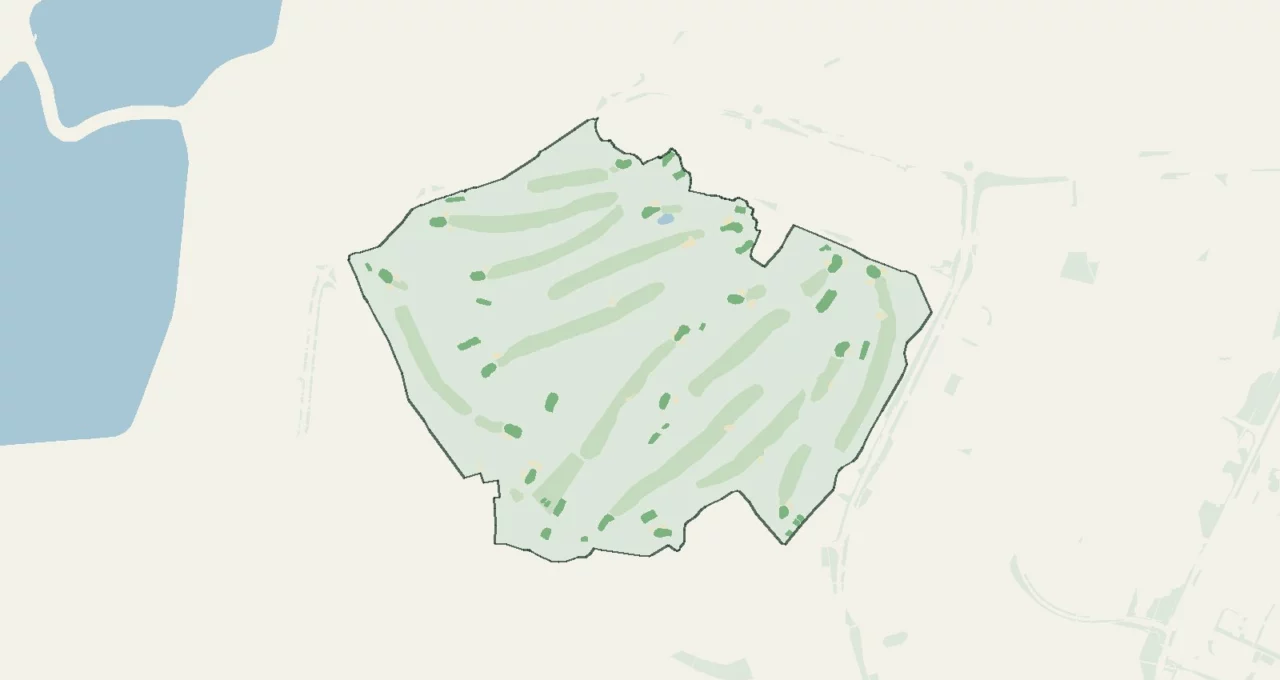
Layout of Cardiff Golf Club from OpenStreetMap survey data (ODbL licence).
Cardiff Golf Club
Holes
18
By
70
Length
6,090 yards from the White tees (club scorecard); Yellow 5,777, Red 5,445 (par 73). Golfshake lists 6,150 yards from the White tees
Green fee
—
Best season
—
Cardiff Golf Club is an 18-hole members’ club on Sherborne Avenue in Cyncoed, a residential suburb on the north side of the Welsh capital. The postcode is CF23 6SJ. The club was formed in 1921 on a farm called Ty-to-maen, and its first holes were laid out by its first professional, Robert Walker, with a small committee of members; the architect C. K. Cotton reworked part of the course in 1950. On the club’s scorecard it is a par 70 of 6,090 yards from the White tees, with Yellow tees at 5,777 yards and Red tees at 5,445 yards, where par is 73. It is a parkland course of tree-lined, rolling fairways, crossed in several places by a brook, and entirely surrounded by housing.
The club describes itself as one of the premier clubs in South Wales and says it hosts many national and county championships. Its own pages, including the scorecard, hole notes and visitor information, are on the Cardiff Golf Club website.
From a farm in north Cardiff to a members’ course
The club’s history pages begin in the spring of 1921, at the Leys Golf Club, a links at Gileston on the coast between Barry and Llantwit Major. Two young men from Cardiff, Reuben Pugsley and Trevor Williams, who had travelled there by tram, train and pony and trap, decided over a drink that the city needed a golf club within its own boundaries. A meeting advertised in the Western Mail drew some 500 people; the club’s centenary website dates it to 24 May 1921 and places it in St Margaret’s Church Hall on Waterloo Road. Pugsley became chairman and Williams secretary.
According to the clubhouse history page, the committee looked at three sites: land near the Three Arches Bridge, judged too small at about 70 acres; land east of Roath Park Lake, which belonged to the Bute estate on terms the committee found unacceptable; and Ty-to-maen farm, recently bought by Ewan G. Davies, a Cardiff and Wales rugby international. Davies offered a lease of up to 21 years. Access was the difficulty, since the only entrance was near what is now the 14th green, and about ten acres of land between the farm and Cyncoed Road had to be bought from a neighbouring owner, Wyndham Clarke, to give the club a road in and room for a clubhouse. The resolution forming the club was passed on 23 November 1921.
Robert Walker, who came from Southerndown, was engaged as professional and laid out the course with the professional of Radyr and a small sub-committee. They planned nine holes first, and the club says the first green of that layout is today’s 17th. On the club’s account the extension to 18 holes was not completed and opened until March 1923. In 1928 Walker and his successor, Bill Smalldon, received Gene Sarazen and Joe Kirkwood at the club; the club says it does not know what brought two of the leading players of the day to Cardiff. Smalldon took over as head professional in 1929 and served until his death in 1973.
The club bought the course from Ewan Davies on 19 June 1947, at a price the club describes as well below market value. In 1950 it called in C. K. Cotton, a golf architect who later designed St Pierre and Ross-on-Wye, according to Top 100 Golf Courses. His changes were substantial: the 1st was altered, a new 2nd and 3rd were built, the old 3rd was lengthened to become the present 4th, the 11th tee was pushed back into the trees, and the short 15th and 16th of the time were removed. In 1972 the club sold land behind the 13th and 15th tees to Cardiff City Council under a compulsory purchase order for the Pentwyn perimeter road. The present clubhouse was built between 1996 and 1998 and officially opened on 7 March 1999 by the President of the Welsh Golfing Union.
The club has produced several Welsh amateur champions and internationals, among them H. C. Squirrell, who won the Welsh Amateur Championship five times, and it has hosted the Welsh Professional Championship on several occasions. The club gives the amateur course record as 65, held by S. P. Jones.
What it asks of you
The figures first. The club’s scorecard gives three sets of tees. From the White tees the course measures 6,090 yards, 3,101 out and 2,989 back, with par 35 on each nine. From the Yellow it is 5,777 yards, also par 70. From the Red it is 5,445 yards and par 73, because the 6th, 13th and 17th become par 5s. The club does not publish course ratings or slope on its website; its slope page sends players to the R&A’s handicap calculator. Golfshake, the golf review platform, lists a course rating of 70 and a slope of 137 from the White tees, 69 and 134 from the Yellow, and 73 and 136 from the Red. A slope in the mid 130s marks a course that is noticeably harder than average for a higher-handicap player, which matches what reviewers say about it.
The card has an old-fashioned shape. There are six par 3s, at the 2nd, 5th, 9th, 12th, 16th and 18th, ranging from 130 to 185 yards from the White tees, and four par 5s, at the 4th, 8th, 10th and 11th, from 478 to 514 yards. The eight par 4s split sharply: two short ones, the 7th at 302 yards and the 14th at 305, and six long ones of 396 yards or more, with the 6th the longest at 466. Top 100 Golf Courses makes the same point about the par 4s, though it gives the short holes as 270 and 290 yards and the overall length as just over 6,000 yards. On paper this is a short course; reviewers repeatedly say it plays longer than its yardage because of the slopes.
The land is the defining feature. The fairways rise and fall, the 10th climbs and the 11th comes back down the same hill, and several approaches are played to raised greens. The brook that runs through the property crosses a number of holes, and the professional’s notes mention it on the 3rd, 6th, 7th, 9th, 11th and 12th. Mature trees, many of them oaks, line the fairways and in places stand in the line of play, so the angle of the tee shot matters more than its length. The greens are described in a golf guide as small to medium in size, and the professional’s notes describe several with tiers or strong slopes. Roads run through the course, and the club’s local rules treat them as immovable obstructions; a halfway house stands between the 10th and 11th.
Hole by hole, from the club’s notes
Yardages are from the White, Yellow and Red tees, as printed on the club’s scorecard, with the stroke index for men. The descriptions summarise the professional’s tips on each hole page of the club’s website.
- 1st, par 4, 414, 372 and 351 yards, stroke index 7. A downhill opener; the tee shot should favour the left of the fairway, leaving a mid or short iron to a well-bunkered green.
- 2nd, par 3, 152, 146 and 129 yards, stroke index 15. A two-tiered green with steep slopes in front and on both sides; the ball needs to finish on the same tier as the flag.
- 3rd, par 4, 432, 422 and 402 yards, stroke index 3. A good drive down the left is needed to reach the green, over the brook, in two. For women it is stroke index 1, and the club advises laying up short of the road and stream.
- 4th, par 5, 514, 494 and 436 yards, stroke index 5. Reachable in two for long hitters, though rarely against the prevailing wind. The fairway slopes from right to left, the green is long, narrow and raised, and a large oak guards its front left.
- 5th, par 3, 147, 135 and 131 yards, stroke index 17. A short iron downhill to a green ringed by five bunkers, with out of bounds on the right and oaks on the left.
- 6th, par 4, 466, 410 and 450 yards, stroke index 1. The hardest hole for men. The drive should go down the left, away from bunkers and the stream on the right, leaving a long iron over the brook. A par 5 for women.
- 7th, par 4, 302, 268 and 222 yards, stroke index 13. From the back tee the drive is played through an avenue of trees and must carry about 200 yards to clear the brook; a pitch to a raised green follows.
- 8th, par 5, 489, 474 and 403 yards, stroke index 9. A risk-and-reward dogleg left with out of bounds on the right; a drive too far left leaves the second shot blocked by trees.
- 9th, par 3, 185, 169 and 163 yards, stroke index 11. A long or mid iron over a brook some 70 yards from the tee to a raised green set into a wood, with bunkers in front.
- 10th, par 5, 478, 449 and 444 yards, stroke index 14. Uphill, with a bunker on the right of the fairway, a ditch across the hole and a pond to the left; the approach plays longer than the yardage.
- 11th, par 5, 506, 488 and 421 yards, stroke index 10. The return down the hill. A good drive may bring the green within reach, but the brook guards its front.
- 12th, par 3, 166, 159 and 151 yards, stroke index 16. An iron through a gap of about 20 yards between trees, over the stream, to a flat green, with a pond short and left.
- 13th, par 4, 425, 420 and 416 yards, stroke index 2. A long uphill dogleg right with trees on both sides; the drive should stay left. A par 5 for women.
- 14th, par 4, 305, 295 and 285 yards, stroke index 8. A short, narrow hole that rewards a long-iron lay-up from the tee, then a pitch to a green guarded by a ditch, with out of bounds behind.
- 15th, par 4, 396, 386 and 363 yards, stroke index 6. A slight dogleg right that the club calls its most attractive par 4, with a green cut into sloping ground and a deep bunker on the right.
- 16th, par 3, 183, 174 and 166 yards, stroke index 12. Trees on the right, a large tree partly hiding the back of the green and two bunkers on its face; the club’s notes for women call it the trickiest of the short holes.
- 17th, par 4, 400, 390 and 388 yards, stroke index 4. An uphill dogleg left; the tee shot should favour the right to avoid a large old oak on the left. A par 5 for women.
- 18th, par 3, 130, 126 and 124 yards, stroke index 18. A short hole slightly uphill to a green that slopes from back to front, with the clubhouse behind it.
Taken together, the notes describe a course that asks for position and judgement rather than length. The hardest holes by stroke index, the 6th, 13th, 3rd and 17th, are long par 4s where the line from the tee decides whether the green is open, and the two short par 4s and several par 5s turn on a choice between laying up and taking on the brook or the trees.
What golfers say
Cardiff Golf Club has been reviewed on golf course ranking websites and review platforms. Top 100 Golf Courses ranks it 33rd in Wales and 15th in South Wales, and Golfshake lists it as highly recommended by its members. The points below summarise what recurs in the reviews. They are other people’s opinions, not ours; nobody from Panxis has played the course, and we name no reviewer.
What comes up in its favour
- Condition is the most frequent compliment: reviewers describe well-cut tees and fairways, fair semi-rough and a ground staff visibly at work.
- The greens are praised as quick and true, and several reviewers say they run well through the year for a tree-lined course.
- The setting is a recurring theme: a lush, tree-lined course that feels enclosed and green despite the housing around it.
- Reviewers enjoy the variety of the holes, singling out the downhill 1st, the 4th, the 5th, the 16th and the run of doglegs at the 13th, 15th and 17th.
- The welcome from members and staff and the food in the clubhouse come up regularly, as does the indoor simulator.
- Among local parkland courses, some reviewers consider it good value and well above average for the area.
What comes up against
- Wet weather is the most common complaint. Reviewers describe clay ground that holds surface water and a course that can become boggy after rain, and some advise against a winter visit.
- The difficulty divides opinion: narrow fairways, trees, thick rough and small, well-guarded greens make it a demanding round, and some reviewers think golfers looking for a relaxed game may find it frustrating.
- The slopes make some holes hard work, with the uphill 10th and 13th described as a slog, and the back nine felt by some to be hillier and tighter than the front.
- Some reviewers rate other parkland courses around Cardiff as highly, and see Cardiff as one good option among several rather than a clear first choice.
Getting there and when to go
The club is at Sherborne Avenue, Cyncoed, Cardiff CF23 6SJ. Golf Today places it three miles north of the city centre and two miles west of the Pentwyn exit of the A48(M), with junction 29 of the M4 as the motorway access. From the end of the A48(M), the course is a short drive through the residential streets of Pentwyn and Cyncoed. The club’s contact page gives a map but no written directions.
There is no railway station beside the course. Wikipedia notes that Cardiff Bus routes link Cyncoed with Roath and the city centre; check the current timetable and the walk from the nearest stop before relying on it with a set of clubs.
The club does not publish a season, and the course is played through the year. It does set summer rates from 1 April to 30 October, and the reviews on drainage suggest that late spring to early autumn is the best time to find it firm. The club’s website has a course status page worth checking on the day.
Visitors book tee times online through the club’s booking system, linked from its how to book page; group enquiries go to the club office by phone, on 029 2075 3320. Top 100 Golf Courses describes visitors as welcome with a call in advance. The club does not state on these pages which days visitors may play or whether a handicap certificate is needed, so ask when booking. Societies are taken, from small groups to golf days of more than 100 players, with catering and a dining room seating up to 120. The club lists buggies, pull trolleys and electric trolleys for hire; Golfshake, by contrast, says there is no buggy hire, so confirm in advance if you need one. Golfshake adds that clubs can be hired subject to availability. The dress code is published on the club’s website and is detailed: collared shirts tucked in, no jeans, tracksuits or cargo shorts on the course, and proper golf shoes on the course and putting green.
Green fees
Visitor, county card, members’ guest and society rates are set by the club and published on its green fees page.
How this page was made
The factual frame comes from public sources: OpenStreetMap for the location of the course; the club’s website for the address, the course and clubhouse histories, the scorecard, the hole-by-hole notes, the local rules, the dress code, the society arrangements and hire options, and the booking route; the club’s centenary website for the date and place of the first meeting; Wikidata for the identifiers, coordinates and founding year; Top 100 Golf Courses for its rankings, its description of the course, the dates of the purchase and of Cotton’s changes, and the background on C. K. Cotton; Golfshake for the course ratings, slope and facilities; Golf Today for the distances and road access; Wikipedia for the bus links to Cyncoed.
Where sources disagree, we say so. The club’s course history page says the course opened in 1922, and Golfshake and Golf Today give 1922 as the founding year; the club’s clubhouse history and centenary website say the full 18 holes were not completed until March 1923; Wikidata and Top 100 Golf Courses date the club to 1921, the year it was formed. The club’s course history page gives 1948 for the purchase of the land, while its clubhouse history, its centenary website and Top 100 Golf Courses give 19 June 1947; we follow the dated account. The scorecard gives 6,090 yards from the White tees and 5,445 from the Red; Golfshake gives 6,150 and 5,511, and Top 100 Golf Courses gives par as 69 where the club’s card adds up to 70. Top 100 Golf Courses gives the 7th and 14th as 270 and 290 yards, against 302 and 305 on the club’s card. The club says it was voted one of the top 20 courses in Wales by Top 100; that site currently ranks it 33rd. The club lists buggies for hire, Golfshake says there are none.
The opinion section summarises reviews on Top 100 Golf Courses and Golfshake, read in October 2026. We report recurring themes rather than individual voices, and we reproduce no quotations from reviewers. Nobody from Panxis has played or visited this course, and this page is no substitute for a round.
The club has not paid for this page, has not seen it before publication and has no say over its content. This page contains no commercial link and earns us no commission. If you know the club and something here is wrong or out of date, write to us and we will correct it.
Other courses nearby
Closest to this one in our British directory:
- Glamorganshire Golf Club — 7 mi
- Burnham & Berrow Golf Club — 19 mi
- St Pierre Country Club — 20 mi
- Fairwood Park Golf Club — 38 mi
The hole to know
A slight dogleg right of 396 yards from the White tees, which the club calls its most attractive par 4: the green is cut into sloping ground, with a deep bunker on the right.