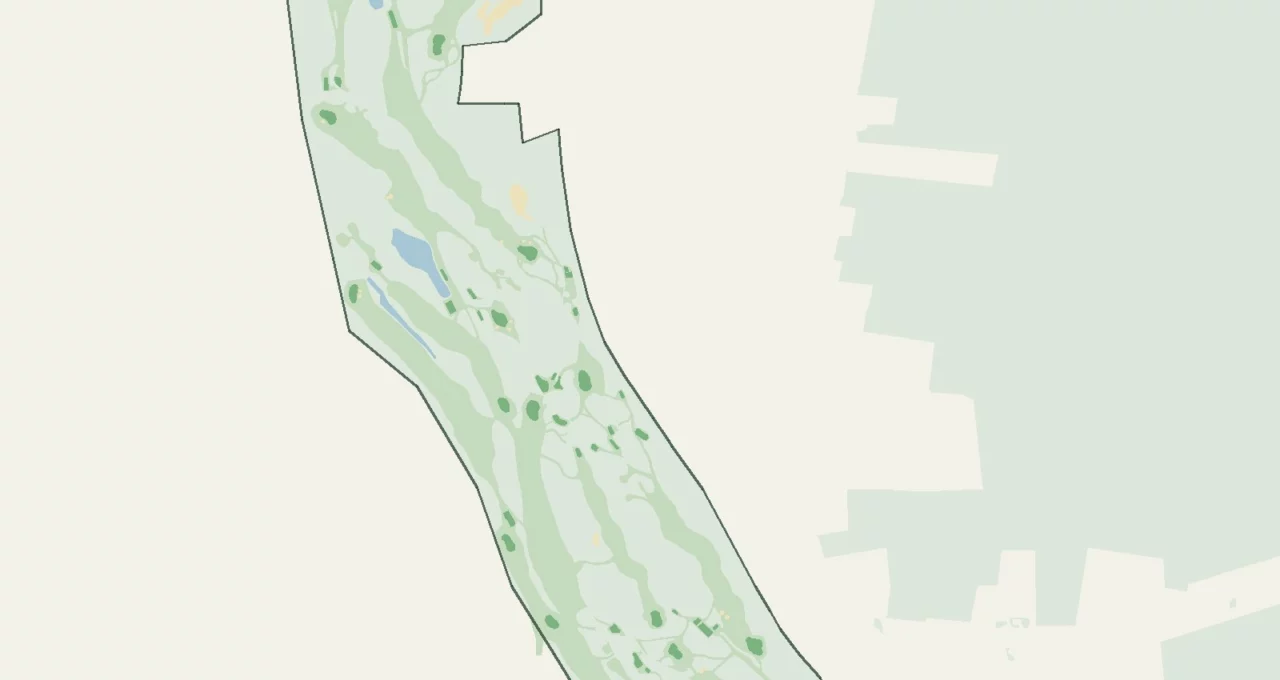
Layout of Burnham & Berrow Golf Club from OpenStreetMap survey data (ODbL licence).
Burnham & Berrow Golf Club
Holes
18
By
71
Length
7,023 yards from the Burnham Blacks (club scorecard, July 2024); Brassie 6,706, Spoon 6,475, Baffy 6,096, Cleek 5,701. Wikipedia and Golfshake's summary give 6,925 yards
Green fee
—
Best season
—
Burnham & Berrow Golf Club is a links club on the Somerset coast of the Bristol Channel, on St Christopher’s Way in Burnham-on-Sea, postcode TA8 2PE. Its land runs north from the edge of the town through the sand dunes of Berrow Warren towards the village of Berrow and its parish church, St Mary’s, which stands inside the course. The club has 27 holes: the 18-hole Championship Course, which this page is mainly about, and the nine-hole Channel Course, laid out by Fred Hawtree on land between the dunes and the shore and opened in 1977.
On the club’s scorecard of July 2024 the Championship Course is a par 71 of 7,023 yards from the back tees, which the club calls the Burnham Blacks. Its layout is the work of several hands over more than thirty years: Charles Gibson, who laid out the first nine holes, Herbert Fowler, Harry Colt, Hugh Alison and Alister MacKenzie, with Martin Ebert of Mackenzie & Ebert in charge of a long-term programme of changes since 2013. The club’s own pages are on its website.
From Berrow Warren to a Colt links
The club’s history page dates its foundation to September 1890, at a meeting of twelve men at the Royal Clarence Hotel in Bridgwater. Charles Gibson, then 19, laid out a nine-hole course of about 2,300 yards on the warren near the Burnham lighthouse, and it opened in June 1891. The first greenkeeper and professional was J.H. Taylor, then at the start of a career in which he won the Open five times; the inaugural match pitted him against Horace Hutchinson. Wikipedia gives 1891 as the year of foundation, under the name Burnham Golf Club.
The course grew in stages. According to the club, the lords of the manor offered to lease the whole warren in 1896, and Gibson extended the course to eighteen holes, reaching as far as the church; the club’s hole notes date that work to 1897. A further extension followed in 1901 under Walter Foord, and in 1910 Herbert Fowler, a member who also designed Walton Heath and The Berkshire, took the course beyond 6,100 yards. The present clubhouse dates from the same year.
Harry Colt visited on 13 August 1913 and recommended removing the blind shots and replacing the weaker holes. His proposal gave rise to the present 1st, 2nd, 4th, 5th, 9th, 10th and 17th. The First World War held the work up; the club thinks that Hugh Alison, Colt’s partner and a former captain of the club, supervised it after 1918, and the redesigned course opened in 1923. Alister MacKenzie was consulted in 1922 and 1923, on the 10th and on a new 9th green. Alison returned in 1936 to improve the approach to the 18th and in 1951 designed a new 8th green, completed in 1953.
The last major reshaping came in the 1970s. Rising sea levels, the club says, had added land along the western boundary, and in 1976 and 1978 the course was rerouted west of the church, giving today’s 6th, 12th and 13th; the old Church hole, which could not be played on Sundays or during weddings and funerals, went out of use. The Channel Course was built at the same time, and around 100 acres were set aside as salt marsh habitat. Since 2013 Mackenzie & Ebert have worked to a masterplan, starting with the 16th green and continuing with the 6th green in 2017 and changes to the 8th, 9th, 12th, 13th and 14th.
Championships and players
The club’s tournament history lists more than 40 national amateur championships and matches. Among them are the Ladies’ British Open Amateur Championship in 1906, 1923 and 1938, the English Amateur six times between 1930 and 2006, the Brabazon Trophy in 1956, 1990 and 2011, the Boys Championship in 1982 and 2011, and the Jacques Léglise Trophy in 1982 and 1999. Justin Rose won the Carris Trophy, the English boys’ stroke play championship, there in 1995. Wikipedia lists the Jacques Léglise Trophy only for 1999.
Since 2024 the course has been one of the four venues of Final Qualifying for the Open. Justin Rose came through at Burnham in 2024, and Harry Hall was among the five qualifiers in 2025, according to the golf press. The club staged Final Qualifying again on 30 June 2026, for the 154th Open.
Two families run through the club’s history. The Bradbeer brothers provided its head professionals for about sixty years, from 1919 to 1970, and four of them reached the final rounds of the 1928 Open. Ernest, Charles and Reg Whitcombe, born near Berrow church, all played in the 1935 Ryder Cup team, and Reg won the Open in 1938. More recently, the club notes that two of its members, the sisters Patience and Mimi Rhodes, were in the Great Britain and Ireland side that won the Curtis Cup in September 2024.
What it asks of you
The card first. The club’s scorecard gives five sets of tees, named after old clubs: Burnham Blacks at 7,023 yards, Brassie at 6,706, Spoon at 6,475, Baffy at 6,096 and Cleek at 5,701. Par is 71 for men, 36 out and 35 home; women play to a par of 74, with the 2nd, 7th and 18th as par 5s. The club’s website does not publish course ratings in its text; Golfshake, the review platform, lists standard scratch scores of 75 from the Blacks, 73.7 from the Brassie, 72.3 from the Spoon, 71.1 from the Baffy and 74.5 for women from the Cleek.
The shape of the card is typical of a links built from dunes. There are only three par 5s, the 4th at 515 yards, the 8th at 516 and the 13th at 572, and four par 3s, all of which measure between 182 and 201 yards from the back. The par 4s are long: eight of the eleven exceed 400 yards from the Blacks, and the longest, the 15th, measures 479. The stroke index rates the 7th, 12th and 2nd as the hardest holes.
The layout is traditional, nine holes out and nine back. The front nine runs north along the dunes and the coast; the back nine turns inland and returns along the coast road through Berrow. Two things recur in the club’s hole notes: the prevailing wind, which the 1st usually plays into, and blind shots. Colt set out to remove them, but several remain. The tee shot on the 10th is played over a sand dune, the drive on the 15th crosses a hill to a fairway out of sight, a drive down the right on the 1st leaves a blind second over a sandhill, and on the dogleg 3rd most players face a blind approach. A ridge runs the full length of the 7th and through its green, the 12th has an elevated two-tier green with a steep front, and several greens, on the 14th, 15th and 16th, are tiered or split by a ridge.
The four short holes have a reputation of their own, and both the club and the ranking sites single them out. The 5th, named after Colt, plays exactly as it looks, the club says, and can call for anything from a short iron to a wood depending on the wind. The 9th, Wreck, is described by the club as a classic MacKenzie par 3, surrounded by six bunkers; it takes its name from the Norwegian barque Nornen, wrecked in a gale in March 1867, whose remains can be seen from the back tee. The 14th, Old Mill, has a two-tier green, and the 17th, Majuba, plays to an elevated green over a steep bank, often with a wood into the wind.
The home hole, High Light, is named after the 1830s pillar lighthouse in the town. It is a dogleg from right to left, played over the dunes to a green with three bunkers on the right and one front left, and with a ridge across its front. The club’s notes call it statistically the hardest hole on the course, although the scorecard gives it stroke index 8.
The setting adds its own features. Five pillboxes can be seen from the 13th, a pond lies behind the 7th green, and a ditch crosses the 8th diagonally. A public footpath crosses the 3rd, 13th and 16th, and walkers have right of way. The dunes are part of the Berrow Dunes Site of Special Scientific Interest, and the club says more than 272 species of flowering plants have been recorded on its part of it. On a clear day the 4th tee looks across the channel to the island of Steep Holm and the coast of South Wales, and the elevated 15th tee to Glastonbury Tor.
The Channel Course is a gentler proposition. Its nine holes, which can be played twice from separate tees, total 2,937 yards and a par of 35 on the club’s page. The club presents it as an introduction to links golf for beginners and experienced players alike, and it has no handicap limit.
What golfers say
Burnham & Berrow is reviewed on ranking sites, on golf review platforms and in golf media. The points below summarise what recurs in that material. They are other people’s opinions, not ours; nobody from Panxis has played the course, and we name no reviewer.
What comes up in its favour
- The greens are the most consistent compliment: reviewers describe them as true, quick and undulating, and some count them among the best they have played.
- The links character draws admiration: tumbling fairways in valleys between high dunes, deep pot bunkers and a sense of a course that has changed little in spirit.
- The par 3s are regularly singled out, the 9th most of all, along with the run of holes through the dunes at the start of the round.
- Condition through the year is praised, with drainage that keeps the course playable in winter.
- Reviewers describe a welcoming club, helpful staff and food above the usual clubhouse standard.
What comes up against
- The blind shots divide opinion. Some enjoy them as part of old links golf; others find it hard to pick a line on a first visit and say local knowledge matters.
- The wind can make the course very hard, particularly the front nine into the prevailing breeze, and higher handicappers say it can become a struggle.
- Value for money gets mixed comments: some reviewers consider it excellent for a course of this standard, others think the visitor rate is high.
- A few recent reviews mention greens that were bumpier than expected on the day.
- On one ranking site, some reviewers feel that a few of the modern changes lack the character of the older holes, or that a handful of holes are less memorable than the rest.
Getting there and when to go
The club is at the north end of Burnham-on-Sea, at St Christopher’s Way, TA8 2PE. By car, the club’s directions start at junction 22 of the M5: follow the signs for Burnham-on-Sea, then for Berrow and Brean, pass the inland lighthouse on the left, and St Christopher’s Way is the third turning on the left after it. From Weston-super-Mare, the A370 leads to East Brent, from where the B3140 runs about 4 miles towards the coast. The nearest railway station is Highbridge and Burnham, a short taxi ride away, and the club gives Bristol Airport, 20 miles away, as the nearest airport.
Visitors can book tee times online through the club’s visitor booking system, or by phone or email. On the Championship Course the club sets a Handicap Index limit of 22 for men and 30 for women, with evidence of a World Handicap System handicap required; the Channel Course has no limit. County card play is available Monday to Friday only, booked on the day. Visitors report to the pro shop before play. Buggies, GPS electric trolleys and pull trolleys can be hired by arrangement, but personal ride-on buggies are not allowed; Golfshake’s listing, by contrast, says there is no buggy hire; we follow the club. Caddies can be booked in advance, and there is a driving range for players with a tee time. The dress code excludes denim, cargo shorts, T-shirts and training shoes on the course.
The club does not publish a season. Its two courses are open through the year, and reviewers often mention that the course drains well in winter. The club asks visitors to call the pro shop in bad weather to check whether the course, buggies and trolleys are restricted. Final Qualifying for the Open has been held there each year since 2024, on 1 July in 2025 and 30 June in 2026, so check the calendar before planning a visit around those dates.
Green fees
Rates vary by course, season and day and are set by the club: see its green fees and tee times page.
How this page was made
The factual frame comes from public sources: OpenStreetMap for the location of the course; the club’s website for the address, the history from 1890, the architects and the dates of their work, the hole-by-hole notes, the scorecard of July 2024, the tournament history, Final Qualifying, the Channel Course, the Berrow Dunes SSSI, the visitor conditions, the dress code and the directions; Wikipedia for the 1891 foundation date, the architects and the championships; Wikidata for the identifiers; Top 100 Golf Courses for its rankings and the description of the dunes and greens; Golfshake for the standard scratch scores and its feature review; and the golf press for the 2025 Final Qualifying.
Where sources disagree, we say so. The club dates its foundation to 1890 and the opening to 1891, while Wikipedia gives 1891. The club dates the extension to eighteen holes to 1896 or 1897 under Gibson, and Wikipedia credits Fowler with the eighteen holes by 1910. The scorecard gives 7,023 yards from the Blacks; Wikipedia and Golfshake’s summary give 6,925 yards, apparently from an older back tee. Wikipedia puts the Channel Course, played as eighteen holes, at 5,818 yards, while the club’s page adds up to 2,937 yards for nine. The club’s hole pages do not always match its scorecard: the 4th is headed as a par 4 and the 15th as a par 5, the 8th is given as 526 yards rather than 516, and the 18th is called the hardest hole while carrying stroke index 8. We follow the scorecard. Rankings also vary: the club’s home page quotes 27th in a Great Britain and Ireland top 100 and its course page 29th from Golf Monthly, while the Top 100 Golf Courses page, as we read it, ranks the course 61st in Britain and Ireland, 24th in England and 3rd in the South West; the club itself cites that site as ranking it first in Somerset.
The opinion section summarises reviews on Golfshake, Top 100 Golf Courses, GolfMagic and other golf review platforms, read in October 2026. We report recurring themes rather than individual voices, and we reproduce no quotations from reviewers. Nobody from Panxis has played or visited this course, and this page is no substitute for a round.
The club has not paid for this page, has not seen it before publication and has no say over its content. This page contains no commercial link and earns us no commission. If you know the club and something here is wrong or out of date, write to us and we will correct it.
Other courses nearby
Closest to this one in our British directory:
- Glamorganshire Golf Club — 13 mi
- Cardiff Golf Club — 19 mi
- St Pierre Country Club — 27 mi
- Fairwood Park Golf Club — 50 mi
The hole to know
Wreck: a par 3 of 182 yards from the back tees, part of Colt's 1913 proposal and opened in 1923, with a green designed with Alister MacKenzie and ringed by six bunkers; named after the barque Nornen, wrecked in a gale in 1867.