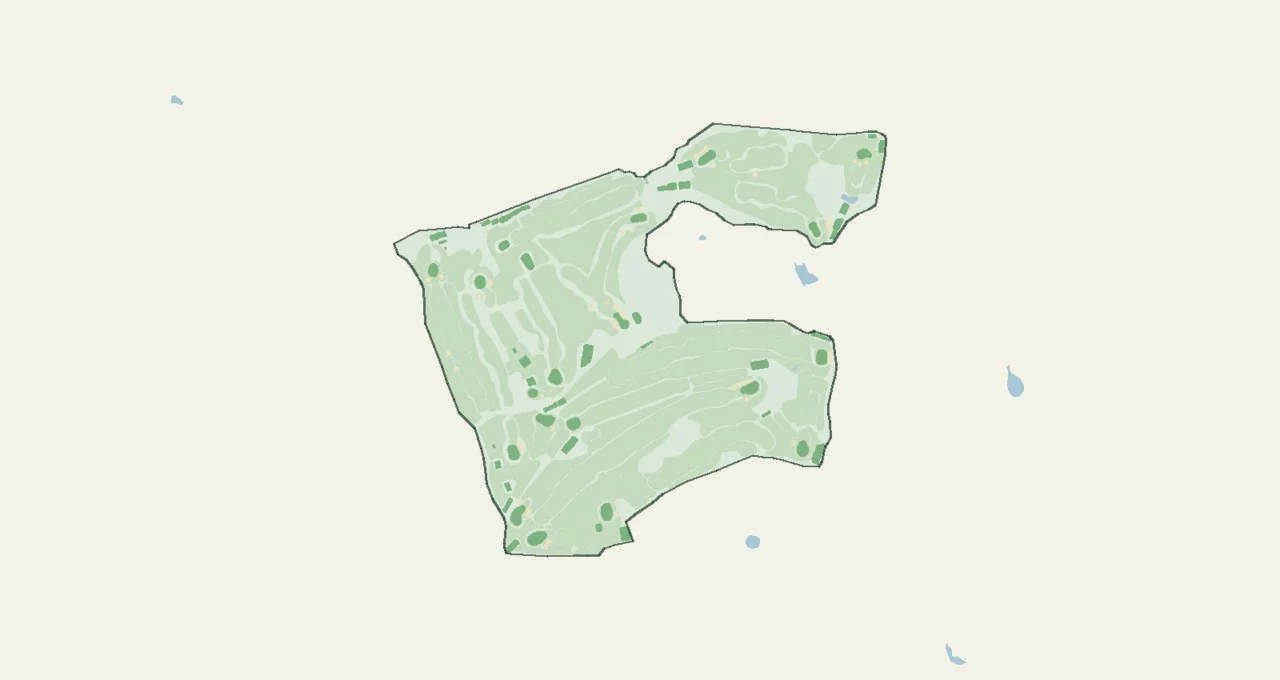
Layout of Llanishen Golf Club from OpenStreetMap survey data (ODbL licence).
Llanishen Golf Club
Holes
18 (club website)
By
68 from the white and yellow tees, 70 from the red tees (club scorecard)
Length
5,348 yards from the white tees, 5,126 yellow, 4,853 red (club scorecard); older directories give 5,338 or 5,301
Green fee
—
Best season
Visitors from 1 March (fee table: April) to 30 October, not on Saturdays; November to March members and their guests only; societies Monday to Friday, 1 March to 30 September (club website)
Llanishen Golf Club is an 18-hole parkland course on the hillside at the northern edge of Cardiff, on Heol Hir between Lisvane and Thornhill, just below Caerphilly Mountain. It is a members’ club founded under its present name in 1905, and its course is short by any modern standard: 5,348 yards and par 68 from the white tees on the club’s own scorecard. The figures are misleading. The course carries a slope of 128 from the whites, well above the neutral 113, and the club’s description stresses small target areas, carefully placed bunkers and fast greens. What it offers in exchange is height: from much of the course golfers look across Cardiff and the Bristol Channel to the Somerset coast. The club was named Wales Golf Club of the Year by Wales Golf, the governing body for amateur golf in Wales, at the awards announced in early 2023. Its website is llanishengc.co.uk.
Visitors are welcome from spring to autumn on weekdays and Sundays, but not on Saturdays, which belong to the members’ competitions, and not in the winter months, when the course is reserved for members and their guests. Adult membership was full at the time of writing, with a waiting list. This page sets out what the public record says about the club, its long and slightly tangled history, the course hole by hole as the club’s professional describes it, and what golfers who have played it report.
Which club is this?
OpenStreetMap names the ground Llanishen Golf Course and links it to the Wikidata item Q24182567, labelled Llanishen Golf Club, and to the English Wikipedia article of the same name. The club itself uses Llanishen Golf Club throughout. Its postal address is Heol Hir, Lisvane, Cardiff, CF14 9UD; Wikipedia places the course in Thornhill, north of Llanishen, and several directories write Heol Hir, Thornhill. The confusion is understandable: the course sits on the boundary between the districts, the club takes its name from Llanishen, its postal address from Lisvane, and directories its location from Thornhill. Reverse geocoding of the OpenStreetMap coordinates gives Heol Hir, Lisvane, with the same postcode the club uses. The Wikidata coordinates lie about 100 metres north of the OpenStreetMap point, a negligible difference; the map at the foot of this page uses the OpenStreetMap position.
Wikipedia describes the course as lying across the M4 motorway from Cardiff, with Caerphilly Mountain as its backdrop. The club’s own words are similar: Caerphilly Mountain behind, the Bristol Channel in front.
History: from Ty Mawr to Cwm Farm
Golf on this hillside predates the Llanishen name. The club’s heritage page says it was known briefly in the early 1900s as Lisvane Golf Club and adopted the title Llanishen Golf Club in 1905, the date it gives as its foundation. Its first course was a nine-hole layout on Ty Mawr Farm.
Other sources tell the earlier part of the story in more detail, and not always in the same way. Wikipedia’s article on Lisvane says that in 1900 part of the Ty Mawr estate, an old farmhouse on the slope that later became a public house, was let to Lisvane Golf Club, which laid out nine holes there, and that two years later the club moved to Radyr, taking its clubhouse with it. Wikipedia’s article on Radyr Golf Club dates Radyr’s foundation to 29 November 1902, after the break-up of the Lisvane club, and adds, citing The Golfing Annual, that the Lisvane club was reorganised in 1905. The records of Coflein, the national historic environment database for Wales, which we could read only through search summaries, put the foundation of Lisvane Golf Club at 1898 and say that most of its members left in 1902 to form Radyr, that the Llanishen club took over the nine-hole course in 1905, and that it played there, beside the Rhymney Railway line, until 1923, when it moved to a new course on the other side of the railway. Coflein dates the present course, on land that was once part of Cwm Farm, to the 1920s.
The club’s own account of the move differs in its dates. According to the heritage page, Llanishen went up to 18 holes in 1924, when a landowner, Ernest Prosser, agreed to lease his land to the club. The course was later moved off the mountain, in the club’s phrase, and the new layout was opened in April 1939, with the club captain driving the first ball. The Second World War interrupted it almost at once. The heritage page says a programme of restoration began in 1946 with an extension to the clubhouse, and that the club’s steward and professional, released from war duties, resumed his post, but it was only in 1948 that the Glamorgan War Agricultural Committee sanctioned the return of four holes, which then had to be redeveloped. Eighteen holes were back in play on 20 May 1950, when the captain hit the opening drive; the club records, with some affection, that his first attempt missed the ball altogether.
From 1952 to 1987 the professional was Jack Taylor, whose 35 years in the post the club still remembers through the swing many of its members learned from him. The club names Jill Edwards as the most notable player it has produced: she represented Wales in 1962, won the Glamorgan ladies’ championship in 1966 and 1968, and later held administrative roles with the Welsh Ladies Golf Union, the Ladies Golf Union and the Sports Council for Wales.
The present clubhouse dates from 1995. The club’s heritage page says it opened in June 1995; Wikipedia, citing a 2005 golf guide, gives April 1995. The club celebrated its centenary in 2005 with a ball at Cardiff City Hall, and a centenary book is available for reference at the club office. Between 2007 and 2009, according to Wikipedia, a drainage programme was carried out to dry out the greens. Wikipedia also records that in August 2015 an 86-year-old member holed in one at the 16th, a par 3.
More recently, the club won the Golf Club Managers’ Association Team of the Year award in November 2019. It also won Wales Golf’s Club of the Year award; its heritage page dates this to 2022 and its club page to February 2023, while The Golf Business reported it in March 2023, saying the award was presented at the Wales Golf Awards lunch at Celtic Manor. According to that report, Wales Golf cited the course’s environmental management and the club’s work with juniors and women, including a New2Golf scheme for beginners that had brought in 57 new women members; membership had risen to more than 700. The club has also hosted Wales Golf events, including the governing body’s finals week. No source we found names an architect for the 1939 layout or for any later revision.
What it asks of you
The club’s scorecard gives three sets of tees:
- White tees: 5,348 yards, par 68 (33 out, 35 home); men’s course rating 66.5, slope 128.
- Yellow tees: 5,126 yards, par 68; men’s course rating 65.4, slope 118.
- Red tees: 4,853 yards, par 70 (34 out, 36 home); women’s course rating 68.5, slope 123.
The 18Birdies app lists the same lengths and the same three ratings, and adds women’s ratings from the white and yellow tees and a men’s rating from the red, which the club’s page does not show; we leave those aside. Visitors play from the yellow or red tees only, according to the club’s green fees page. Wikipedia and Today’s Golfer give 5,338 yards, a figure that dates from around 2005; GolfNow gives 5,301. The Social Golfer gives par 69 and 6,283 yards, and describes a par-3 12th with a pond in front of the green, none of which matches the club’s card, on which the 12th is the longest par 4 on the course.
The shape of the card explains the low par. From the white tees there are six par 3s (the 3rd, 7th, 9th, 11th, 13th and 16th), only two par 5s (the 10th at 495 yards and the 14th at 505), and ten par 4s, several of them short enough to drive. The 1st is 279 yards, the 2nd 287, the 6th 293 and the 18th 279. At the other end, the 8th is 395 yards and the 12th 410, the latter carrying stroke index 1. The front nine is the shorter, at 2,423 yards, against 2,925 for the back nine.
The club calls the course an outstanding parkland layout, ranked within the top 75 in Wales, and says that while it is not long, scoring to your handicap can be quite a challenge, with bunkers placed around fast greens. Today’s Golfer, describing it as a hillside parkland overlooking the city, the Bristol Channel and the Somerset coast, adds that the holes shape both left to right and right to left and that the target areas, from tee to fairway and fairway to green, are small. The club’s local rules give a sense of the ground: out of bounds by the road on the 10th and 18th, a penalty area across a bog on the 12th, a dry range practice facility and starter hut to the left of the 6th, bells on the 1st and 14th for blind shots, winter mats on every tee, and wild flower beds treated as ground under repair. They also list a ventilation shaft on the 4th hole; Wikipedia’s Lisvane article notes that the railway tunnel beneath Caerphilly Mountain runs under the golf club.
The card, hole by hole
The club’s course tour carries a professional’s tip for every hole. In summary, with yardages from the white tees:
- 1st, par 4, 279 yards: a gentle opener that long hitters can drive, at the risk of bunkers in front of the green; the left side of the fairway leaves a short chip.
- 2nd, par 4, 287 yards: position matters more than length; the tee shot goes right of a lone tree, with large firs on the left and mature trees on the right, and a driver can run out of fairway.
- 3rd, par 3, 152 yards: the first of the six short holes, uphill, to a generous green guarded by bunkers in front and a grass bunker behind.
- 4th, par 4, 308 yards: the drive goes left of a big tree to open up a plateau green with a single bunker in front; very long hitters can try for the green.
- 5th, par 4, 348 yards: a drive through an avenue of trees, avoiding a tree in the fairway, then an uphill second to a tiered green; the club suggests checking the day’s pin position before teeing off.
- 6th, par 4, 293 yards: another driveable par 4 for big hitters over the trees on the right; the left of the fairway gives the best line into one of the trickier greens.
- 7th, par 3, 192 yards: straightforward from the forward tees, much harder from the back, with trees left, a bank right and bunkers either side of the green.
- 8th, par 4, 395 yards: one of the longer par 4s, best approached from the left; the tee is singled out for its view over Cardiff and the Channel.
- 9th, par 3, 169 yards: a green sloping sharply left and towards the front, so club selection matters, and a long first putt brings three putts into play.
- 10th, par 5, 495 yards: a risk-and-reward hole, reachable in two with a blind second down the hill; out of bounds lies left of the road and behind the green, and players wait for the bell before playing in.
- 11th, par 3, 199 yards: the tee shot must carry a ditch across the hole and avoid a bunker on the right; a slope at the front left catches anything pulled.
- 12th, par 4, 410 yards: stroke index 1, which the club calls one of the most challenging par 4s you will ever play; the drive must carry trees on the left, ideally with a draw, a long straight drive finds a fir plantation, and a short one leaves a long second across ditches. The safe line is to lay up and rely on the third.
- 13th, par 3, 151 yards: uphill again, to a tiered green with bunkers left and a small back plateau.
- 14th, par 5, 505 yards: the longest hole; another bell before driving, a fairway sloping sharply from left to right, and a grass ditch short of the green that rules out a running approach.
- 15th, par 4, 341 yards: uphill to a plateau green, with no bunkers but trees on both sides.
- 16th, par 3, 155 yards: a short hole with bunkers left and right and little room behind; players wait for the 9th tee to be clear.
- 17th, par 4, 390 yards: a demanding drive, with fairway bunkers left and trees short and right of the green, then a long slope at the front of the putting surface.
- 18th, par 4, 279 yards: a driveable finish, run as a call-through hole, with bunkers in the fairway and around the green, out of bounds for a hook, and a green sloping right to left.
Read together, the tips describe a course that rewards placement over power: trees in or beside many fairways, short par 4s that tempt long hitters, and greens with tiers, plateaus and strong slopes. The club’s marketing quotes a ranking guide calling the course short with slick, subtle greens that demand precise approach play; we found no independent copy of that ranking.
What golfers say
We read the review summary on 18Birdies, the Google rating relayed by Wanderlog, and summaries of reviews on Golfshake, GolfPass and Cademy, along with directory descriptions. Golfshake’s own pages were unavailable when we tried to read them and GolfPass refused our requests, so their contents are known to us only through search summaries. On 18Birdies the course scores 4.5 out of 5 from 14 reviews, with value at 4.5 and course condition at 4.4, difficulty rated hard and both green speed and pace of play rated fast; the reviews show no text. Wanderlog relays a Google rating of 4.6 from 187 reviews, the great majority of them four or five stars. Golfshake, according to search summaries, shows 4.5 from 21 reviews. The points below summarise what recurs. They are other people’s opinions, not ours; nobody from Panxis has played the course, and we name and quote no one.
What comes up in its favour
- The views, over Cardiff, the Bristol Channel and the Somerset coast, are the most frequently mentioned feature.
- The greens are described again and again as small, fast and full of slopes, and generally in good condition; one reviewer found the course in excellent shape even in November.
- It is short but not easy: reviewers say accuracy matters more than length, and 18Birdies users rate it hard.
- Course condition, value and the friendliness of staff and members are praised, as are the pro shop and the food.
What comes up against
- The opening holes strike several players as cramped and close together, before the layout opens up.
- Tightness and trees punish wayward hitting, which some see as a virtue and others as a limit on the course.
- The club is not the easiest to reach, according to some Google reviewers.
- Hire clubs were described as dated; reviewers suggest bringing your own.
- On Golfshake, according to search summaries, hospitality and value score lower than the course itself, and one older review, from 2015, found the greens only average.
The overall picture is consistent across platforms, but the numbers of written reviews are small, and none of these points should be read as more than a recurring impression.
Playing as a visitor
The club’s green fees page says visitors are welcome between 1 March and 30 October, and that Saturdays are never available to them. Its fee table, however, runs the visitor season from April to October and marks November to March as not available, with only guests of members playing in winter; the March dates are best confirmed with the club. Tee times can be booked through the club’s online visitor booking or by contacting the club, and groups of eight or more are asked to call the office. Visitors check in at the pro shop, play from the yellow or red tees, play stableford (scrambles are not allowed), and are expected to get round in under four hours as a fourball. Holders of a Glamorgan or Gwent county card get a reduced rate. Cancellations more than seven days ahead are refunded.
The club has five buggies for hire and push trolleys from the pro shop, both subject to restriction in bad weather. It cannot store clubs or belongings before or after a round. The dress code is conventional on the course: collared and sleeved shirts (roll necks allowed), shirts tucked in, golf or tailored shorts with white socks, golf shoes, caps worn forwards. In the bar, smart jeans are acceptable but T-shirts, tracksuits, cargo shorts and waterproofs are not. Mobile phones are to be kept on silent and calls are not allowed in the clubhouse.
Societies of ten or more can book from Monday to Friday between 1 March and 30 September, with half-day and full-day packages of 18, 27 or 36 holes; the club said in 2026 that almost all society dates for the year were taken. The club runs a calendar of open competitions in summer for men, women, seniors, juniors and mixed teams, open to players with a current handicap index.
The clubhouse has a bar and the Channel View Suite, a restaurant looking across the 10th fairway to the Bristol Channel and seating up to 120, as well as the smaller Cefn Onn Room for up to 40. Catering is run by a franchise caterer, with a bar menu after golf and a Sunday carvery the club advises booking. Bar and catering hours change with the season and are published on the club’s food and drink page. Members have practice facilities including a covered dry range bay, a practice bunker and a chipping green, and there is a PGA professional who gives lessons.
Getting there and when to go
The club is at Heol Hir, Lisvane, Cardiff, CF14 9UD, on the hillside north of the M4 at the northern edge of the city. The Social Golfer places it near the A470. The club’s telephone number is 029 2075 5078, with separate options for course status, the clubhouse, the office, the bar and catering, and the professional’s shop is on 029 2075 5076. The club also gives the what3words reference comet.shine.twig for its location.
The visitor season ends on 30 October, so in practice the course is open to visitors from spring to the end of October. Saturdays are reserved for members’ competitions. The club’s website links to a course status page and its telephone line has a course status option, both worth checking in wet weather, when trolleys or buggies may be restricted. For the views the club advertises, a clear day matters more than the season: the club’s tips single out the 8th tee and the 18th for their views over the city and the Channel.
Green fees
Llanishen sets separate rates for weekdays, Sundays and bank holidays, county card holders, juniors and members’ guests, with no visitor rate in winter: see the club’s website for current prices.
How this page was made
The factual frame comes from public sources: OpenStreetMap for the location, outline and name of the course, and reverse geocoding of its coordinates for the address; Wikidata for the linked item; the club’s website for its foundation in 1905, its history, notable names, awards, scorecard, ratings and slopes, the professional’s hole-by-hole tips, local rules, visitor season, booking, tees, buggies and trolleys, dress code, societies, open competitions, clubhouse, membership and contact details; Wikipedia’s articles on Llanishen Golf Club, Lisvane and Radyr Golf Club for the Ty Mawr course, the Lisvane and Radyr clubs, the clubhouse, the drainage work, the 2015 hole in one and the railway tunnel; Coflein, through search summaries, for the 1898 to 1923 chronology and Cwm Farm; The Golf Business for the Wales Golf award; Today’s Golfer, GolfNow and The Social Golfer for third-party course figures and facilities; and 18Birdies, Wanderlog’s relay of Google reviews and search summaries of Golfshake, GolfPass and Cademy for the opinions summarised above.
Where sources disagree, we say so. The predecessor Lisvane club is dated to 1898 by Coflein and to 1900 by Wikipedia’s Lisvane article. Coflein has the Llanishen club move across the railway in 1923 and dates the present course to the 1920s; the club says it went to 18 holes in 1924 and opened its new layout in April 1939, with 18 holes restored only in 1950. The clubhouse opened in June 1995 according to the club and in April 1995 according to Wikipedia. The Wales Golf Club of the Year award is dated 2022 on one club page and February 2023 on another, and was reported in March 2023. Lengths of 5,338 yards (Wikipedia, Today’s Golfer), 5,301 yards (GolfNow) and par 69 over 6,283 yards (The Social Golfer) differ from the club’s current 5,348 yards and par 68. The club’s green fees page gives a visitor season starting on 1 March, while its fee table starts it in April. The address is given as Lisvane by the club and as Thornhill by Wikipedia and several directories.
Coflein refused our requests, Golf’s Missing Links was offline, Golfshake returned a maintenance page, GolfPass and Wales Golf Holidays refused access, the Daily Mirror report on the 2015 hole in one could not be read, and Today’s Golfer was read from its raw page; where we rely on search summaries we have said so, and we have not used them for any course figure. We found no architect’s name, no detailed account of the 1939 or 1950 layouts and no independent copy of the ranking the club quotes, and we have not invented them. Green fee amounts are deliberately left out.
The opinion section summarises reviews and directory descriptions read in October 2026. We report recurring themes rather than individual voices, and we reproduce no quotations from reviewers. Nobody from Panxis has played or visited this course, and this page is no substitute for a round.
The club has not paid for this page, has not seen it before publication and has no say over its content. This page contains no commercial link and earns us no commission. If you know the course and something here is wrong or out of date, write to us and we will correct it.
Other courses nearby
Closest to this one in our British directory:
- Cardiff Golf Club — 2 mi
- Glamorganshire Golf Club — 9 mi
- St Pierre Country Club — 21 mi
- Burnham & Berrow Golf Club — 21 mi
The hole to know
Stroke index 1, a par 4 of 410 yards from the whites that the club's professional ranks among the hardest par 4s anywhere: the drive must carry trees on the left, a long straight one finds a fir plantation, and a short one leaves a long second across ditches and a bog; the safe play is to lay up.