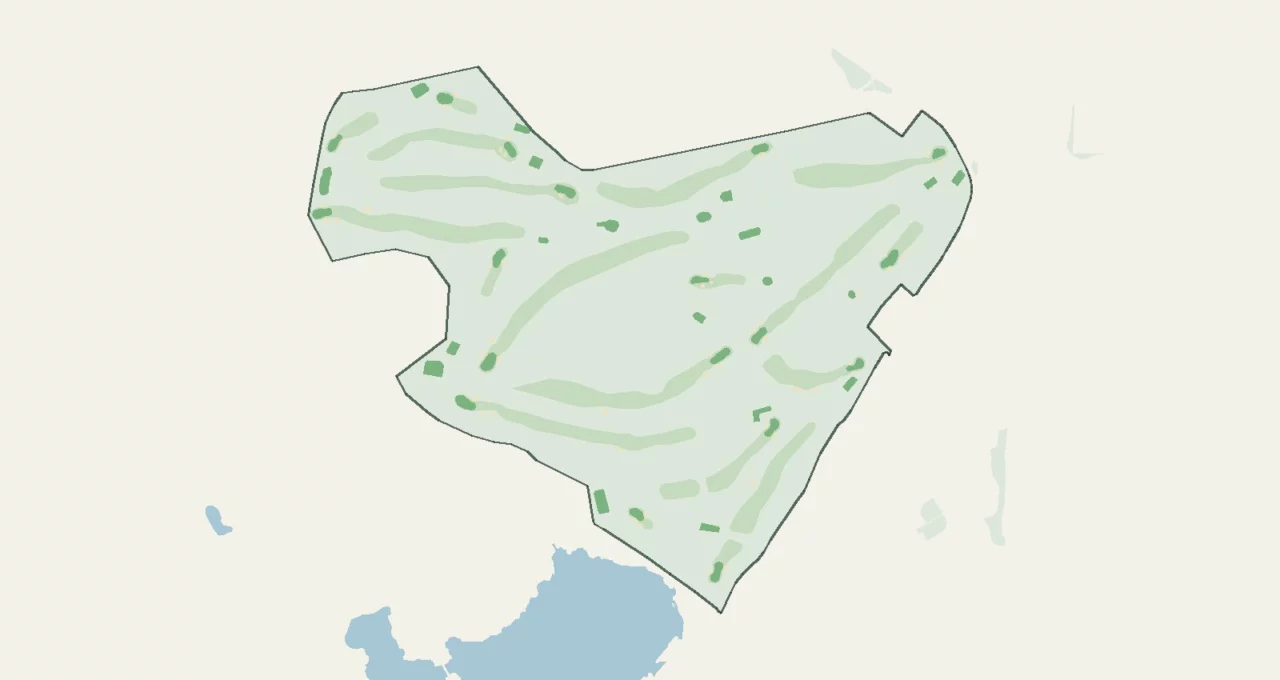
Layout of Glamorganshire Golf Club from OpenStreetMap survey data (ODbL licence).
Glamorganshire Golf Club
Holes
18
By
70
Length
6,134 yards from the burgundy tees, 5,876 gold, 5,535 blue (club scorecard)
Green fee
—
Best season
Year-round (GolfNow); visitors on weekdays only from January to March
The Glamorganshire Golf Club is a private members’ club on Lavernock Road in Lower Penarth, Vale of Glamorgan, postcode CF64 5UP, on the eastern edge of Cosmeston Lakes Country Park and a short way south of Cardiff. It was founded in 1890, began with nine holes on farmland given by the local landowner, and became an eighteen-hole course in time to stage the Welsh Amateur Championship of 1897. Today it is a parkland course of 6,134 yards and par 70 from the burgundy tees, with a men’s course rating of 70.0 and a slope of 131, according to the scorecard the club publishes. The town is by the sea and the views reach across the Bristol Channel to Somerset, but nobody should arrive expecting a links: the ground is inland in character, with mature trees, ditches and water.
The club’s claim to a place in the history of the game is not its age, though it is old, but a scoring system. On 30 September 1898 one of its members, Dr Frank Stableford, put up a prize for a competition scored in points rather than strokes, and the club now calls itself the birthplace of the Stableford system. It also played a leading part in founding the Welsh Golfing Union, hosted the first Welsh Ladies Championship, produced a string of Welsh champions before the First World War and, for nearly a century, entertained the Barbarians rugby club every Easter Sunday. For a course that is now considered too short for the biggest events, it has an unusually crowded past.
Lord Windsor’s farm, the Hunters and the good doctor
The club’s own history, drawn from the local press and its archive, records that in October 1890 the Penarth Chronicle announced that Lord Windsor had given a piece of ground at Lower Penarth for the game, and that a meeting at the Jubilee Hall on 27 October 1890 formed the club. Wikipedia and Top 100 Golf Courses describe the donor as the Earl of Plymouth; Top 100 Golf Courses names him as Lord Windsor, Earl of Plymouth, which reconciles the two. The ground was let on the usual Penarth terms, rent free for the first year, and it was not promising: the club describes the clay fields of Home Farm, criss-crossed by hedges and ditches and patched with gorse, as cold, hard going. William East was appointed the first professional in November 1890, and Tom Barlow was the first captain.
The club cannot claim to be the oldest in Wales, and says so; its claim is to have been the first to bring the game to the industrial south-east of the country. Other sources are more generous. Your Golf Travel calls it the second oldest club in Wales, Top 100 Golf Courses the first course built in the south of Wales, and Today’s Golfer, in a search snippet, the first inland course in Wales. We have not been able to settle which, if any, is right.
The extension to eighteen holes came with the Welsh Amateur Championship of 1897. According to the club, the work was led by its professional Willie Hunter, advised by his uncle Ramsey Hunter, the Royal St George’s professional who was then laying out Royal Porthcawl’s new course, while the member John Hunter supplied much of the physical effort. Wikipedia dates the expansion to 1896 and 1897; the club’s history ties it to 1897. Top 100 Golf Courses adds, on the authority of a book about James Braid, that Braid was later engaged to modify the course, with new bunkering on eight holes, new tees on four and a different approach to the 13th, and that an exhibition match between Harry Vardon, Ted Ray, George Duncan and Braid was played in 1912 to show off the changes. The same page notes that the club appears in a catalogue of courses of the firm Simpson and Co., without knowing what Tom Simpson actually did. No source we found gives a single architect for the present layout.
The professionals’ list is a small history of Welsh golf in itself. Willie Fernie, appointed in March 1902, served twenty-six years and went on to design or build Radyr, Southerndown, Aberavon and the original Newport course at Ladyhill, among more than twenty others. Robert Walker came in 1929 after winning the Welsh Professional Championship. Sid Mouland, the eleventh professional, won the Welsh Professional title a record six times, represented Wales in the World Cup three times and twice won the Regent Oil tournament played at the club in the 1960s; his son Mark became the first Welsh winner of the British Boys Amateur Championship. In 1901 the club staged what its history calls the first professional tournament in Wales, won by Vardon by two strokes from Braid.
Among the members, the club counts John and James Hunter, the only father and son from the same club each to win the Welsh Amateur twice; the Duncan family, including Tony Duncan, who reached the final of the Amateur Championship in 1939 and captained the Walker Cup side in 1953; and Henry Howell, the leading Welsh amateur between the wars, who won the club championship nineteen times and the Welsh Amateur eight times. The Welsh Amateur was held at the club in 1897 and 1902.
Then there is Stableford. The club’s page on him says he joined on 4 June 1898 and that the first competition under his system was played at the autumn meeting of 30 September and 1 October 1898: a bogey competition for which he gave a special prize, with one point for losing a hole by a stroke, two for a half, three for winning by one and four for winning by two, and a third of the handicap added. It was won by William Hastings Watson with 42 points. Wikipedia agrees on the date and the winner, and says Stableford did not play himself. He left to serve as an army surgeon in the Boer War, later joined Royal Porthcawl and then Wallasey, where the system was taken up in 1932 and from where it spread. Wallasey’s version is the one the world remembers; Penarth’s is the one that came first.
The twentieth century left other marks. Wikipedia records that during the Second World War an experimental rocket battery of the Royal Artillery was stationed on the course, with about fifty soldiers in Nissen huts, and that public air raid shelters were built on club land. Wing Commander Guy Gibson, who led the Dambusters raid, married Eve Moore of Penarth in 1940, was made an honorary member through her father, a member and twice captain, and celebrated the news of his Victoria Cross at the clubhouse in May 1943. The Barbarians, who made Penarth their Easter base from 1901, had the course on Easter Sunday for decades; a silver challenge cup they presented in 1925 is still played for, and the Springbok head they won from South Africa in 1961 spends its summers in the bar.
What the course asks of you
The club describes its course as par 70 with mature woodland, wide and narrow fairways and lake and water features, and claims some of the truest greens in South Wales. National Club Golfer, in a passage visible in search results, says that despite flanking a seaside town the course does not play like a links, and that narrow wood-lined fairways and well-protected greens make accuracy crucial, with some eighty bunkers to avoid. The scorecard has an unusual shape: six par 3s, eight par 4s and four par 5s, with all four long holes in the first eleven.
From the burgundy tees the front nine measures 398, 119, 531, 525, 302, 404, 200, 324 and 530 yards, for 3,333 yards and par 37. The back nine runs 177, 498, 334, 181, 179, 413, 417, 415 and 187 yards, for 2,801 yards and par 33, with four of the short holes. The gold tees play 5,876 yards (rating 68.7, slope 128 for men) and the blue 5,535 (67.7 and 125). Women’s ratings on the same three sets run from 73.6 to 75.8, with slopes of 134 to 139. Do not be misled by the short card: four par 5s on the front nine mean the outward half is where the yardage is, and the homeward half is where the score can unravel.
The club’s hole-by-hole course tour, written as tips from the professional, gives a good picture of the round. The opener, 398 yards from the burgundy tees, asks for an extra club on the second because of 15 to 20 yards of flat ground in front of the green. The 2nd is the shortest hole on the course, 119 yards uphill, where the back of the green is the widest target. The 3rd and 4th are back-to-back par 5s of 531 and 525 yards; on the 3rd the ball often sits above the feet for the second shot, and the 4th has a long, undulating green. The 5th, a par 4 of 302 yards, invites a short cut over the corner, and the club’s advice is blunt: do not, because heroic shots end in disaster, and there is out of bounds behind and right of the green.
The 6th, 404 yards, is stroke index 1. Trees push the tee shot right, out of bounds on the left pushes it further that way, and the second shot means deciding whether to carry a ditch about twenty feet wide to a green that slopes towards the player. The 7th, 200 yards from the back but only 151 from the gold tees, plays longer than it looks. The 8th has a wide ditch off the tee that the club says is rarely worth the risk, and the 9th, 530 yards and index 3, wants the tee shot down the left, past bunkers, to a raised green better approached low and running.
The back nine begins with a short hole of 177 yards where a miss on the left can mean a lost ball. The 11th, the last par 5 at 498 yards, prefers an aerial approach. The 12th, a par 4 of 334 yards, has a raised green with deep bunkers on the right and quick putts from the back. Then come two par 3s in a row: the 13th, 181 yards between bunkers, which is index 18, and the 14th, 179 yards, where the club itself recommends laying up short of the green and settling for a chip and a putt, observing that a four is never a bad score. It is a rare club that advises its visitors to aim short of a par 3, and a rarer one that is probably right.
The finish is where the course earns its rating. The 15th, 413 yards and index 2, plays slightly uphill to a two-tiered green. The 16th, 417 yards on the club’s card, is the hole Top 100 Golf Courses calls the signature: a dogleg left to a narrow, raised green with a bunker on either side of a tight entrance, which slopes from front to back, and from which there is an unexpected view across the Bristol Channel to five English counties. The 17th, 415 yards, leaves a downhill lie to a green with a large step in the middle. The 18th is a par 3 of 187 yards, usually into the prevailing wind, with out of bounds all the way down the left and the clubhouse bar looking on.
What golfers say
The Glamorganshire is lightly reviewed in public. On Hole19 it averages 4.5 out of five from 66 ratings, most of them without written comment. Your Golf Travel has a single verified review, scoring it ten out of ten. Older reviews on GolfPass could not be read in full, and the summary below of those relies on what appeared in search results. Top 100 Golf Courses gives it a rating but shows no visitor reviews. The points below summarise what recurs. They are other people’s opinions, not ours. Nobody from Panxis has played the course, and we name no reviewer.
What comes up in its favour
- The greens. They are the feature most often praised, by reviewers and in the testimonials the club publishes, and one reviewer described them as perfect.
- The views over Penarth, the bay and the Bristol Channel from the higher holes, the 16th in particular.
- The test. Reviewers find it challenging for its length, with holes that play across changes of elevation, tree-lined fairways and plenty of bunkers; some also found the wider fairways forgiving.
- The clubhouse, whose bar is described as steeped in history, and the food and the welcome, which several sources, National Club Golfer among them, single out.
- The authentic, established feel of an old club that wears its history openly.
What comes up against
- The ground can be boggy in places after long spells of heavy rain, which is what clay soil does.
- Some visits came during work on the course: one reviewer arrived while the bunkers were being rebuilt, another to find only nine holes open. The bunkers have since been overhauled, according to a later review.
- At a little over 6,100 yards it is short by modern standards, and Your Golf Travel notes that it is now considered too short for the highest-profile events.
- There is very little written review material to go on, so treat any summary, this one included, with some caution.
Getting there and when to go
The club is on Lavernock Road in Lower Penarth, on the southern side of the town, with Cosmeston Lakes Country Park on its western side; Wikipedia says the park shares its eastern boundary with the club. By our measurement on the map the course lies about four miles south of Cardiff Central station in a straight line, rather more by road. The nearest station is Penarth, the terminus of a short branch from Cardiff Central, which Wikipedia puts at a little under three miles by rail, with four trains an hour from Monday to Saturday; from there the course is about a mile and a quarter away in a straight line, again by our measurement. Cardiff Golf Club, also in this directory, is about seven and a half miles to the north as the crow flies: see Cardiff Golf Club.
Visitors are welcome. The club’s visitors page says tee times can be booked online through its booking system or by telephone, and that in 2026 visitors play from Monday to Friday in the low season, from January to March, and from Monday to Friday plus Sunday in the high season, from April to October; there are no Sunday bookings in winter. Groups of twelve or more in summer, and ten or more in winter, are handled as societies, with packages that range from golf only to a bacon roll before and a three-course meal after. The club has a limited number of electric trolleys and ride-on buggies and advises booking them in advance. There is a strict dress code on the course and a smart casual one in the clubhouse, where rain gear is not permitted; check it before you travel.
The clubhouse bar overlooks the 18th, and food and drink are open to the public, with Sunday lunch to be booked ahead. As for when to go: the club takes visitors in every month and GolfNow lists the course as open all year, but given the clay and the reviews about wet ground, late spring to early autumn is the safer bet, and on a clear day the view from the 16th is the reason to choose a fine one.
Green fees
Visitor rates vary by season and by category of player and are published by the club on its visitors information page. Directory listings quote figures that are out of date, and we do not repeat them.
How this page was made
The factual frame comes from public sources: OpenStreetMap for the location; the club’s website, consulted in October 2026, for the address, the scorecard with its yardages, ratings and slopes, the hole-by-hole course tour, the club history, the pages on Dr Stableford, the Barbarians and Guy Gibson, the clubhouse, the visitor and society arrangements, the buggies and the dress code; the English Wikipedia articles on the club, on Cosmeston Lakes Country Park and on Penarth railway station for the founding, the Stableford competition, the wartime battery, the park boundary and the rail distances; Top 100 Golf Courses for the work of James Braid, the 1912 exhibition match, the Simpson catalogue, the 16th hole and the view; National Club Golfer, as shown in search results, for the course character and the bunkers; Stymie and Golfingrecord for the rating tables; Your Golf Travel, Hole19 and GolfPass for reviews; GolfNow for the season; Wikidata for the identifiers. The distances from Cardiff Central, from Penarth station and to Cardiff Golf Club are our own straight-line measurements on the map.
Where sources disagree, we say so. The club’s course overview gives 6,109 yards in its text, while its own scorecard adds up to 6,134 from the burgundy tees; on that card the 8th is 324 yards from the burgundy tees and 329 from the gold, which looks like a slip. Top 100 Golf Courses, GolfPass and GolfNow give 6,184 yards, and Stymie 6,184 from blue competition tees and 6,144 from the burgundy, with par 75 on every set, which matches no men’s card we have seen. The Social Golfer gives par 71 and 6,597 yards, and Golfingrecord credits the design to Colt; no other source supports either, and we follow the club. Top 100 Golf Courses puts the 16th at 419 yards, the club’s card at 417. The extension to eighteen holes is dated 1896 by National Club Golfer and 1896 to 1897 by Wikipedia, and 1897 by the club. The club names the landowner as Lord Windsor, Wikipedia as the Earl of Plymouth. Wikipedia gives Stableford’s third name as Gordon, the club as Gorton. Wikipedia places the club about 7.3 miles south-west of Cardiff; on the map it is due south and much closer. Whether it was the first, the second or simply an early club in Wales depends on whom you read.
The opinion section summarises reviews on Hole19, Your Golf Travel and GolfPass, read in October 2026, together with the testimonials published by the club. We report recurring themes rather than individual voices, and we reproduce no quotations from reviewers. Nobody from Panxis has played or visited this course, and this page is no substitute for a round.
The club has not paid for this page, has not seen it before publication and has no say over its content. This page contains no commercial link and earns us no commission. If you know the club and something here is wrong or out of date, write to us and we will correct it.
Other courses nearby
Closest to this one in our British directory:
- Cardiff Golf Club — 7 mi
- Burnham & Berrow Golf Club — 13 mi
- St Pierre Country Club — 25 mi
- Fairwood Park Golf Club — 39 mi
The hole to know
Par 4 of 417 yards from the burgundy tees, stroke index 4: a dogleg left to a narrow, raised green between two bunkers, with a view across the Bristol Channel to five English counties.