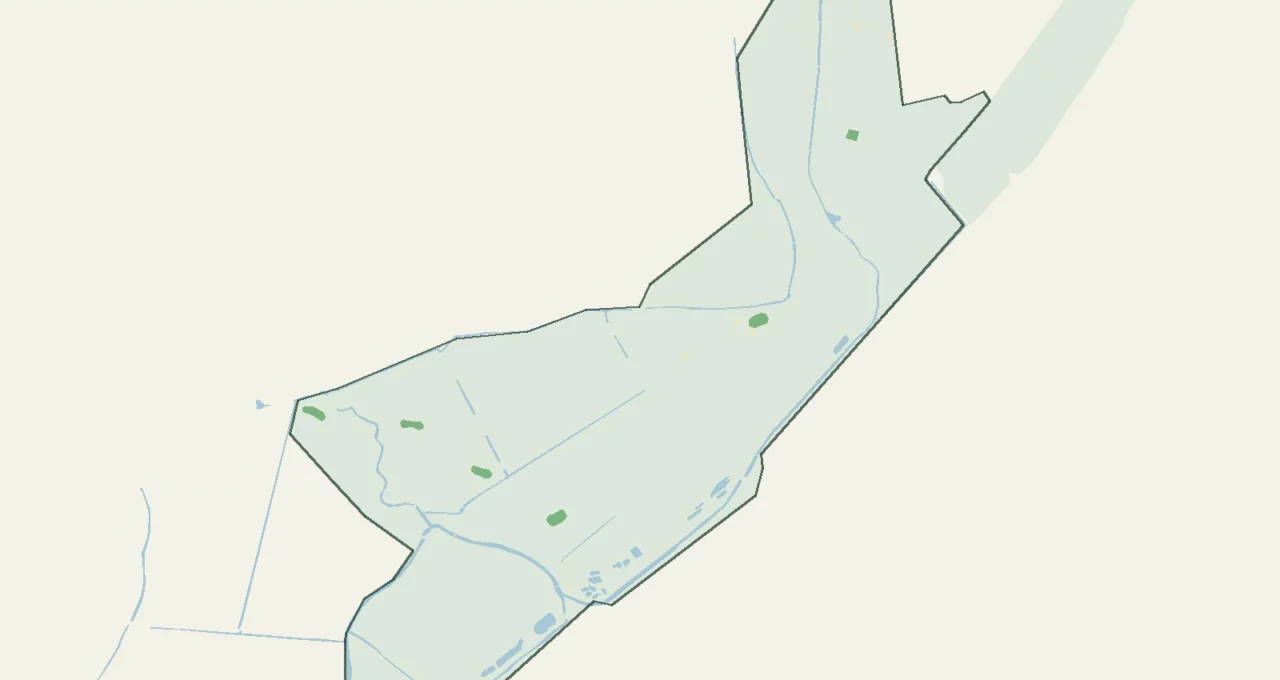
Layout of Frinton Golf Club from OpenStreetMap survey data (ODbL licence).
Frinton Golf Club
Holes
18 (Havers Course), plus the 9-hole Kirby Course
By
71 for men from every tee, 73 for women from the yellow and red tees (club scorecard)
Length
6,171 yards from the white tees, 6,196 black, 5,977 yellow, 5,557 red (club scorecard); the 2024 rating certificate adds a 6,288-yard blue tee; Wikipedia, GolfNow and Golfshake give 6,265 yards
Green fee
—
Best season
Played all year: the club sets twilight times for April to September and for October to March (club website)
Frinton Golf Club is a private members’ club on the Essex coast at Frinton-on-Sea, in the district of Tendring, with its clubhouse at 1 The Esplanade, at the southern end of the town’s seafront. It has two courses: the Havers Course, an 18-hole seaside course of par 71 that measures 6,171 yards from the white tees on the club’s current scorecard, and the Kirby Course, a nine-hole course of 1,481 yards. This page is about the 18-hole course. The club was founded in 1895, and the present course goes back to a 1904 design by Willie Park Jr, later improved on the advice of Harry Colt. Visitors are welcome and book their tee times through the professional’s shop.
A note on names. OpenStreetMap, Wikidata and Wikipedia all call the club Frinton Golf Club, and so does the 2024 Course and Slope Rating certificate, but the club now presents itself as Frinton Links Golf Club, and its old address, frintongolfclub.com, now redirects to frintonlinks.com. The 18-hole course was renamed the Havers Course in honour of Arthur Havers, the 1923 Open champion who later served as the club’s professional. Neither the club nor any other source we read gives a date for either change, so we keep the long-established name for the title and use the current course names throughout.
From hare coursing to a Park and Colt links
Frinton is a planned seaside town, laid out from the 1890s onwards and still known for the tight control over its development that keeps its Edwardian character. The Wikipedia article on the town, citing a 2008 article in Essex Life, says that the industrialist Richard Powell Cooper, who bought out the original developer Peter Bruff in the 1890s, had already laid out the golf course by then. The club’s own history is more precise about the early years. It was founded in 1895 on a nine-hole course designed by Tom Dunn, on land now covered by houses in Second and Third Avenue; Top 100 Golf Courses, quoting a regional golf guide, says the same land is now housing beside the first fairway. Wikipedia, citing The Golfing Annual of 1910, adds that the club was formally instituted in August 1896 and had 380 members by 1910.
In 1904 Willie Park Jr, twice Open champion and one of the leading course designers of his day, laid out an 18-hole course on the present site, ground that the club says was previously known for hare coursing. Later, on the advice of Harry S. Colt, changes were made that left the layout largely as it is today. Neither the club nor Top 100 Golf Courses gives a date for Colt’s work. The club says that Harry Vardon, James Braid and J.H. Taylor, the three dominant professionals of the period, all played at Frinton in the early 1900s, and that in 1929 the British professionals practised here before winning the Ryder Cup for the first time, at Moortown; Wikipedia reports the 1929 visit as well.
The Second World War came close to ending the course. The Essex coast was considered a possible landing site for an invasion, and the club says the Army requisitioned all but the first three holes and laid mines across them, causing considerable damage. Recovery began in 1947. Top 100 Golf Courses gives the same account.
Arthur Havers, whose name the main course now carries, won the Open in 1923 and played in the 1929 Ryder Cup team. The club says he returned to Frinton in 1956 as club professional and stayed until he retired in 1964. Since 1997 a bursary in his name has funded junior coaching and helped members going through hard times; the club says four former juniors have become PGA professionals, two of whom now run the Coastal Golfing Academy, which works with local schools.
Two further details belong to the town as much as to the club. Frinton famously had no public house until 2000, and Wikipedia’s article on the town notes that the golf club was one of the few places with a bar before then; according to the Wikipedia article on the club, which cites a 1929 volume of criminal law reports, the club was caught up in a legal dispute over the sale of alcohol on its premises between 1929 and 1931. The same article, citing the Pevsner architectural guide to Essex, mentions work by Homer and Sharp built between 1903 and 1905; as written, the sentence does not make clear whether it means a course or the clubhouse, and as the Pevsner guides deal with buildings, the clubhouse seems the likelier reading. We could not check the book itself. The club describes its clubhouse as one of the oldest purpose-built golf clubhouses in England, but gives no date for it.
What it asks of you
The figures below come from the club’s Havers Course scorecard, published as an image on its website, and from the Course and Slope Rating certificate issued on 14 November 2024 and also published by the club. Par is 71 for men from every tee and 73 for women from the yellow and red tees, because the 2nd and the 9th become par 5s for women. The scorecard shows four sets of tees: white, 6,171 yards; black, 6,196 yards, which differs from the white only at the 5th; yellow, 5,977 yards; and red, 5,557 yards. The certificate adds a blue tee of 6,288 yards and an orange tee of 5,828 yards, neither of which appears on the scorecard.
The ratings tell you that this course plays harder than its length suggests. From the blue tees the certificate gives a course rating of 70.9 and a slope of 131; from the black 70.5 and 128; from the white 70.4 and 127; from the yellow 69.5 and 125; from the orange 68.8 and 123; and from the red 67.6 and 117 for men. For women the yellow tees are rated 75.8 with a slope of 142 and the red tees 73.1 with 136. A slope well above the neutral 113 means that higher-handicap golfers will find the course relatively tougher than a scratch player does. The certificate also gives the back nine a higher slope than the front from every tee except the blue.
The front nine is the shorter half, at 2,912 yards and par 34 from the whites; the back nine measures 3,259 yards and par 37. There are five par 3s, from the 13th at 117 yards to the 3rd and 16th at 178 yards, and four par 5s: the 4th, at 480 yards, and three on the back nine, the 11th, 17th and 18th, which range from 474 to 490 yards. None of the par 5s is long by modern standards, so the course offers chances, but three of them come in the last eight holes and the closing two are both par 5s. The scorecard makes the 9th, a par 4 of 419 yards, the hardest hole for men.
What makes it difficult is not length but the ground and the weather. The course is open and almost treeless, and Top 100 Golf Courses, GolfNow and Today’s Golfer all point out that tidal ditches cross many of the fairways, which turns the tee shot into a question of where to stop the ball rather than how far to hit it. The club’s hole descriptions mention a ditch in front of the green at the 3rd, a ditch with a stream running through it across the 7th fairway, a drop in the 12th fairway and a ditch on the 17th. The wind off the North Sea is a constant theme in every source. The greens are described by Top 100 Golf Courses and Today’s Golfer as fast, firm and undulating, and they draw more praise from golfers than any other feature.
The club’s own descriptions of individual holes stress bunkering: fairway bunkers on the 2nd, 4th and 7th, and greens closely guarded by sand at the 4th, 8th, 9th and 13th, where the green is narrow and surrounded on three sides. The 11th and 17th are short par 5s within reach in two for longer hitters, with raised greens. The 18th, a par 5 of 474 yards from the whites, curves towards the clubhouse, whose terrace looks out over the final hole. The club’s text refers to coastal dunes on the 16th and 18th; some reviewers, by contrast, point out that the Essex coast lacks true dunes and has clay soils, which is why several of them describe it as close to a links rather than a pure one.
The card, hole by hole
White, yellow and red yardages with par and men’s stroke index, from the club’s scorecard; women’s stroke index in brackets. The black tee is the same as the white except at the 5th.
- 1st: par 4, 350 yards white, 346 yellow, 341 red. Index 11 (women 6).
- 2nd: par 4, 446 yards white, 436 yellow, 392 red, par 5 from the red tees for women. Index 2 (women 12).
- 3rd: par 3, 178 yards white, 166 yellow, 144 red. Index 13 (women 17).
- 4th: par 5, 480 yards white, 468 yellow, 424 red. Index 9 (women 8).
- 5th: par 4, 360 yards white (385 from the black tee), 347 yellow, 337 red. Index 5 (women 2).
- 6th: par 3, 148 yards white, 140 yellow, 125 red. Index 17 (women 14).
- 7th: par 4, 369 yards white, 360 yellow, 332 red. Index 7 (women 4).
- 8th: par 3, 162 yards white, 154 yellow, 135 red. Index 15 (women 16).
- 9th: par 4, 419 yards white, 408 yellow, 390 red, par 5 from the red tees for women. Index 1 (women 10).
- 10th: par 4, 418 yards white, 409 yellow, 382 red. Index 4 (women 1).
- 11th: par 5, 474 yards white, 464 yellow, 420 red. Index 12 (women 7).
- 12th: par 4, 313 yards white, 294 yellow, 289 red. Index 14 (women 13).
- 13th: par 3, 117 yards white, 107 yellow, 93 red. Index 18 (women 18).
- 14th: par 4, 387 yards white, 375 yellow, 348 red. Index 6 (women 9).
- 15th: par 4, 408 yards white, 393 yellow, 383 red. Index 2 (women 3).
- 16th: par 3, 178 yards white, 168 yellow, 151 red. Index 16 (women 15).
- 17th: par 5, 490 yards white, 484 yellow, 435 red. Index 8 (women 5).
- 18th: par 5, 474 yards white, 458 yellow, 436 red. Index 10 (women 11).
Two points to check at the club. The scorecard image gives index 2 to both the 2nd and the 15th, and no hole index 3; the club’s page for the 2nd gives it index 3, which would resolve the duplication. And the stroke indexes printed on the club’s individual hole pages do not always match the scorecard: several show the men’s and women’s figures in the reverse order, and the page for the 13th repeats the indexes of the 14th. We have followed the scorecard.
The Kirby Course
The club’s second course is a nine-hole layout of 1,481 yards next to the Havers Course, which the club presents as suitable for beginners and as a warm-up for the main course, with well-protected greens and some careful bunkering. The club does not publish its par. Golfshake gives the Kirby Course as par 60 over 2,834 yards, which looks like a figure for two circuits of the nine and does not match the club’s yardage. The Kirby Course has its own, lower green fees.
What golfers say
The material we read is the reviews page of Top 100 Golf Courses (five ratings), the category scores and written reviews on Golfshake, which shows 93 ratings, the review summary on Hole19, and the descriptions in Today’s Golfer and GolfNow, as reported by search results. GolfPass and Today’s Golfer refused our requests, and GolfNow showed no reviews. What follows summarises the themes that recur; these are other people’s opinions, not ours. Nobody from Panxis has played the course, and we quote no one.
What comes up in its favour
- The greens, above all: fast, true and in good condition, and described in several reviews as among the best in Essex, all year round.
- The seaside setting and the wind, which reviewers see as the real defence of the course; the holes beside the sea wall are mentioned as highlights.
- Its rarity: reviewers note that seaside golf of this kind is hard to find in Essex.
- Friendly, welcoming staff and members. Hospitality is Golfshake’s highest category score, and the clubhouse and its food are praised.
- A course that tests without beating you up, playable for most handicaps but harder in a wind; the history and the Park and Colt pedigree add to the appeal for some.
What comes up against
- Practice facilities are Golfshake’s lowest category score.
- Fairways draw criticism in some years: reviewers have described them as patchy, or under repair after a hard winter, while the greens stay good.
- Several reviewers question whether it is a true links, given the clay soils and the lack of dunes on this coast.
- The long rough and strong wind can make it hard work, and one reviewer found many holes alike; another asked for clearer signs between holes.
- For many golfers it is a long drive to the end of the Tendring peninsula, and one review mentions the greens running slower than expected for a seaside course.
Facilities and how to play it
Frinton is a members’ club, but its website sets out green fees for visitors on both courses and invites them to book a tee time by calling the professional’s shop on 01255 682456; fees are paid in the shop before play, and the club accepts Essex County Cards. The club office is on 01255 674 618, and society enquiries go to 01255 682453 or office@frintonlinks.com. Societies of twelve or more can choose from several packages that combine the Havers Course with food, and there is a smaller offer for groups of eight to eleven. The club’s visitors page says nothing about handicap certificates, so ask when booking.
The dress code is traditional: smart golf clothing and golf shoes on the course, with no denim, collarless shirts that are not golf wear, or cargo shorts; shirts tucked in unless designed otherwise; and socks with shorts. In the clubhouse, golf shoes and caps are not allowed in the bar, lounge or dining room, though clean spikeless shoes are accepted on the terrace bar. Phones should be on silent and used on the course only for emergencies or scoring.
The club hires out push trolleys, electric trolleys and buggies. The practice area, close to the clubhouse and to the first tees of both courses, has a putting green, practice nets and a short-game area, plus an indoor swing room with a launch monitor (the club’s page names it both as SkyTrak and as GC Quad). Lessons and custom fitting are arranged through the professional’s shop. The clubhouse has a bar, a restaurant and a terrace overlooking the 18th, and is let for private functions. The club is a signatory of the R&A Women in Golf Charter.
Getting there and when to go
The clubhouse is at 1 The Esplanade, Frinton on Sea, CO13 9EP, at the southern end of the Greensward, the long lawn that runs between the Esplanade and the sea. The club says the course lies between the sea and the railway line, which leaves it no room to expand. Frinton-on-Sea station, on the line to Walton-on-the-Naze, is roughly a mile and a quarter north-north-east of the middle of the course as the crow flies, going by OpenStreetMap’s coordinates. GolfNow gives the address as Clacton-on-Sea, which reflects the postal area for the postcode rather than the location; the club itself is in Frinton.
The club publishes twilight times for April to September and for October to March, and no closed season, so the course is played all year. Wind is the decisive factor on any visit: the course is completely exposed, and the same hole can call for very different clubs from one day to the next. One reviewer found the course well kept despite poor weather in October, and the greens are said to be good at any time of year. In September 2026 the club asked golfers not to smoke on the course after a hot, dry spell.
The coastline either side of the course is protected: the Holland Haven Marshes Site of Special Scientific Interest, an area of reclaimed saltmarsh and grazing marsh with a dense network of ditches, runs along the coast from Frinton towards Holland-on-Sea, and the club’s course policy refers to an SSSI file. We have not been able to establish from public sources whether any part of the course lies inside the designated area.
Green fees
The club publishes separate rates for weekdays, weekends and bank holidays, twilight play, members’ guests and juniors, plus an all-day rate for the Havers Course and lower fees for the Kirby Course: see the club’s visitors page for current prices.
How this page was made
The factual frame comes from public sources: OpenStreetMap for the location and outline of the course and its name; Wikidata and the English Wikipedia articles on the club and on Frinton-on-Sea for the founding dates, the 1910 membership, the 1929 Ryder Cup visit, the alcohol dispute, the Homer and Sharp reference and Richard Powell Cooper; the club’s website for its history, Arthur Havers and the bursary, the course descriptions, the hole pages, the scorecard, the 2024 Course and Slope Rating certificate, the Kirby Course, visitor booking, dress code, hire, practice facilities, clubhouse and address; Top 100 Golf Courses for the history, the course description and its county ranking (15th in Essex at the time of reading); GolfNow for the tidal ditches, and Today’s Golfer, read through search results only, for the description of the greens; the Wikipedia article on Holland Haven Marshes, read through search results, for the SSSI; and Top 100 Golf Courses, Golfshake and Hole19 for the opinions summarised above.
Where sources disagree, we say so. Length is 6,171 yards from the whites on the club’s scorecard and course page, while Wikipedia, GolfNow and Golfshake give 6,265 yards, a figure that matches none of the tees on the current card or certificate and is probably from an older card; Hole19 gives 6,171 yards in its description but a scorecard adding up to 5,714 yards. GolfNow lists an orange tee for women rated 70.1 and 125, which does not appear on the club’s 2024 certificate. Golfshake gives the club’s dates as 1895 and 1913 without explanation, and Hole19 dates the course to 1904 rather than 1895; both fit the history if 1904 is the year of the present 18 holes. Top 100 Golf Courses places Tom Dunn’s original nine on land beside the first fairway, the club in Second and Third Avenue. Golfshake names the golf manager as professional, while the club lists a separate head professional. The Wikipedia article on the town says a Prince of Wales frequented the golf club, but identifies him inconsistently, so we leave him out. The Kirby Course’s par and yardage differ between the club and Golfshake, and the scorecard and hole pages differ on stroke indexes, as noted above.
GolfPass, Today’s Golfer and Leading Courses refused or returned nothing to our requests, so their reviews are known to us only through search summaries, and we did not use them for the opinion section beyond the descriptions noted. We could not consult James Bettley’s Pevsner volume or The Golfing Annual directly. The opinion section summarises reviews read in October 2026. We report recurring themes rather than individual voices, and we reproduce no quotations from reviewers. Nobody from Panxis has played or visited this course, and this page is no substitute for a round.
The club has not paid for this page, has not seen it before publication and has no say over its content. This page contains no commercial link and earns us no commission. If you know the course and something here is wrong or out of date, write to us and we will correct it.
Other courses nearby
Closest to this one in our British directory:
- Felixstowe Ferry Golf Club — 13 mi
- Royal Worlington and Newmarket Golf Club — 47 mi
- Dale Hill Golf Club — 64 mi
- Harpenden Common Golf Club — 68 mi
The hole to know
A par 5 of 474 yards from the white tees (458 yellow, 436 red) that curves home towards the clubhouse, whose terrace overlooks the final green; the second of two closing par 5s, stroke index 10 on the club's scorecard.