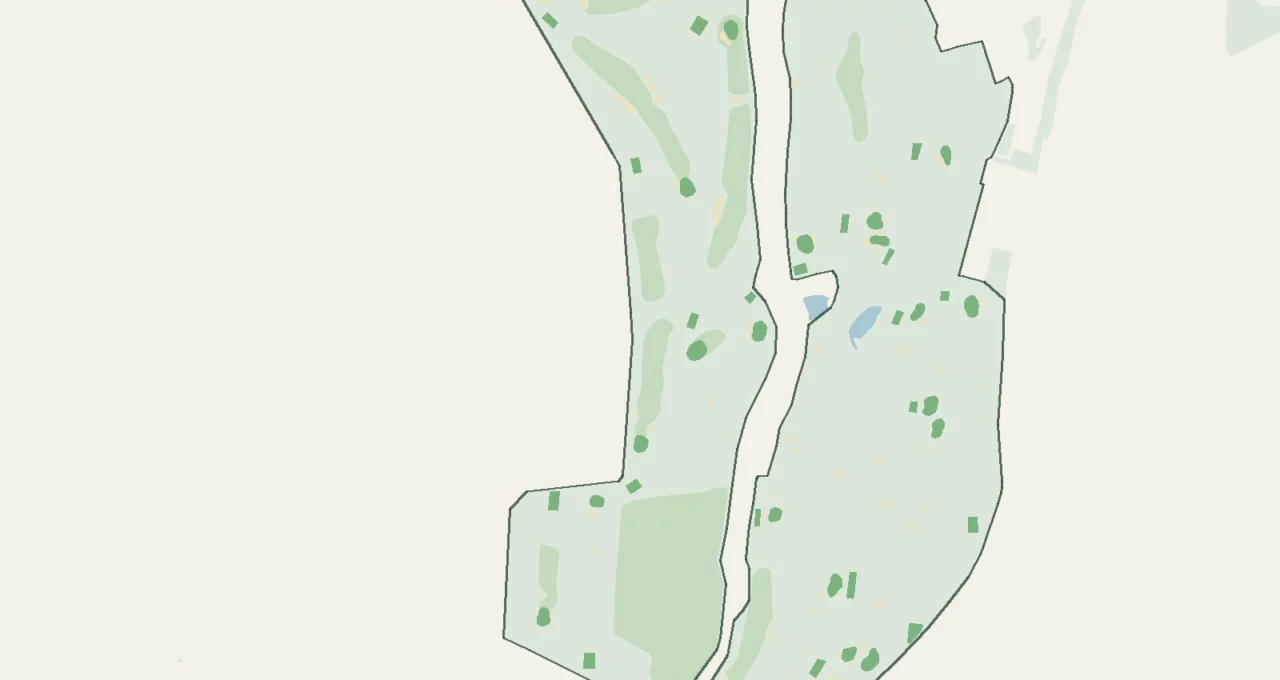
Layout of Felixstowe Ferry Golf Club from OpenStreetMap survey data (ODbL licence).
Felixstowe Ferry Golf Club
Holes
18 on the Martello, plus the 9-hole Kingsfleet (27 in all)
By
Martello: 72 from the black, white and yellow tees, 73 from the red (club scorecard); Kingsfleet: 35
Length
Martello: 6,422 yards black, 6,255 white, 6,158 yellow, 5,732 red (club scorecard); Wikipedia gives 6,379 and Where2Golf 6,423. Kingsfleet: 2,956 yards white (club), 2,986 on Where2Golf
Green fee
—
Best season
The club sets visitor session times for summer (1 April to 31 October) and winter (1 November to 31 March)
Felixstowe Ferry Golf Club is a members’ golf club at the north-eastern end of Felixstowe, in Suffolk, where the town gives way to the hamlet of Felixstowe Ferry and the mouth of the River Deben. It has two courses: the Martello, an 18-hole links laid out along the shore of the North Sea, and the Kingsfleet, a nine-hole course on the landward side with views over the Deben and its marshes. Together they make 27 holes. The club was founded in 1880, and it describes the Martello as the only links course in Suffolk. Its website is felixstowegolf.co.uk.
The Martello takes its name from a Napoleonic-era Martello tower that still stands on the course beside the 17th green and that served as the club’s first clubhouse. The Kingsfleet is much younger: the club built it in the late 1990s on land acquired for the purpose. This page covers the club and both courses, with most of the detail on the Martello, which is the course people travel for. The figures in the summary panel describe the Martello unless stated otherwise.
The club’s address is Ferry Road, Felixstowe, Suffolk, IP11 9RY. A new clubhouse, café and events building has been under construction since early 2025, so anything said here about the clubhouse may date quickly.
A club older than most of English golf
The club’s own heritage page dates its origins to the August Bank Holiday of 1880, when golfers from the London Scottish and Wimbledon clubs played for a gold medal on Bawdsey Common, across the Deben. That medal, the Bawdsey Gold Medal, is still played for each summer. Felixstowe Golf Club, as it was then called, was formally constituted on 30 October 1880 after a dinner at the Bath Hotel. Wikipedia names Francis Charteris, Lord Elcho, later the 10th Earl of Wemyss, as its founder and first president. The trade press describes the club as the fifth oldest in England, and Wikipedia applies the same ranking to the course; we have not found a published list that settles which clubs come before it.
Tom Dunn, the professional at Wimbledon, laid out the first course. The club says it had fifteen holes, three of them played twice, and was later cut to nine for safety reasons; Top 100 Golf Courses simply calls Dunn’s original a nine-hole course, which no longer exists. The Martello tower was leased as the first clubhouse and used for about four years, before the club took on the lease of an 1843 building offered by the local landowner Colonel Tomline. In 1883 the club appointed Willie Fernie, that year’s Open champion, as its professional for three years; he later had a long career at Royal Troon. Arthur Balfour captained the club in 1889, went on to captain the Royal and Ancient Golf Club of St Andrews in 1894, and was Prime Minister from 1902 to 1905. Top 100 Golf Courses adds that the writer Bernard Darwin first played golf here as a boy.
The twentieth century was hard on the links. In 1914 the club closed and the military used the course as a rifle range, with the clubhouse as an officers’ mess. After the First World War a group led by J.D. Cobbold engaged the firm of Colt, MacKenzie and Alison to rebuild the course and extend it to eighteen holes, and the club records that James Braid redesigned four holes during the 1920s. Top 100 Golf Courses attributes the 1920 eighteen-hole layout to Alister MacKenzie, then a partner in that firm, and cites Darwin crediting the redesign to him. The club bought the freehold of the course in 1922, sold the land holding its old 10th and 11th holes in 1936 (the site is now the Clifflands car park) to build new holes on the landward side, and in 1939 was bought by a wealthy member, Herbert Garratt, becoming for a time a proprietary club.
War, floods and the Cotton and Campbell course
In the Second World War the links were requisitioned again. The club says troops were housed in the clubhouse and that the Women’s Royal Naval Service ran Operation Outward on the course. Wikipedia’s article on that operation describes a British campaign of free-flying hydrogen balloons sent across the North Sea on the prevailing wind, some trailing steel wires to short-circuit high-voltage power lines and others carrying incendiaries. The main base was HMS Beehive, a naval shore establishment near Felixstowe, and the releases took place at the golf club; launches ran from 20 March 1942 until 4 September 1944. Top 100 Golf Courses says that by 1946 the course was barely recognisable as a golf course.
After the war the local builder Walter Cross bought the club from Garratt’s estate, saving it from closure, and it took the name Felixstowe Ferry Golf Club. The present Martello layout was designed by Henry Cotton and Sir Guy Campbell. The club dates the redesign to 1948 and 1949, Top 100 Golf Courses to 1948 and Where2Golf to 1947; Wikipedia credits the design to Cotton alone. Serious flooding in 1949 delayed the reopening, and the course officially reopened on 10 June 1950 with an exhibition match in which Cotton and Reginald Knight played Max Faulkner and Cecil Denny. The East Coast floods of January 1953 put it under water again and closed it for many weeks; the club records that neighbouring clubs let its members play free of charge in the meantime. Top 100 Golf Courses notes that the building of a sea wall cost the course a short hole that faced the sea. In 1953 trustees bought the club from Cross’s estate and it returned to private members’ ownership.
Two later changes shaped the club as it is today. In the mid-1990s it acquired land for a large practice area, and in the late 1990s more land for the Kingsfleet; GolfNow gives 1997 as the Kingsfleet’s year of construction. At the same time, according to the club, Martin Hawtree redesigned the 13th, 14th and 15th holes of the Martello. One rankings site, NCG Top 100s, places the Hawtree work in the late 2000s instead; we follow the club. In 2017 the club opened a new driving range and practice facility.
Championships and players
The club’s heritage page lists the East Anglian Open Championship in 1965 and 1980, the England Golf South Eastern Group Seniors Championship in 1992 and 2012, and a national competition and the England Women’s County Finals in 2013, after which it was given championship venue status by England Golf. The club says England Golf named it Championship Venue of the Year for 2017. Among its members it counts Julie Wade, later Julie Hall, who played in the Curtis Cup from 1988 and won the British Ladies Amateur Championship in 1990 and 1995, and Jo Woodward, née Hockley, who won the English and Scottish amateur titles in 1996. In 2012 a 17-year-old member, Paul Waring, won the European Deaf Golf Championship, a title the club says he won three years running.
The Martello: what it asks of you
The club’s scorecard gives the Martello as a par 72 from four sets of tees: 6,422 yards from the black tees, 6,255 from the white, 6,158 from the yellow and 5,732 from the red. The red tees play to a par of 73, because the 17th becomes a par 5 from them. The card is unusual in its balance: the outward nine is a par 37 with three par 5s, the inward nine a par 35 with one. From the black tees the front nine measures 3,378 yards and the back nine 3,044. GolfNow lists a course rating of 71.4 and a slope of 135 from the black tees, 70.5 and 131 from the white, 69.9 and 130 from the yellow, and 74.4 and 142 from the red; these figures do not appear on the club’s own page.
Where2Golf describes relatively flat, open links with modest dunes and gently undulating ground that is easy to walk, and several reviewers say the whole course can be seen from the first tee. The defences, then, are mostly the wind, the bunkering and the water. NCG Top 100s mentions plenty of pot bunkers and a constant sea breeze; Where2Golf notes a sea wall, which doubles as a public footpath, alongside the 13th, 14th and 15th, where the holes run closest to the shore. Ferry Road, the lane that leads to the clubhouse and the hamlet, cuts through part of the layout: it runs down the left of the 1st and the 12th is played over it.
The club publishes a description of only one hole, the 1st: a par 4 of 428 yards from the black tees, stroke index 9, where most players favour the right side to stay away from the road, although a drive left of centre opens up the approach to a green that slopes from right to left and is guarded on the left by a bunker. NCG Top 100s describes the rest of the round hole by hole. The 5th, at 133 yards from the black tees, is the shortest hole, with a stream about 40 yards short of the green; Today’s Golfer calls its green a postage stamp. The 6th, 449 yards, is stroke index 1, a dog-leg right with four bunkers around the green. The 7th and 8th are back-to-back par 5s with a stream down the left of one and the right of the other, and the 8th reaches 538 yards. The 10th, a third par 5 in four holes, has water on the left. The 14th is played from a tee in the shadow of the Martello tower with seven pot bunkers in play, the 16th is the longest par 3 at 204 yards, and the 17th, 441 yards and the longest par 4 on the inward nine, has a narrow fairway with three bunkers in the landing area and finishes beside the tower. The round ends on a par 4 of 324 yards with three bunkers short of the green.
The Martello card, hole by hole
Par and yardage from the black tees, then the yellow tees in brackets, as published on the club’s website. Stroke indexes are those of the club’s card for men’s tees.
- 1st: par 4, 428 yards (424), stroke index 9.
- 2nd: par 5, 546 yards (491), stroke index 5.
- 3rd: par 4, 305 yards (301), stroke index 11.
- 4th: par 4, 328 yards (324), stroke index 7.
- 5th: par 3, 133 yards (129), stroke index 17.
- 6th: par 4, 449 yards (414), stroke index 1.
- 7th: par 5, 491 yards (487), stroke index 13.
- 8th: par 5, 538 yards (499), stroke index 3.
- 9th: par 3, 160 yards (148), stroke index 15.
- 10th: par 5, 487 yards (481), stroke index 4.
- 11th: par 4, 364 yards (310), stroke index 10.
- 12th: par 3, 144 yards (137), stroke index 18.
- 13th: par 4, 336 yards (327), stroke index 14.
- 14th: par 4, 365 yards (360), stroke index 2.
- 15th: par 4, 379 yards (375), stroke index 8.
- 16th: par 3, 204 yards (194), stroke index 12.
- 17th: par 4, 441 yards (438), stroke index 6.
- 18th: par 4, 324 yards (319), stroke index 16.
The Kingsfleet
The Kingsfleet is a nine-hole course of 2,956 yards from the white tees, 2,906 from the yellow and 2,674 from the red, all to a par of 35, according to the club’s scorecard. It is not a pitch-and-putt: it has two par 5s, the 4th at 513 yards and the 8th at 485, three par 3s of 151 to 208 yards and four par 4s, the longest of them the 6th at 396 yards, stroke index 1. The club says it offers views across the River Deben and the marshes, is as much of a challenge as the Martello, and describes its opening hole as a driveable par 4 of 279 yards for those who can avoid the bunkers, with a small green behind a greenside bunker. Played twice as eighteen holes, it measures 5,912 yards from the white tees to a par of 70; GolfNow gives it a course rating of 67.2 and a slope of 113 from those tees.
The practical difference for visitors is access. The club presents the Kingsfleet as available on a pay-and-play basis to everyone, with a nine-hole or eighteen-hole option, whereas its home page says a handicap certificate is required for the Martello. That makes the Kingsfleet the course for newer golfers, for juniors, and for anyone who wants a shorter round on the same site.
What golfers say
The public reviews we read are on Top 100 Golf Courses, which showed an average of 4 out of 5 from 29 ratings and ten written reviews dated from 2022 to 2026; on Hole19, where an average of 4.6 from 47 reviews was visible but not the review text; and in a Golf Monthly forum thread from 2011, useful mainly for its account of the Kingsfleet and the road. We found no published reviews of the Kingsfleet beyond that thread. What follows summarises recurring themes. These are other people’s opinions, not ours; nobody from Panxis has played the courses, and we name and quote no one.
What comes up in its favour
- The setting is the most consistent theme: the first tee above the beach and the North Sea, the Deben estuary and the Martello tower, which is in view from many holes.
- Reviewers value its history as one of England’s oldest clubs and call it a genuine, exposed east-coast links.
- Condition is generally praised, with wide, tightly mown fairways, bunkers in good order and greens that roll true; one reviewer credits recent fairway irrigation with an improvement.
- The closing stretch of the back nine is the part most often singled out, with the 12th, 13th, 14th, 16th and 17th named among the best holes.
- The flat ground makes it an easy walk, and several reviewers call it a hidden gem worth the journey.
- Older forum comments praise the friendly welcome, the food and the value of 27 holes on one site.
What comes up against
- On a calm day, some find it too gentle: with little movement in the ground, the wind is the course’s main defence, and without it the course can feel short of a true links test.
- On a windy day the opposite complaint appears, and newcomers to links golf find the exposed tees, such as the raised tee on the 13th, hard going.
- One reviewer felt the course did not live up to the expectations raised by its setting and history; another rated it short of the very best links in Britain and Ireland.
- In a dry summer the ground can become very hard, and thick rough at the edges makes lost balls a risk.
- Reviewers who visited in 2025 found the clubhouse and facilities in the middle of building work.
- The road crossing on the 12th and the out of bounds down the 1st are noted as a peculiarity rather than a serious problem.
Facilities and how to play
Visitors book tee times online through the club’s visitor booking system, which has separate pages for the Martello and the Kingsfleet, or by telephone on 01394 286834. The club divides its visitor day into morning, afternoon and twilight sessions, with twilight starting at 4pm from 1 April to 31 October and at 3pm from 1 November to 31 March; on weekend days a midday slot is at the discretion of the professional’s shop. Juniors under 18 have their own rates. The club publishes a dress code and a code of conduct for visitors, and takes society bookings. An older Where2Golf entry says visitors were welcome on weekdays and after 1pm at weekends; the club’s current pages describe the sessions above instead, so check the booking system for current availability.
When we read the club’s course status, both courses were open with buggies allowed. The club has a driving range with covered and outdoor bays, opened in 2017, a professional’s shop open seven days a week whose professional gives individual and group lessons, and beginner groups for juniors, women, men and mixed groups. The bar and catering were listed as open daily from 8am to 4pm, with afternoon tea and function rooms; a café named Café 1880 was announced as coming soon.
The new building will change much of this. The club applied for planning permission in 2020 for a project that a trade report put at six million pounds, funded by five houses built on club land. Work began in January 2025 according to The Golf Business: a clubhouse of 1,020 square metres with a public café and public toilets, a sloped living roof and solar panels, designed by Wincer Kievenaar and built by SEH French, with completion due in 2026. The pro shop is to move into the same building. The houses, marketed as Balfour Place after the club’s famous captain, come with club membership. More than 300 lorry loads of excavated soil were to be reused on the course rather than sent to landfill.
Getting there and when to go
The club says it is about 12 miles east of Ipswich, reached by the A14. From the A14 the club’s directions lead across the Dock Spur roundabout and on to Colneis Road, then left at its end into Ferry Road, which the club warns is a narrow lane. The clubhouse and car park face each other at the end of the road. The club gives no public transport information. Across the mouth of the Deben lies Bawdsey, where the club’s first gold medal was played in 1880; the trade report on the new clubhouse places the club’s land within an Area of Outstanding Natural Beauty.
The club publishes visitor session times for both summer and winter, but it gives no other seasonal information. Reviews written in spring, summer and autumn describe the same thing: an exposed site where the wind decides how hard the Martello plays, and a forum member advised warm layers from November to March. The club’s telephone line has an option for course conditions; it is worth using before a long drive.
Green fees
The club publishes its visitor prices for both courses on its website and varies them by day and time of day: see the club’s green fees page for current prices.
How this page was made
The factual frame comes from public sources: OpenStreetMap for the location and outline of both courses; Wikidata for the identifiers; the club’s website for its address, contact details, directions, the history on its heritage page, the Martello and Kingsfleet scorecards, the description of the 1st hole on each course, visitor arrangements and facilities; the English Wikipedia articles on the club and on Operation Outward; Top 100 Golf Courses for its history of the layout, its county ranking and the reader reviews; NCG Top 100s for its hole-by-hole notes; Where2Golf for the terrain, the road and its older visitor information; GolfNow for the course ratings and slopes; The Golf Business for the 2020 plans and the 2025 building work; Suffolk Heritage Explorer for Martello Tower T, built in 1810 to 1812 and a scheduled monument (SF104); Hole19 for its rating; and a Golf Monthly forum thread from 2011.
Where sources disagree, we say so. Wikipedia gives the Martello as 6,379 yards, a figure that matches none of the club’s tees; Where2Golf gives 6,423, 6,178 and 5,726 yards, against the club’s 6,422, 6,255, 6,158 and 5,732, and Today’s Golfer gives 6,178; The Social Golfer shows a white-tee card of 6,361 yards with different hole lengths and with the stroke indexes of the 2nd and 8th reversed. For the Kingsfleet, Where2Golf gives 2,986 yards against the club’s 2,956, and GolfNow’s summary of the Kingsfleet repeats the Martello’s 18 holes, par 72 and 6,422 yards while its tee table gives par 70 for two loops. The redesign after the Second World War is dated 1947, 1948 or 1948 to 1949 depending on the source, and Wikipedia credits Cotton alone. Where2Golf names a John Baird as reviser in 1920, which we take to be a slip for James Braid. The Hawtree work is dated to the late 1990s by the club and the late 2000s by NCG Top 100s. Wikidata places the club about 700 metres south of the courses as mapped in OpenStreetMap. Where2Golf names Robert Joyce as professional; the club’s history records his appointment in 2007 and its contact page now names Andrew Robinson. GolfPass, 1Golf and the full Today’s Golfer page refused our requests, a trade association interview about the course works required a login, and a newsletter essay on the club was behind a paywall.
The opinion section summarises reviews read in October 2026. We report recurring themes rather than individual voices, and we reproduce no quotations from reviewers. Nobody from Panxis has played or visited this course, and this page is no substitute for a round.
The club has not paid for this page, has not seen it before publication and has no say over its content. This page contains no commercial link and earns us no commission. If you know the course and something here is wrong or out of date, write to us and we will correct it.
Other courses nearby
Closest to this one in our British directory:
- Frinton Golf Club — 13 mi
- Royal Worlington and Newmarket Golf Club — 45 mi
- Harpenden Common Golf Club — 75 mi
- Dale Hill Golf Club — 76 mi
The hole to know
Martello course: a par 4 of 441 yards from the black tees, stroke index 6, the longest par 4 on the inward nine, with a narrow fairway and three bunkers in the landing area (NCG Top 100s); its green sits beside Martello Tower T, built in 1810 to 1812, which gave the course its name.