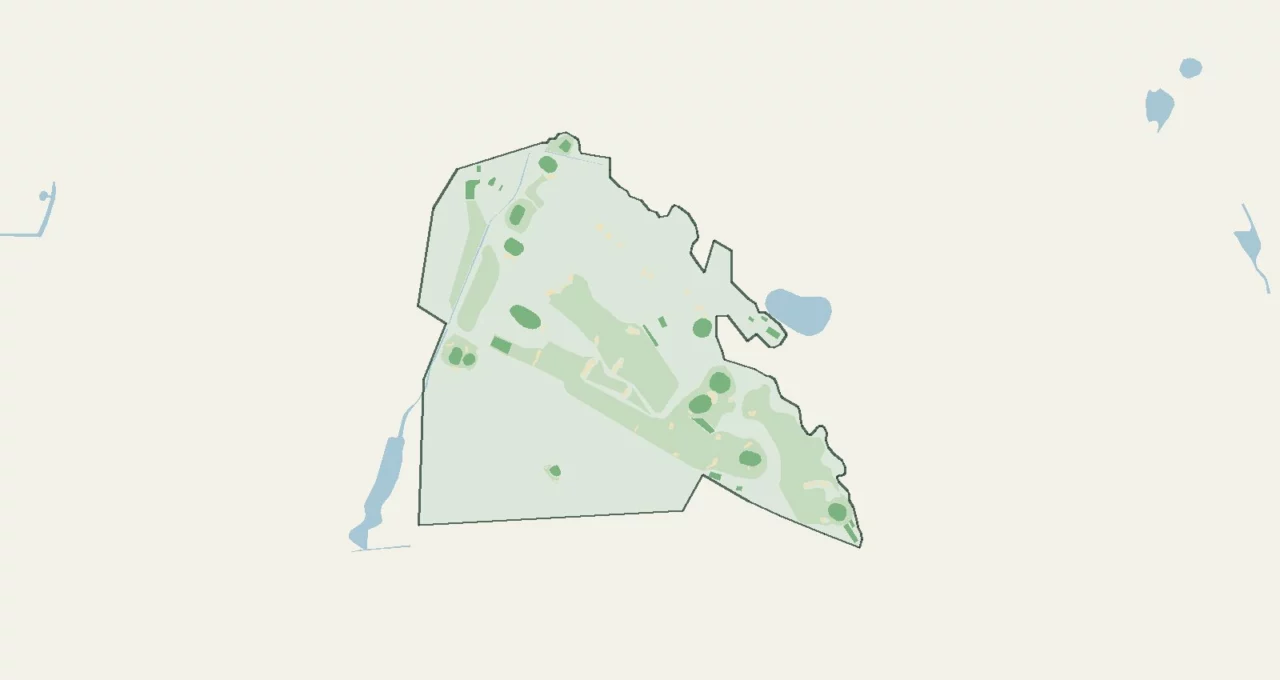
Layout of Royal Worlington and Newmarket Golf Club from OpenStreetMap survey data (ODbL licence).
Royal Worlington and Newmarket Golf Club
Holes
9
By
35 for nine holes, 70 for eighteen (men's blue, white and orange tees, 2024 card); 34 from the men's green tees; 37 for nine, 74 for eighteen (women)
Length
3,121 yards for nine holes from the blue tees, 2,983 white, 2,856 orange, 2,365 green (club scorecards); 6,242 yards for eighteen from the blue; Wikipedia gives 3,155 yards
Green fee
—
Best season
Year-round; the club says its sandy, free-draining soil means no temporary greens are needed in winter
Royal Worlington and Newmarket Golf Club lies just south of the village of Worlington in west Suffolk, about a mile south-west of Mildenhall, on the edge of the Fens and a short way north of Newmarket and its racecourses. The club gives its address as Golf Links Road, Worlington, Bury St Edmunds, IP28 8SD. It is a private members’ club with a single course of nine holes, and it has stayed at nine holes since it was founded on 18 May 1893. On the club’s current men’s scorecard the nine measures 3,121 yards from the blue tees, 2,983 from the white and 2,856 from the orange, all par 35; played twice, as most rounds are, that makes 6,242 yards and par 70 from the back.
Few nine-hole courses anywhere have been written about as much. Bernard Darwin called it the Sacred Nine in a Country Life article of 1928, Henry Longhurst ranked it alongside the Old Course at St Andrews, and the American writer Herbert Warren Wind described it in The New Yorker in 1981 as the best nine-hole course in the world. It is also the home course of Cambridge University’s golfers, who have played there since 1901. The club says it was voted the best nine-hole club in the world by Golf Magazine in 2020, and Wikipedia notes that it has regularly appeared in rankings of the top 100 courses in Britain and Ireland, citing Golf Monthly’s list of 2009/10. Top 100 Golf Courses currently places it 87th in England.
A rabbit warren that became the Sacred Nine
According to the club’s heritage page, golf was first played on the land in 1890, when its owner, William Gardner, invited two friends, Colonel E. W. D. Baird, a local landowner, and Alexander Mackenzie Ross, a well-known Scottish amateur, to lay out a couple of holes for their amusement. The ground had been a rabbit warren, with sandy soil over chalk and firm, short turf. The Scottish professional Tom Dunn was then asked to mark out a course of eighteen holes. When the club was formally founded in May 1893, with twenty members, most of them from the Newmarket area or with interests in horse racing, nine holes were opened for play. The other nine lay on peaty ground and, the club says, it was soon clear they would never be as good. They were never brought into play, and Worlington has been a nine-hole course ever since.
The royal title came quickly. In 1895, the club records, the Prince of Wales, later Edward VII, agreed to become its President, and Queen Victoria granted the request that it be called Royal Worlington and Newmarket Golf Club. An early report of the same year, quoted on the club’s site, praised the sporting character of the holes and compared the greens with those of seaside links. Exhibition matches brought leading professionals of the day, among them J. H. Taylor, Willie Park Junior, Hugh Kirkaldy and Jack White, who was then the club’s professional.
The only substantial changes to the course, according to the club, followed a visit by Harry Colt in the early 1920s: on his advice the 8th hole was lengthened and a new 9th created. Apart from some modest lengthening to keep pace with equipment, the club says, the course is the one that exists today. Its course guide adds that the 4th was lengthened in 1920. Colt has another link with the club: Wikipedia records that he was Cambridge’s first Blue captain, in 1889.
The Cambridge connection is central to the club’s identity. The club’s account is that Cambridge University Golf Club, founded in 1869, played on Coldham Common in Cambridge, a flat and muddy course, shared with a rifle range and later cut by a railway line. From 1901 an agreement allowed the university golfers to play at Worlington, which they called Mildenhall after the nearest station. The club tells the story of students dropping their clubs from the train windows as they passed the course, walking back from Mildenhall station to collect them and climbing the fence near the 5th. That ended, it says, in 1922, when a halt was built at Worlington. Wikipedia confirms that the halt opened in November 1922, first as Mildenhall Golf Links Halt and from January 1923 as Worlington Golf Links Halt, and that it closed with the end of passenger services on the Cambridge to Mildenhall line in 1962. The Oxford and Cambridge Golfing Society, made up of former Blues of both universities, has played an annual match against the club since 1922, and it was after one such match in 1928 that Darwin wrote the article that gave the course its nickname.
The club also claims a drink. Its heritage page credits two members, John Morrison and James Cannon, with inventing the Pink Jug, a mixture of Benedictine, brandy, Pimm’s and sparkling wine, named after the pink jug it was first mixed in and since adopted, the club says, at Sunningdale and other clubs.
What the course asks of you
The site is small. Top 100 Golf Courses puts it at about 40 acres, and Longhurst, quoted by the club, called it a little triangle of dry, sandy land, with gorse and fir trees, just big enough for nine holes. The club describes the soil as sandy and free-draining, with an inland links feel, and says temporary greens are not needed in winter. Wikipedia describes it as heathland in its article on the village. Reviewers agree that the turf plays firm and fast, and that the ball runs a long way on the ground.
On the men’s scorecard the nine has two par 5s, the 1st and the 4th, three par 3s, the 2nd, 5th and 7th, and four par 4s. From the blue tees the holes measure 482, 224, 362, 489, 154, 463, 161, 458 and 328 yards. The par 4s are of two kinds: the 6th and the 8th are long, both well over 400 yards from every men’s tee, while the 3rd and the 9th are short. The card is laid out for eighteen holes, with the second nine played from the same tees and with its own stroke indexes; the 6th is stroke index 1 on the front nine and 2 on the back.
The club’s hole by hole guide describes each hole. The 1st is a gentle opening par 5 whose old, randomly contoured green turns two putts into three. The 2nd is a long par 3, over 200 yards from the back, to a pushed-up green; the poet Patric Dickinson, a former Blue quoted by the club, compared hitting it to pitching on to a policeman’s helmet. The 3rd has a hog’s back fairway that is hard to hold, a swale to carry and a bunker front left of the green. The 4th shares a broad fairway with the 6th, with woods on the right, and its green rises at the front before running away to the back right.
The 5th is the hole everybody writes about. The club calls it the feature hole of the course: a short par 3 of 154 yards from the blue tees, with a green that falls away on both sides and leaves only a narrow shelf for the ball to stay on. A hollow to the left, once a water hazard and now grassed, catches anything pulled, and a stream and out of bounds lie to the right. J. S. F. Morrison, Colt’s design partner, wrote in 1936 that only a perfectly struck shot has any hope of staying on this green, and that the merely good shot that would do at most short holes is no good here. Top 100 Golf Courses and Evalu18, writing for GolfMagic, note that the hole has no bunkers and no water in play, and that the green is multi-tiered.
The 6th is a long par 4 played from a tee beyond the 5th green, with large bunkers on the left between the 4th and 6th fairways and trees on the right; the safe line leaves a long second that has to be shaped around the trees to a raised green that is hard to read. The 7th is a par 3 over a valley, often into a crosswind according to the members’ site, with two greenside bunkers. The 8th has bunkers either side of the fairway at driving distance and a long second over cross bunkers about 80 yards short of a green that runs away from the player, so that the flag is visible but not the putting surface. The 9th, the hole Colt created, is a short par 4 driven across the corner of the boundary, leaving a pitch over a road to a green that slopes from left to right, with bunkers on both sides and the clubhouse right behind.
The club’s local rules give a fair picture of the hazards and the crossings. Out of bounds lies on or beyond the road to the right of the 1st and 2nd holes, and there are lines of white posts beside the 4th, behind the 4th green, beside the 5th and beside the 9th, some of which apply only when playing other holes. The two ponds to the right of the 3rd and part of the stream at the 9th are penalty areas, and there are ditches beside the 4th and 5th greens. Several holes share space: the card asks players to check the road is clear before teeing off on the 1st and 2nd, not to drive from the 5th and 6th tees until the greens in front are clear, to watch for golfers coming in from the left on the 4th, and not to play to the 9th green until the road in front of it is clear. Top 100 Golf Courses and Evalu18 add that centreline bunkers come into play on four holes and that water touches four holes, though it rarely troubles a reasonable shot.
The figures differ by tee and by card. On the men’s card published on the club’s site in 2024, the course rating for eighteen holes is 69.8 from the blue tees with a slope of 113, 68.4 and 110 from the white, and 67.4 and 108 from the orange. The ladies’ card uses the same tees at par 37 for nine and 74 for eighteen, with the 1st, 4th, 6th and 8th all par 5s, and ratings of 75.6, 73.8 and 72.4 with slopes of 132, 127 and 125. A separate card for the green tees, the shortest, gives 2,365 yards for nine holes, par 34 for men, with the 4th played as a par 4, and par 37 for women; the ratings are 62.4 with a slope of 99 for men and 67.0 with a slope of 112 for women.
What golfers say
The points below summarise the golfer reviews published on Top 100 Golf Courses, which counted 47 ratings when we read it in October 2026 with recent reviews from 2024 to 2026, together with the review by Evalu18 published on GolfMagic in 2023. They are other people’s opinions, not ours. Nobody from Panxis has played the course, and we name no reviewer.
What comes up in its favour
- The greens and their surrounds. Reviewers single out the green complexes as the course’s great strength, in particular the 1st, the 2nd, the 5th and the 9th.
- Strategy rather than length. Golfers praise the width, the angles and the variety of the holes, and several say the course gets better the more often you play it.
- Firm, sandy turf with a links character, in good condition through the year.
- The atmosphere. Reviewers describe a traditional, unpretentious club with a strong sense of history and a warm welcome for visitors, and enjoy the quiet of a course with few groups on it.
- Pace. Two-ball play means rounds move quickly, and match play is the club’s preferred format.
What comes up against
- First impressions. Some visitors find the approach, the car park and the land itself unremarkable, and are surprised by how plain the setting is for a course with such a reputation.
- Nine holes. A few reviewers question whether a nine-hole course, played twice, belongs in national rankings at all.
- Few modern facilities. Some visitors expected more modern facilities than they found.
- Tricky greens. The multi-tiered greens on the 1st and the 5th are described as fair but very hard to putt, even for good players.
- Divided opinions. Ratings on Top 100 Golf Courses range widely, and the overall score is a good deal lower than the course’s literary reputation would suggest.
Getting there and when to go
The course lies on Golf Links Road, which leads south from the centre of Worlington; the village itself is on the B1102 between Fordham and Mildenhall, on the south bank of the River Lark. By our measurement on the map, the course is about a mile from the centre of Mildenhall, about seven miles north-east of Newmarket and about eleven miles west of Bury St Edmunds, all in a straight line. Cambridge is about eighteen miles to the south-west. The old halt that served the course closed in 1962; the nearest station today is Kennett, on the line between Cambridge and Ipswich, a little under four miles to the south in a straight line.
Visitors are welcome, the club says, but their numbers are strictly limited. There is no tee booking system: the club works on a roll-up basis, and every visit must be arranged in advance with the Secretary, or with a member of staff in his absence, through the club’s visitor page or its contact page. Visitors playing without a member must hold an official handicap and show it on the day unless the Secretary has agreed otherwise. Play is restricted to singles and foursomes; three-ball and four-ball games are allowed on Thursday afternoons only, with the Secretary’s permission. Measuring devices are permitted. The club says that most rounds of eighteen holes take about three hours, and it encourages groups to call faster players through. Membership is by proposal and secondment from existing members.
The club publishes a dress code for the course and the clubhouse: smart casual, with no denim jeans, collarless shirts or trainers, shirts tucked in, and tailored shorts allowed with long socks preferred, or smart short socks. Jacket and tie are required for men in the dining room. Mobile phones may be used in the car park, only for diary purposes in the clubhouse, and on the course only in a medical emergency. The clubhouse serves light lunches daily, and the club says it is known for its roast lunches and traditional puddings; groups of four or more can book breakfast or lunch with a week’s notice.
The professional’s shop, run by the PGA head professional Ben Kerr, offers lessons, club fitting and repairs, and hires out pull and electric trolleys. The club’s pages say nothing about buggies, so check with the club if you need one.
The club says the course is a joy to play all year round, and that its free-draining sandy soil means temporary greens are not needed in winter. Its green fee tables distinguish a low season from November to March and a high season from April to October. Firm ground is part of the appeal: in a dry summer the ball runs a long way, while in winter the course plays longer but stays open.
How this page was made
The factual frame comes from public sources: OpenStreetMap for the location and our distance measurements; the club’s website, read in October 2026, for the address, the heritage page, the hole by hole guide, the men’s, ladies’ and green tee scorecards with their ratings and slopes, the visitor rules, the dress code, the catering and the professional’s services; the club’s members’ site for its course page, its older hole guide and its men’s scorecard marked new 2023; Top 100 Golf Courses for its course description, ranking and golfer reviews; Evalu18’s review on GolfMagic; the English Wikipedia articles on the club, on Worlington, on Worlington Golf Links Halt and on Kennett station; and Wikidata, which identifies the club as Q7375034.
Where sources disagree, we say so. Wikipedia gives the nine as 3,155 yards, par 35, while the club’s current card gives 3,121 yards from the blue tees. The club’s men’s scorecard marked new 2023 has red rather than orange forward tees and makes the 4th a par 4 from them, so that the nine is par 34 from the red; the card published in 2024 gives par 35 from all three men’s tees. The hole by hole guide on the club’s website gives the 6th as 467, 435 and 415 yards and the 9th as 318, 293 and 284, where the scorecards give 463, 435 and 418, and 328, 301 and 291; we have used the scorecards. The same guide lists the 4th once as a par 5 and once as a par 4. The club credits Tom Dunn with marking out the original course, while Henry Longhurst, quoted on the club’s own heritage page, wrote that he did not know who had laid out the holes. The club says Colt’s changes in the early 1920s lengthened the 8th and created a new 9th, while Top 100 Golf Courses lists his work as the 1st tee and green, a back tee on the 5th, the 6th tee, the 8th green and the completion of the 9th green. Top 100 Golf Courses ranks the club first in Suffolk in one article, while an older article of 2014 on the same site puts another course first. The coordinates in Wikidata and Wikipedia place the course a few hundred metres west of the point we use, which comes from the OpenStreetMap outline. The club’s own pages describe the setting as having an inland links feel, while Wikipedia’s article on the village calls it heathland.
The opinion section summarises golfer reviews on Top 100 Golf Courses and the review by Evalu18 on GolfMagic, read in October 2026. We report recurring themes rather than individual voices, and we reproduce no quotations from reviewers. Nobody from Panxis has played or visited this course, and this page is no substitute for a round.
The club has not paid for this page, has not seen it before publication and has no say over its content. This page contains no commercial link and earns us no commission. If you know the club and something here is wrong or out of date, write to us and we will correct it.
Other courses nearby
Closest to this one in our British directory:
- Bedford & County Golf Club — 43 mi
- Bedfordshire Golf Club — 46 mi
- South Beds Golf Club — 48 mi
- The Millbrook Golf Club — 48 mi
The hole to know
Short par 3 of 154 yards from the blue tees, which the club calls the feature hole: a green falling away on both sides to a grassed hollow on the left and a stream and out of bounds on the right, with no bunker.