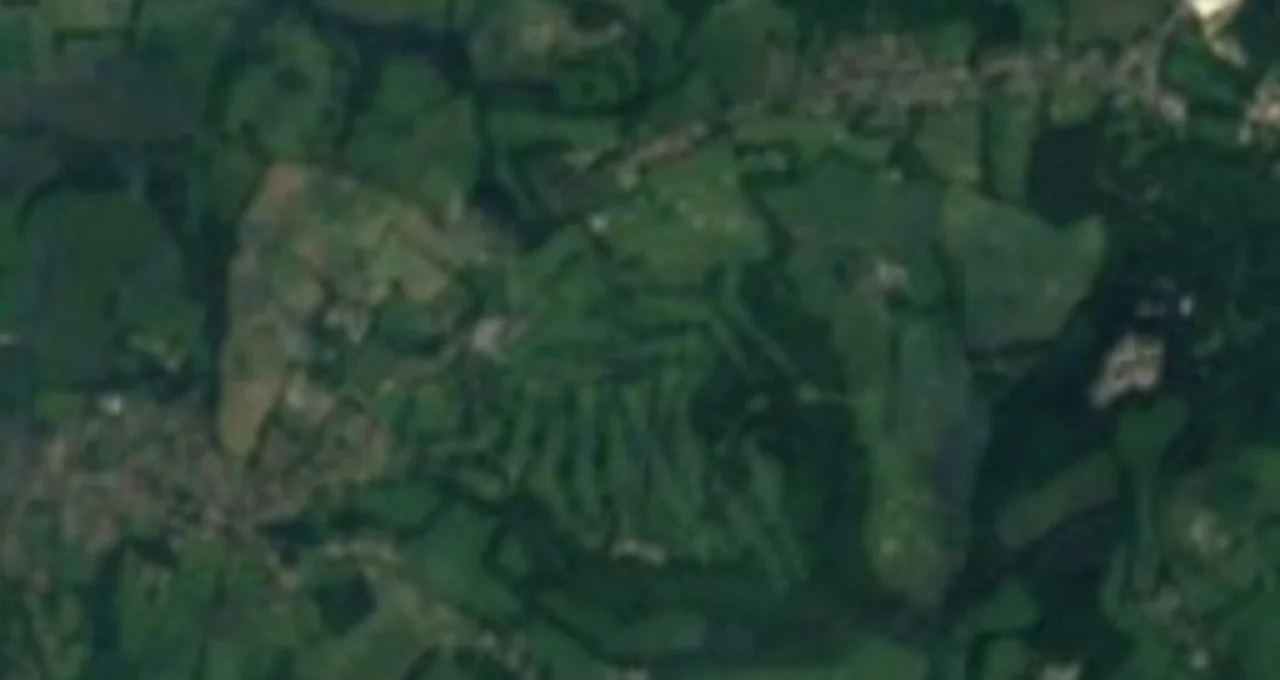
Dale Hill Golf Club from space. Sentinel-2 cloudless 2016 by EOX IT Services GmbH (contains modified Copernicus Sentinel data), CC BY 4.0.
Dale Hill Golf Club
Holes
36 (two 18-hole courses: Ian Woosnam Course, Old Course)
By
71 (Woosnam Course); 69 for men and 70 for women (Old Course)
Length
Woosnam Course 6,512 yards from the white tees, 6,032 yellow, 5,200 red; Old Course 5,856 white, 5,512 yellow, 5,164 red (Golf South West, GolfNow)
Green fee
—
Best season
Year-round; winter schedule November to April, summer schedule May to October
Dale Hill Hotel and Golf Club stands high on the Sussex Weald near Ticehurst, in the Rother district of East Sussex, just off the A21 at the Flimwell crossroads and about a mile north-east of the village. It has two 18-hole courses on more than 350 acres of undulating ground and woodland in the High Weald, a designated area of outstanding natural beauty, with a four-star hotel between them. The Old Course opened in 1973 on what had been a dairy farm and plays to par 69 and 5,856 yards from the back tees. The Ian Woosnam Course, the first design by the 1991 Masters champion and 2006 Ryder Cup captain, opened in 1997 and measures 6,512 yards, par 71, from the white tees.
The postcode is TN5 7DQ. The club belongs to Leaderboard Golf, a privately owned group whose other venues have included the Oxfordshire and Sandford Springs, and it operates as a resort as much as a club: golf breaks, society packages, a driving range, two putting greens, a practice bunker and, by the club’s own count, a fleet of thirty-five electric buggies. Woosnam’s stated aim for his course was that it should be tough enough for the pros and easy enough for the amateurs, and the reviews below suggest that the hills, rather than the design, are what decide the question for most visitors.
From dairy farm to two courses
The Old Course came first, in 1973, laid out over about 130 acres of farmland with views over the Sussex countryside. Golf South West, a golf-travel operator whose course notes we have used throughout, describes a sub-6,000-yard par 69 with tree-lined fairways and small, firm greens, where finding the fairway is the whole job and the rough, though not severe, is lined with trees on either side. Two of its holes, the 9th and the 17th, were redesigned when the second course was built. No designer is named for it in any source we found. The National Club Golfer directory calls the Old Course parkland on the front nine and woodland on the back, and Golfbreaks, a travel agent, gives it 5,842 yards against the 5,856 of GolfNow and Golf South West; the difference is a matter of which card was read.
The Woosnam Course followed in 1997. Top 100 Golf Courses records that it was Ian Woosnam’s first architectural project, designed with the help of European Golf Design, built to USGA green specifications on mostly clay-based soil, and routed through the ridges of the High Weald between the chalk escarpments of the North and South Downs. GolfNow states that the course has hosted the PGA Southern Professional Championship. The club has added drainage since, and the reviews are candid about why.
The hotel, which sits between the courses with most rooms facing south across both, has an indoor pool, a gym and a sauna. The number of bedrooms is given as thirty-five by two directories and fifty by a third; the club’s own site does not say, and we leave the count open.
What the courses ask of you
The Woosnam Course opens with a par 5 of 602 yards, which is a statement of intent, and then opens up to views over the High Weald. The three cards are 6,512 yards from the white tees, 6,032 from the yellow and 5,200 from the red, par 71 from each; GolfNow gives course ratings of 72.8 with a slope of 138 from the white, 70.4 and 131 from the yellow and 71.9 and 130 from the red, figures that place it among the harder courses in Sussex from the back. Long rough calls for accuracy from the tee, and quick greens put the emphasis on approach play and putting.
The holes that reviewers name are on the back nine. The 9th is a stylish downhill par 4; the 10th and 16th are uphill par 3s with tight tee shots, the 16th played across a deep gully filled with greenery and surrounded by woods; the 11th is a three-shot par 5 whose drive over water one reviewer calls the best on the course; the 17th, 327 yards, is a heavily wooded par 4 with a tight tee shot and a hidden green that the club’s director of golf and the course guides agree is the signature hole; and the 18th is a hard uphill finish. The club’s golf director has also named the 9th and 11th as the most demanding holes.
The design is widely described as a buggy course: the walks between greens and tees are long and the slopes are real, and reviewers who walked it advise others not to. The greens, built to USGA specification, are the part of the course most consistently praised; the fairways on clay are the part most dependent on the weather, and in a wet winter the course can be heavy despite the drainage work.
The Old Course is the gentler round, 5,856, 5,512 and 5,164 yards from white, yellow and red, par 69 for men and 70 for women, with ratings of 68.4 and slope 120 from the white, 66.9 and 117 from the yellow and 69.9 and 118 from the red. It is short, but the trees are close, the greens are small and the ground is not flat; it is also the course where the club offers a ten-hole option after eleven in winter and after three in summer, which makes it the natural second round of a golf break.
What golfers say
Dale Hill is reviewed on the main course-rating platforms, on tee-time sites and on general travel sites, with the Woosnam Course drawing most of the attention. The points below summarise what recurs. They are other people’s opinions, not ours; nobody from Panxis has played either course, and we name no reviewer.
What comes up in its favour
- The views across the Weald and the elevated setting are the first thing most reviewers mention, on both courses.
- The Woosnam Course’s greens are regularly described as good, and in some seasons superb, with several reviewers rating the condition as superior to that of the Old Course.
- The variety of holes is praised, in particular the stretch from the 9th to the 17th, with the 11th and 17th named most often.
- The hotel, the practice ground and the two courses together make it, in the words of more than one reviewer, a strong base for a golfing weekend.
- Visitors describe the course as a real test that still lets a mid-handicapper enjoy the day, which is what the designer said he wanted.
What comes up against
- The hills. The walk is long and tiring, with some steep climbs and long transfers between green and tee, and the advice to take a buggy is almost universal.
- Condition in wet weather is the sharpest criticism: the clay subsoil can become waterlogged, and the worst reviews, written after heavy rain, describe mud from tee to green and fairways hard to tell from rough.
- The fairways are rated below the greens even in good reviews.
- Some find the doglegs, with tall trees guarding the inside corner, frustrating, and the greens small for a course of this length.
- Outside the strong middle stretch, several reviewers find the remaining holes ordinary, and the uphill 18th is a hard finish after a long walk.
Getting there and when to go
The club is on the Ticehurst side of the Flimwell crossroads on the A21, the main road from London and the M25 to Hastings. Golf Today places it a mile north-east of Ticehurst and eighteen miles south of Maidstone; Wikipedia puts Ticehurst about ten miles south-east of Tunbridge Wells. The nearest railway station is Stonegate, with hourly trains to London Charing Cross and Cannon Street in one direction and Hastings in the other, and Wadhurst is the next stop towards London; a taxi is needed from either.
Both courses are open all year, with a winter schedule from the start of November to the end of April and a summer schedule from May to October. The club splits each day into morning and afternoon in winter and into morning, midday and afternoon slots in summer, and visitors book by telephoning the pro shop or through the club’s online booking page. Buggies are available to visitors as well as members, subject to availability, and the club applies a winter wheel policy whose dates differ between pages of its site; ask when booking if a buggy matters to you. Members’ guests have their own rate on both courses. The Old Course offers a ten-hole round in the afternoons. On clay, the drier months from late spring to early autumn will show both courses at their best.
Those planning a longer trip in the group’s orbit may find our page on Sandford Springs in Hampshire useful.
Green fees
Visitor rates by course, season and time of day, buggy hire and the ten-hole option are set by the club and published on its green fees page.
How this page was made
The factual frame comes from public sources: OpenStreetMap for the location; the club’s website for the two courses, the 350 acres, the practice facilities, the thirty-five buggies, the address, the booking arrangements, the seasonal schedules, the ten-hole option and the Woosnam quotation; Golf South West for the 1973 opening on a dairy farm, the 130 acres, the redesigned 9th and 17th, the yardages and pars of both courses, the 602-yard opening hole and the USGA construction; GolfNow for the course and slope ratings, the 1997 opening and the PGA championship; Top 100 Golf Courses for European Golf Design, the clay soil, the ownership by Leaderboard Golf and the setting; National Club Golfer for the director of golf’s choice of holes; Golfbreaks and Golf Today for the hotel and the distances; the English Wikipedia articles on Ticehurst and on Ian Woosnam for the railway, the distances and the designer’s record; Wikidata for the identifiers.
Where sources disagree, we say so. National Club Golfer gives the Woosnam Course as 6,152 yards and par 72, against 6,512 and par 71 everywhere else, including the club; we use the latter. GolfNow’s summary box for the Old Course repeats the Woosnam figures, but its card and its description give 5,856 yards and par 69, which match Golf South West. Golfbreaks gives the Old Course as 5,842 yards. The hotel has thirty-five rooms in two sources and fifty in another. Golf Today gives 1976 as the establishment year, against 1973 for the Old Course elsewhere. The club lists thirty-five buggies; a directory lists sixty. Golf South West’s note that the club is less than a mile from the A229 appears to be an error for the A21, which is the road at Flimwell.
The opinion section summarises reviews on Top 100 Golf Courses, Hole19, GolfPass and general travel sites, read in October 2026. We report recurring themes rather than individual voices, and we reproduce no quotations from reviewers. Nobody from Panxis has played or visited these courses, and this page is no substitute for a round.
The club has not paid for this page, has not seen it before publication and has no say over its content. This page contains no commercial link and earns us no commission. If you know the club and something here is wrong or out of date, write to us and we will correct it.
Other courses nearby
Closest to this one in our British directory:
- Seaford Golf Club — 22 mi
- Seaford Head Golf Club — 24 mi
- Worthing Golf Club — 38 mi
- The Richmond Golf Club — 42 mi
The hole to know
Woosnam Course, par 4 of 327 yards, heavily wooded with a tight tee shot and a hidden green: the hole the club's director of golf and the course guides agree is the signature.