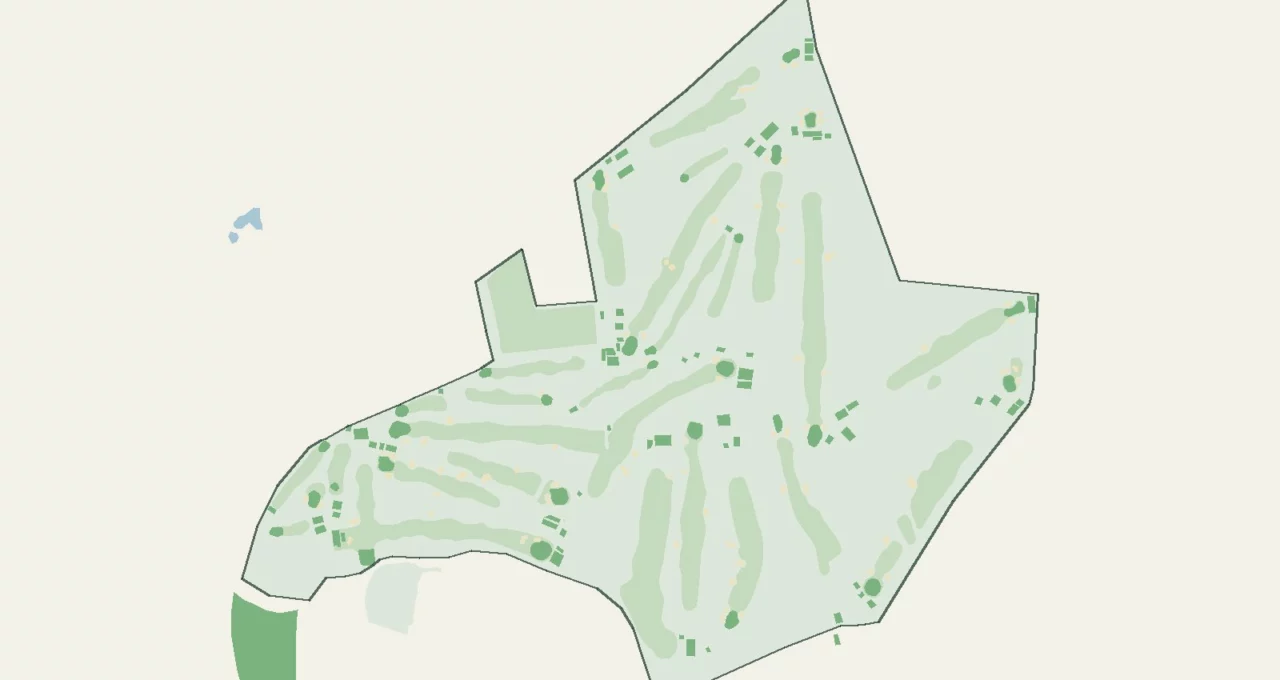
Layout of Lanark Golf Club from OpenStreetMap survey data (ODbL licence).
Lanark Golf Club
Holes
18, plus the nine-hole Wee Course
By
70 (men); 74 for women from the red tees (one listing); Wee Course par 29 (club)
Length
6,428 yards from the back tees (club); 6,443 blue, 6,307 white, 6,107 yellow, 5,736 red (Top 100 Golf Courses)
Green fee
—
Best season
Year-round on free-draining glacial sand (club); winter rates from 1 November to 30 April; mats on some tees in spring (reviewers)
Lanark Golf Club plays over The Moor on the eastern edge of Lanark, the old market town above the Upper Clyde Valley in South Lanarkshire, from a clubhouse on Whitelees Road, postcode ML11 7RX. The club was founded on 4 October 1851, and it describes itself as the oldest inland course in the world and the 25th oldest golf club anywhere. Golf began here on six holes laid out on the Common Moor, then owned by the Royal Burgh of Lanark, and unlike many of the early Scottish clubs Lanark has never moved: the game has been played on the same ground for more than 170 years. The present eighteen holes are par 70 and measure 6,428 yards from the back tees on the club’s own course page. Their outline goes back to 1897, when Old Tom Morris was paid three pounds and ten shillings to lay out eighteen holes, and to 1927, when James Braid supervised the building of several new ones.
The course sits on a bed of glacial sand at around 183 metres, or 600 feet, above sea level, according to Top 100 Golf Courses, and the club stresses that the moorland fairways drain freely and are playable all year. Heather and gorse frame the holes, Lanark Loch lies just beside the course, and the hills of the Southern Uplands, with Tinto the most prominent among them, fill the horizon to the south. Top 100 Golf Courses ranks Lanark 33rd in Scotland and first in North and South Lanarkshire. Alongside the main course, which the club calls its Old Course, there is a nine-hole short course known as the Wee Course.
Six holes on the moor, then Morris and Braid
The club’s history page sets out the essentials. Scottish Golf History, a reference site on the oldest clubs, fills in some of the early detail: before the club was formed, four local men, Robert Lithgow, William Lithgow, John Vassie and Thomas Purdie, are said to have played over four holes on the moor, adding a hole, by tradition, whenever a new member joined. The founding meeting on 4 October 1851 brought together 25 local golfers, by that site’s account; Top 100 Golf Courses speaks of 21 enrolled members. The club adopted the rules of the St Andrews golfers on 8 July 1854. In 1856 the Burgh Council gave permission for a clubhouse, on condition that it would revert to the Burgh if the club were ever dissolved, and the present clubhouse was built in 1882 close to the site of the first.
The number of holes changed several times before the course reached eighteen. Both Scottish Golf History and Top 100 Golf Courses give five holes in 1853, ten in 1857, thirteen in 1869 and fourteen in 1885. The step to eighteen came in 1897, at a cost of £3 10s, the figure the club itself gives. Who did what at that point depends on the source. The club’s history page names Tom Morris alone; its course and visitor pages say the layout was laid out by Old Tom Morris and George Sayers and later refined by James Braid. Top 100 Golf Courses and the course database Evalu18 give the routing to Morris and the choice of green sites to George Sayers. Scottish Golf History reverses the roles, describing an eighteen-hole course designed by George Sayers and constructed by Morris, and dates it to 1887 in its text while giving 1897 elsewhere on the same page. Another short reference, from the LINKS Magazine writer who included Lanark among ten hidden gems in Scotland, has Morris building twelve new holes in 1896.
Ben Sayers altered the 7th and 8th holes in 1909, according to Top 100 Golf Courses and Evalu18, around the time Scottish Golf History says the army left the moor and more land became available. Braid’s turn came in 1927. The club says he supervised the construction of several new holes and that the result, apart from longer tees and modern bunkering, remains largely unchanged. Evalu18 and Top 100 Golf Courses identify the Braid holes as the 10th, 11th, 13th and 14th. Both also say that only the 1st and 18th survive from the six holes of 1851, so a round at Lanark begins and ends on the oldest ground. The LINKS Magazine piece explains Braid’s commission by the arrival of the rubber-cored Haskell ball, which had made the Morris layout play short.
The army has been part of the story from the start. The club says the militia once camped on what is now the practice ground; Scottish Golf History dates the militia camp at the eastern end of the moor to 1855. When Winston Barracks were built nearby, a close link developed with the Cameronians, the Scottish Rifles. The main bar has been renamed the Cameronian Lounge, and several of the club’s trophies were presented by the regiment, among them the 1893 mess silverware, now played for each year as the Army Cup in an invitational foursomes. The club also tells the story that the Caledonian Railway Company chose to build its hotel at Gleneagles rather than at Lanark only on the casting vote of its chairman; Scottish Golf History attributes the decision to a different railway company, a detail we have not been able to settle.
Two later dates matter to the club. In 1995 it bought the course from the local District Council, having owned until then only the land on which the clubhouse stood. In 2008 its constitution was changed to allow women to become full members; Scottish Golf History records a Lanark Ladies Golf Club recognised in 1895, independent from 1909 and back within the club from 1947. The club gives its course record as 62, held jointly by the professional Craig Maltman and the amateur John Bauer.
Lanark has a long record as a championship venue. Golf Monthly and Top 100 Golf Courses both say it has been used eleven times for Regional Qualifying for The Open, and the club says it has hosted national and international amateur championships. Top 100 Golf Courses lists the British Girls’ Championship in 2005, the Scottish Girls’ Championship in 2009, the Scottish Youth Championship in 2013, the Girls’ Home Internationals in 2015 and the Scottish Boys’ Stroke Play Championship in 2016, and calls the course a regular venue for the PGA’s Tartan Tour.
What the course asks of you
The course is a par 70 with only one par 5, which means a long sequence of par 4s and a card that rewards solid driving more than power. The yellow card published by the scorecard site Golfingrecord, which adds up to 6,107 yards, gives fourteen par 4s, three par 3s (the 7th, 10th and 18th) and the 8th as the lone par 5. The club calls the layout tough but fair, long enough to test the best players yet rewarding for the average one. Golf Monthly, in a review published in January 2022, describes greens renowned for being fast and true and fairways that, like a traditional links, are tight, firm and free-draining. It also warns that the heather and gorse which make the course so attractive are treacherous for a wayward drive. Scottish Golf History notes that three pairs of holes cross each other: the 1st and 18th, the 2nd and 15th, and the 9th and 10th.
The 1st, Loch, is one of the two survivors from 1851, a par 4 of 350 yards from the yellow tees and around 364 from the back. The club’s tip is to take enough club from the tee to carry the hill, which leaves a flat lie for the approach. Golf Monthly says the course shows its teeth early, with a run of tough par 4s on the front nine. The 2nd, 447 yards from the yellows and stroke index 3, is a long two-shotter that one recent reviewer named as the standout hole of the round. The 3rd, 385 yards, keeps the pressure on.
The 4th, Houston, is the hole Golf Monthly singles out as the most challenging of that early stretch, and it is stroke index 1. The club’s hole page gives it 447 yards in its heading, 446 from the back tees and 430 from the yellows. The advice from the professional’s team is to aim the tee shot at the spectacle bunkers in the middle of the fairway, then to take an extra club for the second, because all the trouble lies short of the green and the hole plays predominantly into the prevailing wind. After that test the 5th offers relief at 288 yards from the yellows, and the 6th is a par 4 of 352. Reviewers describe the 6th and 7th as being on the high part of the course.
The 7th, Gorstane, is the shortest hole on the course at 135 yards from the back and 125 from the yellows, one of the two holes Ben Sayers altered in 1909. The club’s tip is to admire the view first and then to go for the flag, since the green is big and getting close is what counts. The 8th, Tinto, named after the hill that dominates the view, is the only par 5, 538 yards from the back and 510 from the yellows. The club calls it a good old-fashioned design with a small, undulating green and says it can be taken on in two if you are brave enough. The 9th, 335 yards from the yellows, crosses the 10th on the way back towards the clubhouse.
The 10th, a par 3 of 139 yards on the yellow card, opens the Braid holes. The 11th, Butts, is Golf Monthly’s favourite hole: a par 4 of around 400 yards with, in its words, all sorts to contend with, including burns, heather and a tricky green. The club gives it 413 yards from the back and 390 from the yellows, and asks for a strategic tee shot, laid back far enough from the ditch to see the flag for the second. A slope in front of the green feeds the ball on, so the club suggests one club less for the approach. The 12th, at 386 yards, and the 13th, at 348, lead to the 14th, which Top 100 Golf Courses describes as a par 4 climbing gently to an elevated green with views across the layout and out to the Southern Upland hills.
Golf Monthly calls the stretch from the 11th to the 15th testing. The 15th, stroke index 2, is a par 4 of 445 yards from the yellows, or 450 yards in Golf Monthly’s figure, and one of the holes reviewers describe as seriously long. Three shorter holes then bring the round home, as the magazine puts it: the 16th, 307 yards from the yellows, and the 17th, 290 yards, both give a chance to recover a shot or two. The 18th, Home, another survivor from 1851, is the longest of the par 3s: 207 yards from the back tees and 202 from the yellows on the club’s hole page, which also gives 213 in its heading. It plays to a green below the clubhouse windows. The club’s advice is that the hole cambers from right to left, so the tee shot can be aimed at the corner of the clubhouse and allowed to feed in from the right.
The Wee Course, the nine-hole short course, is described by the club as a par 29 that is fun and challenging in equal measure, and is priced separately, with a junior rate. One listing gives it as a par 27 of 1,337 yards. The club also lists a short game area behind the 1st tee for chipping and bunker practice, a sheltered long-range driving range, practice nets, two putting greens and an indoor lesson area.
What golfers say
The points below summarise what recurs in the reviews published on Top 100 Golf Courses, dated between 2022 and July 2026, and in the editorial verdicts of Golf Monthly and LINKS Magazine. They are other people’s opinions, not ours. Nobody from Panxis has played the course, and we name no reviewer.
What comes up in its favour
- History. Reviewers enjoy playing the claimed oldest inland course in the world, and the Morris and Braid names carry weight with visitors.
- The moorland character. The heather-lined routing, the dips, ridges and hollows of the fairways and the firm turf are described as close to an inland links. The LINKS Magazine writer finds the comparison with the King’s Course at Gleneagles, which the club also makes, flattering but valid.
- Condition. Recent reviewers report fairways, bunkers and greens in very good order, with greens that run fast and true; LINKS Magazine praises the conditioning.
- The views over the course, Lanark Loch and Tinto, which Golf Monthly calls magnificent and which reviewers repeatedly praise.
- The welcome and the atmosphere. Reviewers mention a friendly professional’s shop and a busy community club, with juniors, couples and people coming for Sunday lunch.
- Value. Golf Monthly counts the green fee among the best value in Scotland, and Top 100 Golf Courses makes a similar point in comparison with the better-known links of the coast.
What comes up against
- Difficulty. Some of the par 4s are long and testing, the 1st and 15th especially, and the heather punishes a stray drive.
- Rough. One reviewer found the rough long in places, with time spent looking for balls.
- Wind. The course is high and exposed, and a windy day makes it a different test.
- Balance of the round. One reviewer found the opening and closing holes less memorable than the middle stretch, and another thought the course a little short overall.
- Season. A spring visitor found mats in use on the par 3 tees, and one golfer found the course more manicured than expected for a moor.
- Scenery divides opinion: most reviewers praise it, but at least one felt the setting is less picturesque than some neighbouring courses.
Getting there and when to go
The clubhouse is on Whitelees Road, on the eastern side of Lanark, next to Lanark Loch. Lanark railway station has trains to Glasgow Central, a journey of about 53 minutes according to Top 100 Golf Courses; by our measurement on the map the station is about a mile from the course in a straight line. Top 100 Golf Courses puts Glasgow Airport at around 41 minutes by car.
The club welcomes visitors and recommends booking in advance, either online or by telephoning the office, although the professional will try to fit in casual visitors. Top 100 Golf Courses describes visitor access as available on weekdays, with limited weekend availability. On the club’s green fees page, weekend visitor times are offered from 4 pm on Saturday and 2 pm on Sunday, and these can only be booked by telephone. The club has separate packages for societies and corporate groups, with catering. Manual and electric trolleys and buggies are hired from the professional’s shop, and the club recommends booking buggies and hire clubs in advance; meals are best booked ahead too. Standard golf clothing is expected on the course, with no denim, football or rugby tops, collarless shirts, tracksuits or trainers; the club asks that mobile phones be kept on silent. As a guide, the club expects a three-ball to take no more than three and a half hours.
Thanks to the sandy subsoil the course is played through the whole year, and the club publishes separate winter rates from 1 November to 30 April. The summer season, from May to October, is the club’s peak period, with the firmest fairways and the longest evenings. Spring visitors should be ready for mats on some tees, and on any day an eye on the wind forecast is worthwhile, since the moor offers little shelter.
Green fees
Visitor rates vary by season, by day and by time of day, with reduced rates on Mondays, in the late afternoon and in winter, and a separate rate for Lanark residents. They are published by the club on its green fees page, and tee times can be booked through its online visitor booking page.
How this page was made
The factual frame comes from public sources: OpenStreetMap for the location and the distance from the station; the club’s website, which refused our requests in October 2026 and which we therefore read in its archived versions from 2023 to March 2026, for the 1851 foundation, the history of the course, Morris and Braid, the Cameronians, the 1995 purchase, the 2008 change of constitution, the course record, the length and par, the hole pages and tips for the 1st, 4th, 7th, 8th, 11th and 18th, the Wee Course, the practice areas, visitor booking, hire, dress code and pace of play; the club’s online booking system, which was live when we checked in October 2026; Scottish Golf History for the early holes, the founders, the clubhouse dates and the crossing holes; Top 100 Golf Courses for the ranking, the architects by hole, the altitude, the events, transport times and the user reviews; Evalu18 for the hole-by-hole attribution; Golfingrecord for the yellow scorecard; Golf Monthly for its January 2022 review; LINKS Magazine for its hidden gems article; GolfNow for its tee lengths; Wikidata for the identifiers. We were unable to read the club’s page on the Scottish Golf website, and we use nothing from it.
Where sources disagree, we say so. The club gives 6,428 yards from the back tees, as does Golf Monthly, which adds a slope of 126; Top 100 Golf Courses gives 6,443 from the blue tees, 6,307 white, 6,107 yellow and 5,736 red, and GolfNow 6,438 blue and 5,813 red, while another listing gives 5,754 yards and par 74 for women from the red tees. The club’s hole pages give a heading yardage that differs slightly from their own tee tables at the 1st, 4th, 8th and 18th; one reviewer gives the 18th as 235 yards and the 2nd as 465, against 202 to 213 and 447 on the cards we read. The club names Morris alone on its history page and Morris with George Sayers elsewhere; Top 100 Golf Courses gives Morris the routing and Sayers the greens, Scottish Golf History the reverse, and one scorecard site names Willie Park Jr, which no other source supports. The eighteen-hole course dates from 1897 for the club, 1887 in Scottish Golf History’s text and 1896 in LINKS Magazine. The founding meeting had 25 golfers for Scottish Golf History and 21 members for Top 100 Golf Courses. The Wee Course is par 29 for the club and par 27 on another listing. Other listings date the British Girls’ Championship to 2003 and the Scottish Boys’ Stroke Play to 2001, and count eight Open qualifying events rather than eleven. The club and Scottish Golf History name different railway companies in the Gleneagles story.
The opinion section summarises reviews on Top 100 Golf Courses, read in October 2026, together with the editorial verdicts of Golf Monthly and LINKS Magazine. We report recurring themes rather than individual voices, and we reproduce no quotations from reviewers. Nobody from Panxis has played or visited this course, and this page is no substitute for a round.
The club has not paid for this page, has not seen it before publication and has no say over its content. This page contains no commercial link and earns us no commission. If you know the club and something here is wrong or out of date, write to us and we will correct it.
Other courses nearby
Closest to this one in our British directory:
- Kirkhill Golf Club — 19 mi
- Dullatur Golf Club — 22 mi
- The Royal Burgess Golfing Society of Edinburgh — 27 mi
- Bruntsfield Links Golfing Society — 27 mi
The hole to know
Houston, par 4 of 446 yards from the back tees and 430 from the yellows, stroke index 1: drive at the spectacle bunkers in mid-fairway, then take an extra club into the prevailing wind, as all the trouble lies short of the green.